

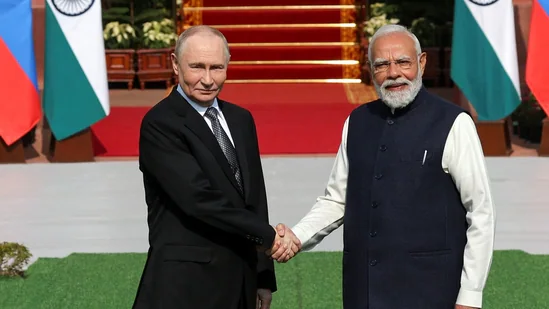
In December 2025, Putin made his first visit to India since the start of Russia’s war in Ukraine.
The visit occurs amid intense Western (especially U.S.) pressure on India over its procurement of discounted Russian oil and defence ties with Moscow.
Against that backdrop, Russia seeks to re-anchor and deepen its long-standing ties with India – demonstrating that the bilateral “special and privileged strategic partnership” remains intact despite global tensions.
Thus, the 2025 visit is not just ceremonial – it is a strategic act aimed at reaffirming Russia’s relevance, securing economic lifelines, and hedging against diplomatic isolation.
Putin’s Aims and Moscow’s Interests
Cementing Energy and Trade Reliance
Putin pledged “uninterrupted” fuel supply to India: oil, gas, coal – reassuring New Delhi that Russian energy remains reliable despite sanctions.
Leaders agreed to expand and diversify trade beyond energy and defence, targeting a bilateral trade volume of US$100 billion by 2030.
Russia is keen to rebalance the trade – Russia currently runs a large export surplus (mostly energy), while India seeks better access for its exports (pharma, agriculture, manufacturing) to Russia.
Why this matters: With Western sanctions constraining Russia’s traditional export markets and foreign-currency revenues, India provides a stable large buyer and a way to channel Russian energy and goods – preserving Moscow’s economic resilience.
Preserving & Upgrading Defence and Military-Technical Cooperation
Defence cooperation remains a core component; leaders pledged to “reshape” ties toward joint research and development, and co-production of advanced platforms such as aircraft or defense systems.
Among proposals: cooperation on a second nuclear power plant with Russian-designed reactors in India; modernization of Indian forces (fighters, air defense) with Russian tech.
Why this matters: India has long depended on Russian arms and technology. In the face of Western scrutiny and sanctions regimes, maintaining this avenue helps Russia preserve influence, earn hard currency, and maintain leverage over Indian strategic choices.
Reinforcing Strategic Autonomy and Multipolarity – a Realignment Signal
Russia and India reaffirmed their “Special and Privileged Strategic Partnership.”
Through cooperation on energy, trade, defense, and possibly financial mechanisms (local-currency settlements, rupee-rouble trade), Moscow seeks to keep open non-Western economic corridors. For example, Russian banking and trade structures are actively facilitating Indian exports and worker migration to Russia post-visit.
This aligns with the long-standing Russian foreign-policy tradition of pushing multipolarity – resisting Western dominance by keeping strong ties in Asia.
Why this matters: Given Russia’s increasing isolation, India is a key global partner enabling Moscow to bypass Western economic pressure. The visit signals that Russia remains capable of building alternative alliances.
Securing Long-Term Strategic Depth Beyond Europe
In the face of protracted war in Ukraine and strain in traditional alliances, Russia is reorienting toward Asia and Global South partners. India, with its economy, population, and strategic weight, is central to that pivot.
Cooperation in areas such as nuclear energy, defence production, technology cooperation (aircraft, space, AI) open pathways for Russia to remain relevant globally.
Why this matters: For Russia, long-term survival amid sanctions and conflict depends on global diversification. India helps provide strategic depth outside the European theatre.
What Moscow Is Trying to Achieve
From the above aims, we can infer that Russia’s 2025 India visit serves a multi-layered strategy:
Economic lifeline: lock in energy and trade flows that bypass Western sanctions.
Arms & tech export revenue: maintain defence-industrial revenue, keep Indian military dependent on Russian know-how.
Geopolitical hedging: sustain a large partner in the Global South to offset isolation in Europe.
Narrative of multipolarity: show the world that Russia retains global soft-power reach, pushing back against Western hegemony.
Strategic resilience: develop long-term, robust ties that outlast temporary crises (Ukraine war, sanctions, global pressure).
Overall, the visit is a strategic reset – not a mere diplomatic ritual.
Likely Reactions & Calculated Responses from China and the United States
China’s likely stance
Historically, China, Russia, and India have maintained a delicate balance under formats such as the RIC (Russia-India-China) triangle or BRICS.
Beijing may view the strengthening of Russia-India ties with cautious neutrality:
On one hand, deeper Russia-India cooperation helps sustain Russia’s relevance and counters Western influence (which aligns with Chinese interest in multipolarity).
On the other hand, Moscow-New Delhi rapprochement might draw India closer to a bloc outside China’s full control or influence, potentially reducing China’s incremental leverage in South Asia and Central Asia.
If India begins sourcing large volumes of fuel, defence tech, or developing alternative connectivity that undercuts Chinese Belt & Road projects, China may see this as strategic competition.
Hence, Chinese reaction will likely be pragmatic and cautious-cooperate with Russia where beneficial, but monitor developments closely.
United States’ likely reaction
Washington – already seeking India to distance itself from Russian energy and defence ties – will view this visit and deepening Moscow-New Delhi cooperation as problematic. U.S. pressure (tariffs, sanctions) aims to isolate Russia; the resumption of large-scale cooperation undercuts that goal.
The U.S. may respond by stepping up diplomatic pressure on India – urging alignment with Western sanctions, threatening economic penalties or reduced cooperation if India deepens Russian ties.
The U.S. may seek to offer India alternatives – increased defence, energy, trade incentives – to dissuade New Delhi from over-dependence on Moscow.
Alternatively, Washington may accept India’s “strategic autonomy” but re-evaluate aspects of U.S.-India partnership, especially sensitive technology transfers or military cooperation, if Russian links deepen.
In short: the U.S. faces a dilemma – confront India (risk alienating a major partner) or recalibrate its own India strategy to compete rather than punish.
Potential Risks and Challenges for Russia & India
While the visit and agreements have promise, multiple risks remain:
Sanctions & secondary pressure: Western sanctions and tariffs on India create economic and reputational costs. Deepening dependence on Russian energy/external supply may jeopardize India’s Western trade goals.
Balance with China: India must juggle relations – stronger Russia ties may complicate its ties with China, especially if Russia-China competition intensifies over Central Asia or maritime influence.
Dependence risk: Over-reliance on Russian defence and energy may limit India’s strategic autonomy in future.
Domestic political backlash: In India, stronger ties with Russia – at a time when Russia is at war and under global condemnation – may provoke domestic debate about moral and geopolitical alignment.
Economic volatility: Oil and energy are volatile; long-term deals can become burdens if global market shifts.
These challenges mean that both Moscow and New Delhi will need to carefully manage the relationship to avoid strategic over-reliance or alienation of other partners.
Strategic Reset – But a Fragile One
Putin’s 2025 visit to India is more than a summit: it’s a calculated strategic maneuver. For Russia, it revives an essential global partnership, helps circumvent isolation, and invests in long-term multipolarity. For India, it offers access to energy, defence technology, and economic cooperation – while asserting its traditional strategic autonomy.
However, the new agreements come with real geopolitical cost: they complicate India’s relations with the U.S. and Europe; they risk pushing India into a more tangled relationship between Russia and China; they make strategic balancing trickier.
For Moscow, this reset offers relief – but depends heavily on India’s continued willingness to absorb Russian energy and arms despite mounting Western pressure.Ultimately, the 2025 India visit may mark the beginning of a new axis in Eurasian geopolitics – but whether it endures will depend on how India navigates global pressure, and whether Russia can deliver on its promises under sanctions pressure.
India’s decision to lease (rent) a Russian nuclear submarine is one of the most strategically significant defence choices New Delhi has made since the Cold War. It was not about saving money — it was about gaining nuclear-submarine capability, training a generation of officers, and accelerating India’s own SSBN/SSN program without waiting 15–20 years.
Here is the full strategic rationale.
India Needed Nuclear Submarine Capability ASAP
A nuclear submarine gives India:
- long-range underwater patrol capability
- stealthy second-strike nuclear deterrence
- ability to operate far into the Indian Ocean and Western Pacific
- the means to track Chinese and Pakistani naval movements
This capability cannot be acquired with conventional diesel submarines, which:
- must surface frequently (which exposes them)
- have limited endurance and patrol range
- cannot credibly provide nuclear second-strike capacity
So the choice was nuclear submarine or no strategic submarine at all.
But building one from scratch would take decades. Therefore:
Leasing from Russia was the fastest way for India to join the nuclear-submarine club.
Russia is the Only Country Willing to Lease a Nuclear Submarine
No Western power would ever sell or lease a nuclear submarine to India.
- The U.S., UK, and France refuse on strategic and non-proliferation grounds.
- China is an adversary.
- No other country produces nuclear attack submarines.
Russia, uniquely, has both:
- the technology, and
- the political willingness to transfer operational capabilities.
Thus:
If India wanted a nuclear submarine, Russia was literally the only possible partner.
Training and Doctrine: India Needed to Build a Nuclear Submarine Culture
A nuclear submarine cannot just be “bought” — it requires:
- specially trained crews
- nuclear propulsion engineers
- long-endurance command teams
- intelligence doctrine
- maintenance infrastructure
- procurement/logistics pipelines
Leasing an operational Russian Akula-class SSN allowed India to:
- train several generations of crews at sea
- learn operational doctrine
- conduct long-range stealth patrols
- master nuclear propulsion, refueling, logistics, acoustic signature management
By the time India began building indigenous nuclear submarines (Arihant-class SSBN), it already had:
- trained officers
- institutional knowledge
- doctrinal understanding
without which domestic nuclear submarine development would have been impossible.
This was the core strategic benefit:
India did not just get a ship — it got experience and doctrine.
Accelerating India’s Own Nuclear Submarine Program
India’s goal was not to remain dependent on Russia forever.
New Delhi needed:
- SSBNs for nuclear deterrence (Arihant class)
- SSNs for sea denial and forward naval operations
The Akula lease allowed India to:
- test technologies
- understand reactor behavior at sea
- train technicians, welders, propulsion officers
- plan operational security, acoustic shielding, electronics and sonar procurement
In effect:
Russia gave India a running start toward building an independent nuclear submarine fleet.
This shaved 10–15 years off India’s military-industrial timeline.
Countering China’s Naval Expansion
China already operates:
- multiple SSBNs and SSNs
- modern surveillance networks in the Indo-Pacific
- operational presence in the Indian Ocean (including Gwadar in Pakistan and Hambantota in Sri Lanka)
India needed a credible strategic naval counterweight.
A nuclear submarine gives:
- long-endurance patrols
- ability to shadow Chinese SSNs in the Indian Ocean
- ability to threaten PLAN surface assets without detection
- ability to protect sea lanes and choke points
Diesel submarines cannot do this against China.
Thus:
leasing was a way to immediately protect Indian maritime space while Indian shipyards caught up.
6. Strategic Autonomy Through Technology Transfer
Russia was the only major supplier willing to:
- share know-how
- allow Indian naval personnel full access
- support crew rotation
- assist in infrastructure development
- tolerate reverse-engineering of doctrine and logistics
Western countries would never allow that degree of sovereignty.
So leasing was not just a rental — it was technology exposure, institutional transfer, and strategic autonomy-building.
It Strengthened India’s Second-Strike Nuclear Deterrent
India’s nuclear posture is based on no first use, which requires credible second-strike capability.
Land-based missiles are:
- vulnerable to preemptive attack
- detectable
Aircraft-based nuclear delivery is limited.
An SSBN fleet is:
- stealthy
- survivable
- continuously deployable
- practically impossible to neutralize
The Akula lease trained the navy for SSN operation — and that expertise was later paralleled into India’s Arihant SSBN nuclear deterrent program.
Thus:
leasing from Russia directly enabled India’s secure nuclear deterrent.
Geopolitically, It Deepened Russian–Indian Strategic Dependence
Russia benefited too:
- India remained a major defence customer
- joint naval programs expanded
- Moscow gained influence in the Indian Ocean
- It counterbalanced U.S. pivot to India
So leasing the Akula cemented a partnership beyond arms purchases — into deep strategic collaboration.
Conclusion
India rented a Russian nuclear submarine because:
- It needed nuclear naval capability immediately
- No Western country would sell or lease one
- Operational training was essential
- It accelerated India’s indigenous SSBN/SSN program
- It countered Chinese naval dominance
- It strengthened India’s second-strike nuclear deterrence
- It solidified strategic autonomy and military know-how
- Russia was willing to provide unrestricted access and technical support.
- Scenario Matrix: Indo–Russian vs Indo–U.S. Naval Alignment (2025–2040)
Scenario
Description
Drivers
Risks
Strategic Outcomes for India
DEEP INDO–RUSSIAN NAVAL AXIS
India consolidates naval and nuclear-submarine cooperation with Russia, accelerating joint projects (SSN development, underwater sensors, naval propulsion, missile integration, Arctic cooperation).
Drivers
Russian willingness to share nuclear propulsion know-how and unrestricted access to operational submarine systems.
India’s preference for strategic autonomy without Western conditionality.
Historical dependence on Russian naval design, metallurgy, sonar systems, and logistics chain.
Shared interest in counterbalancing Chinese hegemony in Central Asia and the Indian Ocean (Russia seeks presence; India seeks deterrence).
Risks
Growing U.S. sanctions exposure (secondary measures on procurement, financing, technology transfer).
Possible political tension with Japan, Australia, and France, complicating Indo-Pacific naval exercises (QUAD).
Risk of over-dependence on Russian shipyards, especially if Russia’s economy continues under sanctions and production timelines slip.
China could pressure Russia to restrain India’s capabilities if Sino-Russian coordination deepens.
Strategic Outcomes
Faster acquisition of SSN fleet capability
Stronger strategic autonomy vis-à-vis the West
Reduced interoperability with Western navies
India emerges as a nuclear-submarine power earlier, but with a more constrained diplomatic environment.
Probability (2025–2040): Medium
HYBRID BALANCING: DUAL NAVAL SUPPLIERS (Russia + U.S./France)
India maintains cooperation with Russia on nuclear propulsion and undersea warfare, while simultaneously deepening navy-to-navy interoperability with U.S., Japan, Australia, France through QUAD, Malabar exercises, joint monitoring of chokepoints, and ISR-sharing.
Drivers
India’s preference for multi-alignment, not alliance.
Critical need for Russian nuclear submarine experience AND U.S./French maritime ISR, carrier aviation tech, and Indo-Pacific situational awareness.
India hedges against Russian instability, while not antagonizing Washington.
Increased Indian naval presence in South China Sea and Western Pacific, requiring QUAD interoperability.
Risks
U.S. pressure for clean separation from Russian platforms in sensitive cooperation domains.
Russian suspicion if India begins to move toward encrypted C4ISR with the U.S.
Complex logistics, heterogeneous fleets, and parallel procurement chains.
Strategic Outcomes
India becomes a swing naval power, enjoying strategic leverage with both blocs.
Builds indigenous SSN and SSBN production, but still benefits from both supply chains.
Maximizes room for maneuver, preserves autonomy, minimizes dependency.
Probability (2025–2040): High
This is the most realistic trajectory.
INDO–U.S. NAVAL ALLIGNMENT (AUKUS-LIKE COOPERATION)
India gradually reduces dependence on Russian platforms and moves toward U.S. and French nuclear submarine technology, or at least deeper platform interoperability (without full technology transfer).
Drivers
QUAD and Indo-Pacific coalition against Chinese naval expansion
U.S. desire to build a continental maritime balance against PLA Navy (PLAN)
Promise of advanced domain awareness: P-8, undersea sonar networks, satellite ISR, anti-submarine warfare
Political desire to avoid secondary sanctions or export controls tied to Russian defense
Risks
The U.S. is unlikely to transfer nuclear propulsion technology, unlike AUKUS to Australia
India would face loss of near-term Russian technical support, delaying SSN output
Heavy interoperability could erode India’s strategic autonomy, politically sensitive domestically
Russia could respond by limiting spare parts, reactor support, and submarine upgrades
Strategic Outcomes
Higher interoperability with QUAD navies
Stronger anti-China coalition
But slower domestic SSN development unless the U.S. softens propulsion rules (unlikely)
Probability (2025–2040): Medium–Low
Most plausible only if U.S. offers India something close to AUKUS tech — currently unlikely.
STRATEGIC DIVORCE FROM RUSSIA
India decouples from Russia as Moscow becomes heavily dependent on China, and Russia begins to harmonize arms diplomacy and naval strategy with Beijing, including constraints on Indian undersea parity.
Drivers
China becomes Russia’s primary financier and political guarantor
Moscow aligns naval technology with PLAN interests and does not want to empower India
Western pressure creates prohibitive cost for India to continue Russian procurement
Russian shipyards suffer long-term delays, sanctions, and manufacturing deterioration
Risks
India loses experienced supply chain and training access for SSN operations
10–15-year setback in domestic nuclear submarine construction
Strategic vacuum until Western cooperation fills the gap
Strategic Outcomes
India is driven toward U.S. and France out of necessity, not preference
Indigenous SSN program must absorb steep internal development costs
India’s maritime deterrence is temporarily weakened vis-à-vis China and Pakistan
Probability (2025–2040): Low, unless Russia–China military fusion deepens beyond current levels
India’s optimal strategic posture is Scenario 2: HYBRID BALANCING, because it:
delivers real nuclear submarine capability via Russia,
preserves strategic autonomy,
allows cooperation with U.S. and QUAD for maritime surveillance, chokepoint control, space ISR, and carrier operations,
avoids dependence on either bloc,
and minimizes sanctions exposure with careful procurement compartmentalization.
In essence, the hybrid pathway allows India to:
train with Russians under the sea and exercise with Americans on the surface — without fully joining any alliance.
This posture maximizes India’s maritime advantage against China without sacrificing autonomy, which remains the doctrinal cornerstone of India’s foreign and defence policy since Nehru.
More on this story: Sanctioning Leverage: U.S. Influence Through India’s Russian Oil Trade
More on this story: Russia Under Sanctions: Diversifying Trade Routes to the East