
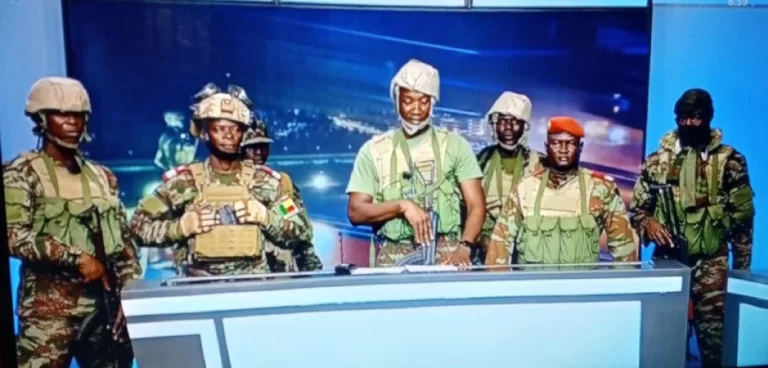
Early morning 7 December 2025: A group of at least eight soldiers seized Benin’s state TV (BTV) in Cotonou and announced that they had removed President Patrice Talon, dissolved all state institutions and suspended the constitution.
They called themselves the “Military Committee for Refoundation” and named Lt. Col. Pascal Tigri as their leader. Borders were declared closed and political parties suspended.
Gunfire was reported near the presidential residence and Camp Guézo in Cotonou; journalists at the TV station were held for some time.
Shortly after the broadcast, the TV signal was cut. Within hours, Interior Minister Alassane Seidou appeared on air saying the coup attempt was “foiled” and describing it as a limited mutiny aimed at destabilising state institutions
Security forces loyal to Talon re-took key sites; around a dozen soldiers were reportedly arrested. President Talon was later confirmed safe.
ECOWAS, the AU and key Western embassies (France, U.S.) condemned the attempted takeover and expressed support for constitutional order.
Is It a Coup?
This was a coup attempt.
- The soldiers explicitly claimed to have overthrown the president, suspended the constitution, and taken power— all classic coup markers
- The government prefers the term “mutiny” to minimise political damage and underline that the broader armed forces stayed loyal.
Analytically, it is best described as:
A limited, poorly coordinated coup attempt by a mid-ranking faction, rapidly contained by loyalist forces.
It is not yet a structural military takeover like in Niger, Burkina Faso or Mali — but it shows that Benin has now joined the list of states where coup dynamics are no longer hypothetical.
The plotters achieved the formal acts of a coup (seizing state TV, announcing the overthrow, suspending institutions) — but failed to consolidate control over the state.
A coup is not just a declaration — it is the consolidation of power
The officers:
- seized national television,
- broadcast a statement claiming they had removed President Patrice Talon,
- suspended the constitution,
- announced a Military Committee for Refoundation,
- said they now governed the country.
All of this meets the definition of a coup attempt.
But a coup is only successful if:
- armed forces remain divided or shift to the rebel camp,
- key state sites (presidency, national assembly, security agencies) fall to the coup coalition,
- the junta becomes the de facto authority, and
- external actors recognise or at least tolerate the new rulers.
None of this happened.
The chain of command stayed loyal to Talon
After the TV broadcast:
- loyalist units retook the TV complex,
- shots near the presidency did not translate into control,
- the core security services stayed aligned with the civilian government,
- the suspected conspirators were quickly arrested or neutralised,
- the presidential authority remained intact.
Had even one of the following occurred — a split in the general staff, paralysis of command, provincial garrisons aligning with mutineers — we would be in successful coup territory.
That didn’t happen.
3. The putschists did not capture critical state infrastructure
A durable coup must secure:
- the presidency
- military headquarters
- communications networks
- airports
- finance ministry/central bank
- and internal security units.
Instead, the plotters held only one symbolic node: the national broadcaster — and only briefly. The ability to announce a coup on TV is necessary, but never sufficient.
Without physical control over ministries and the coercive apparatus, the announcement becomes an empty claim.
The government resumed control within hours
Rapid timeline matters:
- The TV signal was cut,
- Interior Minister appeared to deny the takeover and assure continuity,
- State institutions resumed normal operations by the same day,
- No alternative command structure emerged,
- International partners treated Talon as still legitimate.
In coup analysis, speed is decisive. The moment the loyalists retake symbolic and operational sites, the coup — no matter how dramatic — is already categorised as failed.
5. There was no mass military defection or public mobilisation
Two additional failure markers:
- No part of the army outside the mutineer circle joined
- No mass civilian movement backed the junta
Most successful coups in West Africa have at least one:
- either a broad military coalition,
- or civilian mobilisation providing legitimacy and pressure.
The Benin incident had neither. It remained:
a small group of officers declaring power without the armed capacity to enforce it.
External actors immediately backed constitutional order
- ECOWAS, AU, France, and the U.S. all condemned the coup attempt within hours,
- Nigeria signalled readiness to intervene militarily, even reportedly scrambling jets as a deterrent,
- No neighbour or major power recognised the junta.
International legitimacy is crucial in West Africa. Had even one major regional actor treated the junta as a potential authority, the situation might have evolved.
Instead, the diplomatic environment closed instantly around the existing government.
This alone is a classic indicator of a failed putsch.
7. Operationally, it resembled a mutiny — but politically, it was still a coup attempt
Governments prefer the term “mutiny” because:
- it minimises political shock,
- reassures investors and partners,
- asserts the disciplined loyalty of the wider military.
But analytically, mutiny = soldiers refusing orders,
whereas coup = attempt to seize state power.
What happened in Cotonou was more than refusal of command — it was a bid to take over the state.
Therefore:
Coup attempt = yes. Successful coup = no. Outcome = failed coup.
a coup fails because:
- Rebel officers claimed power,
- but failed to capture the state,
- failed to gain military majority,
- failed to win public or regional legitimacy,
- and were neutralised within hours.
So although the intent and structure were coup-like, the outcome was failure, not a regime change.
This is the internationally accepted analytic classification used by political science, intelligence reporting, and comparative coup studies.
A coup is not just a declaration — it is the consolidation of power
The officers:
- seized national television,
- broadcast a statement claiming they had removed President Patrice Talon,
- suspended the constitution,
- announced a Military Committee for Refoundation,
- said they now governed the country.
All of this meets the definition of a coup attempt.
But a coup is only successful if:
- armed forces remain divided or shift to the rebel camp,
- key state sites (presidency, national assembly, security agencies) fall to the coup coalition,
- the junta becomes the de facto authority, and
- external actors recognise or at least tolerate the new rulers.
None of this happened.
2. The chain of command stayed loyal to Talon
After the TV broadcast:
- loyalist units retook the TV complex,
- shots near the presidency did not translate into control,
- the core security services stayed aligned with the civilian government,
- the suspected conspirators were quickly arrested or neutralised,
- the presidential authority remained intact.
Had even one of the following occurred — a split in the general staff, paralysis of command, provincial garrisons aligning with mutineers — we would be in successful coup territory.
That didn’t happen.
3. The putschists did not capture critical state infrastructure
A durable coup must secure:
- the presidency
- military headquarters
- communications networks
- airports
- finance ministry/central bank
- and internal security units.
Instead, the plotters held only one symbolic node: the national broadcaster — and only briefly. The ability to announce a coup on TV is necessary, but never sufficient.
Without physical control over ministries and the coercive apparatus, the announcement becomes an empty claim.
4. The government resumed control within hours
Rapid timeline matters:
- The TV signal was cut,
- Interior Minister appeared to deny the takeover and assure continuity,
- State institutions resumed normal operations by the same day,
- No alternative command structure emerged,
- International partners treated Talon as still legitimate.
In coup analysis, speed is decisive. The moment the loyalists retake symbolic and operational sites, the coup — no matter how dramatic — is already categorised as failed.
5. There was no mass military defection or public mobilisation
Two additional failure markers:
- No part of the army outside the mutineer circle joined
- No mass civilian movement backed the junta
Most successful coups in West Africa have at least one:
- either a broad military coalition,
- or civilian mobilisation providing legitimacy and pressure.
The Benin incident had neither. It remained:
a small group of officers declaring power without the armed capacity to enforce it.
6. External actors immediately backed constitutional order
- ECOWAS, AU, France, and the U.S. all condemned the coup attempt within hours,
- Nigeria signalled readiness to intervene militarily, even reportedly scrambling jets as a deterrent,
- No neighbour or major power recognised the junta.
International legitimacy is crucial in West Africa. Had even one major regional actor treated the junta as a potential authority, the situation might have evolved.
Instead, the diplomatic environment closed instantly around the existing government.
This alone is a classic indicator of a failed putsch.
7. Operationally, it resembled a mutiny — but politically, it was still a coup attempt
Governments prefer the term “mutiny” because:
- it minimises political shock,
- reassures investors and partners,
- asserts the disciplined loyalty of the wider military.
But analytically, mutiny = soldiers refusing orders,
whereas coup = attempt to seize state power.
What happened in Cotonou was more than refusal of command — it was a bid to take over the state.
Therefore:
Coup attempt = yes. Successful coup = no. Outcome = failed coup.
Conclusion
I call it a failed coup because:
- Rebel officers claimed power,
- but failed to capture the state,
- failed to gain military majority,
- failed to win public or regional legitimacy,
- and were neutralised within hours.
So although the intent and structure were coup-like, the outcome was failure, not a regime change.
This is the internationally accepted analytic classification used by political science, intelligence reporting, and comparative coup studies.
Who Stands Behind It?
The visible front: Lt. Col. Pascal Tigri & the “Military Committee for Refoundation”
- Media reports and the emerging Wikipedia chronology identify Lt. Col. Pascal Tigri as head of the Military Committee for Refoundation (CMR
- The TV statement framed the move in terms of “refoundation”, “national cohesion” and security failures, not ethnic or ideological language.
Likely profile of the network (based on available info)
So far, there is no evidence of a broad, top-down conspiracy by the entire high command. Indicators point to:
- A small cluster of mid-ranking officers, likely with combat experience in the north against jihadist groups, who feel:
- overstretched,
- under-equipped,
- and politically ignored
- A limited operational footprint (TV station, shots near the presidency) rather than a country-wide takeover.
We do not yet have credible evidence of:
- backing from major opposition parties,
- a foreign state sponsor,
- or an organised ideological movement.
Anything beyond this is speculation and should be treated as such until investigations progress.
Reasons: Why Now?
Security grievances and the northern war
Benin has been increasingly drawn into the Sahel jihadist conflict, with an insurgency entrenched in the north since 2021, involving al-Qaeda-linked JNIM and Islamic State Sahel units.
- The coup statement and Reuters reporting mention “national security in northern Benin” and neglect of fallen soldiers as key justifications.
- Army units have suffered casualties in areas near the Niger and Burkina Faso borders, and there is a perception among some officers that Cotonou’s coastal elite is distant from the realities of the front line.
So one core driver is:
resentment inside parts of the army over how the jihadist war is managed, and how sacrifices are recognised or ignored.
Political tension before the 2026 election
The timing is not accidental:
- Talon is due to leave office in April 2026, under a new constitution that extended the presidential term to seven years
- His camp’s preferred successor, ex-finance minister Romuald Wadagni, is widely seen as the front-runner after the main opposition candidate was barred from running.
- Benin’s once-praised democracy has slid into constrained pluralism: opposition bans, controversial electoral reforms and tighter control of the media.
This produces a classic West African coup cocktail:
security crisis + constitutional engineering + blocked alternation of power = military temptation to “reset” the system.
Regional coup contagion
Benin is surrounded by states that have seen coups since 2020: Mali, Niger, Burkina Faso, Guinea, Guinea-Bissau
Each successful takeover normalises the idea that:
- armed officers are legitimate political actors,
- ECOWAS red lines can be tested,
- and foreign partners will eventually adjust.
The Cotonou events show this “coup mindset” has now penetrated a country long considered more stable and democratic.
Who Would Have Benefited if It Had Succeeded?
5.1. Direct beneficiaries
- The Tigri faction itself: they would control the transitional authority, appointments, resources and security portfolio.
- Disgruntled segments of the security forces: especially those deployed in the north who feel abandoned.
- Potentially some marginalised opposition actors who see no electoral path under Talon’s system and might quietly welcome a “reset”, even if they didn’t organise it.
Indirect beneficiaries
- Jihadist groups in the north: any disruption to command, redeployment to Cotonou, or elite infighting would give them room to expand operations.
- Anti-ECOWAS forces in the region (including juntas in neighbouring countries) who want to show that civilian regimes backed by the West are fragile.
For now, because the coup failed quickly, the real short-term beneficiaries are:
- Talon and his camp, who can portray themselves as defenders of constitutional order;
- ECOWAS and Western partners, who can claim their line against coups held in Benin;
- Loyalist officers, who may now be rewarded with promotions and resources.
Foreign Actors: Who Is Involved, Who Is Worried?
6.1. ECOWAS & AU
- ECOWAS and the African Union quickly condemned the coup attempt and expressed support for Talon
- Having been humiliated by juntas in Mali, Burkina Faso and Niger, ECOWAS could not politically afford another successful putsch.
6.2. Nigeria
- Nigeria, Benin’s powerful eastern neighbour, reportedly deployed and then withdrew fighter jets as events unfolded — a very strong signal that Abuja views Benin’s stability as a core security interest, especially given shared jihadist threats and intense cross-border trade
Nigeria’s message is clear:
“We will not treat a coup in Benin as a purely internal affair.”
France, EU, U.S.
- France and the U.S. embassies issued warnings to their citizens; Western media and diplomats framed this as part of the wider West African coup wave
- Paris in particular has strong interests in coastal West African stability after being pushed out of the Sahel.
So far there is no evidence that any foreign power encouraged the coup; the external role is reactive, not causal.
Risks for Ethnic and Regional Stability
Benin is ethnically diverse but historically less polarised than some neighbours:
- Roughly 38–40% Fon and related groups in the south;
- Adja/Mina and Yoruba also mostly southern;
- Bariba, Fulani, Ottamari, Dendi and others dominant in the north
The coup rhetoric so far has not been explicitly ethnic. But there are latent risks:
North–South perceptions
- The jihadist insurgency is concentrated in the northern departments; many of the troops bearing the brunt are from northern communities.
- If Tigri’s network is perceived as rooted in northern units while the political class and loyalist command are seen as predominantly southern/coastal, this can feed a narrative of “northern soldiers vs southern elites”.
Even if factually oversimplified, that narrative could:
- deepen mistrust between regions,
- politicise recruitment and promotions,
- and make ethnic profiling more likely in counter-coup purges.
Security forces vs civilians
If the government responds with heavy, indiscriminate repression:
- opposition activists, journalists, or unions could be labelled “coup sympathisers”;
- specific regions or communities might be stigmatised.
That would erode Benin’s reputation for relatively consensual politics and could turn a failed coup into a broader crisis of legitimacy.
Consequences for Benin
Short-term
- Security clampdown: more checkpoints, arrests, internal vetting of officers, and possible reshuffles in the armed forces and National Guard.
- Chilling effect on dissent: government can use the coup attempt to justify tougher measures against opposition and media under the banner of “preventing destabilisation”.
- Operational distraction: focus temporarily shifts from the jihadist north to regime security in Cotonou — which could be exploited by insurgents.
Medium-term
- Talon and his chosen successor can now argue that “stability” requires continuity, using the coup to delegitimise calls for alternation and deeper reform.
- ECOWAS and partners will likely double down on support for Talon to avoid “another Niger”, providing financial and security backing but also reinforcing perceptions that the regime is externally protected rather than internally legitimated.
- Within the army, there will be a push to identify and neutralise dissident networks, which could either:
- restore professionalism and cohesion, or
- deepen fragmentation if done along factional or regional lines.
Long-term risks
- If underlying drivers — jihadist pressure, political exclusion, perceived corruption and southern domination— are not addressed, this failed coup may be a dress rehearsal, not a one-off.
- Benin could gradually move from being seen as a “democratic outlier” in West Africa to just another fragile hybrid regime vulnerable to military intervention.
- It appears driven primarily by security grievances and political frustration, not by an overt ethnic or ideological agenda.
- The immediate winners are Talon, loyalist officers, and ECOWAS, but the deeper picture is troubling:
- an overstretched army,
- a north under jihadist pressure,
- a closed political arena ahead of 2026,
- and a region where coups increasingly look like an acceptable option.
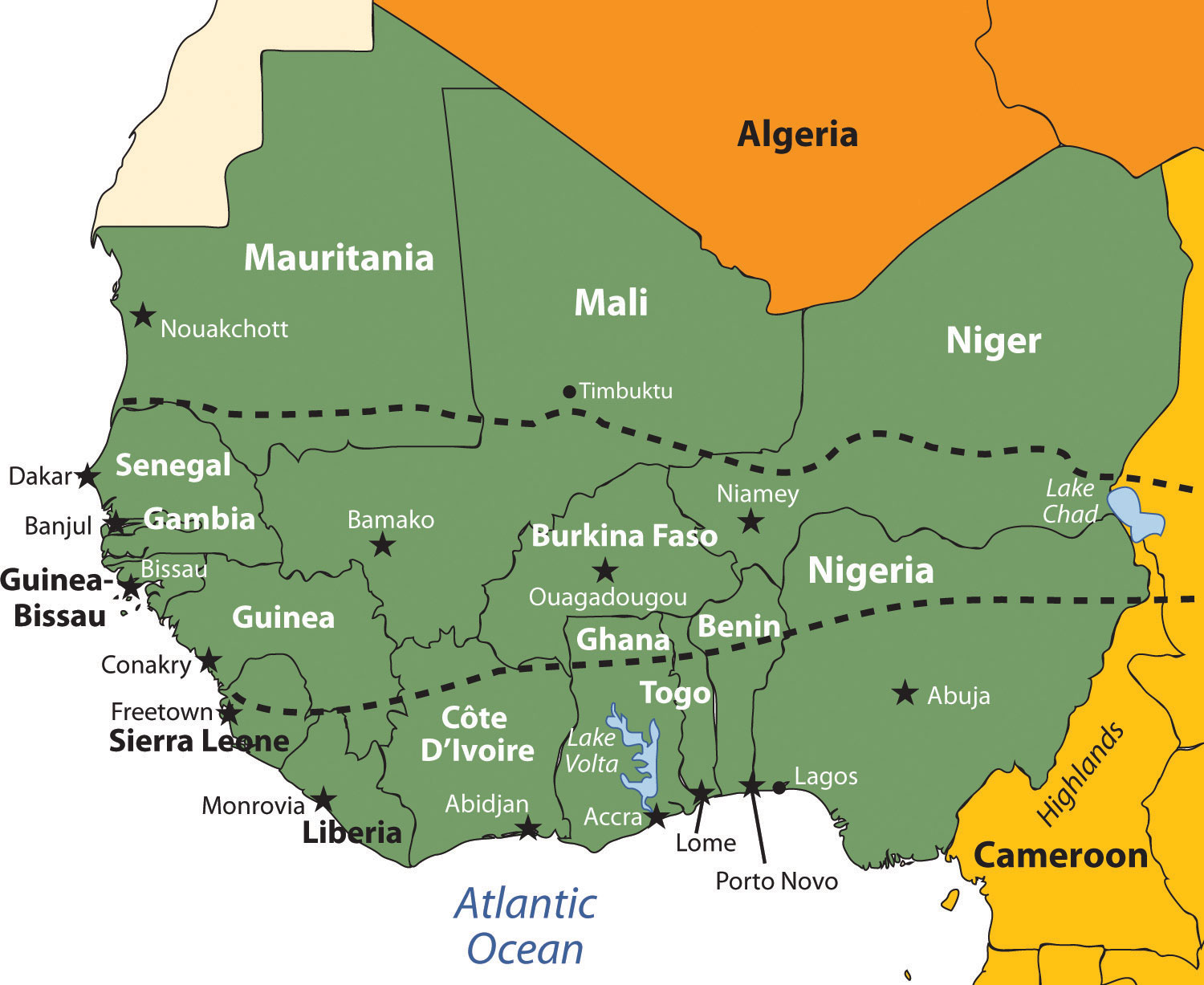
1. Geographical “Coup Belt” – Where Each Country Sits
- Burkina Faso & Niger – core of the Sahel coup belt: landlocked, directly in the jihadist epicentre where Mali–Burkina–Niger meet.
- Benin – coastal, immediately south of Burkina & Niger; its northern departments are now part of the same jihadist theatre, with spillover from Sahel militants.
- Guinea-Bissau – coastal but further west, on the Atlantic; instability here is less about Sahel jihadism and more about drug trafficking and factional militarised politics.
Visually, Benin is the first coastal “frontline” state directly under the Sahel coup belt (Mali–Burkina–Niger–Chad); Guinea-Bissau is on a separate Atlantic axis of coups.
2. Coup Typology: How Do They Compare?
| Country | Type of event | Trigger narrative | Outcome so far |
| Niger | Full, successful coup (2023) – presidential guard removes Bazoum | “Security failure, foreign dependence, corrupt elites.” | Consolidated junta (CNSP), break with ECOWAS/France, tilt to Russia. |
| Burkina Faso | Two successful coups in 2022 (Jan & Sept). | “State collapse vs jihadists; need more radical war footing.” | Military regime under Traoré, open to Russia, France expelled. |
| Guinea-Bissau | Long coup history; attempts in 2022 & 2023–25, plus 2012 coup | Elite factional fights, drug-linked networks, corruption cases. | Presidency survives but institutions hollowed; army remains kingmaker. |
| Benin | Single, failed coup attempt (Dec 2025) by small faction. | “Neglect of troops, northern security crisis, political tension before 2026 poll.” | Talon regime strengthened (for now); security clampdown, coup risk clearly “activated.” |
So: Niger/Burkina = completed transitions to military rule; Guinea-Bissau = chronic coup system; Benin = first serious rupture, still a civilian regime but now within the same risk ecosystem.
3. Drivers: What’s Common, What’s Different?
3.1. Shared structural drivers (all four)
- Weak governance + contested elections or blocked alternation of power.
- Fragmented, politicised armies with histories of intervention
- Perception that external partners (France, ECOWAS, West) failed to deliver security or development.
3.2. Sahel security drivers (Niger, Burkina Faso, Benin)
- Jihadist insurgency is central:
- In Niger and Burkina Faso it is existential: large parts of territory contested or out of state control
- In Benin it is incipient but expanding in the north; officers use the same narrative: “We’re dying at the front while the capital plays politics.” 3.3. Factional/illicit economy drivers (Guinea-Bissau)
- Guinea-Bissau’s instability is driven less by jihadism, more by:
- Cocaine trafficking routes,
- competing political-military factions,
- and use of “coup attempts” to renegotiate power and impunity.
4. Foreign Actors & Security Patrons
| Country | Main external actors now | Trend line |
| Niger | Previously France, U.S., EU; after 2023 coup: Russia (Wagner / follow-ons), some outreach to Iran, Turkey; ECOWAS sanctions. | Shift from West to Russia/“sovereigntist” axis. |
| Burkina Faso | France pushed out; rumours / indications of Russian presence, some coordination with Mali & Niger juntas; Turkey trying to sell drones. | Deepening alignment with anti-Western Sahel bloc. |
| Guinea-Bissau | Portugal, EU, ECOWAS; also narco-networks as de facto actors; some interest from Russia but not decisive. | Chronic instability but no clear Russian “pivot” yet. |
| Benin | Traditionally France, EU, U.S., regional partners (Nigeria); growing security cooperation with Western actors because of jihadist spillover | If Talon holds, Benin remains in Western security camp, unlike Sahel juntas. |
From a mapping perspective:
- Niger/Burkina now form part of a Russia-curious, anti-ECOWAS Sahel arc.
- Benin is the southern buffer, still pro-ECOWAS/pro-West.
- Guinea-Bissau is a West-facing but hollowed state on the Atlantic narco-route.
5. Ethnic & Regional Risk Patterns
- Burkina Faso & Niger – coups justified by war against jihadists, but in practice often deepen ethnic targeting(Fulani/Peul communities seen as suspect), creating cycles of communal violence.
- Guinea-Bissau – instability is more party- and clan-based, with the military as arbiter; ethnicity plays a role but less via north–south war narratives and more via patronage networks.
- Benin – so far, the coup rhetoric is not ethnic, but:
- jihadist activity is concentrated in northern departments,
- political and economic power is perceived as southern/coastal,
- a repeated pattern of northern units rebelling could reframe national politics as “north vs south”, like in Burkina.
Benin currently looks more like “early Niger/Burkina” than like Guinea-Bissau: security-driven military frustration in a state that still has functioning institutions — but now visibly vulnerable to Sahel-style fracture lines.
6. Consequences & Scenarios – Where Benin Sits on the Map of Risk
- Core coup belt (Mali – Burkina – Niger – Chad – Sudan)
- Full or partial military rule, major jihadist wars, strong Russia/Wagner opening.
- Coastal frontline states (Benin, Togo, Ghana, Côte d’Ivoire)
- Still constitutional regimes, but jihadist spillover + economic fragility + visible coup contagion (Benin now a clear example.
- Atlantic coup fringe (Guinea, Guinea-Bissau)
- Repeated coups/attempts driven by elite and illicit-economy politics more than Sahel jihadism — but adding to the regional norm that the military is a political actor.

More on this story: Nature Reserves Provide a Strategic Advantage for Insurgents in Benin
- Niger and Burkina Faso show what happens when jihadist war + institutional decay + external disappointment culminate in full military rule.
- Guinea-Bissau shows a different model: a coup-addicted, narco-penetrated mini-state on the Atlantic.
- Benin now appears as a hinge: geographically between Sahel and Atlantic, politically between democratic facade and coup temptation. How Cotonou manages the next 12–24 months will determine whether it slips fully into the coup belt or stabilises as a coastal counter-model.