
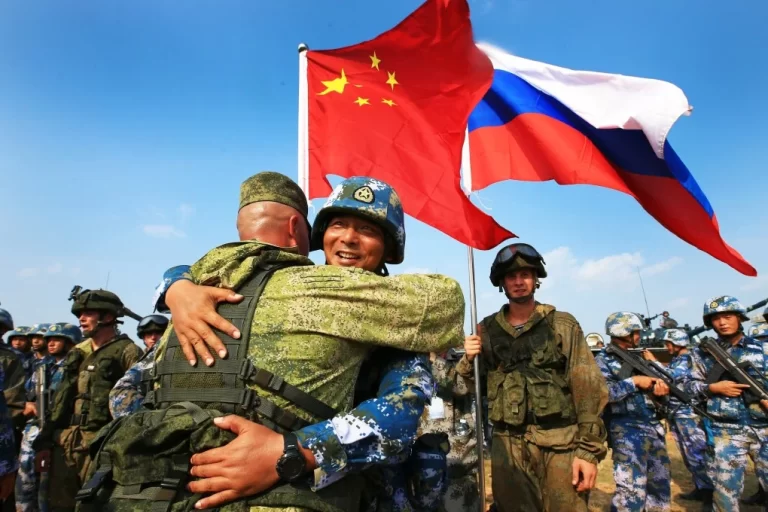
According to the defense ministries of China and Russia, these drills were allegedly not directed against any “specific third party” and were not intended as a response to the current international situation. However, the exercises are part of a systematic pattern. In August 2025, Moscow and Beijing already conducted comprehensive joint naval drills in the Sea of Japan, including artillery, anti-submarine, air-defense and joint search-and-rescue operations.
These actions are not merely a show of force; they represent a structured testing of capabilities, evaluation of a potential adversary’s response profile, benchmarking of military performance, and practical training in coordinated operations. The very format of these maneuvers appears to be a direct strategic answer to the U.S. administration’s plans to create an expanded missile-defense shield—the “Golden Dome” project—and Washington’s declared intention to resume nuclear weapons testing.
In other words, for Russia and China, this cooperation is not simply about joint defense or routine experience-sharing. It is an active effort to develop mechanisms that could be used to counter U.S. military and technological dominance. The evolution of joint missile-defense exercises, combined naval and submarine coordination, and deeper synchronization between Russian and Chinese armed forces creates the foundation for a real alternative to Western military alliances and deterrence architectures, where the United States traditionally holds the central role.
The ability of Moscow and Beijing to act in a coordinated manner during a crisis directly challenges the United States’ capacity to preserve its strategic advantage—especially in the Asia-Pacific region and the broader global balance of power. The public formula used by Russia and China—“not directed against third parties”—is a typical diplomatic maneuver: neither side will openly admit that the drills are aimed at countering the United States, yet in practice they lay the groundwork for a collective missile-defense and military coordination system designed to undermine U.S. strategic interests.
Taken together with U.S. intentions to reinforce its military posture in the Asia-Pacific theatre, this means that direct competition already exists, which may eventually evolve into a real political or military confrontation.
Strategic context of Sino-Russian cooperation
Cooperation between the Kremlin and China has intensified significantly in recent years, particularly after Russia’s full-scale aggression against Ukraine. Although the two countries have not formally announced a military bloc, they have signed a “no-limits strategic partnership,” which envisions regular joint exercises and operational military interaction.
This cooperation unfolds against a backdrop of escalating competition between the United States and China over Taiwan, trade and technology rivalry, nuclear stability, and overall global security architecture. For Moscow and Beijing, structured military coordination functions as a counterweight to U.S. geopolitical influence.
Russia–China military drills now cover a wide spectrum of domains, signaling both countries’ intent to compete with U.S.-led deterrence systems. If this trajectory deepens, it could shift the global balance of power in favor of Moscow and Beijing. For the United States, this translates into a reduced ability to maintain leadership in shaping global security norms, nuclear deterrence frameworks, and missile-defense stability.
A multi-format military partnership between Russia and China is therefore a strategic challenge that requires the U.S. to reassess its policy posture, alliance structure and defense planning.
Implications
• Joint missile-defense exercises
Such exercises may reduce the effectiveness of U.S. deterrence and air-defense architectures. Moscow and Beijing’s public statements expressing concern about U.S. missile-defense expansion and potential resumption of nuclear testing could lead to a new phase in the nuclear arms race.
• Growing naval and submarine coordination
Expanded coordination between Russian and Chinese fleets increases their collective presence in the Pacific, complicating U.S. sea-lane control and threatening regional security. A network of integrated naval, missile, and air-defense capabilities enhances operational flexibility, enabling rapid joint responses and forming a shared deterrence posture against U.S. power projection.
• Development of joint military planning
Sustained cooperation will lead to the emergence of joint operational planning against U.S. and allied interests. Regular drills allow Moscow and Beijing to refine interoperability, crisis-response mechanisms, defense planning and potentially offensive coordination, not only for defensive contingencies but also for projects aimed at countering the United States and its partners.
• Emergence of a structured Moscow–Beijing military alignment
The consolidation of a powerful Sino-Russian military axis would make it harder for the United States to maintain primacy in the international security order. Weaker U.S. leverage may force its allies to seek alternative security arrangements or engage in unfavorable geopolitical compromises.
• Increased risk of regional conflicts
There is a growing risk of localized conflicts involving Russia and China against U.S. interests. In theaters such as Asia, Africa or the Middle East, the Sino-Russian partnership could serve as a coordination hub for countering American influence. Expanded interoperability may evolve into the nucleus of a new military-political bloc directly competing with the United States and NATO, potentially reopening old fronts and creating new arenas of global confrontation.
- Russia and China are gradually standardizing command-and-control procedures, data-sharing models, joint targeting algorithms, and real-time missile-tracking.
- They have already tested satellite cueing, radar coordination, and fleet maneuver synchronization.
- The most dangerous milestone is integrated early-warning, which would allow:
- shared tracking of U.S. and allied missile launches,
- faster decision-making,
- and more resilient targeting if one country’s system is degraded or attacked.
Analytic improvement: quantify how far Moscow and Beijing are from a true shared missile-defense network and whether this would require legal, doctrinal, or technological integration.
Assess the Nuclear Dimension Explicitly
Right now, nuclear issues are implied. You can greatly strengthen the argument by showing why Sino-Russian cooperation alters nuclear stability:
- Russia provides warhead expertise, MIRV experience, and long-range strike doctrine.
- China provides manufacturing volume, hypersonic research, sensor networks, and space-based surveillance.
- Together, both can reduce U.S. confidence in:
- penetration aids,
- interception success rates,
- crisis-stability assumptions,
- extended deterrence for Japan and South Korea.
When two near-peer adversaries begin synchronizing early-warning and missile-defense doctrines, U.S. extended deterrence becomes less credible because Washington must assume that its strikes will be observed, intercepted, or counter-targeted from two coordinated adversary networks rather than one.
Scenario Forecasting
| Scenario | What it means | Strategic consequence |
| Loose Coordination | joint drills, intelligence signaling | U.S. retains dominance but credibility slowly erodes |
| Integrated Early Warning System | real-time radar + space cueing | undermines U.S. missile-defense and extended deterrence |
| Formal Military Bloc | integrated commands, basing rights, nuclear umbrella | ends Western monopoly on structured global deterrence, reshapes Indo-Pacific balance |
| Crisis Flashpoint (Taiwan, Iran, South China Sea) | coordinated naval and missile planning | direct U.S.–China–Russia confrontation becomes realistic |
Alliance Signaling & Intelligence Objectives
- Joint maneuvers are also intended to probe U.S., Japanese, and South Korean intelligence response time, detect:
- radars switched on,
- submarine relocations,
- air patrol changes,
- and diplomatic messaging.
This means:
Every Russian–Chinese exercise is also an intelligence collection operation, not just a military drill.
Indo-Pacific Reaction Layer
- Japan and South Korea interpret Sino-Russian missile-defense drills as preparations for dual-deterrence against U.S. bases in Okinawa, Guam, Yokosuka, and Osan.
- India is uncomfortable: Russia is India’s traditional security partner, but integration with China strategically reduces India’s leverage.
- Australia observes submarine coordination as a threat to maritime freedom and may deepen AUKUS, including nuclear submarine basing and anti-submarine surveillance.
This turns your analysis into regional system-level thinking, not only great-power rivalry.
Technology Layer
- Russian early-warning + Chinese long-range radar arrays.
- Chinese secure space-based communications + Russian nuclear target doctrine.
- Shared testing of:
- hypersonic glide vehicles,
- missile penetration countermeasures,
- electronic warfare coordination.
If Moscow and Beijing integrate technology across these domains, U.S. missile-defense math changes entirely.
AssessedVulnerabilities
- Russia’s industrial base is stressed by war; sanctions limit advanced microelectronics.
- China is cautious about full military lock-in because:
- it wants to avoid nuclear entanglement,
- it dislikes unpredictable Russian escalation,
- it still counts on global trade, which could be disrupted by open confrontation.
A vulnerability section strengthens credibility and shows you understand limits of escalation.
“Crisis Threshold” Analysis
Cooperation becomes conflict-enabling, e.g.:
- Taiwan naval blockade
- NATO–Russia crisis in the Baltic or Arctic
- U.S.–Iran confrontation in the Gulf
- Instability in North Korea
In any of these contexts, Sino-Russian joint missile-defense drills could evolve into live operational coordination.
Impact on U.S. Alliance Confidence
The most important strategic takeaway is:
The more credible Sino-Russian military integration becomes, the more nervous U.S. allies become about extended deterrence reliability, especially Japan, South Korea and Taiwan.
This could lead to:
- independent nuclear programs in Tokyo or Seoul,
- more expensive U.S. forward military posture,
pressure on Washington to relocate more submarines and missile-defense assets to the Pacific.