
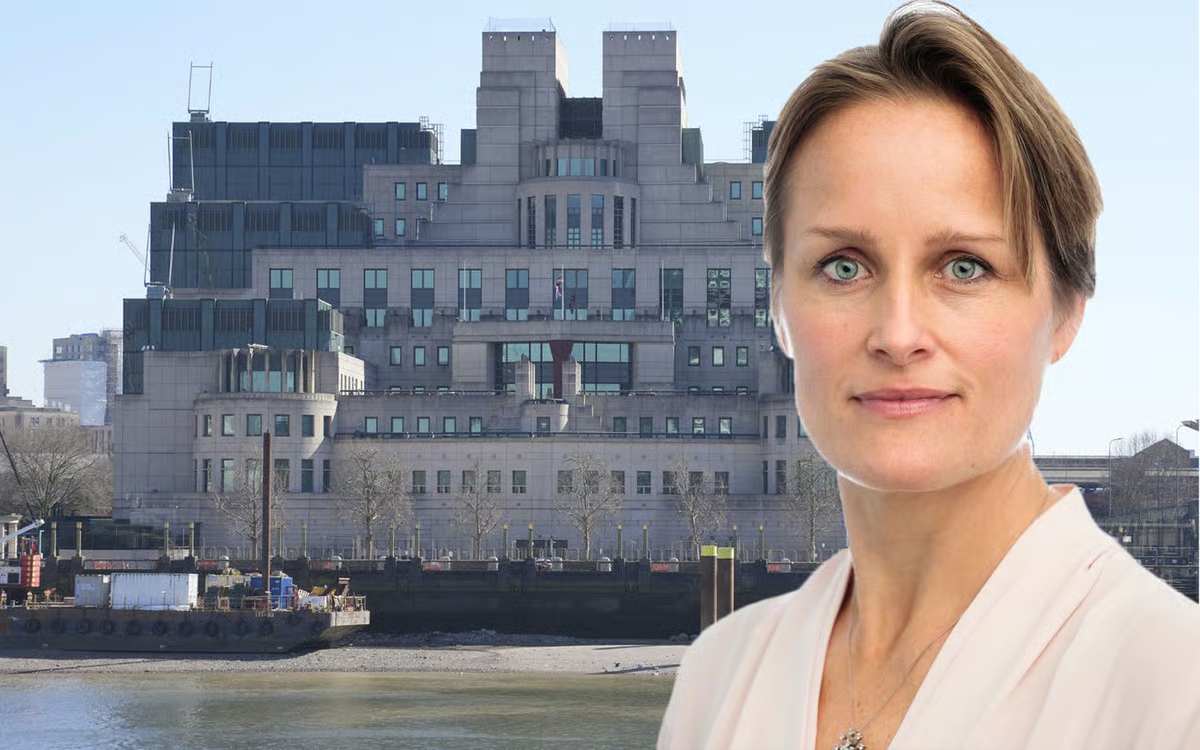
In first speech after taking office, Blaise Metreweli, the head of Britain’s intelligence service MI6, warned that Russia represents an aggressive, expansionist, and revisionist threat. Metreweli stated that assassination plots, sabotage, cyberattacks, and information manipulation conducted by Russia and other hostile states mean that “the front line is everywhere.”
“Vladimir Putin should have no doubt that our support is unwavering. The pressure we apply on behalf of Ukraine will continue. The export of chaos is not a mistake, but a feature of Russia’s approach to international engagement, and we must be prepared for this to persist until Putin is forced to change his calculations,” Metreweli said.
- Strategic consensus in London.
Metreweli’s remarks indicate that a broad consensus has formed within the British political and military eliteregarding the nature of the Russian threat. By explicitly characterizing Moscow as aggressive, expansionist, and revisionist, the speech frames Russia as the primary challenge to European security. The clarity and firmness of this position suggest that Russia is no longer a subject of debate in London, but a foundational assumption of British strategy. This also sends a clear signal to NATO allies about unity and prioritization within the UK leadership. - “The front line is everywhere.”
Metreweli’s formulation captures the contemporary character of conflict, in which war is no longer confined to the battlefield. Cyber operations, information manipulation, sabotage, and covert actions now penetrate all spheres of society. This implies that every domain—economic, technological, informational, and political—can become a target, fundamentally altering the security paradigm toward a comprehensive, multi-dimensional approach. - Chaos as a deliberate Russian instrument.
By defining the export of chaos as a defining feature of Russian policy rather than an error, Metreweli underscores that Moscow deliberately employs destabilization as a tool of influence. This strategy aims to erode trust among allies and weaken democratic institutions from within. The fact that British intelligence articulates this openly reflects readiness to confront not only conventional military threats, but also hybrid and sub-threshold operations. It establishes a clearer analytical framework for understanding Russia’s behavior on the international stage. - Technology at the core of modern intelligence.
Metreweli’s emphasis on technology signals a shift from traditional intelligence-gathering methods toward deep integration of digital tools, big data, and artificial intelligence. This is not merely technical modernization, but a cultural transformation within the intelligence services, where digital literacy becomes a baseline skill for every officer. Such a shift enhances the UK’s capacity to detect, attribute, and respond rapidly to hybrid attacks originating from Russia. - A dual signal: to allies and to Moscow.
Metreweli’s speech functions as a strategic message on two fronts. For NATO allies, it reaffirms that Britain remains a reliable and resolute member of the coalition opposing aggression. For Russia, it demonstrates elite unity in the UK and preparedness for a prolonged confrontation, rather than a short-term crisis response.
More States Define Russia as the Primary Security Threat
Key Judgment
A growing and increasingly influential group of states—primarily on NATO’s eastern and northern flanks, but also in the Anglo-American security core—now define Russia as the central, organizing threat to their national and collective security. This assessment is no longer rhetorical: it is embedded in defense doctrines, budgetary decisions, intelligence priorities, and alliance behavior.
1. United Kingdom: Russia as the principal strategic adversary
The United Kingdom has moved decisively toward treating Russia as the main long-term security challenge.
- Successive UK strategic documents since 2022 identify Russia as the most immediate and capable threat to European security.
- Statements by MI6 leadership, the Ministry of Defence, and senior political figures converge on the view that Russia conducts permanent confrontation through military, cyber, intelligence, and information means.
- London frames the conflict with Moscow as systemic and enduring, not contingent on Ukraine alone.
Implication:
The UK positions itself as a security anchor for NATO’s eastern flank and a driver of intelligence, sanctions, and military assistance policy.
2. Baltic States: Russia as an existential threat
For Estonia, Latvia, and Lithuania, Russia is not one threat among many—it is the existential threat.
- All three states’ national security strategies identify Russia as the primary and most dangerous adversary.
- Threat perception is shaped by:
- historical occupation by the USSR,
- proximity to Russian military districts,
- persistent hybrid operations (cyberattacks, disinformation, border pressure).
- These states openly argue that Ukraine’s defense is inseparable from their own survival.
Implication:
The Baltic states are among the strongest proponents of:
- maximum sanctions,
- long-term isolation of Russia,
- use of frozen Russian assets to support Ukraine,
- permanent NATO forward deployment.
3. Poland: Russia as the central military and geopolitical threat
Poland treats Russia as the primary driver of its defense policy.
- Warsaw has undertaken the largest military expansion in Europe, explicitly justified by the Russian threat.
- Polish strategic culture views Russia as inherently revisionist and incompatible with a stable European order.
- Poland argues that any “compromise” with Moscow increases long-term instability.
Implication:
Poland acts as a bridge between Baltic threat perceptions and broader NATO policy, pushing alliance-wide hardening.
4. Finland and Sweden: Russia as the catalyst for abandoning neutrality
For Finland and Sweden, Russia’s invasion of Ukraine fundamentally altered national threat assessments.
- Finland’s security doctrine now identifies Russia as the principal military threat to national sovereignty.
- Sweden’s intelligence services list Russia as the most capable hostile actor across military, cyber, and intelligence domains.
- NATO accession by both states was driven almost entirely by Russia’s behavior, not internal alliance dynamics.
Implication:
Nordic states now align closely with Baltic and Polish positions, strengthening a northern security bloc inside NATO and the EU.
5. Romania and the Black Sea states: Russia as a regional destabilizer
Romania increasingly defines Russia as the main destabilizing force in the Black Sea region.
- Russian military presence in Crimea and the Black Sea Fleet is viewed as a direct threat to regional security.
- Romania links Russian aggression in Ukraine to risks for Moldova, energy infrastructure, and maritime security.
Implication:
The Black Sea is now framed as a frontline theater, expanding the geographic scope of the “Russia threat” beyond Eastern Europe.
6. The United States: Russia as a major, though not exclusive, strategic threat
The United States defines Russia as a primary acute threat to European security, alongside China as a long-term systemic competitor.
- U.S. National Defense and Intelligence strategies consistently identify Russia as:
- the most immediate military danger to NATO,
- a leading actor in cyber and influence operations.
- Washington views Ukraine as the test case for whether forceful revisionism can succeed.
Implication:
While the U.S. balances focus between China and Russia, it treats the Russian threat as urgent and active, particularly in Europe.
7. Germany and France: from ambiguity to recognition
Historically more cautious, Germany and France have moved closer to eastern-flank assessments:
- Germany’s Zeitenwende marks recognition that Russia is a fundamental security challenge, though Berlin still debates long-term escalation risks.
- France increasingly frames Russia as a revisionist power undermining European sovereignty, even as it seeks strategic autonomy.
Implication:
While more hesitant than eastern states, Berlin and Paris no longer contest the premise that Russia is Europe’s central security problem.
8. States that do not define Russia as the main threat
A small number of states—most notably Hungary and, to a lesser extent, Slovakia—diverge from this consensus.
- These governments frame security primarily in terms of:
- sovereignty vis-à-vis Brussels,
- economic risks,
- migration.
- Russia is portrayed as a secondary or manageable issue, often accompanied by narratives echoing Kremlin talking points.
Implication:
This divergence creates political friction inside the EU and NATO, but it does not negate the broader strategic consensus.
A consolidating security map of Europe
The prevailing trend is clear:
- Northern, eastern, and Anglo-American states define Russia as the main threat to European security.
- Their position increasingly shapes EU and NATO policy through:
- defense spending,
- troop deployments,
- intelligence cooperation,
- sanctions architecture,
- and Ukraine support mechanisms.
In this context, attempts to reframe Russia as a marginal or misunderstood actor—especially during moments of domestic political crisis—run counter to the dominant security assessments of Europe’s most exposed and militarily engaged states.
Bottom line:
For a growing coalition of states, Russia is not a hypothetical future risk but a present, structural threat, and this understanding now forms the backbone of European security planning.
From Partner to Principal Threat: How Russia Chose Confrontation
Russia’s transformation from a potential partner of the West in the 1990s into Europe’s primary security threat was not inevitable. It resulted from deliberate political choices by Russian elites, the construction of a confrontational state ideology, and the sustained cultivation of a population accustomed to viewing international relations through a zero-sum, Cold War lens. Responsibility lies overwhelmingly with Russian authorities, not with abstract geopolitical forces.
The 1990s: A genuine window for partnership
After the collapse of the Soviet Union, Russia entered the international system as a strategically weakened but politically open state.
Key features of the 1990s moment:
Russia formally accepted the end of ideological confrontation;
Moscow joined Western-led institutions and frameworks (IMF, World Bank, Partnership for Peace);
Russia cooperated with NATO on peacekeeping (Bosnia, Kosovo);
Western states treated Russia as a potential partner, not an adversary.
At this stage:
- NATO enlargement was not accompanied by forward deployment or offensive posture;
- The EU promoted integration through trade, aid, and institutional cooperation.
- There was no Western strategy aimed at Russia’s destruction or subjugation.
- Crucially: Russia’s political trajectory was still open. The decisive shift had not yet occurred.
The critical choice: power consolidation over integration
The turning point came with the consolidation of power under Vladimir Putin and the security elite in the early 2000s.
Russian leadership made several interlinked decisions:
- Internal authoritarianism over reform
Independent media, political pluralism, and regional autonomy were dismantled.
Power was centralized in the presidency and security services.
Corruption became systemic, binding elites to the regime through mutual liability.
- Imperial status over economic modernization
- Rather than focusing on institutional reform, diversification, and rule of law, the Kremlin prioritized:
control over energy rents,
restoration of “great power” symbolism,
geopolitical leverage over neighbors.
Security services as the core of governance
- Former KGB/FSB officers (“siloviki”) became the dominant political class.
- Their worldview was shaped by late–Cold War intelligence culture, not post-Cold War cooperation.
This elite cohort did not perceive partnership as opportunity—but as vulnerability.
Manufacturing threat perception: the return of siege mentality
To legitimize authoritarian rule and elite privilege, the Kremlin reconstructed an external enemy.
Key elements of this process:
- NATO enlargement was reframed from a defensive alliance choice into an existential encirclement plot.
- Democratic movements in post-Soviet states were labeled as foreign intelligence operations.
- Western institutions were portrayed as tools of regime change.
This narrative ignored key facts:
- NATO troops were not massed on Russia’s borders in the 1990s or early 2000s.
- No Western state threatened Russia’s sovereignty.
- Russia itself benefited economically from integration with Europe.
The threat narrative was politically useful, not empirically grounded.
The role of the Russian state: escalation by design
From the mid-2000s onward, Russia systematically weaponized confrontation:
- 2007 Munich speech: public rejection of post–Cold War security order.
- 2008 Georgia war: first military reversal of borders by force in Europe since the Cold War.
- 2014 Ukraine: annexation of Crimea, proxy war in Donbas.
- 2022 full-scale invasion: open attempt to destroy a neighboring state.
Each step:
- narrowed diplomatic options,
- hardened Western threat perceptions,
- and locked Russia into an adversarial role.
At no stage was escalation forced upon Russia.
At every stage, alternatives existed.
Society and responsibility: living in a permanent confrontation environment
Russian society cannot be treated as monolithic, but decades of state policy shaped public perception.
Key dynamics:
- Education, media, and culture normalized the idea that Russia is “surrounded by enemies.”
- Historical trauma (WWII, Soviet collapse) was instrumentalized to justify hostility.
- Economic grievances were redirected outward rather than toward domestic accountability.
Many Russians grew up:
- after the Cold War,
- without personal experience of ideological conflict,
- yet immersed in continuous confrontation messaging.
This environment produced:
- political apathy,
- acceptance of repression as “defensive,”
- tolerance of foreign aggression framed as preemptive self-protection.
However: social conditioning does not absolve the state. Responsibility remains asymmetrical.
Why Russia is now seen as the main threat
Today, Russia is defined as the principal security threat by most of Europe because it has demonstrated:
- willingness to change borders by force,
- systematic use of hybrid warfare (cyber, sabotage, disinformation),
- disregard for international law,
- readiness to escalate violence against civilians,
- use of energy, migration, and food security as weapons.
This perception is behavior-driven, not ideological.
Russia is not treated as a threat because it is Russian—
but because it acts as a revisionist power.
Responsibility: who bears it?
Primary responsibility
- Russian political leadership.
- Security-service–dominated elites.
- Decision-makers who chose coercion over cooperation.
Secondary responsibility
- Propaganda apparatus that normalized aggression.
- Economic elites who benefited from confrontation.
- Institutions that suppressed alternatives.
What responsibility does not lie
- Not with NATO expansion as such.
- Not with EU enlargement.
- Not with Ukraine or other post-Soviet states choosing sovereignty.
A threat created by choice, not fate
Russia’s journey from potential partner to primary threat was not preordained.
It was the result of:
- elite fear of accountability,
- preference for imperial control over domestic reform,
- deliberate cultivation of confrontation as a governing tool.
The tragedy is not only geopolitical but societal:
Russia traded the possibility of becoming a prosperous, integrated European state for the illusion of restored empire.
Until the political logic of confrontation is abandoned, Russia will remain a central security threat—not because the world rejects it, but because its rulers reject coexistence.
What Russia Could Have Become
Had Russia chosen institutional reform, economic modernization, and cooperative security integration after the Cold War, it could plausibly have emerged by the 2010s as a prosperous, influential, and secure European power—comparable in status to Germany or Japan after World War II, rather than a revisionist state isolated by its own actions.
A normal great power, not an imperial one
In the counterfactual trajectory, Russia accepts the post–Cold War order as final, not provisional.
- Borders in Eastern Europe are treated as settled.
- Influence is exercised through trade, energy, culture, and diplomacy, not coercion.
- Military power remains defensive and professional, not a tool of regime legitimacy.
Such a Russia would still be a major power:
- permanent UN Security Council member,
- nuclear-armed,
- energy-rich,
- geographically central to Eurasia.
But it would resemble France or the UK in behavior rather than a neo-imperial state.
Integration over domination: a different economic model
Instead of building a rent-seeking, state-captured economy, Russia could have:
- entrenched rule of law and independent courts,
- protected property rights,
- curbed corruption through institutional checks,
- invested energy revenues in diversification and innovation.
A realistic outcome:
- Russia becomes Europe’s largest energy–industrial hub,
- a central logistics bridge between Europe and Asia,
- a technological middle power with competitive civilian industries.
By the 2010s, Russian GDP per capita could plausibly have approached Southern European levels, rather than stagnating below them.
NATO and security: cooperation without membership
In this scenario, Russia does not need to join NATO to be secure.
Instead:
- the NATO–Russia Council evolves into a genuine security dialogue forum,
- joint peacekeeping, counterterrorism, and arms control deepen,
- military transparency reduces misperception.
NATO enlargement still occurs—but:
- without Russian counter-mobilization,
- without forward deployments,
- without mutual threat framing.
Russia becomes a stakeholder in European security, not its spoiler.
Post-Soviet neighbors: influence by attraction, not force
A cooperative Russia would:
- accept Ukrainian, Baltic, and Caucasus sovereignty as irreversible,
- compete for influence economically and culturally,
- treat regional organizations as voluntary, not coercive.
Ukraine, Georgia, and Moldova would not be “lost” to Russia—
they would become stable neighbors, trading partners, and transit hubs.
Russian language and culture would remain influential through soft power, not fear.
Domestic politics: stability without repression
In this alternative path:
- political pluralism survives,
- federalism is preserved,
- regional elites have autonomy,
- media remains competitive.
The state does not require:
- an external enemy to justify control,
- permanent mobilization to maintain legitimacy.
Russian identity evolves toward:
- civic nationalism,
- pride in prosperity and competence,
- international respect earned through contribution, not intimidation.
Military posture: defense, not permanent war readiness
Russia’s armed forces in this scenario:
- modernize for territorial defense,
- participate in international missions,
- remain politically subordinate.
There is no need for:
- mass mobilization,
- mercenary recruitment,
- militarization of society.
Defense spending supports deterrence—not adventurism.
Global role: mediator, not disruptor
A cooperative Russia could have positioned itself as:
- a mediator between Europe and Asia,
- a stabilizer in the Middle East,
- a responsible Arctic power,
- a pillar of arms control regimes.
Rather than exporting chaos, Russia would export:
- energy,
- infrastructure,
- mediation capacity,
- diplomatic credibility.
Why this path was abandoned
This counterfactual failed not because it was unrealistic, but because it was politically inconvenient for Russia’s ruling elite.
It required:
- accountability,
- competition,
- limits on power,
- loss of imperial privilege.
Confrontation offered:
- centralized control,
- unaccountable wealth,
- ideological mobilization,
- protection from domestic scrutiny.
A future traded for control
Russia did not lose its chance because of NATO or the West.
It traded that chance for a system built on fear, extraction, and confrontation.
The counterfactual Russia was possible, plausible, and available.
What prevented it was not external hostility—but internal choice.Until that choice changes, Russia will remain defined not by what it could be, but by what it decided to become.