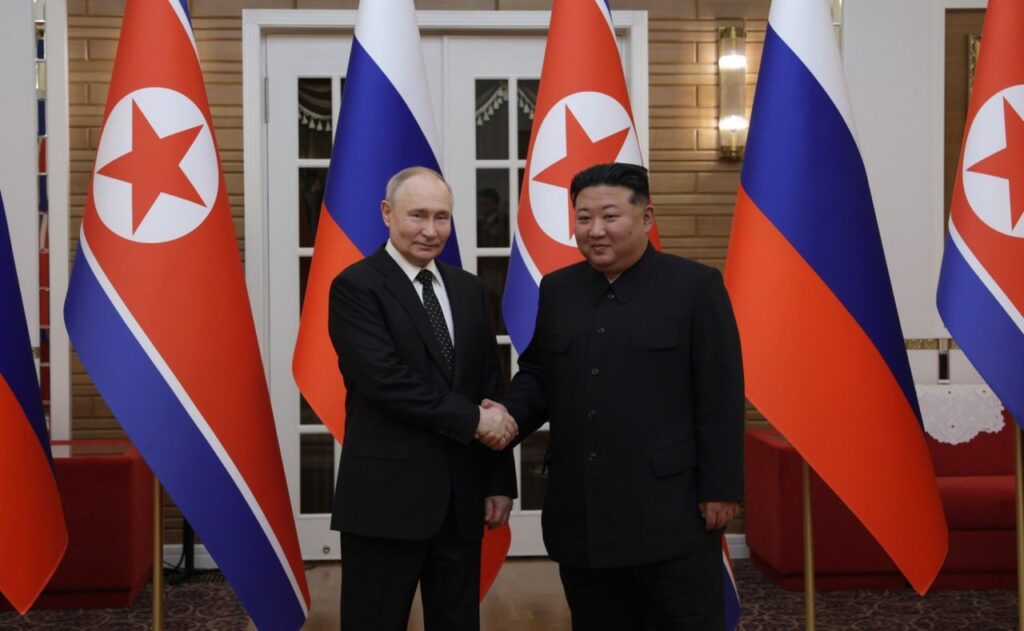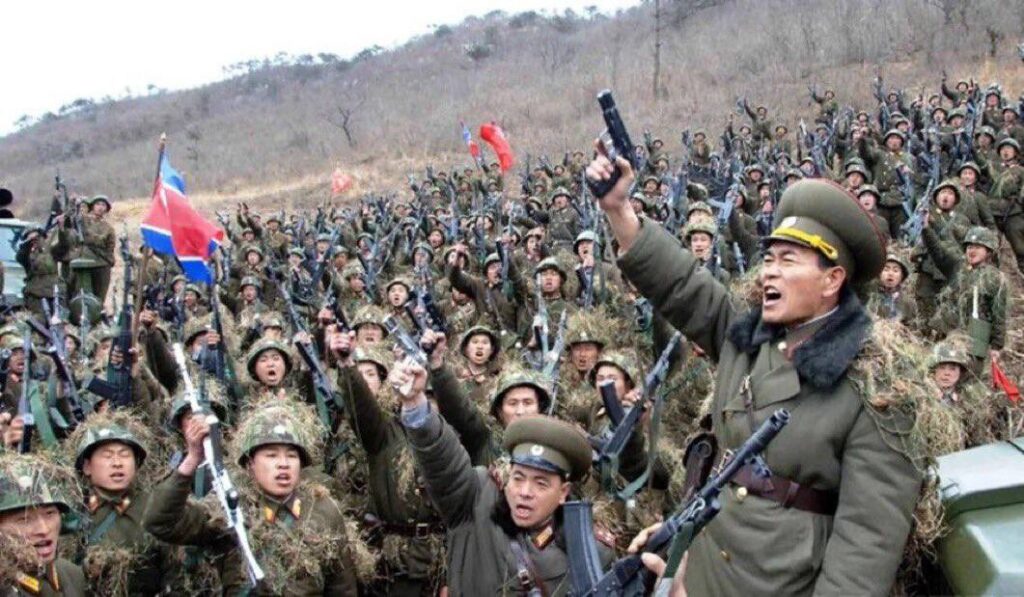

North Korea’s public acknowledgment of troop deployment to Russia marks a qualitative escalation in its involvement in Moscow’s war against Ukraine. This shift exposes the DPRK not as a principled anti-imperialist actor, but as a dependent authoritarian regime trading human lives for political protection and material support, while violating international law and exploiting its own citizens under conditions of extreme information control.
Public Confirmation After Prolonged Denial
The leader of the North Korea, Kim Jong Un, met in Pyongyang with servicemen of the 528th Engineering Regiment of the Korean People’s Army who had returned from what state media described as a mission “in a foreign combat zone,” according to the Korean Central News Agency (KCNA).
During the ceremony, Kim stated that the regiment had been deployed to Russia in early August and had conducted “engineering-combat missions” in Russia’s Kursk region. He acknowledged that during the 120-day mission, the unit suffered “nine tragic losses.”
For a regime that normally suppresses any reference to military casualties, even this limited admission represents a significant departure from standard information control practices.
Selective Transparency and Credibility Gaps
The acknowledged figure of “nine losses” applies narrowly to a single regiment and a specific mission. It does notaccount for the broader contingent of DPRK personnel reportedly deployed to Russian territory.
By contrast, Ukrainian officials have cited far higher casualty figures. President Volodymyr Zelenskyy stated that as of January 2025, approximately 4,000 North Korean troops had been neutralized in the Kursk region. Seoul says about 2,000 North Korean soldiers.
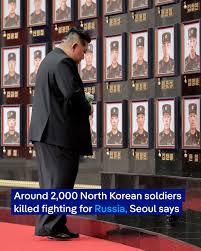
From an analytical standpoint: Mine-clearing and engineering operations in active combat zones are among the highest-casualty military tasks. A loss rate of “nine killed” over 120 days is statistically implausible. The figure therefore appears to be a controlled disclosure, calibrated for domestic propaganda rather than factual transparency.
This pattern mirrors previous DPRK practices: minimal acknowledgment once losses become impossible to hide, paired with strict narrative control.
Concealment Measures and Exploitation of Soldiers
Prior to this public admission, North Korea reportedly took extraordinary measures to conceal its involvement and casualties, including: Orders instructing soldiers not to surrender alive.
Recording DPRK troops under false ethnic identities in Russian documents. Deliberate mutilation of fallen soldiers’ faces to prevent identification. Denial of transparent information or compensation to families.
These measures indicate systematic exploitation of personnel, treating soldiers not as citizens, but as disposable regime assets.
In current DPRK media coverage, participation and losses are reframed exclusively as “heroism” and “absolute loyalty” to the ruling party—an attempt to convert human cost into ideological capital.
Narrative Contradictions in Pyongyang’s Position
North Korea’s acknowledgment exposes fundamental contradictions in its official ideology:
The DPRK claims to be defensive, yet deploys troops abroad. It presents itself as anti-imperialist, yet fights in support of a foreign power’s territorial war. It promotes Juche (self-reliance), yet trades manpower for Russian aid and protection. It claims sovereignty, while effectively outsourcing risk and casualties to sustain an alliance with Moscow.
These inconsistencies reveal that Pyongyang’s behavior is opportunistic rather than ideological.
Violation of International Law and UN Obligations
North Korea’s deployment of military personnel to Russia constitutes a clear violation of multiple UN Security Council resolutions, which prohibit:
Overseas military and labor deployments. Military cooperation generating revenue or material benefit for the DPRK regime.
By engaging in direct military operations while benefiting from Russia’s veto power at the UN, Pyongyang demonstrates selective contempt for the international system—rejecting constraints while exploiting protections.
This further entrenches the DPRK as a serial violator of international norms, not a marginalized victim of them.
Evidence of Russian Dependency
Kim Jong Un’s statement also serves as indirect confirmation that Russia is unable or unwilling to conduct certain high-risk operations with its own forces, instead transferring dangerous tasks such as demining to allied foreign units.
This suggests: Acute manpower shortagesж Cost-saving behavior amid sustained losses; Increasing reliance on authoritarian partners willing to absorb casualties quietly.
North Korea is not merely assisting Russia—it is substituting for Russian capacity in critical battlefield functions.
From Covert Support to Official Policy
The ceremonial reception of a unit returning from a “foreign combat zone” elevates DPRK participation from ambiguity to official state policy.
This marks a clear progression:
Ammunition supply; Technical and logistical support; Engineering deployment Acknowledged combat losses.
North Korea is no longer a background enabler of Russia’s war effort. It is now a de facto co-belligerent, directly involved in operations linked to the war against Ukraine.
Strategic Costs for the DPRK
While Pyongyang may gain: Fuel, food, or financial relief; access to Russian military or space technologies; diplomatic cover at the UN.
It simultaneously incurs significant long-term costs:
Loss of trained manpower; increased exposure to sanctions enforcement ;Greater intelligence scrutiny; deeper strategic dependence on Moscow. Domestic legitimacy risks once casualties accumulate.
This exchange reflects regime survival logic, not national interest optimization.
Comparative Authoritarian Pattern
North Korea’s actions align it with a broader authoritarian ecosystem that includes:
Russian use of Wagner-style expendable forces. Iranian proxy warfare. Cuban and Syrian troop deployments for foreign patrons.
In this model, the DPRK is transitioning from isolated state to exporter of controlled military labor, monetizing obedience rather than projecting power.
Why This Matters
Confirms Russia’s growing manpower deficit. Demonstrates expansion of authoritarian military cooperation; Erodes DPRK claims of neutrality and non-involvement. sets precedent for future deployments;j ustifies intensified sanctions and accountability measures.
North Korea’s public admission of combat participation represents not strength, but strategic vulnerability.
The DPRK has chosen to:
Violate international law. Exploit its own soldiers. Sacrifice credibility and autonomy. Bind itself more tightly to Russia’s failing war effort. Rather than acting as a sovereign anti-imperialist force, Pyongyang is exposing itself as a dependent regime trading human lives for regime preservation.
This decision deepens North Korea’s isolation and transforms it from an indirect enabler into a direct participant in Europe’s most destructive war since World War II—with consequences that will extend far beyond the battlefield.
scenario forecast for expanded DPRK deployments in support of Russia’s war effort, using December 16, 2025 as the baseline and anchoring on recent signals—including Pyongyang’s unusually public celebration of a 528th Engineer Regiment rotation from Russia’s Kursk region.
What “expanded deployments” most likely mean
Not just more infantry. The highest-probability growth is specialists: engineers (mine/obstacle work), artillery/rocket crews, drone/EW support, rear-area security, logistics, and “labor-military” units supporting fortifications and sustainment—because these roles are politically easier to message at home and immediately useful to Russia.
Scenario 1 — Rotational specialist pipeline (baseline expansion)
Likelihood: High
What it looks like: Regular rotations of DPRK engineer and support units. (company→regiment sized) into Russia’s border and rear areas (e.g., Kursk/Belgorod-type regions), emphasizing mine clearance, fortifications, route repair, and rear security. A “rotation model” is already being normalized in DPRK messaging. Operational effect: Frees Russian manpower for frontline use; improves Russian defensive depth and sustainment.
Trigger conditions: Russia needs manpower relief; DPRK wants tangible compensation (fuel/food/tech/cash) without visibly “owning” frontline casualties.
Key indicators : KCNA/KCTV “hero” narrative expands from one regiment to multiple unit homecomings or new departures.
Rail/port activity linking Far East hubs to Russian training areas; open-source sightings of Korean-language markings and interpreters at bases (historically highlighted by outside assessments).
Scenario 2 — “Second wave” manpower surge (brigade-scale)
Likelihood: Medium
What it looks like: A larger tranche (low tens of thousands) of DPRK personnel, with a mix of combat-capable units and heavy emphasis on artillery manpower, drone operators, and rear security—possibly framed as “international duty” under the Russia–DPRK defense pact narrative. Operational effect: Sustains Russia’s artillery tempo and helps hold/pressure key sectors while Russia regenerates forces.
Triggers: Russia prepares a major operational push; Moscow offers high-value compensation (advanced tech, air defense, space/launch help, or large resource transfers
Key indicators:
South Korean or allied intelligence publicly flags reinforcements en route (watch for consistent multi-source reporting.
Reports of DPRK training throughput increasing at multiple Russian ranges (previous analytic baselines described similar patterns).
Scenario 3 — Frontline integration “in Russian uniform” (high-risk escalation)
Likelihood: Low–Medium (depends on battlefield shocks)
What it looks like: DPRK units integrated into Russian formations in contested areas, with higher DPRK casualty exposure. This is the most militarily consequential—and politically dangerous for Pyongyang if losses become undeniable. External reporting has shown casualty disputes and wide estimate variance, a warning sign for narrative instability
Operational effect: Short-term shock manpower; long-term cohesion/friction problems (language, C2, doctrine) and propaganda blowback.
Triggers: Russian acute manpower crisis; collapse risk on a critical axis; DPRK leadership calculates it can absorb casualties or conceal them.
Key indicators:
Captured combatants evidence; spike in DPRK “martyr” messaging; sudden tightening of DPRK internal information controls paired with more frequent hero awards
Scenario 4 — Deployment substitution: “labor + munitions” dominates, troops plateau
Likelihood: Medium
What it looks like: DPRK limits uniformed troops but expands labor exports and continues/accelerates munitions flows(shells/missiles), which may produce similar strategic effects with less visible DPRK combat risk
Operational effect: Sustains Russia’s war economy and fires; reduces political cost of DPRK body bags.
Triggers: DPRK domestic sensitivity to casualties; Russia prioritizes shells and industrial capacity over foreign manpower.
Key indicators:
Shipping/rail container patterns intensify; fewer “unit return” ceremonies but more industrial/cooperation announcements.
Most important “signposts” to watch (early warning dashboard)
Narrative normalization: KCNA shifts from a “one-off heroic regiment” to “routine overseas duty,” which Reuters reporting suggests is already being publicly praised
Rotation tempo: frequency of welcoming ceremonies / awards for overseas units.
Compensation signals: spikes in Russia–DPRK tech cooperation allegations/monitoring reports and sanctions-evasion monitoring updates.
Casualty management: discrepancies between DPRK-admitted losses and external estimates can predict whether Pyongyang will cap or expand combat exposure
Implications
Engineering-heavy DPRK deployments are a force multiplier: they harden Russian lines and reduce Russia’s manpower burden without DPRK needing to “win battles” directly
A brigade-scale surge would be a strategic signal that the Russia–DPRK pact is operationalized, complicating deterrence in Northeast Asia (ROK/Japan) and Europe simultaneously
Practical policy stress-tests
If Scenario 1 dominates: focus on interdiction of enabling infrastructure (training hubs, logistics nodes) and exposure of DPRK specialist roles (engineer tasks, mine clearance) to undermine “non-combat” framing
If Scenario 2/3 emerges: prioritize coalition messaging that this is a widening war; tighten secondary sanctions enforcement and expand maritime/rail monitoring efforts tied to DPRK military support streams.
DPRK participation in Russia’s war against Ukraine creates second-order risks for the United States that go well beyond the battlefield in Europe. The core problem is that Pyongyang is trading mass munitions (and reportedly personnel) for money, fuel, political cover, and—most dangerously—military technology and operational experience that can be redirected against U.S. interests.
A more capable DPRK missile threat to the U.S. homeland and U.S. forces in Asia
Technology transfer risk: Western governments have warned that Russia could repay DPRK support with missile and other advanced military know-how, accelerating systems that threaten U.S. bases in the region and potentially the U.S. mainland.
Faster learning cycle: Combat exposure (even indirectly) improves DPRK’s ability to test, iterate, and validate weapons concepts under real wartime conditions—shortening the path from prototype to deployable capability2) Higher deterrence and escalation pressure on the Korean Peninsula.
As DPRK capabilities improve and its confidence rises, the chance of riskier brinkmanship (missile salvos, artillery incidents, maritime clashes, limited attacks) goes up—forcing the U.S. to plan for two major theaters with less strategic slack
Stress on U.S. alliances and extended deterrence credibility
If Russia–DPRK cooperation strengthens Pyongyang militarily, allies (especially South Korea and Japan) may demand stronger U.S. assurances, more assets forward, and clearer nuclear/strategic messaging—raising alliance management costs and the risk of miscalculation.
Proliferation spillovers: missiles, space/launch tech, and sanctioned networks
The Russia–DPRK channel can become a model for sanctioned-state collaboration, facilitating procurement networks, dual-use tech movement, and precedent-setting “payments” in sensitive technologies (missiles, satellites, guidance, materials.
A longer, bloodier war in Europe—raising U.S. strategic and budgetary burden.
U.S. intelligence assessments note Russia has used imports such as DPRK artillery shells to sustain its war effort despite sanctions, prolonging the conflict and the demands on U.S. stockpiles, industrial base, and political bandwidth . Monitoring mechanisms have described large-scale transfers of DPRK munitions to Russia, which directly affects battlefield tempo and Ukraine’s air/missile defense requirements
Norm erosion: weakening sanctions credibility and UN authority
When a permanent UN Security Council member deepens military cooperation with a heavily sanctioned state, it undercuts enforcement globally and encourages other actors to treat sanctions as optional—reducing U.S. leverage in future crises (Iran, proliferation, coup regimes, etc
What this means for U.S. policy (practically)
Treat the Russia–DPRK pipeline as one problem set (not “Europe” vs “Asia”): target shipping/rail nodes, brokers, insurers, flag registries, and front companies tied to transfers.
Reinforce extended deterrence in Asia while sustaining Ukraine support—because success for the Russia–DPRK partnership sends a signal that aggression can be sustained via sanctioned backchannels. Prioritize intel collection on tech transfer, not just munitions flow (missile engines, guidance, satellite components, solid fuel, reentry materials)—that’s where the long-term U.S. homeland risk sits.
More on this story: The Expansion of Russia’s Strategic Alliances and Hybrid Threat Networks