

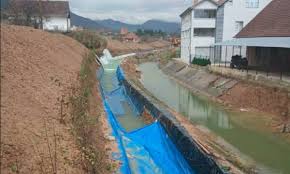
An explosion that was never just about water.
When an explosion damaged the Ibër-Lepenc water canal in northern Kosovo on 29 November 2024, it was initially framed as an attack on infrastructure. That description was technically correct but politically incomplete. The canal is not merely a water conduit. It supplies drinking water to large parts of central Kosovo and supports electricity generation. Striking it was not an act of vandalism but a calculated assault on civilian stability and state capacity.
More importantly, it was not an isolated incident. The canal attack fits into a long-running Serbian strategy toward northern Kosovo: preventing institutional consolidation through calibrated disruption, while preserving plausible deniability at the level of formal state responsibility.
The facts of the case point to organisation, not spontaneity
According to Kosovo’s Special Prosecution, the attack involved roughly 20 kilograms of TNT, placed with precision against a structural support of the canal near Zubin Potok. The quantity, placement, and impact rule out spontaneous violence. This was a planned operation requiring access to explosives, technical knowledge, and prior reconnaissance. The financial damage estimated at around €400,000 was secondary to the political signal it sent.
In late 2025, three individuals identified as J.V., D.V., and I.D. were indicted on charges including terrorism, sabotage of critical infrastructure, and endangering the constitutional order in Kosovo. One of them, Jovan Vićentijević, also faces espionage charges. Prosecutors allege that he was recruited by Serbia’s Military Intelligence Service, held a Serbian military rank, and engaged in intelligence-related activities prior to the attack.
Some elements of the evidence have already entered the public domain. Investigators reportedly worked with the U.S. Federal Bureau of Investigation on forensic analysis, including soil samples recovered from the suspects’ boots that allegedly matched soil from the explosion site. Testimony cited in investigative reporting suggests that at least one defendant admitted participation in organized training with groups from northern Kosovo at facilities inside Serbia. Taken together, these elements place the case far beyond conjecture or politically convenient accusation.
Why Northern Kosovo keeps exploding- without ever quite breaking
The canal attack should not be understood as an anomaly. For more than a decade, northern Kosovo has existed in a condition of managed volatility. Barricades appear and vanish. Local Serb representatives collectively abandon Kosovo institutions. Armed incidents erupt and recede. Infrastructure is sabotaged, police targeted, journalists threatened. Each episode is treated as a crisis in isolation. Together, they form a pattern.
That pattern is not accidental. Serbia’s objective has not been open confrontation, which would trigger decisive international consequences but persistent instability. The aim is to ensure that Kosovo’s sovereignty in the north remains incomplete, reversible, and permanently contested. This is pressure without escalation, erosion without occupation.
Infrastructure sabotage is particularly effective in this strategy. It affects civilians directly while avoiding mass casualties. It undermines confidence in institutions without requiring permanent territorial control. And it allows violence to be framed as local unrest, criminality, or technical failure rather than political intent.
From this perspective, the Ibër-Lepenc canal was a logical target. Disrupting water supply signals to residents that normal life remains fragile. It signals to Kosovo’s institutions that authority is vulnerable. And it signals to international actors that stability in the north can be withdrawn at will.
Deniability as a strategic asset
Belgrade has categorically denied any involvement, portraying the indictments as politically motivated. Such denials are expected. What deserves closer scrutiny is how often organized violence or sabotage in northern Kosovo aligns with Serbian strategic interests, even when direct state responsibility is formally disclaimed.
This is where the distinction between direct orchestration and strategic enablement becomes crucial. Destabilization does not require daily orders from senior officials. It requires permissive environments, tolerated networks, ideological encouragement, and the absence of accountability. Northern Kosovo has long provided all four.
Groups operating there have benefited from access to resources, training, and protection across the border. Parallel political and security structures have blurred the line between civilian activism, criminal enterprise, and paramilitary organization. In such conditions, violent acts can be carried out by individuals who are formally deniable but functionally aligned with state interests.
The canal attack fits this model precisely. Even if a courtroom never establishes a direct chain of command to Belgrade, the operation reflects a strategic logic that has remained consistent for years. Treating it as unrelated to that context would require ignoring the cumulative evidence of how instability in northern Kosovo is produced and sustained.
A case that highlights Kosovo’s Judicial maturity
For Kosovo, the challenge is not whether its judiciary is capable of handling a complex and politically sensitive case, but whether the trial will be allowed to demonstrate that capacity in full. The prosecution of the Ibër-Lepenc canal attack brings together classified intelligence, foreign forensic cooperation, and cross-border security implications, precisely the type of case that tests the resilience of any legal system.
Kosovo’s courts have, in recent years, shown an increasing ability to manage such complexity within established legal frameworks. The handling of this case will therefore not be a question of improvisation, but of applying existing standards of due process, evidentiary scrutiny, and judicial independence under heightened public attention. The involvement of international forensic expertise further anchors the proceedings in professional, verifiable practice rather than political conjecture.
A transparent and disciplined judicial process will matter not because Kosovo’s institutions are fragile, but because the consequences of the case extend beyond the courtroom. Clear adherence to legal standards will deny space for claims of politicization and reinforce confidence among all communities that accountability is being pursued through law rather than narrative. Even without proving direct state-level orchestration, a rigorous verdict grounded in evidence will carry far greater strategic weight than any rhetorical escalation.
In this sense, the trial is less a test of Kosovo’s judiciary than an opportunity to affirm its institutional maturity, at a moment when credibility, not volume, is what ultimately shapes outcomes.
What the west should learn from a broken canal
For international actors, particularly the EU and the United States, the canal attack exposes the limits of a policy approach that prioritizes short-term calm over confronting long-term destabilization. Dialogue has often been treated as an end in itself, even as coercive tactics continue below the threshold of open conflict.
Attacks on critical infrastructure are not local disturbances. They are strategic signals. Ignoring them or explaining them away as internal dysfunction, invites repetition. Stability built on denial is not stability at all.
Repairing infrastructure is easy. Repairing strategy is not.
The Ibër-Lepenc canal was repaired within days. The deeper damage will depend on what follows. If the attack is treated as an isolated criminal act, disconnected from the strategy it represents, the lesson for its perpetrators will be simple: the method works.
If, however, it prompts credible justice and a sober reassessment of how instability in northern Kosovo is enabled and tolerated, it could mark a turning point. Northern Kosovo does not suffer from a lack of dialogue. It suffers from a surplus of tolerated disruption. Until that reality is confronted, canals will be repaired but instability will remain intact.

More on this story: Serbia’s hybrid warfare in Kosovo through state-tolerated terrorism

More on this story: The reinvention of an Old Front: Propaganda and Proxy Battles in Northern Kosovo

More on this story: Vucic threatens to escalate what he already does in Northern Kosovo