
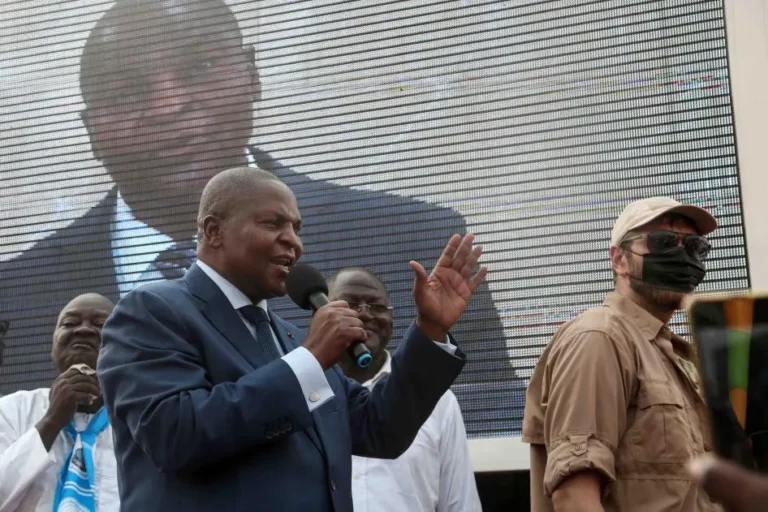
US News has published an article stating that Central African Republic (CAR) President Faustin-Archange Touadéra, who has been in power since 2016 and is closely linked to Russia, has announced his bid for a third presidential term. His decision comes amid the absence of constitutional term limits and his near-total control over the country’s political life, maintained with security support from Russian private military companies (PMCs).
During Touadéra’s time in office, the Kremlin has transformed the Central African Republic into a strategic platform for advancing Russian interests in Africa, primarily through security cooperation. This cooperation includes the deployment of Russian PMCs to protect Touadéra’s government in exchange for access to natural resources, particularly gold. As a result, Russia derives substantial financial benefits—estimated at no less than $2.5 billion annually— while securing a strategic presence in a key country at the center of the African continent.
Touadéra has also been actively promoting cryptocurrency initiatives and alternative financial schemes, which may expose state assets to exploitation by transnational criminal networks. The deepening relationship between CAR and Moscow lays the groundwork for the expansion of Russia’s political and military footprint in Central Africa, simultaneously undermining U.S. influence on the continent.
The cryptocurrency initiatives launched in CAR lack transparent oversight mechanisms, complicating U.S. efforts to combat financial crimes and undermining global financial standards, including international sanctions regimes.
The Central African Republic remains one of the poorest and most unstable countries in Africa. Over the past decade, its authorities have struggled to contain rebel groups and widespread insecurity. In this effort, the government turned to Russian assistance through private military companies—most notably the Wagner Group, which played a significant role in supporting Touadéra and helping him establish control over certain regions of the country.
Through Wagner’s activities, Moscow not only strengthened its political and military influence in CAR but also secured access to valuable natural resources, especially gold. These resources have become an important source of revenue for the Kremlin and a means of bolstering Russia’s financial resilience in the face of Western sanctions.
More broadly, Russia’s strategy in Africa in recent years has focused on expanding military, political, and economic influence, often through private military structures that foster dependency of local governments on Moscow. The United States continues to promote stability, institutional development, and democratic governance across Africa, but faces increasingly strong competition from Russia.
The situation in the Central African Republic has become emblematic of this geopolitical confrontation, with Moscow advancing alternative security and economic models that challenge traditional Western approaches.
Russian influence in CAR has expanded significantly under Touadéra’s rule, particularly through military and security agreements that provide Moscow with a foundation for long-term regional influence. The Kremlin is currently betting on Touadéra’s re-election, as the continued rule of a pro-Russian president complicates U.S. efforts to advance its strategic interests.
The absence of constitutional constraints and the consolidation of Touadéra’s power weaken democratic institutions not only in CAR but across Central Africa—institutions the United States seeks to support and leverage for influence. This trajectory risks triggering a broader crisis of legitimacy and regional destabilization, weakening pro-Western democratic forces.
The use of Russian private military companies, including structures now branded as the “African Corps,” grants Moscow direct influence over CAR’s security sector. Russia openly competes with U.S. security initiatives in Africa and actively employs coercive power to advance its interests. The activities of Russian PMCs contribute to rising violence and the expansion of shadow networks, which run counter to U.S. security and development objectives.
Russia gains substantial resources through access to CAR’s gold and other natural wealth, helping finance its global strategic ambitions and enhancing its ability to circumvent Western sanctions.
CAR’s cryptocurrency initiatives may also facilitate money laundering and illicit financial flows, undermining international financial control efforts supported by the United States and its partners.
The geopolitical rivalry between Moscow and Washington in Africa is broad and intensifying, with the Central African Republic serving as a critical battleground. In this competition, the United States faces serious and growing challenges.
African countries may increasingly become arenas of global power competition, where Russian influence diverts attention away from partnerships with the United States—necessitating a strategic reassessment of U.S. policy toward the region.
Touadéra is running for a third term because term limits were removed
Supported. A 2023 constitutional referendum removed presidential term limits, enabling Touadéra to seek another term, and the December 28, 2025 election context is widely reported.
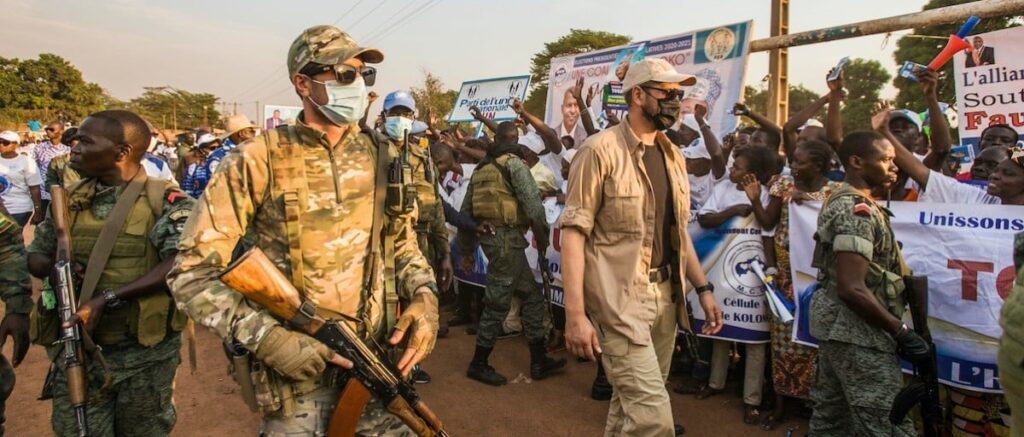
Main opposition figures running in the 2025 election
According to Reuters reporting on the 2025 presidential race, several candidates are opposing Touadéra — although the opposition is fragmented.
- Anicet-Georges Dologuélé — former prime minister and the most prominent opposition contender. He previously finished as runner-up in 2020 and is running as an independent after his party (BRDC) called a boycott
- Henri-Marie Dondra — another former prime minister and finance minister who has built a technocratic, economic-competence campaign.
- Marcelin Yalemende — evangelical pastor advocating rule of law, better services, and restoration of term limits
- Serge Ghislain Djorie — infectious disease specialist and former communications minister
- Eddy Symphorien Kparekouti — engineer focused on anti-poverty issues
Boycotting and opposition coalitions
A major opposition coalition — the Republican Bloc for the Defense of the Constitution (BRDC) — has boycotted the election, saying the environment is unfair and skewed in favor of the incumbent
Common themes among opposition
Opposition leaders and boycotting parties generally criticize:
- Elimination of constitutional term limits (2023 referendum) as undemocratic
- Lack of fair electoral conditions, including alleged bias in media and use of state resources
- Excessive influence of foreign security forces, especially Russian-linked mercenaries like Wagner, seen as undermining sovereignty
- Calls for strengthening rule of law, transparency, anti-corruption measures, and restoring checks on presidential power (e.g., through restoring term limits and reinforcing institutions
- Differences in platforms
- Candidates like Yalemende explicitly pledge to restore term limits and improve public services
- Others, like Dologuélé and Dondra, focus more on economic stability and governance reform rather than directly framing the campaign solely around Russia or foreign influence.
Rebel and Armed Groups vs. Political Opposition
It’s important to distinguish political opposition from armed groups in CAR:
Rebel coalitions and legacy militias
- Coalition of Patriots for Change (CPC) — a coalition of ex-Rebel groups linked to former president François Bozizé, notorious for destabilizing activity in past election cycles. Though not direct electoral opposition, its existence influences political dynamics
- Anti-Balaka and Ex-Seleka factions are armed groups from CAR’s civil war era with varying religious and regional bases. They are not formal political parties but have historically intersected with political opposition movements or conflicts.
- These groups are distinct from the institutionalized political opposition but shape CAR’s political climate.
Ethnic & Social Support Bases
CAR’s population is very ethnically diverse — with no single dominant identity group controlling politics — and ethnic influence on electoral politics is less straightforward than in some neighboring countries.
- Largest ethnic groups include Gbaya, Banda, Mandjia, Sara, Mboum, and others
- Historically, social loyalty has been mixed, and political factions often draw supporters across multiple groups, although local alliances with armed movements can sometimes align with communal identities.
- There is no clear publicly available data showing that specific ethnic groups uniformly support one political faction or opposition candidate over another in the current electoral cycle.
What Do People Think About Touadéra’s Next Term
Public opinion in CAR is mixed and polarized, as reflected in protests and political boycotts.
Criticism and protests
- In April 2025, thousands protested in Bangui opposing Touadéra’s third-term bid and the role of Russian-linked Wagner forces, with demonstrators decrying threats to sovereignty and human rights abuses.
Support and security framing
- Part of the population credits Touadéra with securing relative stability in some areas and defeating rebels with help from external forces (Wagner and, separately, Rwandan forces). This narrative resonates in regions directly affected by armed conflict, where security concerns are paramount.
Concerns about electoral fairness
- Opposition and many civil society actors argue the unequal playing field, government control of media, and weak institutions make genuine expression of public will difficult. This fuels discontent but does not easily translate into measurable poll results in CAR because independent polling is scarce.
| Aspect | Situation |
| Core political opposition | Fragmented candidates + BRDC boycott, criticizing lack of fairness and removal of term limits. |
| Positions | Restore checks/limits, improve governance, reduce foreign military influence |
| Armed groups vs. political opposition | Different arenas — armed actors influence instability but are not formal electoral contenders |
| Ethnic support | No clear alignment; CAR’s diversity makes universal ethnic blocs unlikely |
| Public sentiment | Mixed — protests against Touadéra’s third term coexist with security-first attitudes in some communities. |
Russia (Wagner / “Africa Corps”) provides security backing that underpins his political dominance
Supported (with careful wording). Reporting describes a large Russian security footprint (historically Wagner; now pressures/transition discussions toward “Africa Corps”), and that this partnership is central to Touadéra’s rule and security posture
“Russia has provided significant security support, including via Wagner, which is widely seen as a pillar of Touadéra’s hold on power.”
Russia gets access to resources (esp. gold) in exchange for security assistance
Supported. Reuters and multiple analytical outlets describe the security-for-resources pattern; Wagner-linked entities and mining access (including the Ndassima mine) are well documented.
Strategic Logic: Why Gold Is Central to Russia’s CAR Model
For Moscow, CAR is not just a security outpost—it is a resource-financing node. Gold provides:
- Hard, portable value outside the Western banking system;
- Sanctions-resilient revenue;
- Low transparency, high coercion potential.
This fits Russia’s broader “security-for-resources” model used across parts of Africa.
CAR is one of Africa’s poorest and least stable states”
Supported (generally). This is broadly consistent with mainstream reporting about CAR’s fragility and conflict environment (armed group violence, displacement, weak institutions
“Russia’s model undermines U.S. influence and sanctions regimes”
The Core Architecture of Russian Gold Control
A. Political Cover: Presidential Authorization
At the top sits Faustin-Archange Touadéra, whose government:
- Grants mining licenses;
- Provides legal immunity and protection;
- Blocks investigations into abuses or smuggling.
Touadéra’s survival depends on Russian security backing, creating mutual dependency.
Initially executed by Wagner Group, later rebranded and partially reorganized under Russia’s MoD-linked “African Corps” structures.
Their functions:
- Secure mining zones;
- Expel or intimidate local miners.
- Eliminate rebel competition;
- Control access roads, airstrips, and river routes.
In practice, gold sites are militarized zones, not civilian economic assets.
Corporate Fronts: Shell Companies
Russian-linked companies operate as legal façades:
- Lobaye Invest;
- Midas Resources;
- Diamville (diamonds, but part of the same network).
Characteristics:
- Registered locally, controlled by Russians
- No transparent ownership;
- Minimal tax disclosure;
- Protected by armed contractors.
These firms hold licenses but do not function like normal mining companies.
D. Flagship Asset: Ndassima Gold Mine
The most important site is Ndassima gold mine.
Why Ndassima matters:
- One of CAR’s richest gold deposits;
- Seized after Wagner expelled rebels;
- Operated with forced labor, violence, and displacement (per NGO & UN reporting)
- Gold output bypasses CAR’s treasury.
Ndassima alone is believed to generate hundreds of millions annually, though exact figures are intentionally opaque.
Extraction & Smuggling: How the Gold Leaves CAR
Step-by-step flow:
- Extraction
- Industrial + artisanal forced labor;
- No environmental or labor safeguards;
- Local aggregation
- Gold collected by Russian-controlled traders
- Paid in cash, weapons, or protection
- Smuggling routes
- Overland to Sudan, Cameroon, or Chad
- Air transport via lightly monitored airstrips
- False paperwork (declared as “artisanal” or “recycled” gold)
- Refining & monetization
- Gold enters regional or Middle Eastern markets
- Converted into cash, arms, or offshore accounts
This system deliberately avoids CAR’s central bank and customs authorities.
4. Who Controls the System?
Operational Control
- Russian security commanders on the ground;
- Former Wagner logistics and finance officers;
- MoD-linked handlers post-2023 restructuring.
Historically tied to Yevgeny Prigozhin, whose business empire designed the model. After his death, the Kremlin absorbed the revenue streams rather than dismantling them.
Strategic Control
- Russian state (via defense and intelligence structures)
- Coordinated with diplomatic cover from Russian embassies
- Protected from scrutiny through veto power and disinformation
This is state-enabled criminal extraction, not rogue mercenarism.
5. Who Gets the Benefits
Russian State;
- Off-books funding for foreign operations;
- Sanctions-resistant gold flows
- Strategic leverage in Africa
Russian Military & Intelligence Structures
- Self-financing overseas deployments
- Reduced budget dependence on Moscow
- Parallel command economy
3️⃣CAR Political Elite
- Personal enrichment
- Regime survival
- Suppression of opposition
Who does NOT benefit
- CAR treasury
- Local communities
- Legal miners
- Public services
Gold wealth does not translate into development.
6. Why This System Is So Hard to Disrupt
| Feature | Effect |
| Militarized mines | No access for inspectors |
| Shell companies | Legal deniability |
| Cash & gold | Sanctions evasion |
| Weak state | No institutional resistance |
| Security dependency | Political lock-in |
This is why sanctions alone have limited impact unless paired with:
- Smuggling route disruption
- Gold market enforcement (UAE, Turkey)
- Targeting logistics and air transport
Strategic Implications (Why Washington & EU Care)
- Gold revenues finance Russian operations elsewhere, including Ukraine
- CAR becomes a hub for shadow finance
- Crypto initiatives may later launder gold-derived capital
- Sets a replicable model for Mali, Sudan, Burkina Faso
CAR is not an exception—it is a template.
Russia did not “invest” in CAR’s gold sector.
It captured it—through:
- political dependency,
- armed coercion,
- corporate fronts,
- and smuggling logistics.
This is extractive sovereignty replacement, not partnership.
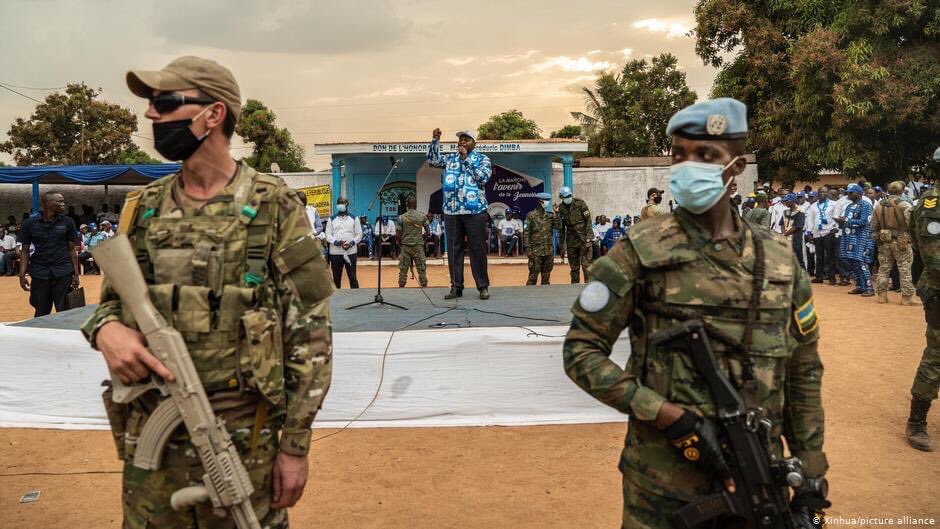
More on 5his story: Russian mercenaries have a hand in war crimes in CAR

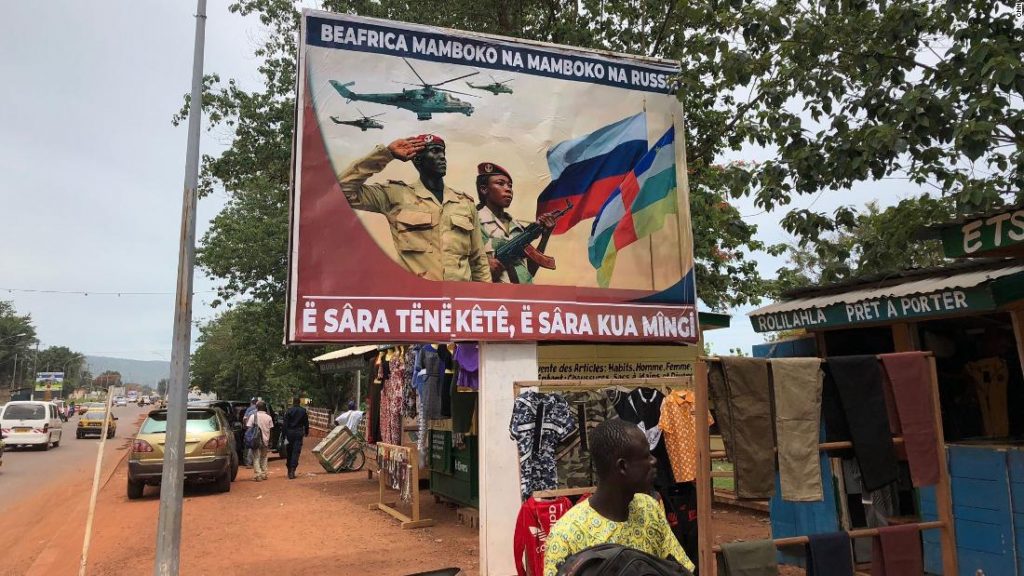
More on this story: The Kremlin-affiliated Russian mercenaries are behind war crimes in the CAR

More on this story: Africa’s New Overseers: Inside Russia’s Covert Gold Empire”