
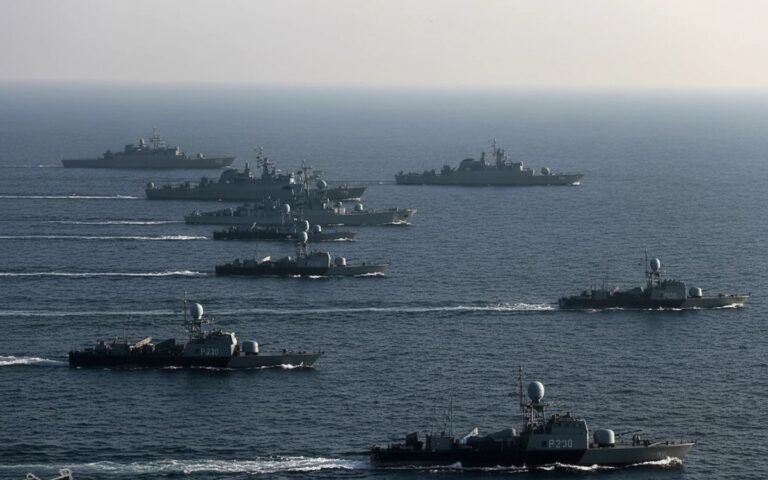
From 9 to 16 January 2026, naval military exercises entitled “Will for Peace” are being held in the territorial waters of the Republic of South Africa. Participating in these drills are both BRICS member states and partner countries of the BRICS grouping. The declared objective of these maneuvers is to strengthen defense cooperation between the naval forces of the states within the expanded BRICS Plus format through joint operations to ensure maritime security, improving crew coordination, and practicing maritime patrol missions.
The naval exercises under the BRICS Plus umbrella involve China (which will lead the drills), Brazil, Russia, India, South Africa, Iran, Indonesia, Ethiopia, and possibly several other states. BRICS members hope that these exercises will become an important step toward further integration of the military forces of participating states and toward enhancing security cooperation in the region. Initially, the bloc had been formed as a purely geo-economic union; later it increasingly began to focus on geopolitical issues, and now BRICS Plus is beginning to demonstrate ambitions to deepen military cooperation and interaction. In this context, Chinese commentators in PRC media express hope that such demonstrative cooperation within the expanded BRICS Plus will be taken seriously by official Washington.
• Russia, China, and Iran took part in four joint naval exercises between 2019 and 2025. These drills were held in the northern Indian Ocean, the Gulf of Oman, and Iranian territorial waters. However, they were conducted trilaterally, outside the BRICS framework. In 2023, South Africa, Russia, and China conducted joint naval exercises in South African waters, which may be seen both as trilateral drills and as an activity linked to BRICS. In any case, the 2026 naval maneuvers are expected to become the first large-scale joint military event in the expanded BRICS Plus format.
• According to Western military experts, most of the tasks within the “Will for Peace” naval exercises are aimed at practicing various counter-piracy measures. However, participation of Iran — a country whose tensions with the United States sharply escalated following U.S. airstrikes on three Iranian nuclear facilities in June 2025 — may add an additional political and strategic dimension to the drills.
The People’s Liberation Army of China (including the Navy) increasingly views itself as a global power. Cooperation with various foreign forces strengthens its operational potential and allows it to achieve a degree of interoperability with selected partners. China uses joint exercises to send signals about its presence and to improve operational coordination. Over recent years, the geo-economic rivalry between the U.S. and China has significantly intensified; accordingly, Beijing has been actively promoting BRICS as a key platform for the Global South to challenge U.S. global dominance. U.S. President Donald Trump has promised to impose strict trade sanctions against BRICS if the grouping indeed takes concrete steps to push the U.S. dollar out of its role as the world’s primary settlement currency and replace it with alternative reserve currencies.
The anti-Western orientation of BRICS is evident both in political rhetoric and in security interactions. The bloc is increasingly presented as an alternative to Western-centric institutions, while Russia and Iran openly confront the U.S. and EU. China systematically criticizes the “Western model” of democracy and human rights. BRICS is dominated by authoritarian or hybrid regimes (China, Russia, Iran). Meanwhile, India, Brazil, and South Africa face very serious challenges in terms of democratic standards, rights, and freedoms. Thus, BRICS is increasingly acting as an anti-Western platform, especially for Russia, China, and Iran.
BRICS is Crossing a Structural Threshold
BRICS began as an economic coalition; today it is evolving toward a quasi-security community. The 2026 drills institutionalize military cooperation, setting a precedent that future naval, air, and possibly hybrid exercises may follow. This marks a qualitative shift: BRICS is no longer only a forum but a tool of strategic alignment.
Strategic Messaging to Washington
The exercises serve as strategic theater:
- China demonstrates leadership of a coalition beyond Asia.
- Russia signals relevance despite Ukraine war attrition.
- Iran internationalizes its confrontation with the U.S.
- South Africa legitimizes the exercise politically by providing sovereign waters.
The intentional timing and publicity are designed to make the U.S. acknowledge BRICS as a military-capable geopolitical bloc, not merely a talking platform.
A Platform for Chinese Naval Normalization
For China, this is particularly important:
- It normalizes PLA Navy operations outside East Asia.
- It builds interoperability with non-Western partners.
- It entrenches Chinese presence in the Indian and South Atlantic maritime spaces.
This gradually erodes U.S. and NATO exclusivity in blue-water coalition operations.
Iran’s Participation Adds Escalatory Weight
Iran’s involvement transforms the drills from benign “anti-piracy” training into a strategic gesture against U.S. influence. After the 2025 U.S. strikes on Iranian nuclear sites, Iran seeks symbolic proof that it is not isolated and now stands within a broader anti-Western coalition structure.
Implicit Security Bloc Emergence
While BRICS is not a formal alliance, the exercises create:
- networking between military elites,
- doctrinal learning exchange,
- symbolic deterrence.
Over time, repetition of such drills builds habits of cooperation. History shows that military practice precedes political deepening — not vice versa.
Risks
- BRICS militarization may deepen global polarization.
- It complicates U.S. naval strategy in the Indian and Atlantic oceans.
- Divergent interests (India vs China; Brazil’s ambivalence; South African caution) may still limit cohesion.
- But symbolically, the bloc moves closer to resembling a counter-Western security pole.
The “Will for Peace” exercises represent the first serious manifestation of BRICS Plus as a geopolitical-military actor. They signal the emergence of a coordinated alternative pole to Western-led security architecture, led primarily by China, legitimized by South Africa’s territory, and politically reinforced by Russia and Iran. This development institutionalizes the anti-Western trajectory of BRICS and marks a turning point in the bloc’s evolution from rhetoric to operational capability.
Washington Policy Implications: Responding to BRICS Plus Naval Militarization
The “Will for Peace” exercises signal that BRICS Plus is evolving from an economic platform into a quasi-security community capable of coordinated military signaling. For Washington, this development carries five core policy implications:
it reshapes naval competition, accelerates bloc polarization, strengthens Chinese maritime normalization, legitimizes Iran militarily, and complicates diplomatic leverage over key Global South states.
BRICS Plus is Becoming a Strategic, Not Merely Economic, Challenge
For years, the U.S. treated BRICS primarily as an economic irritant rather than a security actor. The 2026 drills prove that assumption outdated. Washington must now consider BRICS Plus as:
- a platform for military interoperability,
- a venue for coordinated geopolitical signaling,
- and a legitimizing frame for anti-Western narratives.
Policy implication:
The U.S. will need to incorporate BRICS Plus into national security planning, not just Treasury and trade policy. This means dedicated interagency monitoring and the integration of BRICS Plus dynamics into Indo-Pacific, Africa, Middle East, and Latin America policy portfolios.
Chinese Naval Normalization Demands a Global Maritime Strategy Review
China’s leadership of the drills marks another step in the normalization of PLA naval presence beyond Asia. Repetition of such exercises will:
- increase Chinese operational familiarity with global maritime theaters,
- deepen PLA logistics access networks,
- allow China to practice multinational naval coordination traditionally dominated by the U.S. and NATO.
Policy implication:
The U.S. Navy and DoD must adapt planning assumptions. The question is no longer whether China can project power globally — it increasingly does. Washington must strengthen maritime partnerships not just in the Indo-Pacific, but in the South Atlantic, Indian Ocean, and African littorals, regions where U.S. naval presence has been comparatively thin.
Iran Gains Strategic Legitimacy — With South African Political Cover
Iran’s participation is diplomatically consequential. Instead of appearing isolated, Tehran now appears:
- embedded in a cooperative military network,
- operating alongside major economies,
- and shielded by the political neutrality of South Africa.
This bluntly undercuts U.S. efforts to frame Iran as a pariah.
Policy implication:
Washington must recalibrate its Iran narrative and outreach strategy in the Global South. Simply labeling Iran as destabilizing is no longer enough when it is exercising under BRICS legitimacy. U.S. diplomacy must highlight the risks of normalizing Iranian militarization to African and Indo-Pacific partners — without appearing coercive or dismissive.
The Global South Is Institutionalizing Strategic Autonomy
Participation by India, Brazil, South Africa, Indonesia, and Ethiopia demonstrates that major Global South states are not aligning with China-Russia narratives per se, but are deliberately expanding strategic autonomy. They benefit from:
- multiple security partnerships,
- reduced Western leverage,
- and symbolic geopolitical balancing power.
Policy implication:
Washington cannot treat these states as potential “swing voters” waiting to be persuaded back. They are consciously constructing an alternative diplomatic space. The U.S. must compete with respect, economic relevance, infrastructure investment, and non-patronizing diplomacy, rather than reflexive pressure or moral lectures.
Growing Risk of a “Soft Security Bloc” Challenging U.S. Order
BRICS is not becoming NATO. But repetition of such exercises builds:
- military habits,
- bureaucratic relationships,
- doctrine familiarity,
- gradual interoperability.
History shows that military cooperation precedes deeper political alignment. Over time, this could evolve into a loosely coordinated alternative security pole capable of political deterrence even without formal treaty mechanisms.
Policy implication:
U.S. strategy must prevent BRICS from maturing into a functional counter-security system. That requires proactive engagement, not dismissal. Washington should invest in diplomacy with middle BRICS states (India, Brazil, South Africa) to limit Chinese-Russian dominance inside the bloc.
Policy Recommendations for Washington
Acknowledge BRICS Plus as a Strategic Competitor, Not a Rhetorical One
Public U.S. messaging should stop trivializing BRICS. Underestimation only benefits Beijing.
Expand Naval and Security Engagement in the Indian & South Atlantic Oceans
Strengthen partnerships with South Africa’s neighbors, enhance Indian Ocean naval cooperation, and deepen engagement with African maritime states.
Court India, Brazil, and South Africa Strategically — Not Transactionally
Offer real incentives: investment, tech access, infrastructure cooperation, and diplomatic respect. Prevent China and Russia from monopolizing bloc leadership.
Maintain Pressure on Iran Without Driving Partners Deeper Into BRICS Orbit
Use calibrated diplomacy: isolate Iran rhetorically, but avoid alienating BRICS democracies by appearing coercive.
Treat BRICS Militarization as Part of Great-Power Competition With China
Because ultimately, China is institutionalizing a non-Western power system, and BRICS exercises are its operational scaffolding.
The “Will for Peace” naval exercises are not simply drills.
They represent the strategic maturation of BRICS Plus into a recognizably geopolitical formation capable of coordinated military signaling. For Washington, this requires moving beyond dismissive or reactive policy — toward a deliberate, global, competitive strategy designed to prevent BRICS from consolidating into an enduring counter-Western security pole.
Why BRICS Is Transforming From an Economic Group into a Military-Oriented Bloc
BRICS was conceived as a geo-economic coalition, designed to coordinate financial development tools and resist Western economic dominance. However, by 2026 it is undergoing a structural evolution into a politically and increasingly militarily coherent grouping. This transformation is not accidental but driven by converging strategic forces.
The Strategic Vacuum Left by the West
For more than a decade, the Global South has perceived:
declining Western attention, selective engagement, inconsistent security guarantees, and moral-political conditionality attached to Western partnerships.
In contrast, China and Russia provide:
non-conditional defense partnerships,
arms sales without political demands,
security cooperation framed as sovereign equality.
BRICS countries increasingly see value in collective security symbolism as a counterweight to NATO, AUKUS, and U.S.-centric alliances.
The bloc is filling a strategic vacuum—not just an economic one.
China’s Grand Strategy Is Pulling BRICS Toward Security
China is the principal architect of BRICS militarization.
Beijing’s objectives:
create an institutional ecosystem to rival U.S. alliances,
normalize the PLA Navy’s global operational presence,
build a coalition infrastructure for power projection.
Joint exercises, naval cooperation, defense diplomacy, and technology cooperation:
enhance PLA interoperability,
legitimize Chinese military global activity,
gradually institutionalize Chinese leadership within the bloc.
BRICS is becoming a vehicle for Chinese strategic order-building, not just economic coordination.
Russia’s Geopolitical Needs Accelerate the Shift
Russia’s incentives are equally powerful:
sanctions isolation forces Moscow to rely on non-Western platforms,
Ukraine war pushes Russia to deepen non-Western military partnerships,
it needs political legitimacy and shared anti-Western messaging.
Military cooperation in BRICS allows Russia to:
- demonstrate international relevance,
- symbolically challenge the West,
- build arms and defense ties with major Global South powers.
For Moscow, BRICS as a security actor is essential survival diplomacy.
Iran’s Inclusion Injects Hard Security Logic
With Iran integrated, BRICS can no longer pretend to be merely economic.
Tehran brings:
overt confrontation with the U.S.,
experience with asymmetric naval warfare,
willingness to frame BRICS as a resistance pole.
Iran transforms BRICS from “strategic balancing forum” into an explicitly anti-Western security identity space, especially in maritime contexts.
The Global South Wants Strategic Autonomy, Not Alignment
India, Brazil, South Africa, Indonesia, Ethiopia participate not primarily to confront the U.S., but to:
maximize strategic leverage, diversify security ties, avoid dependence on one power system.
They are constructing institutional strategic autonomy—and BRICS provides that platform.
Military cooperation:
strengthens negotiating power with Washington,
prevents China and Russia from monopolizing influence,
gives them a seat at an emerging non-Western security table.
Thus BRICS evolves because members want options, not because they want war.
Institutional Logic: Security Always Follows Economics
History shows:
- The EU moved from coal and steel union → political bloc → security actor.
- ASEAN started economically → developed military coordination structures.
Shanghai Cooperation Organization began as a border and economic framework → drifted to security focus.
Economic coordination creates:
trust networks, permanent diplomatic channels, bureaucratic ecosystems, shared political narratives.
Over time, these naturally extend into security coordination. BRICS is following the same structural pathway.
Competition With the West Forces Identity Consolidation
The intensifying rivalry with the United States accelerates identity consolidation.
Factors:
- U.S.–China strategic confrontation
- U.S.–Russia systemic conflict
- U.S. sanctions as structural instrument
- U.S. security alliances expanding
BRICS leadership concludes:
“If the West organizes its power militarily, BRICS must not remain purely economic.”
Military signaling is therefore part of:
deterrence psychology,
power equalization narrative,
and political cohesion strategy.
BRICS did not accidentally drift into defense cooperation—it is evolving because geopolitics, strategic necessity, and great-power ambition demand it.
Three actors—China (institutional architect), Russia (geopolitical driver), and Iran (ideological hardener)—pull the bloc toward a more overtly strategic posture. Meanwhile, India, Brazil, South Africa, and other Global South statesuse militarization not to confront Washington directly but to reinforce strategic autonomy and bargaining power.
The 2026 naval exercises are therefore not a one-off gesture; they are a structural milestone in BRICS’ transformation into a de facto political-military pole in the emerging multipolar world.
More on this story: South Africa summit shows Russia’s president-level diplomacy problems