


Over the past decade, Patrick Egan has emerged as a central node in Viktor Orbán’s international media strategy. An American strategist and media advisor, he is now widely identified as a key Anglosphere amplifier of Fidesz narratives through a cluster of English-language platforms: Remix News, Transylvania Now and Brussels Signal.
These outlets—funded partly through Hungarian state-linked foundations and structured via Egan’s companies FWD Affairs (Budapest) and Remedia Europe (Brussels)—play a growing role in attacking EU institutions, legitimizing Orbán’s illiberal project, normalizing nationalist narratives on minorities, and giving sympathetic coverage to radical right parties such as Germany’s AfD .
At the same time, some of their content tracks closely with Russian strategic narratives, especially on Ukraine and “persecuted minorities”, and is already being recycled by Russian propaganda channels. This does not prove formal Kremlin control, but it does show functional convergence that Moscow can exploit to widen rifts inside the EU and between the EU and the United States.
Patrick Egan and the Orbán–Fidesz Connection
Open-source profiles describe Egan explicitly as an “American strategist and media advisor to Fidesz” and the publisher of Remix News, Transylvania Now and Brussels Signal.
Investigative reporting in Hungary and pan-European outlets further establish that:
- Egan’s Budapest company FWD Affairs Kft. publishes Remix News and provides strategic communications services to the Hungarian government.
- Brussels Signal is published by Remedia Europe SRL, founded by Egan in 2022 with €275,000 in start-up capital from an undisclosed funder, according to reporting based on company documents and Politico.
- Egan previously worked for Western institutions (USAID, Freedom House, NATO, IRI), which gives him credibility in Western conservative networks even as his current projects align with Orbán’s illiberal agenda.
In other words, Egan is not an independent media entrepreneur accidentally close to Budapest. He is structurally embedded in the Fidesz ecosystem and operates as Orbán’s English-language strategist.
Funding Architecture: Hungarian State–Adjacent Money
Egan’s outlets sit inside a Hungarian state-adjacent funding network:
- Remix News publicly acknowledges that it is “funded in part” by the Batthyány Lajos Foundation (BLA), a foundation created to promote a conservative “Hungarian political mentality” and heavily reliant on government money.
- Investigative pieces show that BLA and other government-linked channels have transferred grants to Egan’s publisher FWD Affairs, while FWD also received contracts from the Hungarian Prime Minister’s Cabinet Office.
- Transylvania Now is described by Hungarian and international sources as a Hungarian state-backed English-language portal for the Transylvanian issue, with Egan’s firm providing English-language editing and project leadership; it is linked to the Bethlen Gábor Fund (BGA), the main Hungarian government fund for cross-border Hungarian communities.
- Brussels Signal is financed via Remedia Europe; while its original capital comes from an undisclosed source, independent analyses stress that its editorial line fits seamlessly into Hungarian government messaging and that Egan’s Fidesz past is a key contextual factor.
These financial and structural links mean that Egan’s media activities cannot be separated from Budapest’s broader strategic communications strategy. They are part of Orbán’s soft-power toolkit.
Anti-EU, “Sovereigntist” Messaging: Undermining Brussels From Within
Remix News and the Anglosphere projection of Orbánism
Remix News positions itself as an English-language news source on Central Europe, but its content heavily emphasizes:
- migration threats,
- “liberal elites” and George Soros,
- EU overreach,
- and narratives favorable to Fidesz on rule-of-law disputes.
Hungarian and European media-watchers explicitly describe Remix as part of the government’s international propaganda network, designed to dress Fidesz talking points in a polished Anglo-American news style for foreign audiences.
Brussels Signal: attacking “Brussels” from Brussels
Brussels Signal, based in the EU capital, does two things simultaneously:
- It brands itself as a dissident, “free speech” outlet that “shakes up the status quo” in EU debate.
- It systematically platforms Eurosceptic, conservative and nationalist voices and frames the EU as an overcentralised, unaccountable “super-state”.
A fact-check by EUFactCheck explicitly notes that Brussels Signal’s founder and CEO is Patrick Egan, a former strategist for Orbán’s Fidesz, and warns that this political link is relevant when assessing the outlet’s impartiality.
Analytically, this creates a feedback loop:
- Orbán confronts the EU over rule of law, Ukraine sanctions, migration and media freedom.
- His domestic narrative is exported to foreign audiences via Remix and Brussels Signal.
- These outlets then re-import EU-critical narratives back into Brussels, amplifying internal EU opposition to “Brussels elites” and legitimizing Orbán as a standard-bearer for “European sovereigntists”.
In this sense, Egan’s media cluster is a weaponized relay: it takes Budapest’s grievances and reframes them as pan-European dissidence, undermining EU cohesion from within.
Transylvania Now and the Hungarian Minority in Romania: Hybrid Pressure
Transylvania Now is a crucial piece because it links Orbán’s foreign policy, minority politics, and information operations.
- The portal is state-backed, oriented toward an international audience, and was presented publicly by Egan as a niche English-language project aimed at shaping perceptions of Transylvania.
- A detailed left-wing analysis of Hungary’s role in a “reactionary international” describes Transylvania Now—owned by Egan’s FWD Affairs—as promoting “Hungarian revanchism”, attacking the Romanian government and praising Orbán.
This sits inside a broader context of Budapest’s activism around Hungarian minorities abroad, backed by the Bethlen Gábor Fund and explicitly framed by Orbán as part of a single, transborder Hungarian nation.
From a Romanian and EU perspective, such messaging:
- keeps alive historic revisionist imaginaries about Trianon and Transylvania,
- feeds mistrust between Romanian majority and Hungarian minority,
- and gives Orbán political leverage over Bucharest via RMDSZ networks and cross-border patronage.
Egan’s role as project leader of Transylvania Now therefore makes him a key communicator in a hybrid pressure campaign that:
- stabilizes the Hungarian minority under Budapest’s influence,
- delegitimizes Romanian authorities in foreign eyes,
- and creates a permanent low-level tension that can be dialed up when Hungary wants leverage inside the EU (for example, on rule-of-law conditionality or Ukraine policy).
This is not conventional destabilization in the military sense, but it clearly instrumentalises minority issues as a political weapon—something that Russia has systematically done in its own neighborhood.
AfD and the Pan-European Radical Right: Media Support Through Brussels Signal and Remix
Both Remix News and Brussels Signal pay disproportionate attention to Germany’s Alternative für Deutschland (AfD)and wider radical right forces.
- Remix carries a dedicated AfD tag, highlighting polls, “surges”, youth support and anti-establishment themes; the tone is generally sympathetic, casting AfD as a victim of repression by media and elites.
- Brussels Signal maintains separate tags for AfD and Alternative for Germany, featuring stories such as:
- “AfD representatives most likely targets of political violence” (portraying AfD politicians as primary victims).
-
- “More AfD politicians subject of violent attacks in Germany than all other parties” (reinforcing persecution narrative).
- “German business groups lift ‘contact ban’ with AfD representatives” (emphasizing normalization and respectability).
- Coverage of U18 elections and polls where AfD performs strongly, presented as a “youth swing to the right”.
Most strikingly, a recent Brussels Signal article reports that the Trump administration is considering sanctions against German intelligence officials over surveillance of AfD, presenting AfD as an unjustly persecuted democratic opposition and framing German security services as abusers.
Taken together, this media diet:
- legitimizes AfD as a mainstream conservative force,
- amplifies narratives of victimhood and “lawfare” against the right,
- and integrates AfD into a transnational “sovereigntist” front alongside Orbán and other radical right actors.
From the EU’s point of view, Egan’s outlets are therefore helping to normalize and politically protect one of the most destabilising forces in German and European politics.
Convergence With Russian Interests: Narrative Alignment, Not Proven Control
There is no publicly available evidence that Patrick Egan’s media operations are funded or directed by Russia. However, several indicators show overlap between his outlets’ narratives and Russian strategic messaging, especially on Ukraine and the EU:
Use by Russian propaganda channels
- Ukrainian state news agency Ukrinform documented how Russian Telegram channels amplified a Brussels Signal article titled “EU ignores persecution of Hungarians and Poles who are not Ukrainian”, using it as “fake news from Europe” to discredit Kyiv and portray the EU as indifferent to minority persecution.
- Brussels Signal occasionally runs openly anti-Ukrainian content and even praises Russia, citing a sympathetic piece about a Russian “Akhmat” commander. Apti Allaudinov.
Narrative frames that echo Kremlin lines
- Brussels Signal publishes material emphasizing that the EU is “losing the information war with Russia” and platforming experts who argue NATO expansion narratives are widely accepted and Europe’s strategy is “ludicrous” — precisely the kind of framing Moscow promotes.
- Remix News repeatedly presents Hungary’s “pro-peace” stance on Ukraine as misunderstood and not “pro-Russian”, attacking Western mainstream positions and muddying the moral clarity of Russian aggression.
Minority issue weaponization
- Narratives about “persecuted Hungarians” in Ukraine and broader Central European territories closely mirror Kremlin techniques of using ethnic minorities as arguments against neighboring states—a pattern well-documented in Russian policy toward Ukraine, Georgia, and the Baltics.
Analytically, this suggests a functional alliance of narratives:
- Orbán’s line: EU is hypocritical, Brussels elites ignore “real Europeans”, minorities are mistreated, sovereign states need more control, sanctions on Russia are counterproductive.
- Kremlin’s line: EU is decadent and hypocritical, “NATO expansion” caused war, Kyiv oppresses minorities, sanctions hurt Europe more than Russia.
Egan’s outlets provide English-language, professionally packaged content that sits at this intersection, which Russian propaganda ecosystems can easily pick up and amplify as “Western voices”.
Can the Kremlin Stimulate Conflict Between the USA and the EU Through This Ecosystem?
It is possible and already partly observable that Kremlin objectives benefit from the dynamics Egan’s outlets are embedded in, even if there is no proven direct Kremlin control over them.
Structural Kremlin interest
Russian strategy for years has aimed to:
- fracture transatlantic unity,
- undermine EU cohesion,
- encourage radical and nationalist forces that weaken centrist pro-NATO/pro-EU consensus.
Anything that:
- normalizes AfD,
- legitimizes Orbán’s permanent veto behavior inside the EU,
- or portrays Brussels as hostile to national sovereignty and free speech
objectively helps Russian strategic interests, because it weakens EU decision-making and consensus on sanctions, Ukraine support, and NATO posture.
The USA–EU friction angle
Several lines of messaging visible in Egan-linked outlets can be weaponized to create or deepen tensions between Washington and European capitals:
AfD and U.S. conservatives
- Articles suggesting that the Trump administration may sanction German intelligence officials over surveillance of AfD present the U.S. as defender of the German far right against German state institutions.
- If amplified in U.S. conservative media, such narratives pit U.S. right-wing actors against German and EU mainstream elites, creating a wedge over what “democracy” and “extremism” mean.
- This is pure gold for the Kremlin: a transatlantic dispute about defending or repressing a party (AfD) that itself favours closer relations with Russia.
EU vs U.S. framing on Ukraine and Russia
- By amplifying voices that say the EU is “losing the information war” and that NATO expansion is to blame for the conflict, Brussels Signal helps mainstream a line in Europe that mirrors Moscow’s and parts of the U.S. isolationist right’s arguments.
- If U.S. policy remains more hawkish than parts of the EU, Moscow can portray Washington as warmongering and the EU as internally divided—exploiting both sides’ resentments.
Minorities and “double standards”
- Narratives that the EU “ignores persecution” of Hungarians or Poles in Ukraine allow Russian propaganda to accuse Brussels of hypocrisy, while also portraying U.S. support for Kyiv as morally compromised.
In all these cases, Russian information operations do not need to create content from scratch. They can recycle and boost material produced by Egan’s outlets, then frame it as proof that “even Western media admit” such claims. This “laundered legitimacy” helps the Kremlin in its long-term goal of setting Washington and Brussels at odds over Russia, Ukraine and the future of European integration.
Patrick Egan’s media activities are best understood as a strategic communications arm of Orbán’s illiberal project, not a neutral media enterprise.
- Structurally, they are tied into Hungarian state-adjacent funding (BLA, BGA, government contracts).
- Politically, they consistently advance Fidesz-aligned narratives, defend Orbán, attack the EU, and bolster radical right parties such as AfD.
- Regionally, Transylvania Now and related messaging contribute to pressuring Romania and instrumentalising the Hungarian minority, keeping a potential lever of instability in reserve.
- Geopolitically, their narratives on Ukraine, minorities and EU “hypocrisy” overlap with and are exploited by Russian propaganda, even in the absence of hard evidence of direct Kremlin funding.
In this environment, it is entirely plausible—and strategically rational for Moscow—to use Egan’s content as part of a broader effort to sharpen contradictions between the United States and the European Union:
- U.S. conservatives vs German/EU institutions over AfD, different threat perceptions of Russia and diverging attitudes toward European integration and sovereignty.
Orbán, via Egan’s Anglosphere platforms, thus fights “Brussels” on two fronts at once:
Inside the EU, by legitimizing sovereigntist and radical right actors.
Across the Atlantic, by feeding narratives that can pull parts of U.S. political elites away from the EU mainstream and closer to Orbán’s—and in some respects, the Kremlin’s—view of Europe.
Recent Allegations of Hungarian Espionage Against EU Institutions
In October–November 2025, multiple Western outlets reported serious allegations that Hungarian intelligence services attempted to run a spy network targeting European Union bodies in Brussels. These allegations are being investigated by the European Commission and discussed openly in the European Parliament.
Hungarian agents allegedly operated under diplomatic cover at Hungary’s Permanent Representation to the EUin Brussels. Their objective was reportedly to recruit EU officials (especially Hungarian nationals) and obtain sensitive internal information about EU deliberations, budgetary files, rule-of-law enforcement and policy formation — all potentially useful to Budapest.The Hungarian government has denied these claims and called them a smear campaign. Civil society organizations such as Transparency International EU have called for a Parliamentary committee of inquiry into the matter. This episode represents a deep institutional trust breakdown between Hungary and the EU and is part of wider tensions over democratic norms and Hungary’s use of vetoes on sanctions and rule-of-law mechanisms.
Hungarian Intelligence Services: Who and What
Hungary has multiple intelligence agencies, including:
- Information Office (Információs Hivatal) — the civilian foreign intelligence service reportedly involved in the alleged EU espionage activities in Brussels.
- Constitution Protection Office (Alkotmányvédelmi Hivatal) — Hungary’s counterintelligence and internal security agency.
The allegations focus on the Information Office and its activities embedded in Hungary’s diplomatic mission in Brussels.
Egan’s Media Activities: A Parallel Information Sphere
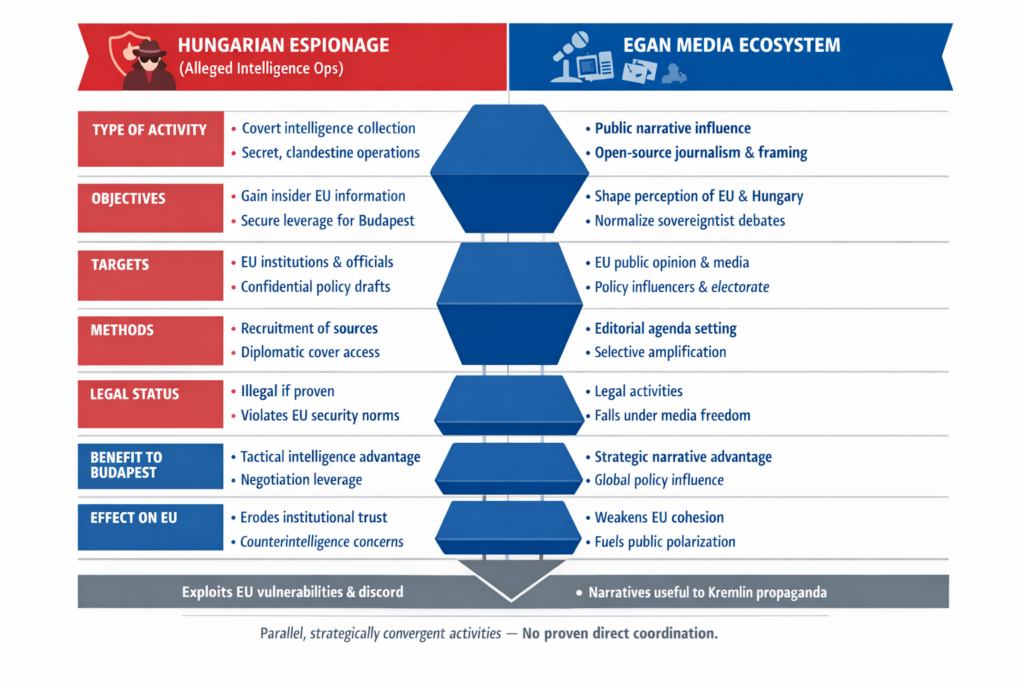
Patrick Egan’s media ecosystem — including Remix News, Transylvania Now, and Brussels Signal — operates in a different domain: public narratives and influence, not traditional intelligence collection. But there are functional correlations worth noting:
Common Strategic Goals
Both the alleged espionage activities and Egan-linked media serve overlapping strategic aims in relation to the EU:
Undermining EU cohesion and credibility
Egan’s outlets routinely publish content that questions the legitimacy, effectiveness, and motives of EU institutions and officials — narratives that can weaken internal trust and external respect for the EU’s unified agenda.
Providing political cover for Hungarian policy positions
By amplifying sovereigntist critiques of Brussels, these platforms help legitimateHungary’s confrontational stance within and outside the EU.
Increasing Hungary’s informational leverage
Intelligence operations aim at internal information advantage; media operations aim at external narrative advantage. Both contribute to Hungary’s ability to shape perceptions about the EU to its benefit.
These parallels do not imply coordination, but they demonstrate convergent tactics in political and information spaces.
Differences Between Espionage and Media Influence
It is important not to conflate two very different phenomena:
| Activity | Nature | Tools | Targets |
| Espionage (alleged) | Covert intelligence gathering | Diplomatic cover, recruitment, classified data | EU internal processes, confidential files |
| Media operations | Public narrative shaping | Journalism, commentary, storytelling | EU publics, policymakers, global audiences |
Egan’s media operations do not — based on any public evidence — participate in covert intelligence collection or recruitment. Their effect is softer, structural, and reputational, whereas espionage allegations involve classified and possibly clandestine state actions. These are adjacent but distinct domains.
Ideological Convergence and Kremlin Narratives
One reason analysts have linked these phenomena in discussion is similarity with narratives exploited by external powers like Russia:
- Media narratives from Egan’s outlets — e.g., that the EU is hypocritical, weak, or in internal conflict — are frequently echoed and amplified by Russian information channels.
Russian intelligence and propaganda ecosystems explicitly use Western sources that undermine EU unity to support their own geopolitical goals. While there is no evidence that Egan’s outlets are controlled by foreign intelligence, their content is functionally reusable by hostile actors. This mirrors how disinformation theorists describe “amplification networks.”
Hungary’s espionage efforts, by contrast, are aimed at internal EU political advantage, though Russian media also amplify these stories to feed narratives of EU dysfunction. The result is a narrative resonant with Russian interests, even in the absence of direct Kremlin involvement.
Correlation, Not Causation: Key Distinction
There is no evidence in credible reporting that:
Egan coordinates with Hungarian intelligence agencies. His media operations are part of or directed by espionage networks. He has access to or is influenced by classified Hungarian operational intelligence.
What is observable is contextual correlation:
Hungary’s political leadership under Prime Minister Viktor Orbán has been confrontational toward the EU on rule-of-law, sanctions, and institutional authority — in both overt political discourse and in alleged clandestine information gathering.
Egan’s media outlets often amplify narratives that align with Budapest’s political messaging and sometimes with broader skepticism toward EU integration and policies.
This creates an information ecosystem in which media narratives can buttress political positions that Hungarian authorities may also seek to advance through intelligence or diplomatic channels.In short, the *strategic objectives of Egan’s media work and the targets of Hungarian espionage overlap in their focus on EU decision-making, cohesion, and legitimacy — but their methods remain fundamentally different.
Implications for EU Counterintelligence and Narrative Resilience
The allegations of espionage and the proliferation of external influence narratives like those from Egan’s outlets highlight two pressures on EU institutions:
Internal trust erosion when a member state’s intelligence is suspected of targeting EU bodies.
External reputational challenges when media narratives contribute to questioning the legitimacy or competence of EU governance across multiple contexts.
This dual challenge — intelligence pressure and narrative pressure — complicates the EU’s capacity to respond cohesively, illustrating that soft power and hard power can interact in ways that are synergistic for actors seeking to exploit divisions.Patrick Egan’s media activities are part of a broader Hungarian political information strategy that challenges and critiques EU authority — but there is no evidence that his media outlets are part of Hungary’s intelligence operations or that they participate in espionage. The correlation lies in shared strategic interests around framing EU policies and unity, not in evidence of operational cooperation. Meanwhile, Hungarian espionage allegations represent a distinct, legally serious security concern, now under formal EU investigation.
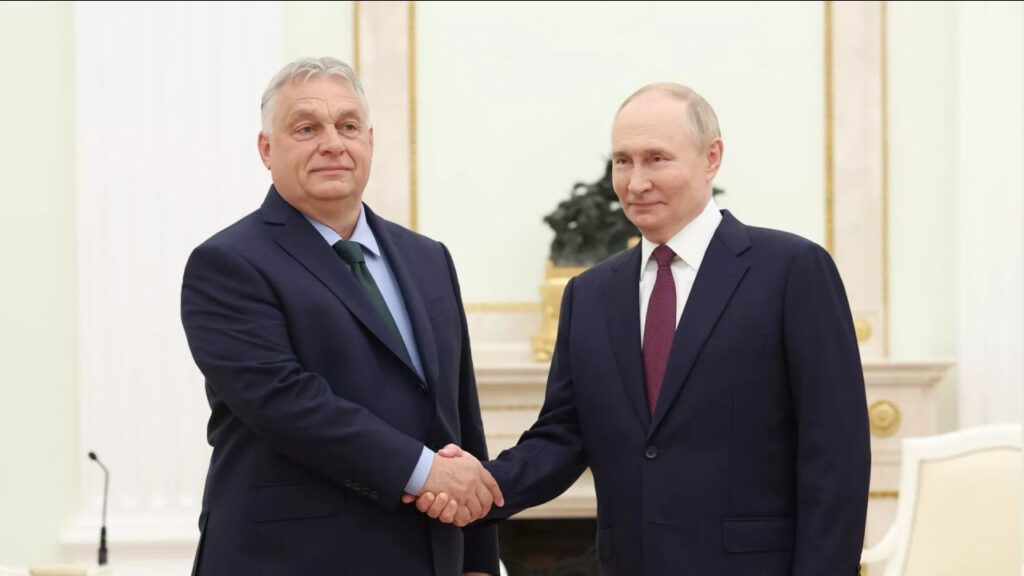
More on this story: Hungary’s Espionage Against EU Institutions:
More on this story: Hungary’s Balancing Act: Strategic Risks of Budapest’s Covert Ties with Russia
More on this story: Hungary: Trojan Horse in Russia’s Proxy War Against Europe
More on this story: The Kremlin’s Battle for Budapest: Russia’s Hybrid War to Keep Orbán in Power
More on this story: Hungary plays as China’s bat to kick the US out of the EU economy