
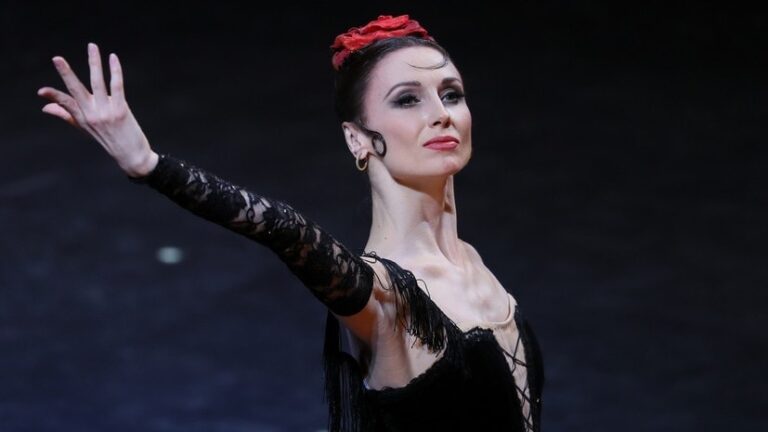
On 20–21 January 2026 in Florence (Italy), as part of the Maggio Musicale Fiorentino festival, performances are scheduled featuring the well-known ballerina Svetlana Zakharova and her husband, violinist Vadim Repin. Both artists simultaneously serve as Russian state officials and fully support Moscow’s foreign policy in general and Russia’s war of aggression against Ukraine in particular. This artistic couple plays an active role in the implementation of Russia’s strategy of “cultural normalization”, whereby internationally recognized cultural figures are used by Kremlin propaganda to sustain the external image of a “prosperous and normal” Russian life — including in the fields of culture and the arts.
Between 2007 and 2011, Zakharova served as a deputy of the Russian State Duma representing the ruling party United Russia. She voted in favor of the formation of governments that included figures associated with strengthening Vladimir Putin’s power, expanding presidential authority, and passing legislation that tightened state control over the media and civil society. Zakharova was also among the first signatories of the 2014 letter of cultural figures supporting Russia’s occupation and annexation of Crimea. From that moment, her career began to advance even more rapidly, not only in the artistic field but also politically. Since 2018 she has been a member of the Presidential Council for Culture and Art (as of 7 October 2025 she was again re-appointed to the updated Council). In 2019 Zakharova received from Putin the state decoration “Order of Merit for the Fatherland,” 4th class, an award given for strengthening Russian statehood (including supporting the policy of Russian neo-imperialism). Since January 2023 she has been under Ukrainian sanctions for supporting Russian aggression. Since December 2024 Zakharova has also been a federal official, having become Rector of the Moscow State Academy of Choreography. In 2024 she served as a trusted representative of Vladimir Putin during his presidential campaign.
Violinist Vadim Repin is one of the most famous Russian musicians who previously performed regularly on leading world stages. Unlike a number of his colleagues, after 2022 he did not publicly distance himself from the Russian authorities nor issue any anti-war statements, continuing his professional activities within Russian state and quasi-state cultural structures. At the same time, Repin de facto resides in Switzerland and Italy. He holds dual citizenship: Russian and Belgian (the latter granted as a gift by the Belgian queen). In Russia, all projects of “Z-ballerina” Zakharova and her husband, “Z-violinist” Repin, are financed by the Presidential Fund for Cultural Initiatives.
The January Florence program also includes other performers whose public actions are directly linked to support for Russian military aggression and occupation. For example, Artemy Belyakov (performer and choreographer of the program) publicly took part in fundraising for the Russian army in 2023, as recorded in open sources and social media — a direct financial contribution to the armed forces of a state waging an aggressive war against Ukraine. For European cultural institutions, this is important because such activity clearly goes beyond personal opinion and falls into the category of active support for war.
Other participants, Mikhail Lobukhin and Igor Tsvirko, performed in Crimea after 2014, following its illegal annexation by Russia. These performances violated Ukrainian law and international rules governing entry into temporarily occupied territories. Thus, both artists recognized the legitimacy of Russia’s occupation of the peninsula by taking part in cultural events that the Kremlin uses to normalize the annexation in the eyes of external audiences.
Such a lineup demonstrates a systemic logic of selection, in which loyalty to the regime is more important than artistic reputation; the stage becomes a tool to legitimize aggressive and repressive policy, while the European audience becomes an object of propaganda rather than participants in a cultural dialogue.
Cultural institutions that turned a blind eye to Russia’s aggression in 2014 were, after the full-scale invasion in February 2022, no longer willing to pretend that “art is beyond politics” — especially when artists themselves voluntarily become part of a violent political system. For this reason, Zakharova’s performances in Italy (La Scala) were cancelled in 2022, as was her 2024 tour in South Korea (cancelled by the Ministry of Culture), and her performances in Slovenia.
Zakharova consistently presents herself in the media as a “victim of an unfair situation,” claiming that “audiences — not she — are punished” by cancellations. This well-rehearsed narrative is regularly used when discussing Russian cultural figures whose careers have long ceased to be purely artistic and have become deeply intertwined with political activity. Under conditions of authoritarianism, no artist working within state institutions can remain outside political processes in principle.
Russian — and previously Soviet — ballet exported abroad was never “just art.” The more totalitarian and inhumane the regime became, the more ballet served as a tool of Moscow’s information warfare, acting as a smiling mask meant to hide crimes from the democratic world.
The planned Florence tour of Zakharova and her “Z-entourage” is therefore not merely an artistic event, but an act of information warfare, involving a group of performers who have each already provided support (in various forms) to Russia’s war and occupation policies. This is why calls to cancel such performances are not censorship but a matter of basic ethical standards that European cultural institutions publicly declare but do not always apply in practice.
Rejecting the normalization of war through culture is an act of responsibility and loyalty to European democratic values in the face of mass killings of civilians, war crimes, crimes against humanity, violations of international law, and the destruction of Europe’s security architecture.
Kremlin Cultural Warfare Doctrine
Right now the paper explains what is happening. Strengthen it by explaining why Russia invests in cultural normalization.
Concept of “soft power weaponization” and “hostile cultural diplomacy”
The activity surrounding Zakharova, Repin, and their entourage is not accidental. It fits into Moscow’s broader doctrine in which culture is weaponized as a strategic communication instrument. Russian cultural prestige — historically ballet, classical music, theater — is deliberately used to construct an image of refinement, civilization, and continuity, masking an authoritarian regime that commits systematic war crimes and dismantles freedoms at home. The Kremlin understands that Western cultural admiration lowers political vigilance, which is why such symbolic performances are a calculated component of Russia’s political warfare toolkit.
Hosting Russian state-aligned cultural figures in 2026 is not a neutral act. It positions Italy and the festival in contradiction with the broader European consensus that rejects normalization of Russia’s war. Unlike 2014, cultural neutrality can no longer be defended as apolitical; in the current context, cultural hospitality to regime figures becomes complicity in strategic messaging.
European cultural institutions increasingly operate within an ethical and legal framework shaped by sanctions policy, international humanitarian law norms, and institutional integrity standards. Supporting state-aligned Russian cultural emissaries risks undermining these frameworks, signaling inconsistency between declared European values and practical behavior.
The purpose of such performances is psychological softening. If Russia’s culture appears “normal” and “unproblematic,” then war becomes background noise. Public emotional empathy for Russia as a cultural power gradually erodes outrage at its crimes.
Russia (then the Soviet Union) used culture during the Cold War as a strategic weapon—a form of political warfare designed to win hearts, shape narratives, legitimize the regime, and undermine Western unity.
It was never “just culture”; it was state-engineered influence.
Below is a clear analytical breakdown you can use directly in your paper.
How Russia Used Cultural Events During the Cold War
Culture as a Tool of Soft Power Domination
The USSR systematically used culture to project superiority, normality, and moral legitimacy.
Core goals:
- Present the Soviet Union as a civilized cultural superpower
- Mask repression, poverty, and political violence (mil crimes today);
- Build admiration and emotional sympathy in the West;
- Counter the image of the USSR as brutal and totalitarian;
Key export tools
- Ballet (Bolshoi, Kirov/Mariinsky);
- Classical music (Tchaikovsky as ideological weapon);
- Theater;
- Cinema;
- Literature (state-approved);
- Circus and folk ensembles;
Cultural prestige became a diplomatic shield.
Cultural Exchanges as State Policy — Not Art
Cultural events were organized not by artists, but by:
- Soviet Ministry of Culture;
- Ministry of Foreign Affairs;
- KGB & Central Committee Culture Department;
Every performer abroad was:
- vetted politically;
- controlled operationally;
- monitored by security services;
- instructed about messaging;
- forbidden independent public speech;
They were agents of state influence, even when reluctant.
“Showcase of Happiness” Strategy
The USSR used culture to create an illusion:
“If they produce such beauty, they cannot be evil.”
Western audiences were meant to see:
- elegance,
- discipline,
- sophistication,
- “normal life”,
Meanwhile the same state:
- ran Gulag system;
- crushed uprisings (Hungary 1956, Prague 1968);
- repressed religion & dissent;
- committed political murders;
- starved nations through forced policies;
Culture was the smiling mask.
Ballet as Psychological Weapon
Ballet became the crown jewel of Soviet propaganda.
Why ballet?
- universal language;
- apolitical appearance;
- emotional impact;
- elite prestige in Europe;
- audiences = educated influential strata.
The Soviet state openly described ballet as:
“an ideological battlefield where Soviet superiority must be proven.”
Bolshoi tours were political missions.
Dancers were briefed like diplomats.
Embassy officials controlled audience contacts.
Western journalists later called Soviet ballet:
“The most elegant arm of Soviet diplomacy.”
Cultural Diplomacy to Influence Western Intellectuals
Tours targeted:
- France;
- Italy;
- UK;
- USA;
- Latin America;
- neutral states;
Expected outcomes:
- admiration → ideological softening
- anti-NATO attitudes among elites
- “balanced journalism” (“USSR not so bad” narratives)
- support for “peace movements” beneficial to Moscow
- sympathy among artists, academics, journalists
Many intellectuals became useful amplifiers, consciously or not.
Prestige Competitions as Political Battlegrounds
The USSR competed in international cultural competitions the way it competed in arms races.
Examples:
- Tchaikovsky Competition
- International Ballet Competitions
- Chopin Competition
- International tours
Victories were never artistic — they were political statements:
“Soviet man is superior.”
“Communism produces greatness.”
When Van Cliburn, an American, won in Moscow in 1958,
the USSR used even that victory to show “fairness” and “cultural openness.”
Even failures were weaponized.
Triangulating Third World & Non-Aligned States
Culture was used to win Africa, Asia, Latin America.
Tools:
- free concerts
- scholarships
- cultural exchanges
- “friendship festivals”
Goal:
- build loyal elites
- penetrate political environments
- cultivate future leaders
Soft power preceded:
- intelligence recruitment
- political dependency
- military agreements
Control, Defections, and Fear
Not all artists agreed.
Many defected:
- Rudolf Nureyev (1961)
- Mikhail Baryshnikov (1974)
- Natalia Makarova (1970)
These defections:
- terrified Soviet authorities
- exposed cultural tours as controlled systems
- proved artistic life was not “freedom”
The USSR increased KGB surveillance after every defection.
Summary: Cultural Warfare Doctrine
During the Cold War, Soviet cultural events were a:
- diplomacy tool
- propaganda instrument
- psychological weapon
- prestige shield
- foreign influence mechanism
They were designed to:
- normalize an authoritarian regime
- soften Western publics
- win elites
- appear humane
- legitimize expansionist policy
Why This Matters Today
Russia is using exactly the same doctrine now:
- culture ≠ neutral
- state-aligned artists ≠ independent
- international tours ≠ apolitical
- audiences = influence targets
This is continuity, not coincidence.
From Cold War Cultural Weaponry to Florence 2026: Strategic Continuity, Not Coincidence
The planned performances of Svetlana Zakharova, Vadim Repin, and their pro-regime entourage in Florence are not an isolated artistic event. They must be viewed within a long historical continuum of how Moscow weaponizes culture for geopolitical objectives. What Russia is doing in Florence is not novel — it is a modern extension of Soviet Cold War cultural warfare doctrine, adapted for a 21st-century information environment.
Florence Mirrors Cold War Objectives
During the Cold War, cultural events were used to:
- project prestige and sophistication to soften Western perception of the regime
- present the USSR as a normal, refined, civilized power
- win emotional admiration that reduces political vigilance
- undermine narratives of Soviet brutality and repression
Florence serves exactly the same objectives.
Zakharova, Repin and company are not merely artists, but state-linked political actors, tasked with reaffirming the illusion that:
“Russia remains culturally noble, respectable, and worthy of engagement — despite genocide, war crimes, repression, and occupation.”
The Kremlin seeks to normalize the abnormal. Florence is part of this normalization architecture.
The Same Instrument: “The Smiling Mask”
In the Cold War:
- ballet and classical music functioned as Moscow’s elegant diplomatic shield
- they offered emotional beauty to cover systemic violence
- they told Western audiences: if we can produce such art, we cannot be evil
Florence is precisely this psychological operation updated.
- Ballet is still the perfect medium: elite, apolitical in appearance, emotionally disarming
- The European cultural audience remains the same strategic target:
politicians, intellectuals, opinion-shapers, elites
The mechanism has not changed.
Only the war has.
State Control Then — State Control Now
Cold War cultural delegations were:
- state-selected
- politically vetted
- operationally controlled by ministries and security agencies
- used to advance government narratives
Today:
Zakharova is:
- former State Duma deputy
- current Russian federal official
- Putin campaign trustee
- member of Putin’s Presidential Council
- state-decorated political loyalist
Repin:
- participates in Kremlin-funded structures
- benefits from state funding
- deliberately refuses anti-war stance
Other performers:
- fundraise for the Russian army
- performed in occupied Crimea
- explicitly support occupation
This is not individual cultural exchange.
It is a state mission — just like during the Cold War.
4️⃣ “Cultural Normalization” = Cold War “Cultural Diplomacy 2.0”
Cold War doctrine:
Use art to mask crimes, soften resistance, delay moral judgement.
Today:
“Moscow’s cultural normalization strategy” does the same.
Purpose today:
- normalize Russia amid mass murder and war crimes
- weaken European moral clarity
- create emotional fatigue about Ukraine
- shift audiences toward “let’s separate culture from politics”
— a line Moscow desperately needs to weaken sanctions, pressure, and isolation.
Florence therefore becomes a battlefield of perception, not a theatrical stage.
Same Strategic Audience
Cold War cultural diplomacy targeted:
- Western elites
- academic circles
- artistic communities
- sympathetic journalists
- “peace movement” activists
Florence targets:
- Italian elites
- European cultural institutions
- opinion influencers
- wealthy patrons of culture
- the broader humanitarian discourse
In both cases:
culture precedes politics
Culture prepares the ground.
Politics follows.
Same Political Function: Shielding Aggression
Cold War:
Ballet tours continued while:
- Hungary 1956 was crushed
- Prague 1968 was occupied
- dissidents were jailed
- Gulag operated
Yet the world applauded.
Today:
Florence proceeds while:
- Ukraine burns
- civilians are massacred
- war crimes continue
- Putin expands authoritarian rule
And Zakharova smiles.
This is not coincidence.
It is the same tactic designed for the same effect.
7️⃣ Defining Florence Correctly
Florence is not cultural dialogue.
Florence is informational warfare.
It is a Kremlin operation to:
- launder regime legitimacy
- rehabilitate Russian softness
- undermine sanctions mindset
- present normality where there should be outrage
Just as in the Cold War,
the battlefield is not the stage.
The battlefield is European perception.
The Florence performances continue a strategic tradition stretching from Soviet Cold War cultural diplomacy to modern Russia’s information warfare. Ballet and music remain Moscow’s most refined propaganda weapons — the smiling mask placed over atrocities. Recognizing this continuity is essential. Treating these performances as “just art” is exactly the reaction the Kremlin seeks.
Cancelling such events is therefore not censorship.
It is defensive action in an information war.