
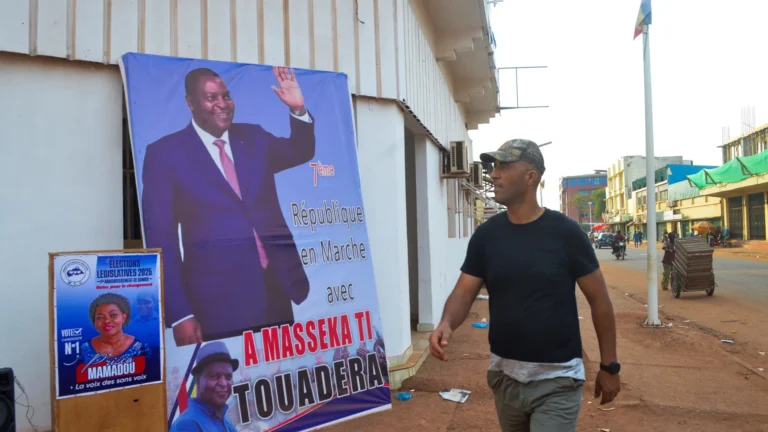
The general elections held on 28 December 2025 in the Central African Republic (CAR) have provisionally returned incumbent President Faustin-Archange Touadéra to power for a third term, with 76.15% of the vote, on a turnout of roughly 52.4%.
The unfolding 2025–26 electoral process in the Central African Republic confirms core elements of the assessment published by the Robert Lansing Institute, which warned that elections in contexts of weak institutions, ongoing insecurity, and dominant incumbents often produce formal victories that lack substantive legitimacy. The Institute’s analysis anticipated that a constitutional revision eliminating term limits, combined with a securitized political environment shaped by armed groups and foreign backers, would skew competition heavily in favor of the incumbent and marginalize opposition participation — including through boycotts or restricted campaigning conditions. This analytical framework is borne out in the provisional results and process dynamics: President Faustin-Archange Touadéra secured a commanding lead of 76.15% in a contest marked by a major opposition boycott, allegations of irregularities, and a turnout of just over 52% despite logistical and security challenges. The Robert Lansing Institute also underscored the risk that such elections reinforce authoritarian consolidation and do not resolve underlying grievances tied to insecurity and state peripheral exclusion — patterns clearly reflected in both the conduct and consequences of the CAR vote, where structural constraints and external influence have shaped the outcome more than genuine contestation
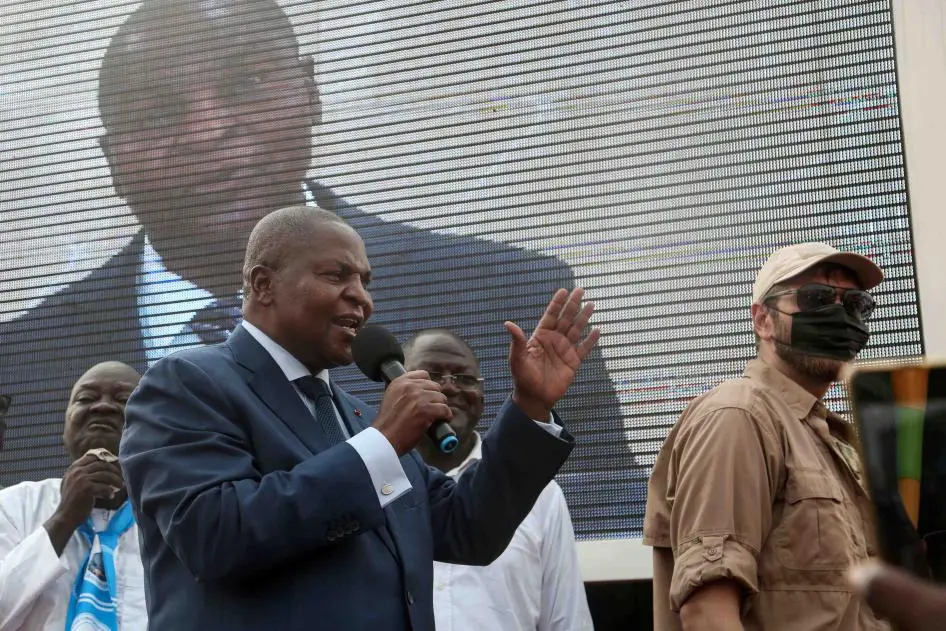
These results come two years after a controversial 2023 constitutional referendum that abolished presidential term limits and extended terms from five to seven years, enabling Touadéra to run again and potentially rule indefinitely. The main opposition coalition boycotted both the referendum and the 2025 elections, citing an uneven playing field and intimidation.
The election thus marks less a democratic renewal than the institutionalization of a hybrid, heavily securitized regime, backed by foreign military partners—most notably Russia—and embedded in a political economy centred on conflict and resource extraction.
Results and Political Landscape
Numbers and contestants
According to the National Elections Authority’s provisional results:
- Faustin-Archange Touadéra (United Hearts Movement): 76.15%
- Anicet-Georges Dologuélé (Union for Central African Renewal, former PM): 14.66%
- Henri-Marie Dondra (former PM): 3.19%
- Turnout: 52.42% of 2.4 million registered voters.
The BRDC opposition coalition largely boycotted the process, arguing that the 2023 constitutional change and the security environment made free competition impossible.
Runner-up Dologuélé and Dondra have already rejected the results, alleging fraud and legal violations (including complaints that “over half” of votes were disregarded) and have called for the election to be annulled, though so far without presenting conclusive evidence. The Constitutional Court must confirm or adjust results by 20 January 2026.
Nature of the mandate
On paper, the numbers look like a landslide. In political reality, the election reflects:
- Fragmented participation – with major opposition forces outside the race.
- Incumbent advantage and securitization – Touadéra’s regime controls much of the security apparatus and relies on foreign military allies.
- Weak institutional constraints – the 2023 referendum hollowed out term limits and strengthened the presidency.
Touadéra therefore emerges with a strong formal mandate but weak substantive legitimacy, particularly in the eyes of opposition elites and conflict-affected communities.
Consequences for Internal Politics
Regime consolidation and authoritarian drift
The third term cements CAR’s shift from fragile electoral democracy toward a personalized, security-backed presidency:
- The removal of term limits, combined with the scale of Touadéra’s reported victory, signals that alternation of power via elections is increasingly unlikely.
- Opposition leaders will draw the lesson that ballots do not change power; this historically pushes politics back into the logic of rebellion, armed patronage, or external sponsorship.
The risk is a dual delegation crisis:
- Citizens doubt that elections can represent them.
- Elites doubt that legal politics can secure their interests.
In a country whose post-independence history has been marked by coups, mutinies, and armed rebellions, that is structurally dangerous.
3.2 Peace process fatigue and armed group calculations
Since the 2013 crisis, CAR’s security landscape has been shaped by:
- The Seleka coalition (largely Muslim, northern-origin)
- Anti-balaka militias (mostly Christian/animist)
- Various splinter groups with ethnic, local or economic agendas. A 2019 peace accord brought some groups into the political process, but several have since withdrawn or fragmented.
Touadéra’s re-election under contested circumstances may lead armed actors to conclude that:
- The regime is not going anywhere, and
- The only way to rebalance power or extract concessions is via coercion, territorial control or threatening the capital.
This raises the risk of:
- Renewed spoiler violence in peripheral areas.
- Political entrepreneurs re-mobilizing dormant militias or ethnic networks.
At the same time, some warlords embedded in government may stay loyal as long as their access to rents, mining sites and local authority is preserved.
Impact on Ethnic and Communal Tensions
CAR’s conflicts are often simplified as “Muslim vs Christian” or “north vs south”, but they are better described as overlapping layers of:
- Ethnic/communal identity
- Regional marginalization
- Control over trade routes and mining areas
- Religious belonging used as a political marker.
- Perceptions of exclusion
The electoral outcome risks deepening perceptions of exclusion among communities that:
- Live in zones still partially controlled by ex-Seleka groups or other armed factions.
- Have limited access to state services, voter registration, or safe polling.
Where turnout was low or polling impossible due to insecurity, communities may read the 76% result as “Bangui voting for itself”, reinforcing the narrative that:
“The capital decides, the periphery pays.”
This is particularly sensitive for:
- Muslim communities in the north and centre.
- Pastoralist groups (including Fulani/Peulh) who are frequently displaced and securitized by both government forces and militias. Risk of localized flare-ups
Election-related grievances are likely to manifest not through big national clashes, but via:
- Localized attacks on state outposts and roads.
- Inter-communal disputes over grazing lands, markets, and mining concessions.
- Retaliatory violence between militias aligned with or opposed to the regime.
Given that CAR populations are already assessed to be at “imminent risk” of atrocity crimes due to ongoing abuses by armed groups and pro-government forces, even limited electoral tensions can act as a trigger multiplier.
Relations with Foreign Actors
Foreign actors are central to understanding both the election’s conduct and its consequences. Touadéra’s victory is good news for some, bad or ambiguous for others.
Russia: from Wagner to Africa Corps
Russia has become Touadéra’s primary security patron since 2018, via arms shipments and the deployment of Wagner Group mercenaries who shored up Bangui against rebel offensives and helped secure key mining areas.
Key points:
- Wagner helped protect the 2020–21 elections and then the 2023 referendum, in exchange for mining concessions (gold, diamonds) and political access.
- After Wagner leader Yevgeny Prigozhin’s death in 2023, Moscow began pushing to replace Wagner with the state-run “Africa Corps” and demanded that CAR start paying cash rather than simply paying in resources.
- Bangui has been reluctant – both due to cost and because Wagner is seen as combat-effective and deeply embedded in local patronage networks.
Touadéra’s re-election:
- Locks in a leadership that is politically invested in Russian protection.
- Gives Moscow continued leverage over CAR’s security and mining policy.
- But also occurs amid friction: Russia is pressuring for Africa Corps, while Touadéra wants to preserve Wagner-style arrangements.
Immediately after the provisional results, Touadéra praised Putin as a “great leader” and invited him to visit CAR, signalling continuity and loyalty despite these tensions.
Strategically, Russia will likely:
- Maintain a security umbrella to keep Touadéra in place.
- Use CAR as a flagship example of Russian “stabilization” in Africa.
- Deepen control over gold, diamonds and potentially lithium and uranium. 5.2 Rwanda and regional African actors
Rwanda has consistently provided troops to defend Bangui and key corridors, working both under the UN and via bilateral security agreements.
Touadéra’s continuation:
- Ensures a status quo favourable to Kigali, which benefits from security contracts and regional influence.
- Helps maintain a Rwanda–Russia co-existence in CAR’s security architecture, even if their long-term interests may diverge.
Regional organizations (ECCAS, AU) have limited leverage; most states are concerned with containing spillover rather than reshaping CAR’s internal politics.
5.3 France and the West: marginalization and narrow options
France, the former colonial power, largely withdrew militarily after being politically sidelined by Bangui and out-competed by Russia.
For Western actors (EU, US):
- Touadéra’s re-election confirms that CAR is firmly in Russia’s camp on security.
- Yet he has expressed openness to Western investment in strategic minerals, especially lithium and uranium—likely as a way to diversify economic partners without changing security patronage.
Policy options for Western states are constrained:
- Hard pressure (sanctions, isolation) risks pushing Bangui further into Russia’s orbit.
- Engagement without leverage risks legitimizing a semi-authoritarian partner and entrenching extractive, militarized governance.
5.4 The UN and MINUSCA: shrinking footprint, rising risk
The UN peacekeeping mission MINUSCA has been a central actor in protecting civilians and supporting elections, but is now facing funding shortfalls and mandate fatigue.
As MINUSCA scales back:
- Local communities lose a relatively neutral security provider.
- State and Russian-backed forces gain more room, which may increase abuses and unaccountable violence.
Touadéra’s victory thus comes at a moment when international oversight is weakening, and the balance tilts further toward illiberal peacebuilding—order provided by coercive force, not rule of law.
Scenario Outlook
Scenario 1: Managed authoritarian stability (baseline)
Touadéra consolidates his third term, Russia (via Wagner/Africa Corps) and Rwanda continue to secure the regime, and armed groups remain fragmented. Violence persists at low to medium intensity, primarily in the provinces. Elections become a ritual of confirmation, not competition.
Risks:
- Chronic human rights abuses.
- Slow-burning ethnic and regional resentment.
- Entrenchment of a resource-rent, patronage-based state.
Scenario 2: Renewed insurgency and ethnic flare-ups
If opposition elites and marginalized communities see no political horizon and if key warlords feel under-rewarded or threatened, parts of the armed landscape could re-mobilize, especially in the north and east.
Triggers might include:
- Disputed final results or repressive crackdowns.
- Redistribution of mining concessions away from certain groups.
- Missteps in the transition from Wagner to Africa Corps.
This would exacerbate ethnic and sectarian narratives (Muslim vs Christian, Fulani vs sedentary farmers), with civilians again bearing the brunt.
Scenario 3: Rebalancing via external pressure
If Russia overplays its hand on payment or control, and if Western and regional actors coordinate, Touadéra might try to rebalance foreign influence, inviting more diversified partnerships.
This would require:
- Serious Western investment and security guarantees—currently unlikely.
- Internal reform steps that Touadéra has so far resisted.
At present, this scenario is low probability but remains a medium-term possibility if Moscow’s demands become politically or economically unsustainable.
Conclusion
The 2025–26 elections in the Central African Republic do not mark a democratic breakthrough but a consolidation of power by an incumbent president under a militarized, foreign-backed framework. Touadéra’s provisional landslide, made possible by the prior removal of term limits and by an uneven playing field, will deepen perceptions of exclusion and futility among opposition forces and many communities.
The consequences are threefold:
- Domestic politics
- Elections risk losing their meaning as mechanisms of change.
- Armed actors may again be tempted to seek leverage through violence.
- Ethnic and communal tensions
- Existing fault lines (north/south, Muslim/Christian, pastoralist/sedentary) could be sharpened by perceptions of political marginalization and uneven security.
- Localized violence and atrocity risks remain high.
- Foreign relations
- Russia’s grip tightens, with Wagner/Africa Corps at the core of regime security and access to minerals.
- Western leverage shrinks, even as they remain rhetorically committed to human rights and democracy.
- UN presence is declining, reducing neutral protection at a volatile moment.
In sum, the election result stabilizes who rules in Bangui, but not how the country is governed. It secures the presidency; it does not secure peace.