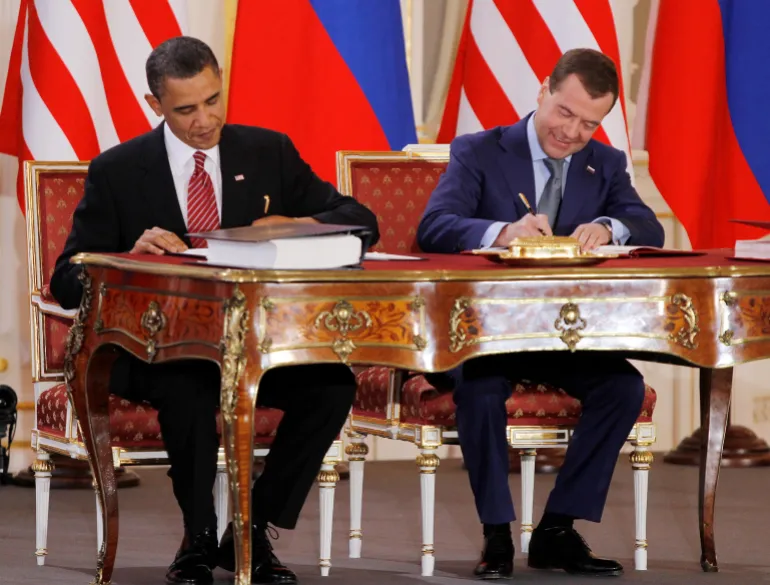

Russia’s actions are generating a critical situation of strategic asymmetry in the nuclear domain on the eve of the expiration of the New START Treaty, scheduled for 5 February 2026. Since 2023, Moscow’s suspension of mutual inspection mechanisms has deprived Washington of the ability to verify compliance with the ceiling of 1,550 deployed warheads, turning continued U.S. adherence to the treaty into a source of unilateral strategic risk.
The Kremlin’s proposal of September 2025 to formally preserve quantitative limits for an additional 12 months without restoring inspections indicates an intent to lock in a state of American self-restraint while Russia expands its capabilities outside any effective verification regime. This destruction of transparency forces the United States to base strategic planning on pessimistic assumptions, thereby increasing the likelihood of miscalculation in crisis situations.
At the same time, the rapid expansion of China’s nuclear arsenal—from approximately 600 warheads in 2024 to more than 1,000 by 2030—creates a strategic environment in which constrained U.S. responses, combined with uncertainty about Russian capabilities, significantly weaken Washington’s leverage over Beijing in arms-control diplomacy.
After 2022, the arms-control domain has been fundamentally devalued amid systemic sanctions pressure and political confrontation between the West and Russia. Any agreement with Moscow is now assessed primarily through the lens of domestic political risk in the United States and allied countries. As a result, New START has shifted from being perceived as a technical instrument of stability to a test of the reputational credibility of the parties involved.
Simultaneously, the global security environment has transformed. Washington has moved toward a strategy of simultaneous deterrence of two nuclear powers—Russia and China. Beijing, for its part, consistently rejects participation in trilateral formats, citing the asymmetry of nuclear forces. In this context, any U.S. decision regarding limitations with Russia functions as a strategic signal to China and a key variable in allied security calculations.
Thus, the nuclear problem has become part of a broader dilemma: how to preserve escalation predictability without creating a precedent whereby aggressive rule-breaking produces no strategic consequences for the violator.
The transformation of arms control from a stabilizing mechanism into a tool for managing an opponent’s costs creates conditions of systemic exhaustion for the United States. The absence of effective verification compels the Pentagon to plan against worst-case assessments of Russian nuclear forces, as reliable data are unavailable. This drives investment in additional delivery systems, modernization of the nuclear triad, and expansion of infrastructure—even in the absence of confirmed numerical breakthroughs by Russia.
In this configuration, the Kremlin gains an advantage not through actual arsenal growth, but by forcing Washington into the most resource-intensive deterrence model. The erosion of transparency undermines the core principle of nuclear deterrence—predictability of behavior. When inspection data are replaced by analytical estimates, subjective assumptions and political interpretations inevitably increase in weight.
This poses a particular danger in crisis scenarios, where decisions are made under severe time constraints and incomplete information. For the United States, this means a critical increase in the probability of false signals and erroneous reactions, even without an intentional escalation logic on Moscow’s part.
Russia has integrated the nuclear domain into its broader confrontation strategy, treating arms-control agreements as instruments of political bargaining rather than technical safeguards. Maintaining formal limits without verification allows Moscow to project the image of a “responsible actor” while avoiding real constraints. For the United States, this creates a strategic asymmetry: any symmetrical response is portrayed as undermining arms control, while restraint is interpreted as acceptance of rules imposed by the Kremlin.
The erosion of bilateral arms control has a direct multiplier effect on the global non-proliferation regime. The example of ignoring verification mechanisms without tangible political consequences discourages self-restraint by other nuclear states and strengthens arguments in favor of autonomous arsenal expansion. In such an environment, the U.S. role as a guarantor of international order weakens, as rules lose their universality and binding character.
The ultimate destructive objective of Russia’s strategy is to narrow the horizon of American strategic thinking. Instead of building a long-term stability architecture, the United States is forced into reactive planning under persistent uncertainty. This degrades forecasting quality and diverts intellectual and financial resources away from systemic solutions. As a result, arms control is transformed from a risk-reduction instrument into a factor of chronic instability—precisely the outcome Moscow seeks.
What Russia Is Actually Achieving (Strategic Logic)
Russia’s objective is not numerical breakout, but decision-making distortion. By collapsing verification while keeping nominal limits, Moscow:
- maximizes U.S. uncertainty,
- forces worst-case planning,
- externalizes costs onto the U.S. defense budget,
- and preserves escalation ambiguity as leverage.
This is asymmetric coercion through opacity, not arms racing.
Why This Is More Dangerous Than Open Treaty Collapse
Paradoxically, a formally dead treaty would be less destabilizing than a hollow one. A non-verified New START:
- preserves legal ambiguity,
- constrains only the compliant party,
- and normalizes strategic bad faith.
Opacity combined with nominal legality is more destabilizing than transparency combined with rivalry.
The China Factor: The Silent Beneficiary
China gains indirectly from this asymmetry:
- U.S. planning bandwidth is stretched across two nuclear peers.
- Washington loses leverage to argue for Chinese restraint.
- Beijing’s refusal to join arms-control talks becomes structurally justified.
Russia is thus not only degrading U.S.–Russia stability, but also rebalancing the trilateral nuclear order in China’s favor.
Strategic Implication for U.S. Policy
The central U.S. dilemma is no longer “extend or not extend” New START, but:
How to restore predictability without rewarding opacity.
Any future framework that:
- preserves limits without verification,
- accepts inspection asymmetry,
- or decouples transparency from compliance
will institutionalize strategic vulnerability.
Russia is not dismantling arms control accidentally—it is reengineering it into a weapon. By destroying transparency while preserving formal ceilings, Moscow converts predictability into uncertainty, restraint into liability, and compliance into exhaustion. This is not arms control erosion—it is strategic coercion by design.
Scenario Matrix (2026–2030): Post–New START Strategic Trajectories
Key Drivers (2026–2030)
- Verification: restoration vs continued suspension; Russian posture: restraint, opacity, or breakout; U.S. response: disciplined hedging vs accelerated expansion
- China factor: pace of buildup + refusal/acceptance of arms talks; Crisis environment: frequency of coercive nuclear signaling incidents.
Scenario 1 — Managed Opacity / “Frozen Limits” (Baseline)
Probability: Medium–High
Core idea: The treaty expires; no new binding framework emerges. Russia preserves nominal restraint while keeping verification blocked, maintaining strategic ambiguity. The U.S. hedges but avoids maximum expansion.
2026–2030 trajectory
- 2026–27: U.S. shifts to conservative worst-case planning; modest force posture adjustments; increased ISR and national technical means reliance.
- 2027–28: Russia continues coercive signaling, but no clear breakout; ambiguity becomes the tool.
- 2028–30: China’s buildup accelerates and becomes the dominant driver of U.S. modernization urgency; Russia benefits from U.S. resource dilution.
Triggers
- No inspection restoration + no replacement treaty
- Repeated Russian “responsible actor” messaging paired with opacity
- Limited crisis events that don’t force hard escalation
Consequences
- Predictability declines; miscalculation risk rises
- Arms control becomes symbolic, not stabilizing
- U.S. deterrence costs rise steadily, not explosively
- China gains leverage by staying outside constraints
Scenario 2 — Russian Breakout / Quantitative Expansion
Probability: Medium
Core idea: Russia uses the post–New START space to expand deployed warheads and/or delivery systems, calculating that the U.S. will hesitate to respond symmetrically due to alliance politics and arms-control optics.
2026–2030 trajectory
- 2026–27: Signs emerge: unusual production tempo, deployment anomalies, doctrinal escalation.
- 2027–28: Russia formally abandons restraint and accelerates deployments; strategic messaging emphasizes inevitability and “Western hostility.”
- 2028–30: U.S. responds with accelerated modernization and new deployments; China continues parallel expansion → de facto tri-polar arms race.
Triggers
- Major conventional setback for Russia or elite instability
- Kremlin decision to force U.S. into budgetary exhaustion
- Collapse of remaining confidence-building measures
- A major crisis incident (Baltics/Black Sea) prompting nuclear posturing
Consequences
- Rapid erosion of strategic stability
- Higher probability of nuclear coercion in conventional crises
- Allied anxiety (especially Europe) spikes; demand for U.S. guarantees grows
- Nonproliferation regime weakens sharply
Scenario 3 — U.S. Maximal Hedging / Cost-Imposition Spiral
Probability: Medium
Core idea: Even without confirmed Russian breakout, Washington chooses a maximal hedging posture (new delivery systems, expanded infrastructure, upload potential), treating opacity itself as a strategic attack.
2026–2030 trajectory
- 2026–27: Major budget allocations toward surge capacity (warhead upload, production, basing resilience).
- 2027–28: Doctrinal shift: emphasis on “deterrence through resilience and redundancy.”
- 2028–30: Russia and China both interpret U.S. moves as expansion → reciprocal steps → arms race by interaction, not intent.
Triggers
- Persistent uncertainty + domestic pressure to “stop unilateral restraint”
- Any intelligence suggesting Russian “latent breakout capacity”
- Congressional push for visible strength after treaty expiry
Consequences
- Costs rise dramatically; opportunity costs for conventional readiness and Indo-Pacific posture
- Higher allied reassurance but increased escalation anxiety
- Arms control narrative collapses into pure force competition
- Russia achieves its goal of narrowing U.S. strategic horizon through cost imposition
Scenario 4 — Partial Stabilization / Verification-lite Framework
Probability: Low–Medium
Core idea: A limited arrangement emerges: data exchanges, notifications, or narrow inspections—less than New START but enough to reduce worst-case planning. It may be bilateral U.S.–Russia, or parallel track with confidence measures.
2026–2030 trajectory
- 2026–27: Backchannel talks; narrow confidence-building steps (notifications, telemetry-like exchanges).
- 2027–28: A “verification-lite” regime forms without deep intrusiveness.
- 2028–30: Stabilization reduces crisis miscalculation; China remains outside but faces stronger diplomatic pressure.
Triggers
- Russia seeks sanctions relief or wants to reduce escalation risk
- U.S. ties limited transparency to bounded incentives
- High-risk crisis convinces both sides to restore guardrails
Consequences
- Reduced risk of accidental escalation
- U.S. planning becomes less worst-case; cost pressure eases
- But political vulnerability: critics call it appeasement if Russia remains aggressive in Ukraine/Europe
- China may exploit the gap unless pressure is coordinated
Scenario 5 — Crisis-Driven Shock / Near-Miss Escalation
Probability: Low but high impact
Core idea: A major crisis (Europe, Arctic, Black Sea, cyber/space incident) occurs under opacity and poor signaling conditions. Even without intentional escalation, misinterpretation drives dangerous moves.
2026–2030 trajectory
- Any year: A near-miss triggers emergency hotlines, rapid force posture shifts, and public nuclear signaling.
- Aftershock: Either a return to limited transparency (Scenario 4) or a hard arms race (Scenario 2/3), depending on domestic politics and crisis outcome.
Triggers
- Escalatory incident + lack of verified force posture knowledge
- Simultaneous crises involving China
- False alarms or misread readiness signals
Consequences
- Dramatic increase in deterrence instability perception
- Accelerated militarization of nuclear decision-making
- Higher appetite for “hard guardrails” — or for “total force competition”
Cross-Scenario Summary (One-Box Insert)
- Most likely world (2026–2030): Managed Opacity (Scenario 1) with creeping cost and risk, while China expands.
- Most dangerous world: Crisis-driven shock (Scenario 5) or Russian breakout (Scenario 2).
- Most resource-draining world: U.S. maximal hedging spiral (Scenario 3)—Russia gains by forcing U.S. into the most expensive model.
- Most stabilizing but politically fragile: Verification-lite framework (Scenario 4).
U.S. Policy Options After New START Expiry (Post–5 Feb 2026)
Strategic Goals (baseline for all options)
- Preserve crisis stability (reduce miscalculation under opacity)
- Avoid unilateral disadvantage (do not self-restrain without verification)
- Maintain alliance confidence (Europe and Indo-Pacific)
- Avoid a resource trap (deny Russia cost-imposition strategy)
- Create leverage on China (prevent Beijing from free-riding)
Option 1 — Conditional Interim Framework: “Limits Only With Verification”
Concept: Offer a narrow, time-bound arrangement (12–24 months) that preserves numerical ceilings only ifinspections/data exchange resume.
Tools
- Reintroduce inspections with modernized modalities (fewer sites, shorter notice windows, digital pre-notification)
- Resume data exchanges and notifications
- “Snapback” clause if inspections are blocked again
Advantages
- Restores predictability without rewarding opacity
- Reduces worst-case planning burden
- Improves allied confidence and crisis stability
Risks
- Moscow may demand sanctions relief or political concessions
- Domestic U.S. criticism: “rewarding bad faith”
Likely Russian response
- Tries to trade verification for geopolitical concessions; may accept limited inspections if facing budget pressure.
Likely Chinese response
- Watches for precedent; may harden refusal to join trilateral talks unless U.S. demonstrates enforcement credibility.
Option 2 — Deterrence Hedging Without Arms Racing: “Reversible Upload Strategy”
Concept: Build surge capacity (upload potential and production resilience) without immediately breaking out numerically.
Tools
- Increase warhead production and refurbishment throughput (pit production, tritium, sustainment)
- Expand “upload capability” on existing delivery systems
- Harden C2 and dispersed basing; resilience investments
- Publicly declare: U.S. will not exceed prior limits unless Russia’s breakout is confirmed
Advantages
- Denies Russia the cost-imposition win
- Keeps response reversible and politically defensible
- Preserves stability while signaling readiness
Risks
- Russia and China may portray this as expansion
- Allies may want clearer visible deterrence steps
Likely Russian response
- Keeps ambiguity; tests U.S. thresholds; may try psychological operations claiming U.S. is “breaking arms control.”
Option 3 — Secondary-Sanctions Model for Arms Control: “Penalty for Opacity”
Concept: Treat verification refusal as a hostile act with a defined cost—without making arms control contingent on goodwill.
Tools
- Designate specific Russian institutions involved in verification obstruction for sanctions escalation
- Condition any future arms-control talks on concrete transparency steps
- Expand export controls targeting strategic nuclear-industrial supply chains (machine tools, electronics)
Advantages
- Creates consequences for rule-breaking (key strategic principle)
- Prevents “responsible actor” image laundering by Moscow
Risks
- Russia may retaliate in other domains (cyber, escalation rhetoric)
- Could close remaining diplomatic channels
Likely Russian response
- Propaganda counterattack; attempts to split allies; may deepen reliance on China.
Option 4 — Allied Deterrence Integration: “NATO + Indo-Pacific Signaling Package”
Concept: After treaty expiry, stabilize perceptions by showing unity, not just U.S. capability.
Tools
- NATO: reinforce nuclear consultation (NPG), regular exercises, C2 resilience
- Increase allied missile-defense, ASW, ISR integration
- Indo-Pacific: extended deterrence dialogues with Japan, ROK, Australia; reassure against China growth
- Joint declarations: opacity by Russia increases allied cohesion, not decreases it
Advantages
- Raises the political cost of Russian coercion
- Limits Moscow’s wedge strategy
- Helps deter simultaneous Russia–China pressure
Risks
- Russia claims “encirclement,” uses it to justify expansion
- Requires intensive allied diplomacy and burden-sharing
Likely Russian response
- Attempts to fracture European consensus; increases nuclear signaling around Baltics/Black Sea.
Option 5 — Full Competitive Posture: “Numerical Expansion and New Systems”
Concept: Break out of New START-era constraints quickly (new deployed warheads, new delivery systems), matching worst-case Russian assumptions and preparing for China.
Tools
- Rapid upload and deployment increases
- Accelerate nuclear modernization timelines
- Expand warhead stockpile readiness
Advantages
- Strongest “hard signal”
- Removes any unilateral constraint
Risks
- Most expensive; high strategic opportunity cost
- Encourages arms race dynamics with both Russia and China
- Increases escalation anxiety among allies and non-nuclear states
- Damages nonproliferation credibility
Likely Russian response
- Declares U.S. responsible for collapse; accelerates own expansion
Likely Chinese response - Uses it to justify rapid buildup and refusal to negotiate.
Option 6 — New Architecture: “Plurilateral Guardrails + Crisis Management”
Concept: Accept that comprehensive treaties may be unreachable; build a network of smaller guardrails.
Tools
- Crisis hotlines, incident-at-sea agreements, deconfliction protocols
- Ban or limit the most destabilizing categories (e.g., certain non-strategic deployments, ambiguous dual-capable patterns)
- Transparency measures on exercises and readiness changes
- Engage non-nuclear allies in resilience and early warning
Advantages
- Reduces miscalculation without requiring full treaty trust
- More politically resilient than a single big deal
Risks
- Less effective than full verification
- Russia may accept “guardrails” while still expanding secretly
Recommended Course (Pragmatic Package)
A strong U.S. posture can blend deterrence and stability without falling into Russia’s cost trap:
- Option 2 (Reversible Upload Strategy) as the backbone
- Option 4 (Allied Deterrence Integration) to prevent wedge tactics
- Option 1 (Conditional Interim Framework) only if verification returns
- Add targeted elements of Option 6 for crisis stability
This combination:
- denies Russia the ability to profit from opacity,
- controls costs,
- reassures allies,
and keeps leverage for China diplomacy
.