
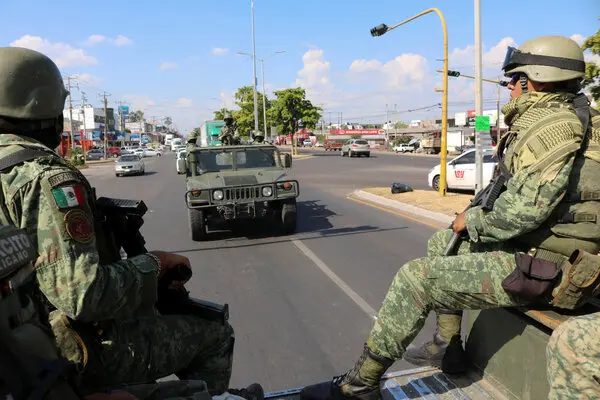
In early January 2026, President Donald Trump signaled that the U.S. would begin “hitting land” against drug cartels, asserting that cartels are “running Mexico,” and suggesting that military action could extend beyond maritime interdictions. The threats come immediately after a major U.S. operation in Venezuela, creating a perception of a widening, Monroe-Doctrine style coercive posture across Latin America.
Strategically, Trump’s posture aims to (1) restore deterrence against transnational criminal networks, (2) demonstrate “strength without war” at home, and (3) force Mexico into deeper security alignment with Washington. But operational effectiveness against cartels is uncertain, and escalation risks are high due to sovereignty sensitivities and cartel adaptation.
Why now: timing and drivers of escalation
Political sequencing after Venezuela
Trump’s threats appear designed to capitalize on momentum from the Venezuela operation and reposition the administration as decisively “back in the hemisphere” with coercive power. U.S. press accounts frame this as part of a broader posture that could include Mexico and Cuba.
A domestic narrative: fentanyl as national security
Trump’s threats align with his administration’s framing of fentanyl and cartel violence as an existential national-security issue rather than a policing matter—creating justification for military tools (ISR, raids, special operations).
“Coercive bargaining” with Mexico City
Mexico’s president Claudia Sheinbaum has repeatedly rejected foreign intervention on sovereignty grounds. Trump’s threats should be read as pressure diplomacy: force Mexico to choose between:
- deeper intelligence/security integration with the U.S., or
- the risk of unilateral U.S. action.
Reuters reporting indicates Mexico may seek tighter cooperation to avoid suffering Venezuela’s fate—precisely the coercive effect Washington likely wants.
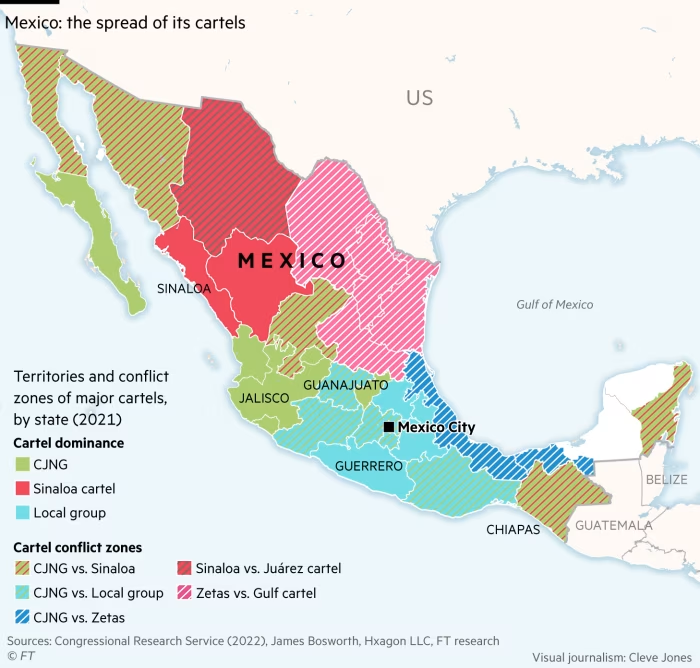
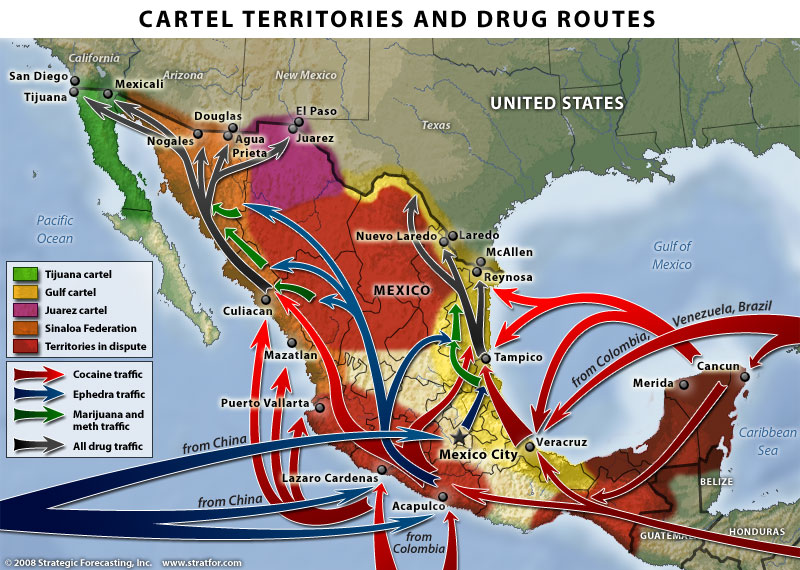
Effectiveness: would land strikes/ground operations break cartel power?
Tactical success is plausible; strategic success is not assured
A U.S. strike/raid model could produce visible tactical wins:
- elimination/capture of select leaders; destruction of labs, caches, logistical hubs
- disruption of specific corridors But the strategic history of cartel wars suggests limited durability. Cartels behave like adaptive networks:
- leadership decapitation often fragments groups into more violent splinters
- disruption shifts flows rather than ends them (“balloon effect”)
- corruption and local governance capture regenerate capacity
Cartel “military vulnerability” is not the same as cartel “political defeat”
Even significant operational pressure rarely dismantles cartels unless paired with:
- sustained Mexican state consolidation (police reform, anti-corruption, judiciary capacity)
- financial warfare against cartel banking/asset systems
- persistent border/ports controls on precursors and weapons
In other words, kinetic action can reduce capacity, but it does not solve the institutional conditions enabling cartel power.
Mexico’s internal security trend complicates the justification
AP reports Mexico claims a sharp homicide decline, though analysts caution the data and note cartel consolidation could also reduce visible violence. If Mexico successfully argues “security is improving,” Trump’s unilateral strikes look less like assistance and more like sovereignty violation—which weakens legitimacy.
The four core risks for the U.S.
Risk 1 — Sovereignty backlash and bilateral rupture
Mexico has clearly signaled “coordination but not subordination.”
Unilateral operations risk:
- collapse of security cooperation
- downgrading intelligence sharing
- retaliation through migration and trade pressure
- long-term anti-American mobilization in Mexico
Reuters notes Mexico will likely increase cooperation behind the scenes precisely to avoid U.S. unilateral action—meaning Trump may be deliberately escalating for leverage. But coercion can misfire: Mexico may harden instead.
Risk 2 — Cartel retaliation on U.S. soil
Cartels have asymmetric options:
- attacks on U.S. personnel near border
intimidation of U.S. consular targets
disruption of commercial routes
escalation of migrant-smuggling weaponization
If cartels interpret strikes as existential, they could internationalize violence.
Risk 3 — Legal/constitutional and alliance blowback
Unilateral military operations in Latin America raise:
- U.S. domestic constitutional conflict (war powers debate)
- international legal criticism for violating territorial integrity
Time notes congressional pushback via war powers resolution dynamics after Venezuela. Even within Republican ranks, prolonged unilateral operations invite institutional resistance.
Risk 4 — Strategic distraction and reputational damage
Large-scale involvement in Mexico could:
- drain operational bandwidth
- create another open-ended theater
- distract from Russia/China priorities
- damage U.S. reputation as rule-based power—especially after Venezuela criticism
This matters because Russia, China, and anti-U.S. regimes will weaponize the narrative: “the U.S. is an interventionist empire.”
Likely international reaction
Latin America
The hemisphere reaction is likely to be sharply negative, especially from left-leaning governments and regional blocs, framing U.S. actions as violation of sovereignty. Al Jazeera describes regional alarm after Venezuela and Mexico being placed “on edge.”
Europe
Europe’s reaction will be cautious but critical—focused on:
- sovereignty norms
- escalation risks
- destabilization of migration dynamics
Russia/China/Iran bloc
They will exploit the event for:
- propaganda (“U.S. aggression”)
- diplomatic positioning in UN forums
- influence ops targeting Latin American publics
- narratives justifying their own coercive actions elsewhere
Mexico’s likely reaction
Mexico will likely pursue a two-level strategy:
Public posture: sovereignty and rejection
Sheinbaum has already rejected intervention and framed cooperation as conditional. Public resistance is politically mandatory in Mexico.
Quiet accommodation: deepen security coordination to prevent unilateral action
Reuters reports Mexican officials see intensified cooperation and a stronger domestic fight against cartels as the best way to deter U.S. intervention. AFP/Barron’s reporting similarly signals interest in closer security coordination after Trump’s threats.
Mexico’s overriding objective is to prevent a precedent of U.S. “sovereignty override.”
U.S. domestic reaction
Republican base
A strike posture is likely to be popular among:
- border-security voters
- “tough on fentanyl” constituencies
- anti-cartel public sentiment
It fits the “strong leader” image, and is politically marketable as defensive action.
Democrats / civil liberties / institutionalists
They will frame it as:
- unconstitutional or reckless
- a violation of international law
- escalation that makes Americans less safe
Security establishment
Split:
- some will welcome expanded counter-cartel authorities
- others will warn of mission creep and blowback
Ratings: how Trump’s approval could react
Short term: likely bump
Historically, presidents can receive a “rally effect” after decisive external action—especially when framed as counterterrorism/countercrime and tied to domestic safety. Trump will likely gain among:
- independents concerned about fentanyl
- conservative base
- some border-state constituencies
Medium term: depends on “cost visibility”
Approval will fall if:
- U.S. casualties occur
- cartels retaliate inside the U.S.
- trade disruption hits prices
- Mexico cooperation collapses and migration spikes
- operation becomes prolonged with unclear results
Bottom line: Trump may win the messaging phase, but operational consequences determine durability.
Trump’s threats to attack Mexico reflect a deliberate escalation strategy designed to convert cartel violence into a national security mandate and force Mexico into deeper compliance through coercive bargaining. The United States could achieve tactical disruption of cartel nodes, but strategic dismantlement is unlikely without Mexican institutional transformation and sustained financial warfare.
The policy carries four principal risks—sovereignty rupture, cartel retaliation, legal/political backlash, and strategic distraction—and would trigger strong negative reactions internationally, while producing polarized domestic response. Trump’s ratings would likely rise briefly, but the durability of political gains depends entirely on whether the operation stays limited, avoids casualties, and yields visible results without provoking blowback.
Domestic U.S. supporters of an operation
A) MAGA / Republican base (core support)
Why they support it
- It fits the “strong leader / law-and-order” narrative.
- Treats fentanyl/cartels as an invasion-like threat.
- Provides visible action without “nation-building.”
Strongest support segments
- Border-state conservatives
- Voters prioritizing immigration + crime
- Voters receptive to “cartels running Mexico” framing
B) Republican national security hawks
These are not necessarily pro-Trump ideologues, but they support:
- maximal enforcement of U.S. sovereignty
- transnational threat suppression
- kinetic approaches (especially SOF raids)
They will back it if framed as counter-terror style targeting, especially after cartel “terrorist designation” logic.
C) Some border-state Democrats and moderates
Support is conditional and practical, not ideological.
They might support it if:
- operation is limited (raids/ISR, not occupation)
- there’s measurable fentanyl disruption
- it’s coordinated with Mexico (or plausibly presented as such)
Their logic: fentanyl deaths + border insecurity are politically lethal.
D) Law enforcement and parts of the security bureaucracy
Many in:
- DEA / DHS / CBP
- parts of DoD/SOUTHCOM coordination cells
…will support expanded ISR, targeting support, maritime interdictions, and selective raids.
But: Pentagon institutionalists will resist open-ended cross-border operations because of escalation + mission creep risk.
E) Victim-driven advocacy blocs
Families affected by fentanyl and cartel violence can become a strong moral constituency supporting action.
This is politically powerful because it frames military pressure as:
“defending Americans” rather than foreign intervention.
Domestic U.S. opponents (who will fight it)
This matters because their resistance shapes political costs.
A) Democratic leadership + human rights bloc
They will frame unilateral strikes as:
- illegal
- destabilizing
- imperial
- likely to increase violence
B) Congressional institutionalists (War Powers)
After Venezuela, there is heightened sensitivity about:
- executive overreach
- legality of cross-border force
(You already saw this dynamic emerging.)
C) Business / trade stakeholders
Major sectors will worry about:
- supply chain disruption
- border commerce interruption
- investment risk
This group becomes loud if markets react negatively.
International supporters
A) Some U.S. regional security partners (quiet alignment)
Certain states in Central America and parts of the Caribbean might quietly welcome cartel pressure because cartels undermine their own sovereignty.
But most will avoid public support due to fear of:
- setting a precedent of U.S. intervention
B) Hardline anti-cartel, anti-fentanyl coalition states
Some governments may support parts of the operation if it strengthens:
- intelligence cooperation
- trafficking suppression
- financial targeting
But again: mostly quiet, not public endorsement.
C) Potential European “functional support”
Europe is unlikely to praise U.S. strikes.
But security institutions in some NATO states may support:
- counter-narcotics enforcement,
- maritime interdictions,
- sanctions against cartel finance
while publicly emphasizing sovereignty/legal norms.
International opponents (most likely the dominant camp)
A) Mexico (public rejection almost guaranteed)
Mexico’s President Sheinbaum has explicitly rejected U.S. intervention and emphasized sovereignty.
Even if Mexico cooperates behind the scenes, public support is politically impossible for Mexico City.
B) Latin America broadly
The Venezuela precedent has already alarmed the region and created “next target” fears.
Expect regional rhetoric:
- “imperialism”
- “violation of international law”
- “Monroe Doctrine revival”
This is likely to include left, center, and even some right governments, because sovereignty is a shared red line.
C) China, Russia, Iran and hostile regimes
They will oppose it aggressively because it fuels:
- anti-U.S. messaging globally
- UN confrontation narratives
- justification for their own coercive actions
This bloc will weaponize it as proof:
“America behaves like an empire.”
Who supports it in practice vs in rhetoric (important distinction)
A key analytical point:
Public supporters will be mostly domestic.
Internationally, even friendly governments will likely:
- privately cooperate on enforcement
- publicly stress sovereignty and restraint
Because open endorsement = political suicide in Latin America.
This means Trump’s strategy will likely be:
- build domestic coalition
- use threats to force Mexico into deeper cooperation
- avoid needing international legitimacy
Domestically: Trump can count on strong support from MAGA, border-security voters, and many Republicans, with conditional support among moderates if results are visible.
Internationally: public support will be limited; Mexico and Latin America will oppose, while Russia/China/Iran exploit the event. The only “support” abroad will likely be quiet operational cooperation, not political endorsement.
More on this story: Russia’s Intelligence Infrastructure in Mexico: