
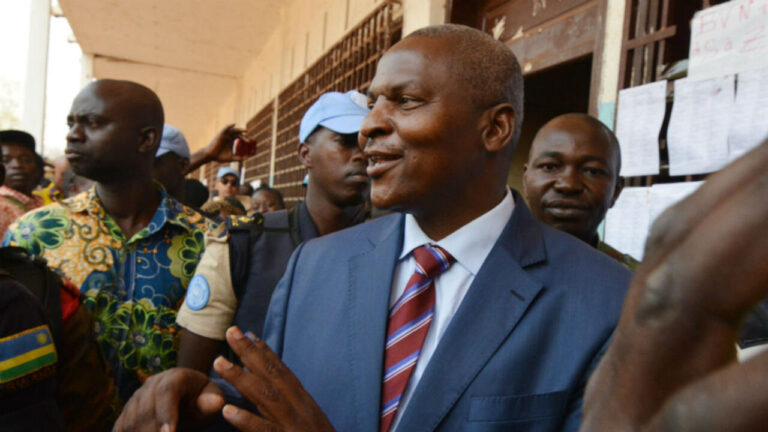
Just days after being sworn in for a third term, Central African Republic (CAR) President Faustin-Archange Touadéra is facing a destabilizing spike in violence in the country’s remote south-east, where clashes erupted between government forces and the Azandé Ani Kpi Gbè (AAKG) militia—an armed group originally formed with Russian backing that has now turned against Bangui.
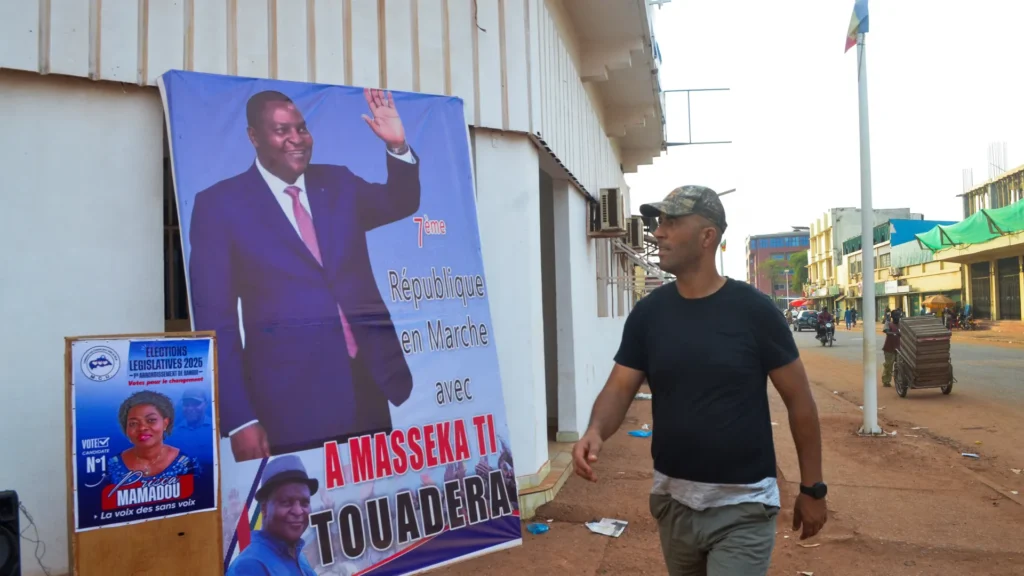
More on this story: Central African Republic Elections 2025–26: Consolidation Without Consensus
The fighting in Haut-Mbomou prefecture, particularly around Zémio and the border town of Bambouti, is not merely a localized insurgency. It reflects a deeper structural problem: the political economy of security outsourcing, in which state authority is subcontracted to foreign-backed armed proxies that later evolve into autonomous forces with their own local legitimacy, revenue incentives, and grievance narratives.
The AAKG case is especially revealing because it demonstrates a consistent pattern in Russian military influence operations: short-term tactical gains through proxy formation followed by long-term instability caused by loss of command discipline, wage failures, ethnicized violence, and “militia nationalism.” The result is a rapidly expanding threat environment that risks reopening dormant conflict corridors—from South Sudan to DR Congo—while exposing Touadéra’s post-election security architecture as brittle.
What Happened: Violence as a Post-Election Stress Test
According to the report, armed violence in Haut-Mbomou intensified after the presidential election held on 28 December, with the AAKG militia launching attacks on state-linked targets and disrupting voting in Bambouti. The assault reportedly involved backing from across the border in South Sudan, and included kidnappings of a local official, a gendarme, and an election worker—the latter later executed.
In Zémio, gunfire has been heard nearly every night since early January. Civilians have repeatedly fled to a Catholic mission that has effectively turned into a displacement camp, while others seek refuge in a hospital that was attacked and is now guarded by UN peacekeepers.
No official death toll has been published, though dozens are believed killed and thousands displaced, including large-scale flight into the Democratic Republic of Congo.
Bottom line: the violence is not episodic—it is sustained, politically timed, and strategically located along borders that enable external support and refugee flows.
Strategic Meaning: From “Self-Defense” to Rebel Movement
The most important analytic point is the transformation underway: the AAKG’s shift from a community self-defense force into an openly anti-government rebel movement.
International Crisis Group researcher Fulbert Ngodji argues the timing is deliberate—attacks on “state symbols” are meant to demonstrate power and signal that the group is escalating into direct opposition.
This creates an immediate strategic warning for Bangui:
- The AAKG now competes with the state for legitimacy in Zandé areas;
- violence is framed not as criminality but as political resistance;
- the geography (1,300+ km from Bangui) makes conventional state response weak and slow.
This is how insurgencies consolidate: not through military wins, but through symbolic defiance, territorial presence, and the construction of grievance narratives.
3. The Root Cause: Wagner-Enabled Militia Engineering and Blowback
The AAKG originated from Zandé self-defense formations that united in 2023, pushing the UPC out of Bambouti. But soon the group was accused of abuses against civilians and of treating Muslims as rebel fighters—an early indicator of how quickly “community defense” can mutate into ethnicized violence.
The decisive structural inflection came later:
- In 2024, around 200 fighters were recruited, armed, and briefly trained by Russian mercenaries (linked to Wagner), then integrated into the national army. Locally they were known as “Wagner Zandé.”
- Discipline collapsed amid complaints over unpaid wages and reckless tactics.
- The militia then turned against government troops, Russian trainers, and civilians—especially Muslims and Fulani.
- At least 200 people were reportedly killed, including soldiers, Russians, and a UN peacekeeper.
This is the classical proxy blowback cycle:
- external patron arms/trains local militia for short-term gains;
- the militia gains status, weapons, and battlefield confidence;
- pay/command issues generate resentment;
- militia reframes itself as “true protector” of the local community;
- militia becomes competitor to the state.
In CAR, the blowback is magnified by the state’s governance vacuum in Haut-Mbomou—no infrastructure, limited roads, and decades of neglect, as the bishop of Bangassou emphasized.
The Trigger: The Peace Deal With UPC and the “Betrayal Narrative”
A key turning point occurred in spring 2025 when the government signed a peace deal with the UPC rebel group. The AAKG interpreted this as betrayal.
This matters because peace agreements can destabilize regions when:
- local militias perceive they are excluded from benefits,
- former enemies are legitimized,
- “security entrepreneurs” lose leverage.
Thus, for AAKG, the peace deal was not reconciliation—it was evidence that Bangui is willing to bargain with outsiders while neglecting local sacrifices.
That betrayal narrative is now the militia’s political fuel.
Regional Dimension: Cross-Border Support and Humanitarian Spillover
The report indicates the Bambouti attack may have involved support from across the border in South Sudan. This opens two strategic risks:
External sanctuary and logistical depth
If armed groups can retreat, resupply, or recruit across borders, state counterinsurgency becomes far harder.
Spillover into DR Congo
Thousands have already fled into DR Congo. This displacement has consequences:
- militant infiltration into refugee flows;
- local resource competition;
- new armed recruitment pools.
CAR’s south-east has historically been targeted by multiple armed groups, from the Lord’s Resistance Army to Séléka factions and the UPC. The area is, in effect, a long-standing conflict corridor—now reactivated.
Implications for Touadéra: A Third Term Begins With Security Fragility
Touadéra’s third mandate begins under a paradox:
- overall security is calmer than 2016, when most of the country was under rebel control,
- yet the state remains vulnerable in remote peripheries,
- and the government is now facing what Ngodji called “the monster it created.”
This is not simply a security threat. It is a legitimacy challenge.
If Bangui responds with overwhelming force, it risks:
- deepening ethnic and religious polarization,
- expanding AAKG recruitment,
- turning the south-east into a permanent insurgent pocket.
If Bangui responds weakly, it risks:
- the spread of the rebellion across the wider south-east,
- collapse of state credibility beyond the capital.
Touadéra is therefore trapped between two destabilizing options: escalation or erosion.
The Russian Variable: Why This Matters for Moscow’s Africa Strategy
Russia’s role here is politically toxic because the AAKG was originally supported by Wagner and even trained as part of a quasi-state security architecture.
This episode highlights a structural vulnerability in Russian influence systems in Africa:
- Russia gains leverage by militarizing local actors;
- but lacks durable governance tools to manage the downstream effects;
- instability becomes both a byproduct and a mechanism of continued dependence.
Even if Moscow no longer controls AAKG, the long-term outcome still fits a familiar pattern:
Security dependence is manufactured not through stability, but through recurring crises.
CAR is a strategic hub for Russia’s broader influence network in Central Africa. The emergence of a Wagner-enabled militia now threatening Bangui undermines the claim that Russian security involvement produces state consolidation.
Forecast: Three Scenarios (2026)
Scenario 1 — Contained Insurgency (most optimistic)
Government and UN forces stabilize Zémio/Bambouti, militia splinters.
- Probability: medium
- Risk: violence persists but stays local.
Scenario 2 — Expansion Across the South-East (most likely)
AAKG gains momentum, spreads through neglected zones, triggers chain reactions among armed actors.
- Probability: high
- Risk: prolonged displacement + chronic insecurity corridor.
Scenario 3 — Regionalization and Proxy War Dynamics (worst case)
Cross-border support increases; violence internationalizes; CAR becomes another node in transnational militia competition.
- Probability: low–medium
- Risk: dramatic destabilization, humanitarian crisis, major UN strain.
The violence in Haut-Mbomou is not a short-lived flare-up; it is a strategic warning. It exposes the fragility of CAR’s peripheral governance and reveals the blowback risks of militia engineering under foreign patronage. The AAKG’s shift toward open rebellion demonstrates how quickly state-aligned armed actors can become anti-state competitors once discipline collapses and betrayal narratives take hold.
For Touadéra, this is the first crisis of the third term—and it may define it. For Russia, it is a reminder that influence built on coercive networks is inherently unstable: the same proxies used to secure power can become the agents of renewed disorder.
Wagner is not really “ideologically” on the side of anti-government forces in CAR. What is happening is a much more typical (and more dangerous) pattern of proxy blowback: a militia that Russia/Wagner helped arm and organize has partly broken away, and Wagner’s actions on the ground have become entangled in local revenge dynamics and fractured chains of command.
Here’s the clearest explanation, based on what credible reporting and research describes.
Wagner didn’t “switch sides” — it helped create a militia that later turned anti-state
The armed group at the heart of the current violence — Azandé Ani Kpi Gbè (AAKG) — emerged as a local self-defense force in CAR’s southeast and was later trained/armed with Russian involvement, producing fighters known locally as “Wagner Zandé.” International Crisis Group describes this as an ill-planned initiative that increased abuses and eventually produced clashes between militiamen and state forces.
So the key point is:
Wagner empowered a local actor for tactical reasons — then lost control of it.
This is classic proxy behavior: short-term battlefield utility, long-term instability.
The militia’s anti-government turn was driven by “betrayal + unpaid wages + autonomy”
Multiple sources identify reasons why these forces broke away:
- Unpaid salaries / broken promises after integration attempts and recruitment drives
- Local grievances (Zandé communities feeling neglected by Bangui)
- Perceived betrayal after Bangui made deals with rival armed groups (including UPC dynamics in the region)
- Economic motives: control of local routes, gold, taxation, and coercive power
International Crisis Group directly frames the episode as the state and Russians struggling to “rein in” the Zandé militia, after the initiative backfired and led to serious violence.
Wagner’s “position” is fractured: coercion, punishment, and local bargaining coexist
In these environments, Wagner forces (now linked to Russia’s Africa Corps structures) operate less like a normal army and more like a security enterprise:
- They may negotiate with certain local commanders.
- They may use force against others.
- They may temporarily tolerate an armed group if it helps secure roads/mines.
- They may fight it when it threatens Bangui’s control.
So what looks like “Wagner on the anti-government side” is often Wagner managing a messy portfolio of armed actors, not loyalty to rebels.
This also matches wider observations about Wagner’s model in Africa: blending coercive security operations, political support to incumbent leaders, and exploitation dynamics.
Information warfare: rebels benefit from claiming Wagner support — even if it’s not true
In CAR, narratives are operational tools. Armed groups often claim links to Wagner (or claim Russia has betrayed the government) to:
- terrify civilians,
- split government supporters,
- deter local rivals,
- signal strength to cross-border backers.
That means “Wagner is backing rebels” can itself be part of a strategic messaging war — a psychological weapon, not a verified alliance.
Bottom line: this is “proxy blowback,” not Russian political betrayal of Touadéra
Moscow’s strategic preference still remains supporting Touadéra because CAR is central to Russia’s regional positioning.
But Russia’s own militia-building created a “monster it can’t fully control.” That’s the deeper analytic conclusion:
Wagner’s side is the side of leverage — and leverage in CAR is produced through armed actors, not stable institutions.
Why Wagner Appears to Back Anti-Government Forces: Proxy Blowback and Fragmented Control
At first glance, the renewed violence in CAR’s south-east may look like a paradox: a Russian-linked security actor that is formally aligned with the Touadéra government appears—directly or indirectly—to be entangled with anti-government forces. This apparent contradiction has fueled speculation that Wagner has “switched sides.” In reality, what is happening is more consistent with Wagner’s operational model elsewhere in Africa: proxy blowback combined with fragmented control, where armed actors initially cultivated for tactical purposes evolve into semi-autonomous forces, and where Moscow’s instruments on the ground are forced to improvise, bargain, punish, or tolerate local militias depending on circumstances.
Wagner did not change ideology—it lost monopoly over coercion
Wagner’s core mission in CAR has been to secure the political survival of the incumbent regime and protect Russian strategic interests, including access to resources and influence networks. However, the security architecture built around that mission has relied heavily on arming, training, and politically sponsoring local actors—often under conditions where the state lacks real administrative penetration. The outcome is structurally predictable: the state becomes dependent on non-state violence, and the “auxiliaries” gradually become power centers in their own right.
In such systems, Wagner’s role becomes less that of a disciplined chain-of-command force and more that of a security broker attempting to manage a crowded space of armed entrepreneurs. When instability rises, Wagner can appear to be on “both sides”—not because of betrayal, but because the system it built produces multiple armed stakeholders with diverging incentives.
Blowback is built into the militia-engineering model
The most dangerous dynamic in CAR is that some groups now attacking state symbols were at some stage empowered—directly or indirectly—by Russian-linked structures, whether through training pipelines, arms access, or incorporation into hybrid formations. This is a classic blowback cycle:
- Phase 1: tactical empowerment (militia is armed and encouraged to fight a common enemy)
- Phase 2: political elevation (militia gains legitimacy and battlefield confidence)
- Phase 3: grievance accumulation (unpaid wages, broken promises, local abuses, rivalry with other forces)
- Phase 4: strategic defection (militia reframes itself as “protector” of the local population against the state)
- Phase 5: insurgent normalization (attacks become political signals, not criminal acts)
This is why the issue is not merely a “security incident.” It is the structural failure of governance through proxies. Once armed and legitimized, local militias rarely return fully to subordinate status. Their incentives shift toward autonomy, territorial control, and bargaining power.
Fragmented control: Wagner is not a single unified actor on the ground
Another factor behind the perception of “Wagner supporting rebels” is that Russian involvement in CAR is not always operationally uniform. Different Russian-linked units and networks can pursue overlapping but not identical goals:
- some focus on leadership protection and regime stability;
- others prioritize access routes and extraction sites;
- some may tolerate local militias to keep informal order in remote zones;
- others may confront the same militias if they threaten Bangui’s authority.
This creates mixed field signals: local communities can observe Russians interacting with certain armed actors at one moment, then fighting them later. The net effect is confusion—exactly the kind of ambiguity that armed groups can exploit in their information campaigns.
Local bargaining produces the illusion of “side-switching”
In peripheral regions far from Bangui, control is not exercised through institutions, but through negotiation and coercion. Wagner’s field logic often resembles transactional counterinsurgency:
- bargaining with one commander to isolate another,
- tolerating a group temporarily to avoid opening a new front,
- paying or rewarding cooperation,
- punishing defection through raids and targeted killings.
These actions can be misread as “support” for the anti-government side. But they are better understood as conflict management through coercive market logic—a method that prioritizes short-term stabilization of Russian interests rather than long-term state-building.
Information warfare: rebels actively weaponize the Wagner narrative
Even where Wagner has no direct link to a militia’s current operations, insurgents benefit greatly from claiming Russian association. The narrative that “Russians are behind this” serves several purposes:
- it amplifies fear among civilians,
- signals strength to potential recruits and cross-border sponsors,
- undermines trust in the government’s security guarantees,
- fragments pro-government coalitions by suggesting the regime is losing control.
In this sense, the Wagner label becomes a psychological operations tool—a brand that armed actors can use to multiply perceived power, regardless of the reality.
Analytical conclusionWagner’s apparent alignment with anti-government forces is best understood not as a deliberate political pivot, but as the predictable consequence of a governance strategy that substitutes institutions with coercive proxies. The more a regime outsources sovereignty to armed partners, the higher the probability that those armed partners will eventually challenge the regime. In CAR, Wagner helped build a security ecosystem that is now producing instability of its own. The state confronts not only rebels—but the deeper problem of armed autonomy created inside the pro-government camp.

More on this story: Russian mercenaries have a hand in war crimes in CAR