

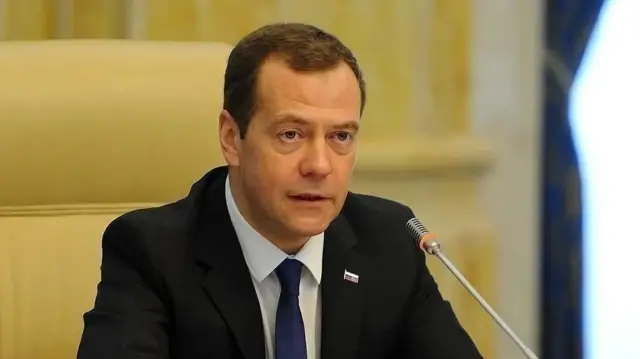
Dmitry Medvedev’s statements should be viewed as an instrument of information pressure designed to destabilize the U.S. position by imposing a toxic Greenland-related agenda on Washington. Russia is reframing the discourse surrounding America’s Arctic presence—shifting it away from security considerations into the realm of political scandal. This amplifies domestic polarization in the United States and places the administration before a dilemma: a tough response will be interpreted as escalation, while a soft response will be perceived as weakness.
In parallel, Moscow seeks to provoke disputes between the United States and its NATO allies (particularly Denmark), undermining trust in a region where critical U.S. capabilities for monitoring and controlling the North Atlantic are concentrated. Even without formal territorial claims, Russia achieves the strategic effect of managed uncertainty: it increases the political price of the American presence, tests Washington’s reaction patterns, and casts doubt on the legitimacy of U.S. decisions in the eyes of partners and local actors.
The modern Arctic is increasingly becoming a zone where strategic advantage is determined not by political declarations but by physical control over key nodes: sea approaches to the GIUK Gap (Greenland–Iceland–United Kingdom), logistical routes across the North Atlantic, and the functioning of early-warning systems and space-based monitoring. In this architecture, Greenland is a critical element enabling the United States and NATO to secure the northern flank, conduct missile and air reconnaissance, and maintain resilient communications in high latitudes.
The island’s special status as a self-governing territory within the Kingdom of Denmark—with its own economic priorities—means that any external initiative must pass through the filter of local legitimacy. Under these conditions, U.S. operational capability directly depends on tripartite coordination with Copenhagen and Nuuk on infrastructure development issues. Russia’s practical interest lies in identifying vulnerabilities in this interaction.
Moscow aims to discredit Washington in the eyes of allies by portraying the United States as an impulsive actor, while simultaneously encouraging local elites to engage in political bargaining through artificially manufactured tensions. By instrumentalizing such statements, Russia systematically erodes the legitimacy of the U.S. presence, transforming Washington’s defense posture—at least in the perception of third parties—into an “expansionist policy.” This simplifies the Kremlin’s work with neutral audiences that are sensitive to narratives accusing the United States itself of violating international rules.
The Kremlin also uses official response patterns to calibrate future information operations. This enables Russia to more precisely identify pressure points in America’s political timing and to test the boundary between diplomatic deterrence and rhetorical escalation.
The core risk is that the “Greenland case” becomes a tool of internal polarization within the United States. Moscow creates conditions in which Arctic presence turns into a pretext for mutual accusations between political camps—reducing the stability and predictability of Washington’s long-term course in the eyes of its partners. Artificially heightened uncertainty also opens a window for economic penetration by third actors: due to rising political risks, local elites may seek alternative investments as a form of “balancing,” compelling the United States to strengthen counterintelligence and financial oversight in sensitive infrastructure sectors.
Finally, systematic information injections undermine allied discipline within NATO. Copenhagen and other partners are forced to spend substantial political capital disavowing fictitious threats, slowing practical decision-making and allowing Moscow to scale the illusion of Western “division” into other regions.
Strategic objective: political sabotage rather than territorial signaling
Russia’s main objective is not Greenland itself, but the erosion of legitimacy and cohesion underpinning U.S. Arctic presence. Moscow seeks to reframe American security architecture in the High North as a politically scandalous and potentially “expansionist” project. This is crucial: in the Arctic, legitimacy is a force multiplier—particularly in environments where infrastructure, access permissions, basing arrangements, and local political consent are decisive.
Medvedev’s provocations therefore function as a trigger mechanism for media amplification and political contention. Moscow benefits not from proving anything, but from forcing Washington into a situation where every reaction becomes costly:
- Strong response → can be framed as escalation and “imperial assertiveness.”
- Soft response → can be framed as weakness and strategic retreat.
- No response → enables Moscow to harden the narrative uncontested.
This is a classic Kremlin tactic: manufacturing an impossible communications dilemma and then using U.S. domestic political dynamics as the accelerant.
Reframing: shifting the Arctic discourse from security to scandal
Russia is attempting to convert U.S. Arctic presence from a security imperative into a polarizing political topic. This is particularly dangerous because the Arctic agenda is inherently technical—bases, radar coverage, undersea surveillance, satellites, air defense, sea-lane control. Moscow’s aim is to force these issues into the American political culture war ecosystem, where nuance collapses and symbolic interpretations dominate.
In this framework, Greenland becomes an ideal narrative platform because it is:
- geographically critical,
- politically sensitive,
- easy to simplify into tabloid-style controversy,
- and immediately linked to NATO allied relations (Denmark).
Thus, Moscow is not contesting the U.S. in the Arctic by deploying ships; it is contesting the U.S. by degrading the political sustainability of Washington’s posture.
Operational logic: undermining NATO trust through allied friction
A second-order objective is to provoke strains between Washington and NATO partners—especially Denmark—thus weakening the cooperative architecture needed for U.S. Arctic projection.
Greenland is not simply a piece of territory; it is a triangular governance environment involving:
- Washington (strategic interests),
- Copenhagen (sovereign authority + alliance discipline),
- Nuuk (local legitimacy + economic priorities).
This structure is strategically fragile because it depends on continuous political coordination and trust. Russia exploits this by pushing narratives designed to portray:
- the U.S. as impulsive and politically toxic,
- Denmark as weak or obstructive,
- and Greenland’s political elites as leverage points.
If Moscow succeeds in generating even temporary tension, the result is delayed infrastructure decisions, slowed modernization, and reduced agility in high-latitude operations.
Why Greenland is the keystone node in the High North
In today’s Arctic, strategic advantage is determined not by declarations but by physical control of key nodes and information corridors, including:
- approaches to the GIUK Gap (Greenland–Iceland–UK),
- North Atlantic logistics routes,
- early warning radar chains and aerospace monitoring,
- undersea surveillance and communications resilience.
Greenland is vital because it enables the U.S. and NATO to lock the northern flank, maintain ISR and early warning coverage, and secure strategic depth in the North Atlantic. The island also serves as a platform for domain awareness, which is foundational for deterrence.
Therefore, any destabilization of the political environment around Greenland produces disproportionate strategic consequences—precisely why Russia targets it.
“Managed uncertainty”: the Kremlin’s preferred Arctic weapon
Russia’s tactic here is not escalation but managed uncertainty—a method of controlling risk while maximally increasing the opponent’s political and strategic cost.
This approach produces several effects simultaneously:
- Political cost inflation — U.S. Arctic presence becomes harder to justify domestically.
- Alliance uncertainty — partners question Washington’s predictability and tone management.
- Local bargaining leverage — Greenlandic elites gain incentives to politicize negotiations.
- Narrative contamination — U.S. strategy becomes associated with opportunism rather than security.
Importantly, managed uncertainty is sustainable: it can be replayed cyclically, adjusted to political timing, and scaled without physical risk.
Calibration benefit: Medvedev’s role as a low-cost probing tool
The Kremlin uses figures like Medvedev as flexible instruments for testing response thresholds. His statements generate high visibility but low diplomatic cost because:
- he can be treated as “unofficial,”
- yet remains a recognizable representative of elite discourse,
- and his rhetoric allows rapid escalation/de-escalation without formal commitments.
The U.S. response becomes data. Russia can measure:
- the U.S. administration’s sensitivity,
- NATO partners’ coordination discipline,
- media traction and amplification patterns,
- and political polarization dynamics.
These signals help Moscow refine future information operations around Arctic logistics, basing, infrastructure investments, or sovereignty debates.
Strategic risk: internal polarization as the decisive vulnerability
The main risk is that Greenland becomes a weaponized topic inside U.S. politics. If the Arctic posture transforms into an arena for inter-party accusations, the long-term effect is not merely reputational—it threatens the stability of U.S. strategy itself.
For allies, the key question becomes: will U.S. Arctic policy remain consistent after the next election cycle?
That uncertainty is strategically valuable to Russia, because deterrence relies not only on capability but on predictable political will.
Economic penetration window: third actors as “balancing investors”
A further structural danger is that heightened uncertainty creates a window for external actors to enter Greenland’s economy and infrastructure landscape. The logic is straightforward:
- as political risk rises,
- local elites seek diversification (“balancing”),
- alternative investors gain access to strategic sectors,
- and Washington must compensate through deeper financial screening and counterintelligence controls.
This is a common Russian playbook: create an informational shockwave that makes local stakeholders “hedge,” then exploit the hedging process to weaken Western control.
9) NATO discipline erosion: exhausting partners with fictional threats
Finally, sustained narrative attacks impose a resource drain on NATO allies. Denmark and other partners must repeatedly spend political capital to deny, clarify, reassure, and manage reputational fallout.
This produces operational consequences:
- decision-making slows,
- attention shifts from capability building to reputational management,
- and Moscow gains an opportunity to export the “Western split” narrative to other theaters.
This is strategic sabotage via exhaustion: Russia does not need to win the Arctic contest militarily—it only needs to decrease Western speed and cohesion.
Strong concluding assessment
In sum, the “Greenland provocation” is best understood as an Arctic adaptation of Russia’s hybrid warfare doctrine: delegitimize, polarize, and delay. Moscow aims to make U.S. Arctic posture politically expensive, alliance-coordination fragile, and locally contested. Greenland is targeted not because Russia expects ownership or direct confrontation, but because it is a keystone node where the United States depends on legitimacy, coalition unity, and sustained policy continuity—precisely the domains Russia is most capable of undermining.
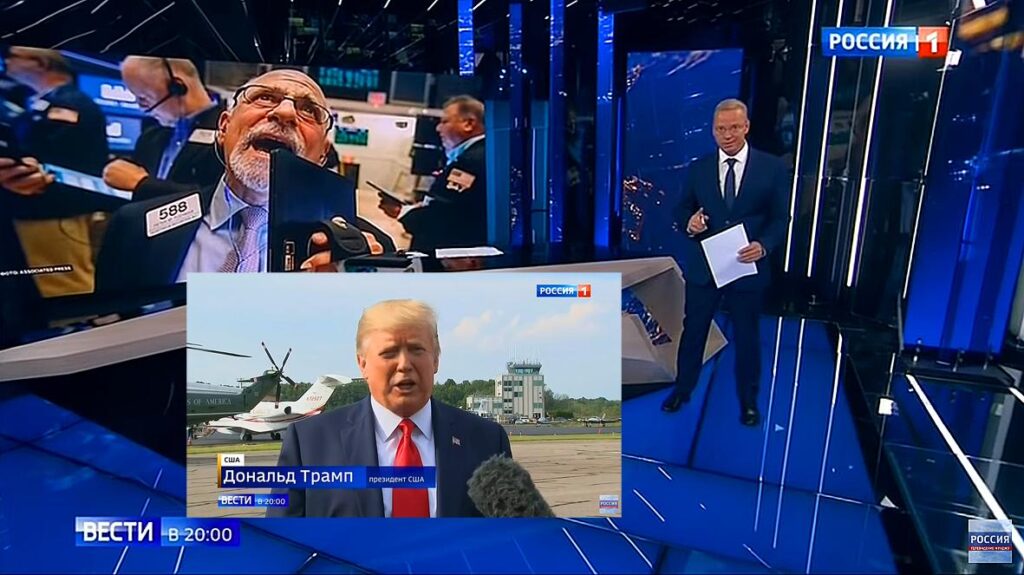
More on this story: Trump’s Greenland Proposal Fuels Russian Propaganda