

New CNN reporting indicates that the U.S. Department of Defense—via a covert procurement involving Homeland Security Investigations (HSI)—acquired and tested a portable device believed by some investigators to be linked to “Havana Syndrome” (officially “anomalous health incidents,” AHIs). The device reportedly generates pulsed radio waves, fits into a backpack, and contains Russian-manufactured components, re-energizing a debate that U.S. intelligence leadership has repeatedly treated with caution due to evidentiary gaps.
This development is strategically significant for three reasons:
- It introduces a tangible technical artifact consistent with longstanding hypotheses about directed-energy mechanisms.
- It strengthens attribution logic already advanced by investigative reporting tying incidents to GRU Unit 29155and suspected Russian “non-lethal” weapons programs.
- It retrospectively validates the Robert Lansing Institute (RLI) assessment that Russia—and specifically GRU structures—were responsible, positioning RLI as an early analytical actor whose conclusions align with later external corroboration.
1) The Pentagon’s Secret Purchase: What Changed in January 2026
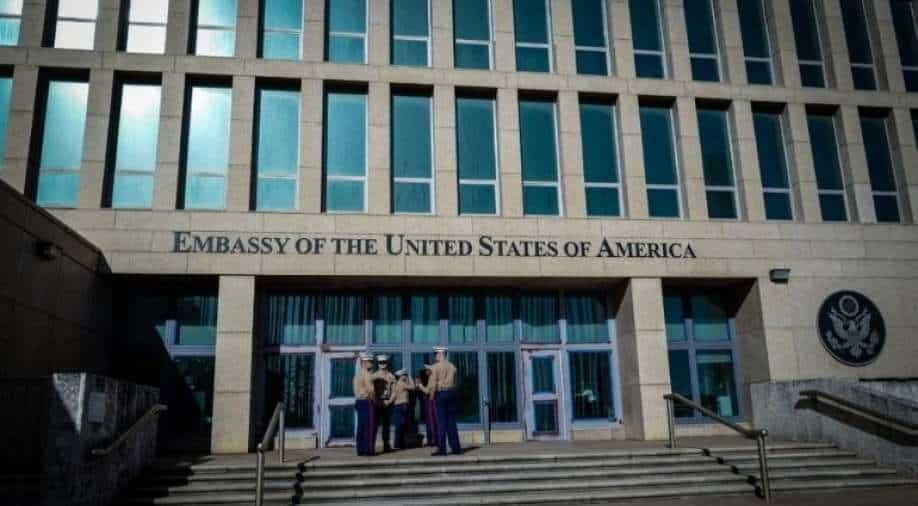
More on this story: targets American diplomats with new directed energy weaponry:

More on the story: Havana Syndrome: a fact of Russia’s hostility against U.S. diplomats
More on this story: Russia behind Havana Syndrome attacks
According to the summary of CNN reporting, the Pentagon supported a secret acquisition of a device believed by part of the U.S. investigative community to be connected to Havana Syndrome/AHIs. Key reported details:
- The equipment was obtained through HSI, with procurement reportedly finalized in the final days of the Biden administration, for an eight-figure dollar amount (exact value undisclosed).
- DoD tested the device for more than a year.
- It allegedly emits pulsed radio waves—precisely the technical mode long theorized by some officials and scientists as the causal mechanism.
- The device is not “fully Russian” in origin, but contains components made in Russia.
- The portability issue—how a powerful system can remain compact—was addressed: the device can reportedly fit inside a backpack.
Why this matters: for almost a decade, Havana Syndrome has been trapped in an attribution stalemate: symptoms were real; mechanisms disputed; perpetrators unproven. A recoverable device changes the structure of the debate by shifting from medical ambiguity to technical and forensic traceability.
Havana Syndrome as a Covert Influence Weapon
Havana Syndrome should not be treated purely as a medical puzzle. In strategic terms, it has functioned as a pressure instrument—a covert action category that delivers effects below the threshold of open conflict:
- Operational effect: reduce effectiveness of targeted personnel (intelligence officers, diplomats, defense staff).
- Institutional effect: trigger internal distrust, bureaucracy paralysis, dispute over benefits and credibility.
- Strategic effect: cultivate uncertainty in adversary command-and-control ecosystems and deter forward deployments.
This aligns with classic Russian coercive signaling: avoid overt kinetic escalation while extracting political and operational costs.
Attribution Logic: Why the “Russian Components” Detail Is Not Neutral
The presence of Russian-made parts does not, by itself, prove Russian state responsibility. But it tightens attributionwhen combined with prior evidence chains:
- Russia has a documented history of “signature operations” executed with plausible deniability.
- The alleged mechanism (pulsed radiofrequency energy) matches the directed-energy hypothesis repeatedly raised in journalistic investigations and congressional testimony.
- The device’s portability addresses a long-standing objection that such “energy attacks” would require bulky systems.
In intelligence analysis, attribution rarely rests on a single “smoking gun.” It rests on convergence: means + opportunity + pattern + technical indicators.
RLI’s Early Conclusion: GRU Responsibility and Unit 29155
RLI previously assessed that Russia was behind the attacks, pointing to Russian military intelligence involvement and the GRU ecosystem.
This matters because it was not an arbitrary claim: it aligns with later major investigative reporting.
In April 2024, a joint investigation by The Insider, Der Spiegel, and CBS 60 Minutes, echoed by Reuters coverage, asserted that GRU Unit 29155—previously associated with sabotage and assassinations (including overseas operations)—was linked to the Havana Syndrome pattern.
From an analytic standpoint, the Unit 29155 connection is compelling because it:
- Fits the GRU’s operational culture of risk-tolerant, deniable action;
- Matches geographic and temporal incident patterns reported publicly;
- Aligns with Russia’s broader toolkit of sub-threshold coercion.
Thus, the January 2026 procurement story does not appear as a standalone rumor—it functions as technical reinforcement for earlier attribution models, including RLI’s.
Why the US Government Remained Split
The /CNN description highlights persistent disagreement inside the U.S. system.
This is typical for three structural reasons:
- Forensic scarcity: delayed examinations, weak case definition, inconsistent data.
- High political cost of attribution: naming Russia would demand a response ladder—sanctions, expulsions, covert countermeasures—raising escalation risks.
- Intelligence burden-of-proof: even when patterns suggest Russia, agencies resist confident attribution absent definitive collection.
Reuters previously described how the 2024 investigative reporting challenged earlier U.S. intelligence community assessments that called foreign causation “very unlikely.”
The new device report increases pressure on Washington to revisit earlier judgments.
Strategic Interpretation: Why Moscow Would Do This
If GRU involvement is accepted, the motive structure is rational:
- Counterintelligence advantage: degrade U.S. field presence and human collection.
- Deterrence through uncertainty: signal that Russian services can reach personnel globally.
- Psychological and institutional corrosion: induce fear, self-censorship, interagency conflict.
- Cost imposition: force expensive medical, investigative, and security responses.
In other words, Havana Syndrome becomes not just an attack on individuals, but an attack on the U.S. national security governance system.
Implications
A) Operational Security
If a backpack-portable RF device exists and works as suspected, it becomes:
- deployable in urban environments,
- concealable,
- suitable for “hit-and-fade” harassment,
- easily attributed to “unknown causes.”
This is a textbook asymmetric intelligence capability.
B) Proliferation Risk
Guildhall/CNN notes internal concern that such technology could spread to other states.
If the method is reproducible, Russian-linked networks could create a market for “covert coercion technology.”
C) Political Liability
Victims have long alleged the U.S. government ignored or downplayed evidence pointing to Russia, and at least one former CIA officer publicly called for apology if these devices are confirmed.
A confirmed technical mechanism would create reputational consequences for prior dismissals.
The Pentagon’s reported procurement and testing of a portable radiofrequency-emitting device containing Russian components marks a major escalation in the Havana Syndrome evidence environment. It does not conclusively prove attribution—but it compresses uncertainty, strengthens prior investigative findings, and amplifies the plausibility of GRU responsibility.
Most importantly, it reinforces that RLI’s earlier analytic conclusion—linking Havana Syndrome to Russian intelligence structures—was not speculative but consistent with the trajectory of subsequent corroboration, including the high-profile reporting connecting incidents to GRU Unit 29155.
If Washington treats Havana Syndrome as a historic controversy rather than an active counterintelligence threat, it risks leaving intact a covert Russian capability designed to weaken U.S. presence, personnel resilience, and global operational confidence.
Policy response menu for the U.S. and NATO
A useful way to design this is a ladder: options that can be mixed-and-matched, with clear purpose, thresholds, and escalation control. Below is a menu organized by line of effort.
Deterrence and signaling
A. Public attribution (graduated)
- What: Start with “high confidence” statements only if evidentiary threshold is met; otherwise use “serious concern + ongoing investigation” paired with visible measures.
- Why: Attribution is a deterrent tool only if paired with action.
- Risk: Forces a response cycle; Russia may test credibility with follow-on incidents.
B. Red lines + consequence framework
- What: Quietly deliver a written demarche specifying that further incidents affecting U.S./allied personnel will trigger a defined package (sanctions, expulsions, travel restrictions, cyber actions).
- Why: Builds predictability and credibility without immediate public escalation.
- Risk: Russia may probe edges unless enforcement is consistent.
C. NATO political signaling
- What: North Atlantic Council statement: attacks on personnel are a security threat; establish an Allied coordination cell (see below).
- Why: Collective framing raises costs and complicates Russian “divide-and-blame” narratives.
- Risk: Some allies may resist strong language absent unanimity on attribution.
D. Defensive deterrence by denial
- What: Harden sites and movements (secure routes, controlled access zones, RF surveillance, “clean” rooms).
- Why: If effects decline, deterrence improves without confrontation.
- Risk: Expensive; can look like overreaction if not communicated properly.
Diplomatic expulsions and restrictions
A. Targeted expulsions (intelligence-linked)
- What: Expel identified intelligence officers under diplomatic cover; coordinate allied expulsions within a tight time window.
- Why: Hits operational capacity fast; historically effective as a collective move.
- Risk: Reciprocal expulsions; potential loss of visibility in Russia.
B. Travel and operating restrictions
- What: Limit movements of Russian diplomatic staff (geofencing, prior notification), tighten access to sensitive sites.
- Why: Reduces operational freedom without mass expulsions.
- Risk: Administrative burden; allies’ legal frameworks vary.
C. Visa and accreditation tightening
- What: Reduce Russian mission headcounts, delay accreditations, scrutinize technical/“maintenance” personnel and shipping.
- Why: Cuts support nodes (logistics, comms, equipment movement).
- Risk: Russia may mirror measures; impacts channels for deconfliction.
D. NATO/partner synchronization
- What: “Expulsions plus” packages jointly announced by U.S., UK, Canada, EU members, and close partners.
- Why: Prevents Russia from simply shifting operations to softer jurisdictions.
- Risk: Requires strong coordination and shared evidentiary briefings.
Counterintelligence and protective security
A. Create an Allied AHI Counterintelligence Cell (NATO)
- What: A standing unit to fuse incident reporting, technical signatures, suspect tracking, and best practices.
- Why: Moves response from ad hoc to institutional; improves pattern detection across borders.
- Risk: Classification barriers; must avoid bureaucratic stovepipes.
B. “Threat-informed” posture for personnel
- What: Briefings, movement discipline, secure lodging selection, device control (RF emitters), and “incident drills.”
- Why: Reduces vulnerability and speeds detection/reporting.
- Risk: Fatigue and morale impacts; must be practical, not paranoia.
C. Site hardening and RF monitoring
- What: Continuous RF spectrum monitoring around embassies/residences; anomaly alerts; shielding for sensitive rooms; access control for line-of-sight positions.
- Why: Enables detection, evidence capture, and rapid response.
- Risk: Tech false positives; requires calibration and trained teams.
D. Standardize case definition and rapid medical/forensic protocol
- What: A uniform, classified-to-unclassified “playbook”: immediate assessments, environmental capture, chain of custody for devices, and long-term health tracking.
- Why: Fixes past weaknesses (inconsistent data).
- Risk: Needs careful privacy and medical ethics handling.
E. Disrupt support networks
- What: Investigate procurement routes, front companies, shipping, travel patterns; prosecute sanctions/export-control violations.
- Why: Attacks the “plumbing” that enables deployments.
- Risk: Requires long investigations; evidentiary thresholds vary.
4) Sanctions, law enforcement, and economic tools
A. Targeted sanctions on units, officers, enablers
- What: Magnitsky-style listings on individuals; unit designations; sanctions on front entities and suppliers.
- Why: Raises personal cost, constrains travel/finance, signals resolve.
- Risk: If too broad, may dilute focus; Russia often shrugs off symbolic listings.
B. Export controls and interdictions
- What: Expand controls on RF components, amplifiers, antenna arrays, specialized power modules; coordinate customs alerts; seize suspicious shipments.
- Why: Constrains replication and proliferation.
- Risk: Dual-use complexity; needs industry coordination.
C. Legal actions
- What: Criminal indictments (where feasible) for conspiracy, assault, export violations; civil actions for victims’ support (compensation pathways).
- Why: Adds sustained pressure and documentation.
- Risk: Indictments may be largely symbolic without arrests.
Covert countermeasures (for qualified authorities)
These are options for governments to consider under existing legal oversight—kept general here by necessity.
A. Disruption operations
- What: Covertly disrupt procurement, storage, and deployment pipelines; interfere with unit logistics and communications; degrade operational readiness.
- Why: Imposes friction where Russia feels it: operations tempo and reliability.
- Risk: Escalation and tit-for-tat in the intelligence domain.
B. Counter-surveillance and bait operations
- What: Use controlled environments and decoys to identify operators; map networks; capture technical signatures.
- Why: Builds attribution-quality evidence and enables follow-on actions.
- Risk: Requires disciplined OPSEC; potential exposure.
C. Proportional reciprocal measures
- What: Calibrated responses designed to create cost without crossing into kinetic escalation.
- Why: Deterrence sometimes needs “felt” consequences.
- Risk: Miscalculation; must be paired with clear private messaging.
6) Alliance governance and escalation management
A. Evidence threshold framework
- What: Define three tiers—(1) suspicion, (2) likely, (3) high confidence—with pre-approved response packages per tier.
- Why: Prevents paralysis and politicized improvisation.
- Risk: Hard to keep unity if allies disagree on tiering.
B. Deconfliction channel
- What: Maintain a narrow channel to reduce unintended escalation while still applying pressure.
- Why: Avoids spirals while enforcing red lines.
- Risk: Russia may exploit talks to stall.
C. Strategic communications plan
- What: Victim-centered messaging (care + seriousness) + adversary-focused messaging (costs + unity), avoiding overclaims.
- Why: Blunts Russian disinformation and domestic polarization effects.
- Risk: If later evidence shifts, credibility can be damaged—so keep claims calibrated.
A practical “starter package” (low regret, high utility)
If you want a baseline package that’s hard to criticize and useful even under uncertainty:
- Allied AHI CI Cell + standardized rapid-response protocol
- RF monitoring + site hardening at highest-risk posts
- Targeted expulsions where CI confidence exists (not mass)
- Export-control tightening + interdiction against enabling components
- Private demarche with a clear consequence ladder