
- Most plausible motive cluster: spoiler prevention (removing a rallying figure for a “third force” / pro-Gaddafi current) + settling long-standing scores tied to 2011–2017 detention networks and post-2011 militia politics in western Libya.
- High-risk near-term effect: localized retaliation and tit-for-tat violence, especially if blame is assigned to a specific militia/tribal bloc in the Nafusa–Zintan orbit.
- Strategic effect: his death removes a symbolic “unifying” claimant for Gaddafi-era loyalists, but it can also radicalize parts of that constituency by turning him into a martyr—creating incentives for sabotage against any political roadmap.
1) What we know (baseline facts)
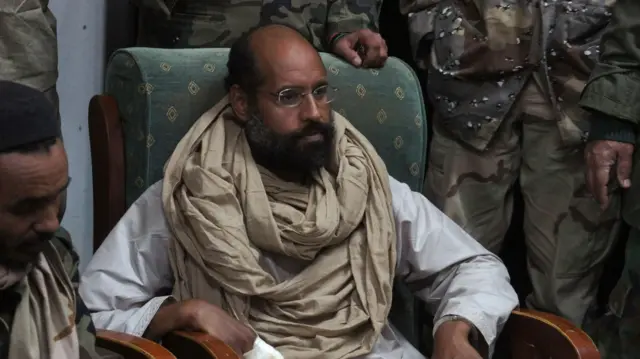
Saif al-Islam Gaddafi, 53, was killed by masked gunmen who stormed his home; accounts cite disabling CCTV and a targeted killing in Zintan (Tripolitania/Nafusa area).
No credible public claim of responsibility (as of Feb 4, 2026), and prosecutors reportedly opened an investigation.
Saif was long detained by Zintan-linked brigades after 2011 and released in 2017 under an amnesty context, remaining a potent symbol for loyalist politics.
Who could stand behind the killing (hypothesis)
Hypothesis A — Western militia networks / local rivals in the Zintan orbit
Logic: Zintan’s armed landscape is fragmented and historically central to Saif’s detention and local power bargaining. Removing him could be driven by:
- preventing a re-emergence that threatens local balances,
- eliminating a liability (international legal/political exposure),
- or settling factional disputes over protection arrangements.
What would support A: evidence of insider access; local facilitation; rapid “containment” narratives; intimidation of investigators/witnesses in Zintan.
Hypothesis B — Tripoli-aligned spoiler action (pre-empting a “third pole”)
Logic: Saif’s loyalist brand complicates Tripoli’s legitimacy ecosystem. His existence kept alive an alternative sovereignty claim—useful for mobilization, elections bargaining, or destabilization. Removing him:
- narrows the field of symbolic challengers,
- reduces a potential vote-sink/coalition magnet,
- or prevents a “nostalgia” bloc from consolidating under a single face.
What would support B: linkage to ministries/security bodies; messaging portraying the killing as “closing a chapter”; coincident political moves on elections/law.
Hypothesis C — Eastern power centers / LNA-linked interests (indirect)
Logic: Some eastern actors have historically used (or tolerated) Gaddafi-era constituencies as bargaining chips against Tripoli. But a living Saif could also:
- compete with eastern figures for nationalist legitimacy,
- fracture coalitions by attracting “order/stability” voters,
- or create succession uncertainty within loyalist tribal networks.
This hypothesis is lower confidence without signs of reach into Zintan logistics.
Hypothesis D — Jihadist/ideological actors (low–medium likelihood)
Logic: Gaddafi legacy + “icon target” logic. But the described operation (tight commando-style) can fit many actors; jihadi groups usually message claims for recruitment value.
What would support D: immediate propaganda claim; signature tactics; target list continuity.
Hypothesis E — Foreign-enabled operation (possible amplification; uncertain direction)
A foreign service could benefit from chaos, but benefit ≠ proof. With current public reporting, the most responsible analytic posture is:
- Plausible foreign encouragement/amplification after the fact,
- Unproven foreign orchestration of the assassination itself.
Who is interested in his death (winners vs. losers)
Likely “winners” (political utility)
- Actors trying to simplify the political chessboard (removing a symbolic contender who could re-enter an electoral/negotiation track).
- Militia entrepreneurs who profit from fragmentation: every national figure who could unify constituencies is bad for militia-based rent systems.
- Hardliners on both sides of the Tripoli–east divide who prefer binary confrontation to a “third camp” that could reshuffle alliances.
Likely “losers”
- Gaddafi-era loyalist constituencies (tribes and networks that saw Saif as the “civilian face” of restoration politics).
- Any UN-track scenario premised on broad inclusion: his death can become a pretext for boycotts, revenge, and delegitimization.
Consequences for inter-tribal and inter-militia relations
Near-term (weeks–3 months): retaliation risk + blame politics
- Risk of localized revenge is significant if the loyalist base (often tribal/social networks rather than a single disciplined militia) identifies perpetrators as coming from a rival tribal-militia bloc.
- Zintan’s historical militia structures (Qaaqaa/Sawaiq etc.) are politically salient; even if uninvolved, they may be accused and dragged into cycles of reprisal.
Medium-term (3–12 months): loyalist fragmentation or radicalization
Two diverging paths:
- Fragmentation: Without a single figurehead, loyalist tribes/networks negotiate separately, weakening their leverage.
- Martyr effect: A faction pivots to sabotage/insurgency style violence—especially against “state” symbols, elections infrastructure, or oil facilities (classic spoiler toolkit in Libya).
Which path dominates depends on whether a successor brand emerges (a charismatic surrogate, clerical figure, or a coalition of notables).
Is Russia likely involved?
What can be said responsibly:
- Russia benefits from instability and from Libya serving as a permissive logistics hub into Africa, particularly in the east where Moscow has cultivated ties and a footprint.
- But there is no publicly established evidence (as of today’s reporting) that Russia ordered or executed this assassination. Current coverage emphasizes unknown assailants and an ongoing investigation.
Russian involvement cannot be claimed on available evidence; however, Russia has structural incentives to exploit any resulting fragmentation—through information amplification, brokerage with armed actors, and positioning around energy/security nodes.
Strategic consequences (Libya + region + US/Western posture)
Libya’s political process
- Short-term shock and heightened uncertainty around elections sequencing—either by delaying (security rationale) or by accelerating (to pre-empt chaos).
- Removal of Saif may reduce one spoiler, but it can also increase spoiler violence if loyalists feel shut out.
Security and migration (Europe-facing)
- Any uptick in western instability tends to reverberate through smuggling corridors and coastal security dynamics.
Energy
Libya remains politically brittle while trying to attract investment and expand exports; instability shocks investor confidence and operational continuity.
Indicators to watch (to attribute responsibility and forecast escalation)
- Who controls the investigation (prosecutor access, forensic transparency, arrests).
- Claim/denial pattern from named militias (especially Zintan-linked and Tripoli-aligned units).
- Tribal notables’ statements (Qadhadhfa/Warfalla-adjacent figures vs. Nafusa/Zintan leadership).
Targeting pattern after the assassination (revenge attacks? oil facilities? elections offices?).
Center of gravity
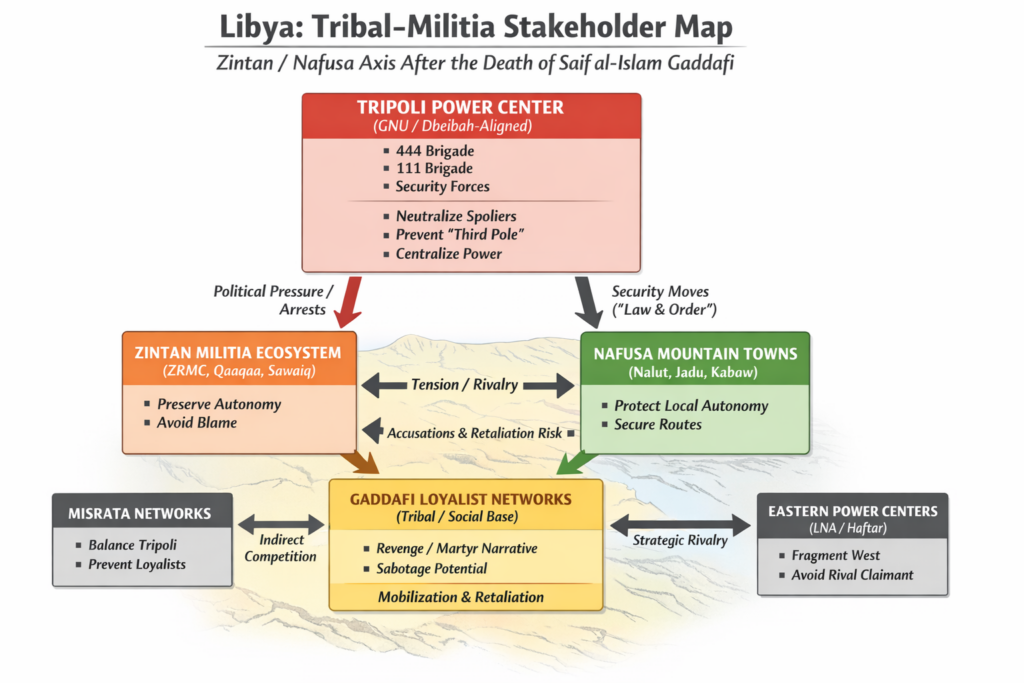
- Zintan + Nafusa Mountains form the geographic and symbolic core of post-assassination risk.
- Zintan’s historic custody of Saif makes it the most exposed node, regardless of guilt.
Primary escalation vectors
- Blame attribution → Zintan brigades → retaliation by loyalist networks
- Tripoli “law & order” push → arrests/checkpoints → Zintan mobilization
- Loyalist martyr narrative → sabotage or revenge attacks
Why Nafusa matters
- Mountain towns are buffer zones.
- If pulled in, conflict expands from a targeted killing into inter-communal warfare.
Bottom-line analytic takeaway
The death of Saif al-Islam Gaddafi transforms Zintan from a local power broker into a strategic pressure point. Whoever controls the narrative and security response around Zintan and the Nafusa Mountains will shape whether Libya absorbs the shock—or slides into a new cycle of tribalized violence.