

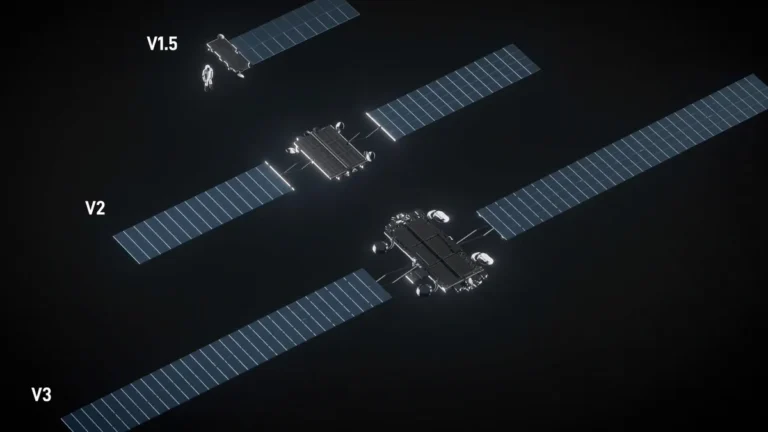
In early February 2026, SpaceX, in cooperation with the Ukrainian Ministry of Defense, introduced a “whitelisting” system for Starlink terminals. This move was a response to Russia’s large-scale use of unauthorized Starlink terminals along the front line, including their installation on Shahed-type attack drones. As a result, by February 5, 2026, Russian military bloggers and servicemen began reporting a “catastrophe”: Starlink terminals used by Russian units were being massively отключed along the entire front line.
This led to the collapse of command-and-control systems for Russian occupation forces in several sectors, particularly around Kupiansk, as Russian units had become critically dependent on this communication infrastructure for coordinating assaults and UAV operations. Elon Musk publicly confirmed the effectiveness of these measures, urging users in Ukraine to complete verification.
Realizing that Russia has no domestic alternative and lacks the technical capacity to break SpaceX’s protection systems, Kremlin propaganda—acting on Vladimir Putin’s personal instructions—shifted to open blackmail. Russian media attempted to portray the situation as if Musk had “switched them off” on orders from above and began demanding that Donald Trump intervene. These demands were accompanied by threats of strikes against American factories and satellites should uninterrupted connectivity not be restored for Russia.
The Starlink issue escalated to a new level following statements by Vladimir Solovyov, one of the Kremlin’s key propagandists, who publicly issued an ultimatum on air: Donald Trump must use his political influence to force Elon Musk to shut down Starlink satellite communications for the Ukrainian Armed Forces. In doing so, Solovyov effectively assigned Trump the role of intermediary—or executor—of the Kremlin’s will, betting that personal or political ties between the U.S. president and the owner of SpaceX could become a tool for Ukraine’s digital capitulation.
These demands were accompanied by direct military threats previously considered unthinkable. Solovyov stated that if these demands were rejected, Russia would strike Starlink factories located on U.S. territory and begin shooting down satellites directly in space—an attempt to legitimize state terrorism against American industrial infrastructure.
Within Russia’s rigid propaganda hierarchy, Solovyov’s radical threats against the United States are not a personal initiative by a television host. They represent a direct Kremlin directive, personally sanctioned by Putin, designed to test the White House’s reaction. Other figures from Russia’s power vertical and influential media joined the aggressive campaign against Starlink, confirming the coordinated nature of the threats. Among them were Dmitry Medvedev, deputy chairman of Russia’s Security Council; Konstantin Vorontsov, a representative of the Russian Foreign Ministry; and prominent military correspondents and propagandists such as Alexander Kots, Yevgeny Poddubny, and Alexander Sladkov. Together, they have systematically framed Starlink as “absolute evil” and openly called for the physical destruction of the American company’s satellites.
This coordinated campaign demonstrates that the Kremlin, on Putin’s personal orders, has moved to open blackmail of the United States, attempting—through threats of industrial terrorism and the destruction of SpaceX facilities—to coerce the Trump administration into political concessions.
Through these actions, Putin publicly signals that he does not perceive Donald Trump as an independent political figure or a strong leader. For the Kremlin, Trump is portrayed merely as a “courier who must call Musk” and carry out Moscow’s instructions. This tone represents a deliberate humiliation of the U.S. presidency, as a foreign dictator assigns “tasks” to the occupant of the Oval Office via his propagandist.
Russian propaganda actively exploits the myth of a special relationship between Trump and Putin to sow doubt within American society about the loyalty of its leader. The call to “just call and sort it out” serves as a marker through which the Kremlin attempts to portray Trump as its puppet.
By issuing the ultimatum—“either Trump forces Musk, or we bomb SpaceX factories”—Moscow seeks to destabilize internal U.S. stability by provoking a conflict between the state and a key defense contractor. By demanding political interference in SpaceX’s business operations, the Kremlin is attempting to export its authoritarian governance model to the United States.
By invoking Trump’s name in threats against Musk, Moscow is attempting to manipulate U.S. political leaders into a format of “shadow diplomacy,” bypassing official communication channels and exploiting fear of escalation to extract concessions harmful to U.S. national interests and those of its allies. At the same time, Russian propaganda seeks to destabilize the American elite from within by turning national security issues into objects of personal disputes and political bargaining.
By proposing that Trump “resolve the Starlink issue,” the Kremlin seeks to make him complicit in its pressure campaign against Musk. Should a U.S. president yield to such blackmail, it would amount to acknowledging Russia’s right to dictate which technologies America is allowed to deploy.
Through Solovyov, Putin has effectively declared outer space a battlefield against U.S. civilian objects. This is not a localized dispute over terminals, but an attempt to prepare the ground for the destruction of the global communications system should it fail to serve Russia’s imperial ambitions.
Threats by Russian state propaganda against SpaceX are not merely wartime rhetoric; they represent a direct attack on the institution of private property. Calls to bomb factories on U.S. soil and destroy private satellite constellations aim to normalize acts of state terrorism against American business, requiring an immediate response from U.S. law enforcement and defense agencies.
Russia’s intentions to attack Starlink satellites pose a threat to all humanity. The mass destruction of objects in low Earth orbit would create a cloud of space debris that could make spaceflight, GPS operation, and meteorological systems impossible for decades—constituting an overt act of international terrorism.
The aggressive rhetoric of Solovyov is an admission that Russia has lost the technological race. Lacking Starlink analogues and unable to effectively suppress its signal through electronic warfare, the Kremlin resorts to the only method it understands: the physical destruction of civilian infrastructure—evidence of the deep degradation of its military strategy.
The escalation of threats to the level of strikes on U.S. territory indicates a complete loss of contact with reality by Russia’s leadership. When leading propagandists call for direct military attacks on a nuclear-peer state over the operation of a commercial internet provider, it underscores Moscow’s unpredictability and the need to strengthen missile defense systems around key U.S. industrial hubs. Kremlin threats should also accelerate Pentagon efforts to deploy its own satellite networks, as Moscow has clearly identified high-speed communications as the most critical vulnerability to its imperial ambitions.
Why the Kremlin escalated rhetorically
The Kremlin’s information response is best understood as coercive signaling after a capability failure:
- Technical defeat: Russia cannot easily replicate Starlink’s performance and cannot reliably defeat it with electronic warfare in many tactical contexts; the whitelist reduces Moscow’s workaround (black-market terminals).
- Narrative pivot: When a capability gap is exposed, Kremlin messaging often shifts to deterrence by fear—threatening escalation to force political intervention in the West.
What the Kremlin is trying to achieve (objectives)
This looks less like a “single demand” and more like a three-layer pressure campaign:
A. Coerce a policy outcome:
Recreate Russian access to Starlink (or degrade Ukraine’s access) by pressuring U.S. leadership and/or SpaceX.
B. Split the U.S. system internally:
Create a perceived clash between the U.S. government and a key defense/space contractor, and turn a national-security issue into a partisan or personality-driven fight.
C. Normalize attacks on commercial space assets:
Kremlin-linked threats against Western commercial satellites are not new (Russia has previously warned that commercial satellites supporting Ukraine could become targets, raising thorny legal questions).
What’s “new” here is the mainstreaming of this idea into an immediate crisis narrative tied to Starlink’s battlefield utility.
What is credible vs. what is “information warfare”
Credible: Russia has long had counterspace capabilities and has threatened to treat certain satellites as legitimate targets in conflict contexts; the legal “laws of war in space” area is contested and underdeveloped.
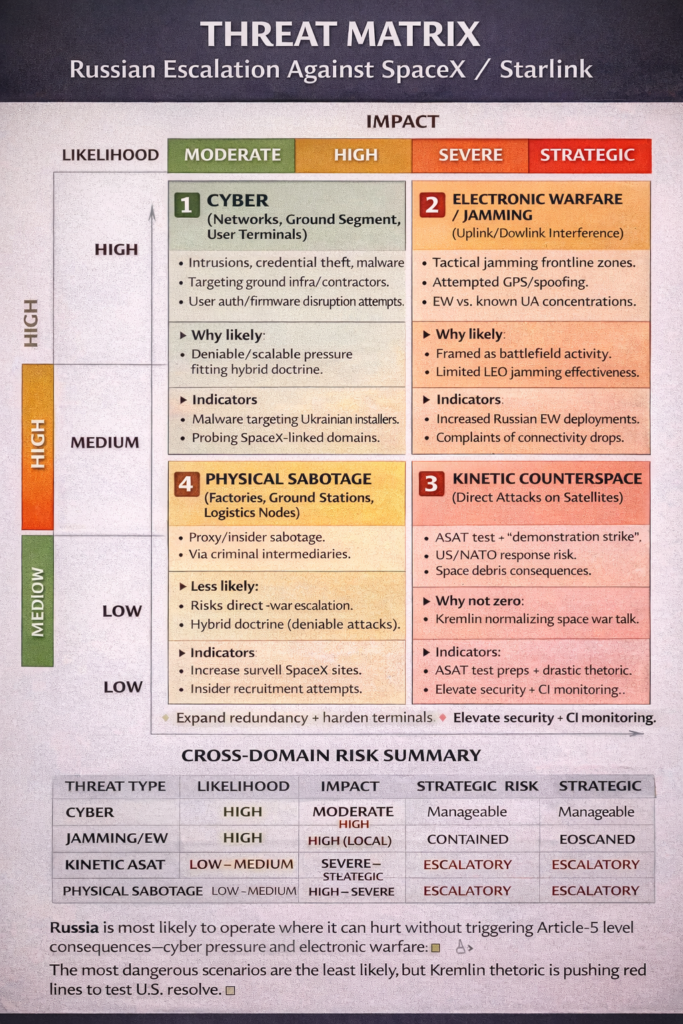
Less credible as an immediate move: large-scale kinetic attacks on satellites would be strategically self-harming because of escalation risk and the debris problem; but limited, deniable harassment (jamming, spoofing, cyber intrusion attempts, reversible interference) is more plausible as a near-term pressure tactic.
Strategic consequences for the U.S.
This incident is not just about Ukraine communications—it is a test case for how the U.S. protects:
- commercial systems that are strategically important in war, and
- private-sector resilience against state coercion.
If the U.S. is seen as vulnerable to threats against private firms’ infrastructure, the precedent extends well beyond Starlink.
Recommendations for the U.S. Administration
Treat threats against SpaceX facilities and satellites as a national-security matter, not “media noise”
- Issue a formal, unambiguous deterrence statement that attacks on U.S. commercial space systems and U.S.-based industrial facilities would trigger serious consequences (economic, legal, diplomatic, and—where appropriate—defensive measures).
- Ensure the messaging is institutional (NSC/DoD/State), not personality-centric, to deny Moscow the “Trump–Musk” framing.
Build an interagency “Commercial Space Threat Cell” for the Ukraine theater
Create a standing mechanism led by NSC/DoD with participation from:
- Space Force / USSPACECOM (threat intel and domain awareness),
- CISA/FBI (cyber + domestic threat),
- State (diplomatic signaling + coalition),
- Treasury/Commerce (sanctions + export controls),
- and key providers (SpaceX + other satcom/LEO players).
Purpose: rapid attribution, deconfliction, resilience actions, and unified public lines.
Harden resilience: reduce single-point dependence and expand redundancy for Ukraine
Do not let the conflict become “Starlink or nothing.”
- Accelerate procurement/fielding of multi-orbit and multi-provider satcom pathways for Ukraine (LEO + GEO + HEO options, where feasible).
- Expand support for mesh networks, terrestrial microwave links, and hardened line-of-sight relays in key sectors.
This reduces coercion leverage: if one network is threatened, the mission continues.
Move the debate from “business decision” to “hostile-state coercion”
- Encourage SpaceX to maintain and document compliance with export controls and anti-diversion safeguards, while the U.S. government frames Kremlin pressure as state coercion against U.S. private property.
- Publicly emphasize that the whitelist is a lawful anti-abuse measure responding to unauthorized use reported by Ukraine and covered by Reuters.
Use law enforcement tools to attack the Russian workaround ecosystem
Target the supply chain that made unauthorized terminals possible:
- identify brokers, payment rails, logistics routes, and front companies enabling diversion into Russian units;
- prosecute sanctions/export-control violations and coordinate with EU partners on seizures and designations.
The operational goal is to make reconstitution “expensive and slow.”
Pre-coordinate an allied response on norms: commercial satellites are not fair game
Use a coalition approach (U.S., EU, UK, Canada, Japan, Australia) to:
- reaffirm norms against destructive counterspace actions,
- coordinate diplomatic costs for any interference,
- and clarify that targeting commercial satellites would be escalatory and destabilizing.
Also use this to isolate Moscow’s narrative and reduce “space-war normalization.”
Quietly elevate protective measures around key U.S. industrial sites and space operations
Without public theatrics:
- reassess physical security posture for prominent space/defense industrial nodes,
- ensure rapid incident response planning for sabotage attempts,
- conduct red-team exercises involving cyber + physical + insider-risk vectors.
Don’t get pulled into “shadow diplomacy”
Moscow’s desired frame is personal mediation (“call Musk”). The U.S. should:
- keep communication in formal state channels,
- refuse personalized bargaining,
- and treat any attempt to compel commercial decisions by threats as coercion.
Strategic communications: split Moscow’s coalition
Message in three lanes:
- Domestic U.S.: this is coercion against U.S. industry; respond as a state, not as a personality feud.
- Global South: Russia is threatening civilian infrastructure and global space safety—this endangers everyone.
- Russian audiences: emphasize that their leadership’s dependence on foreign tech is the root failure; threats won’t fix capability gaps.
This is a coercion testaimed at forcing U.S. political interference into a private network that has become strategically decisive in Ukraine. The best response is to deny Moscow leverage (redundancy + enforcement), raise the cost of coercion (sanctions + law enforcement + diplomacy), and harden U.S. commercial space as critical infrastructure.