

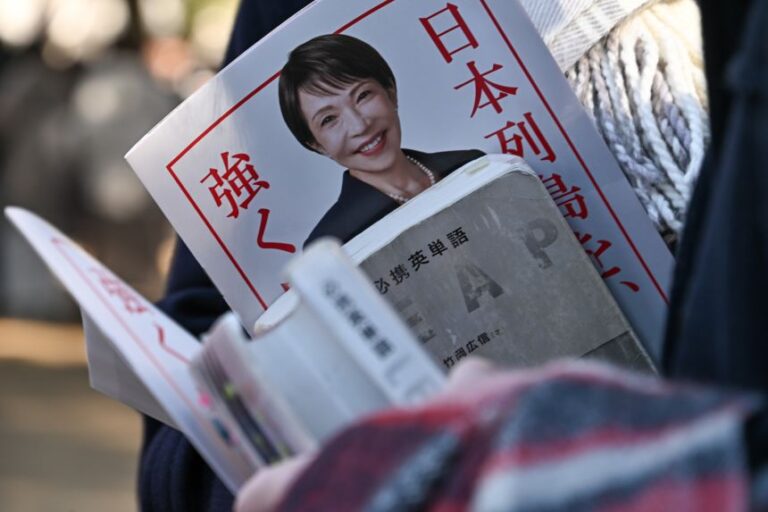
- Japan votes on February 8, 2026 in a snap lower-house election called by Prime Minister Sanae Takaichi only months into her tenure.
- Polling in major reporting suggests a strong LDP-led showing, with some projections putting the governing camp at ~300+ of 465 seats (a potential two-thirds majority depending on partner math).
- The race is structured less as “government vs. opposition” and more as a contest over mandate, coalition geometry, and policy direction—fiscal/price pressures, defense posture, China/Taiwan signaling, and immigration politics are central.
- Foreign influence is unusually explicit: U.S. President Donald Trump publicly endorsed Takaichi days before the vote—an atypical move that becomes part of Japan’s campaign narrative and elite debate.
Situation before voting: why this election, why now
Takaichi called the snap election early in her premiership to convert personal popularity and opposition fragmentation into parliamentary strength and to lock in a governing mandate before economic headwinds (inflation/yen weakness) and coalition bargaining costs rise. Major outlets describe her “surge” and the sense of momentum around her leadership style, including strong approval readings in multiple surveys.
A key structural backdrop is a reconfigured coalition landscape: reporting indicates the LDP is no longer relying on its long-time partner Komeito and has instead built a new governing arrangement involving Japan Innovation Party (Ishin).
Main actors and political forces
Main parties and possible outcomes
A) Governing camp — LDP and coalition partners
Projected Outcome:
- Most polls show the LDP and its allies consolidating a comfortable majority, potentially approaching or exceeding the two-thirds threshold in the 465-seat chamber — a powerful position for legislative reform.
Who stands behind them?
LDP Establishment
- Internal power factions: Dominant LDP factions tied to former PMs and kingmakers (e.g., the Nukaga, Machimura, and Abe supporting currents) provide elite backing. These factions control candidate endorsements, fundraising networks, and prefectural party machinery.
- Bureaucratic support: Large segments of Japan’s civil service (especially Ministry of Finance, METI, and MOFA planning units) tend to orient toward conservative governance and stability — they provide policy continuity and institutional confidence to the LDP.
- Business and finance lobbies: Corporate federations such as Keidanren and banking/trade associations favor continuity and clarity in economic policy; they contribute funding and messaging aligned with the LDP’s “economic stability” narrative.
2) Ishin (Japan Innovation Party)
- Reformist conservatives and local powerbrokers: Ishin draws support from urban reform constituencies, entrepreneurial networks in Osaka and other metropolitan centers, and voters disillusioned with traditional LDP localism but not inclined toward left-center parties.
- Alliance dynamics: Ishin’s backing helps the governing camp secure seats in constituencies where the LDP historically underperforms.
3) Security and defense communities
- Think tanks, retired Self-Defense Forces leadership, and defense industry stakeholders — while not monolithic — generally favor continuity and clarity on defense policy, which underpins support for the incumbent coalition.
4) Right-leaning media ecosystem
- Conservative media outlets (national and regional) and online opinion platforms have given disproportionately favorable coverage to Takaichi’s leadership and policy framing, helping sustain momentum and shape narratives about national “decisiveness.”
B) Opposition camp
Projected Outcome:
- The primary opposition coalition — a patchwork including the Centrist Reform Alliance (CRA), Constitutional Democratic Party of Japan (CDP), Democratic Party for the People (DPFP), and allied progressives — has struggled to coalesce a compelling alternative narrative. Polls generally place them behind the governing camp by double digits nationally.
1) Progressive civic networks
- Civil society groups advocating for social protection, labor rights, and climate action form part of the CDP/CRA base.
2) Komeito remnant constituencies
- Historically, Komeito served as the LDP’s coalition partner; in the new realignment, some Komeito figures and supporters have leaned toward opposition alliances, hoping to temper conservative policy pushes.
3) Regional/local alliances
- Opposition strength varies by region; local labor unions, community associations, and civic associations drive turnout in pockets, but not yet enough to shift the national balance.
Foreign influence and strategic signaling
United States
U.S. involvement stands out in this election cycle. Former President Donald Trump publicly endorsed PM Takaichi, urging voters to support her leadership. This is unusual in Japan’s electoral politics — U.S. leaders typically avoid direct campaigning involvement in allied democratic contests. The endorsement:
- Becomes a focal narrative exploited by both sides (pro for alliance affirmation, con for sovereignty critiques).
- Signals U.S. strategic preference for a government aligned with Tokyo on defense and regional security.
- Risks domestic blowback if framed as foreign interference.
Moscow and Beijing are less directly visible in campaign operations — but their geostrategic footprints shape the issues:
- China’s posture on Taiwan and regional security informs defense themes.
- Russia’s war in Ukraine and evolving ties with Tokyo influence strategic alliance debates.
Other actors
- EU and Australia: Official observation engagement and diplomatic signalling underline the appeal of a stable, democratic process.
- South Korea: Historical tensions with Tokyo (trade, wartime legacies) influence domestic nationalist narratives but do not overtly translate into electoral operations.
Poll-based outlook and uncertainties
Base case:
- The governing coalition (LDP + Ishin) wins a clear majority — enabling policy continuity and legislative momentum on security and economic agendas.
- Key variables include voter turnout, the performance of local candidates, and small party spoiler effects in marginal districts.
Upset scenario:
- A fragmented opposition with localized strong performances diminishes the LDP majority and forces post-election coalition bargaining — dampening policy momentum and injecting volatility into foreign policy stances.
Wild card:
- Security incidents near Japan’s interests (e.g., Taiwan Strait crises or North Korean missile tests) in the final week could shift public sentiment decisively toward security-centered leadership — favoring incumbents.
Consequences and strategic meaning
A) Domestic governance
If the governing camp wins decisively:
- Expect stronger legislative authority for defense budget increases, revised security legislation, and enhanced deterrence measures.
- Potential tightening of immigration policy as part of social stability messaging.
- Fiscal risk management remains a political priority given domestic cost-of-living concerns.
If the majority is narrow:
- More negotiation within the ruling bloc and with minor parties.
- Economic policy may center on consensus measures and incremental reforms.
B) Foreign policy
U.S.–Japan alliance:
- A strong result consolidates Japan’s role as an anchor in U.S. regional strategy — especially in context of Indo-Pacific security.
- Trump’s involvement will be scrutinized domestically but may strengthen diplomatic alignment.
China and regional dynamics:
- A government with a robust mandate could firm up Tokyo’s stance on Taiwan, South China Sea issues, and regional cooperation frameworks.
Multilateral engagement:
- Japan’s engagement in QUAD, ASEAN Regional Forum, and G7 platforms is likely to be steadier with a clear mandate.
C) Broader meaning
This election is more than a routine power contest — it is a mandate test on direction:
- Will Japan unify around a security-oriented, alliance-firm posture?
- Can the governing coalition translate popular momentum into durable institutional reform?
- Does the opposition crystallize into a viable alternative coalition?
The result will help define Japan’s approach to regional power competition, economic resilience, demographic challenges, and the balance between national sovereignty and alliance integration.
All major indications point to a governing victory, underwritten by established party structures, broad institutional backing, and a coherent coalition. The real question is how large a mandate Japan’s ruling forces secure and how they leverage it — both domestically and in foreign policy. U.S. engagement, especially the unorthodox public intervention, adds an unusual layer that may influence both elite and mass perceptions of Tokyo’s strategic positioning.
Governing camp
- Liberal Democratic Party (LDP) led by PM Sanae Takaichi: running on leadership strength, security posture, and economic relief signals.
- Japan Innovation Party (Ishin): coalition partner; aims to expand influence and shape reform/administrative agendas inside government.
Opposition / challengers
- Centrist Reform Alliance (CRA) (reported as a new alignment involving CDP + Komeito): positioned as the principal electoral alternative but described as struggling to match the governing narrative momentum.
- Other national parties (role varies by district dynamics): DPFP, Reiwa, JCP, and a fringe/right-populist layer including Sanseito—the latter has helped pull immigration and “foreigners” into sharper campaign focus.
Key issues shaping voter behavior
A) Economy: prices, yen, fiscal credibility
Market and household anxiety sits behind much of the campaign. Reporting flags concern about fiscal proposals and market volatility, with voters sensitive to cost-of-living pressures.
B) China/Taiwan and defense posture
Takaichi has taken a more openly hawkish posture, including sharper rhetoric around Taiwan that has contributed to diplomatic friction with Beijing.
C) Immigration and social cohesion
Immigration has become more salient, with reporting describing how conservatives are tapping anxieties about a growing foreign worker population—while critics warn this can become scapegoating that distracts from inflation and wages.
Who is likely to win (poll-based assessment)
Across recent reporting, the most likely outcome is that the LDP-led governing camp retains power comfortably, with some projections suggesting the coalition could approach or exceed the threshold associated with a two-thirds majority in the 465-seat lower house.
What would change the forecast?
- Turnout and late mobilization: winter election conditions and opposition targeting could compress margins.
- Coalition arithmetic: Takaichi’s stated political risk is real—she has publicly tied her position to meeting majority expectations, increasing volatility if results disappoint.
Bottom line: a governing victory is the base case; the key analytic question is how large (simple majority vs. near–two-thirds), because size determines how aggressively Tokyo can move on security, immigration controls, and fiscal policy.
Foreign influence and interests
United States
Trump’s public endorsement is an unusually direct foreign-leader intervention into Japan’s electoral environment. Even if it doesn’t swing many voters, it matters because it:
- reinforces a narrative of Takaichi as Washington’s preferred partner, and
- injects U.S. domestic politics into Japan’s coalition debates.
China
Beijing is a “silent actor” shaping the stakes: Taiwan signaling and defense strengthening are campaign themes, and any post-election mandate may harden Japan’s posture—raising the risk of more frequent political crises in the bilateral relationship.
Russia and North Korea
While not the dominant campaign frame in the sources above, the regional security environment (Ukraine war lessons; DPRK missile behavior) raises the premium on resilient alliances and defence modernization—issues that typically benefit incumbents running on security competence.
Consequences and meaning
If the LDP-led camp wins big
- Stronger mandate for hawkish security policy and clearer alignment with the U.S. on deterrence posture.
- Greater room for immigration tightening and “order” politics (with a risk of social polarization if rhetoric hardens).
- Higher fiscal-policy scrutiny from markets if stimulus/tax-cut pledges are perceived as debt-negative—potential yen volatility and constraints on BoJ normalization debates.
If the margin is weaker than expected
- More dependence on coalition partners and intra-right bargaining; reduced bandwidth for controversial reforms; and greater vulnerability to external shocks (China incidents, economic surprises).
Strategic meaning: This election is effectively a referendum on whether Japan moves into a more explicitly nationalist/hawkish governing style with durable parliamentary backing, and whether political competition consolidates into a new two-bloc system (LDP–Ishin vs. CRA) or remains fragmented—fragmentation generally advantages the incumbent camp under district-level dynamics.