

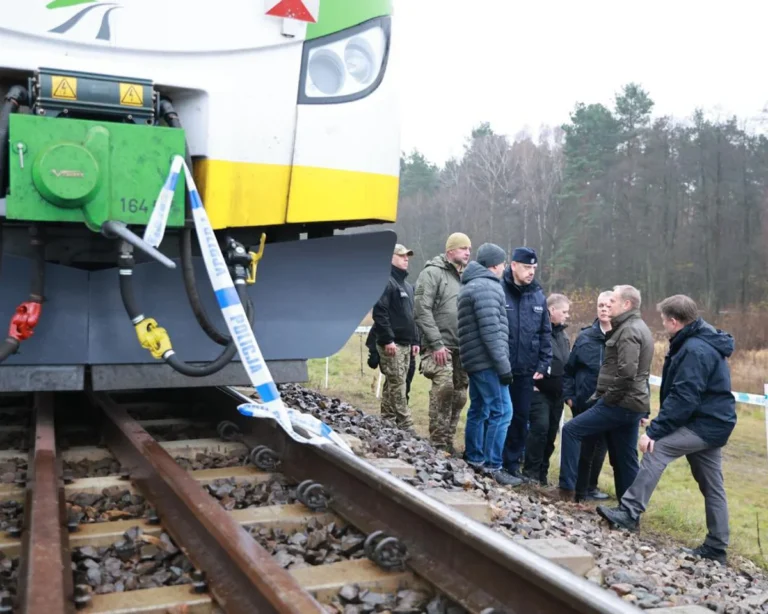
Russia’s approach to rail sabotage in NATO states is indirect, deniable, and layered. Rather than deploying uniformed operatives, Moscow outsources risk through criminal proxies, extremist milieus, and information operations, while retaining plausible deniability. The objective is disruption, intimidation, and uncertainty, not mass casualties.
Strategic logic: why railways?
Rail networks are:
- Critical dual-use infrastructure (civilian + military logistics)
- Highly visible (delays ripple into public confidence)
- Geographically dispersed (hard to secure end-to-end)
- Politically sensitive during elections, crises, or major events (e.g., Olympics)
Disrupting railways supports Russia’s broader aim to raise the cost of NATO cohesion and Ukraine support without crossing thresholds that trigger direct retaliation.
The preferred model: proxy and cut-out operations
Russia overwhelmingly avoids “signature” state action. Instead, it relies on three proxy layers:
A) Criminal networks (most scalable)
- Who: local criminals, smugglers, or gangs already operating near infrastructure corridors
- Why: they understand terrain, accept payment, and are disposable
- How Russia engages: intermediaries, cash/crypto, tasking framed as “jobs,” not ideology
Analytic indicator: suspects with criminal histories, weak political ideology, and unexplained payments—often through non-traditional channels.
B) Extremist or radical milieus (ideological cover)
- Who: far-left anarchists, far-right extremists, or single-issue radicals
- Why: ideology provides self-justifying narratives (“anti-war,” “anti-state,” “anti-capital”)
- How Russia benefits: even when groups act autonomously, Russian amplification magnifies impact.
Key point: Russia does not need to control these groups—encouragement, validation, or resource nudges can be sufficient.
C) Hybrid “useful idiot” recruitment
- Who: individuals with grievances, financial stress, or desire for notoriety
- Method: online recruitment via encrypted platforms, often with deliberately vague tasking
- Plausible deniability: recruiters pose as activists, journalists, or “concerned citizens”
Indicator: sudden radicalization paired with foreign-linked digital contacts.
Information operations as a force multiplier
Physical disruption is only half the operation. Russia systematically pairs incidents with information warfare:
- Narrative seeding: “Europe is unsafe,” “governments can’t protect citizens”
- Attribution fog: encouraging competing explanations to delay consensus
- Amplification: state-linked media and social ecosystems spike coverage after incidents
Even unclaimed or minor acts can be turned into strategic messaging victories.
Command and control: how Moscow stays hidden
Russia’s security services (most notably the GRU) favor mission-type control:
- Broad objectives (“cause disruption,” “create pressure”)
- Minimal instructions
- No written chains linking Moscow to execution
This makes legal attribution extremely difficult, even when intelligence assessments point to Russian involvement.
What Russia avoids (deliberately)
- Mass-casualty attacks (high escalation risk)
- Complex operations requiring sustained presence
- Clear command links that enable retaliation
This restraint is strategic: persistent low-level disruption is more useful than spectacular violence.
How this differs from Cold War methods
Cold War:
- Direct links to ideological groups, heavier training/support footprints
- Higher risk tolerance for attribution
Today:
- Transactional, deniable, digital
- Reliance on criminality and social fragmentation
- Emphasis on ambiguity over ownership
Attribution: what investigators look for
Analysts test for Russian involvement using pattern convergence, not single clues:
- Target alignment: Do incidents coincide with NATO logistics routes or Ukraine support surges?
- Temporal clustering: Are attacks synchronized with political events or summits?
- Financial anomalies: Small, irregular payments tied to foreign crypto wallets
- Digital fingerprints: Reused recruiter accounts across countries
- Narrative echo: Rapid amplification by pro-Kremlin ecosystems
One signal is rarely decisive; convergence across domains raises confidence.
ussia does not need to “run” rail sabotage directly to benefit from it.
Its modern method is to:
Enable, encourage, and exploit disruption while denying ownership.
This model:
- Keeps escalation below NATO’s red lines
- Exploits open societies and infrastructure complexity
- Turns small acts into strategic pressure
For NATO states, the challenge is not just guarding rails—but disrupting the proxy ecosystem that makes sabotage cheap, deniable, and repeatable.
- map this into a threat matrix (actors × methods × indicators),
- compare Russia’s rail sabotage model with cyber or arson campaigns, or
Most exposed NATO countries and why
Tier 1 — Highest exposure
Poland
- Why: It is the primary land bridge for military and humanitarian flows to Ukraine and NATO’s eastern flank; rail lines toward the east are high-value targets.
- Evidence signal: Poland has publicly treated railway sabotage as a serious national-security issue and prosecutors have charged individuals alleged to have collaborated with Russia in an attempted rail sabotage on the Warsaw–Lublin line (a route connecting onward to Ukraine).
- Exposure type: High strategic value + high adversary interest + proximity.
Germany
- Why: Germany is the central transit state linking North Sea ports to the eastern flank; disruption there has outsized alliance-wide effects. This logic is embedded in EU/NATO “military mobility” corridor planning centered on the Netherlands–Germany–Poland axis.
- Exposure type: Network centrality (chokepoints, hubs, switching/cable infrastructure) + demonstrated vulnerability to disruption.
Netherlands & Belgium (as a combined logistics complex)
- Why: They host major North Sea ports and onward rail corridors used for reception, staging, and movement into Germany and beyond. The EU/NATO mobility corridor expansion explicitly connects this western gateway through Germany toward the east.
- Exposure type: Gateway dependence—if port-to-rail interfaces are disrupted, downstream movement suffers.
Tier 2 — High exposure
Lithuania, Latvia, Estonia
- Why: Frontline geography, limited depth, and high political signaling value. Even modest disruptions can have major psychological and readiness effects.
- Exposure type: Proximity + limited redundancy (fewer alternate routes).
Romania
- Why: Critical for Black Sea logistics and support routes; also part of emerging military mobility cooperation in Southeast Europe (corridor logic that includes Greece–Bulgaria–Romania).
- Exposure type: Strategic corridor + infrastructure constraints.
Norway (and, increasingly, Sweden & Finland as a logistics ecosystem)
- Why: Northern flank logistics are gaining importance; Norway’s Narvik/Ofotfjord–rail connections are repeatedly flagged as key staging areas for allied operations in the High North.
- Exposure type: Fewer critical arteries (low redundancy) + high strategic value.
Tier 3 — Moderate but event-driven exposure
Italy
- Why: Not a primary eastern-flank transit hub, but exposure spikes during major events and when networks are politically “spotlit.” Italy’s 2026 Winter Olympics period saw repeated suspected rail sabotage incidents and authorities linked them to deliberate disruption.
- Exposure type: Visibility-driven targeting (public confidence attacks).
France
- Why: Major logistics depth, but higher redundancy than Poland/Germany; still a key node for west-to-east movement.
- Exposure type: Important but less chokepoint-dominant than Germany.
Quick map of “why” by mechanism
- Corridor chokepoints: Germany, Poland, Netherlands/Belgium
- Frontline proximity: Poland, Baltics, Romania
- Low redundancy / single-artery risk: Norway, parts of Finland/Sweden logistics routes
- High-visibility event targeting: Italy (Olympics)
Bottom line ranking (most exposed → less exposed)
- Poland (frontline + Ukraine rail lifeline + active sabotage cases)
- Germany (transit heart of Europe; corridor backbone)
- Netherlands/Belgium (port gateways feeding the corridor)
- Baltics (frontline, limited redundancy)
- Romania (Black Sea relevance + corridor development)
- Norway/Sweden/Finland (northern flank arteries)
Italy (situational spikes during major events)

More on this story: Kremlin operations increase risks for European railways.
More on this story: Mock far-left sabotage to threaten Europe