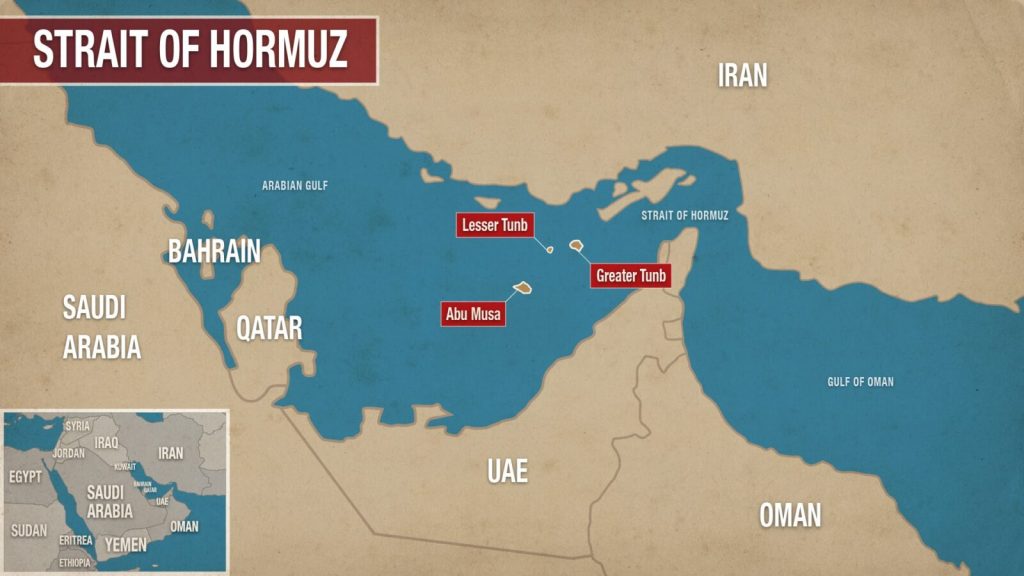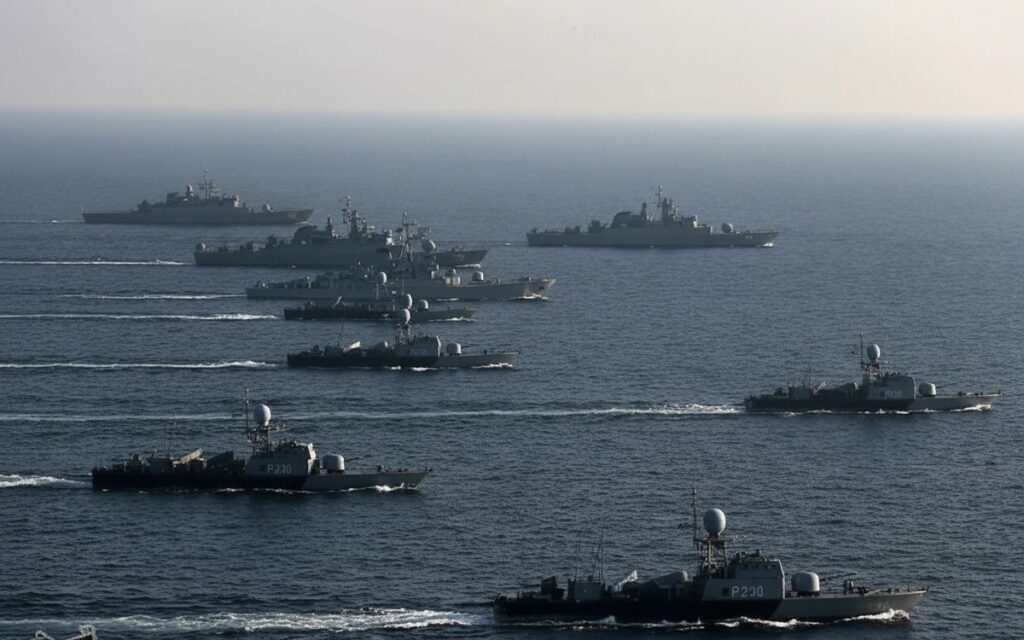

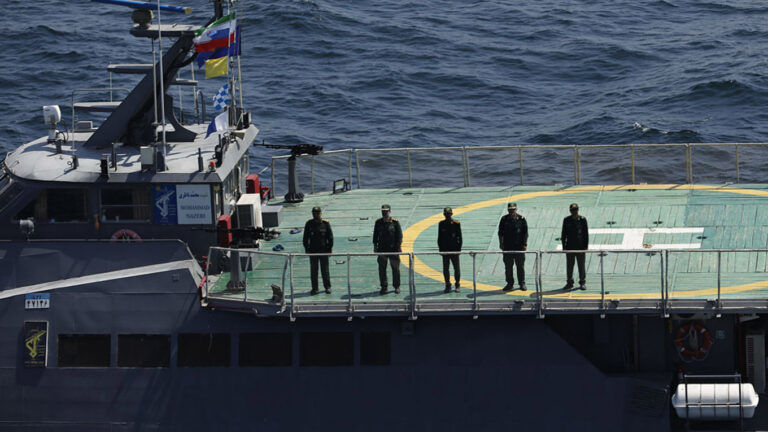
Planned joint naval exercises between Iran and Russia are set to take place in the Sea of Oman and the northern Indian Ocean. The maneuver area lies close to strategically vital maritime routes through which a significant share of global oil and gas exports passes. The drills are occurring amid rising tensions between Tehran and Washington, as well as Russia’s ongoing war against Ukraine. A powerful U.S. naval grouping is already present in the Middle East.
The joint actions of Russian and Iranian warships in these waters demonstrate a deepening of their military coordination. For the United States, this signals a potential erosion of its monopoly on naval deterrence in the region. Practicing joint operations enhances fleet interoperability and the ability to act in a coordinated manner during crisis scenarios. Russian-Iranian naval activity creates new risks for U.S. vessels and allied forces in the event of incidents or escalation.
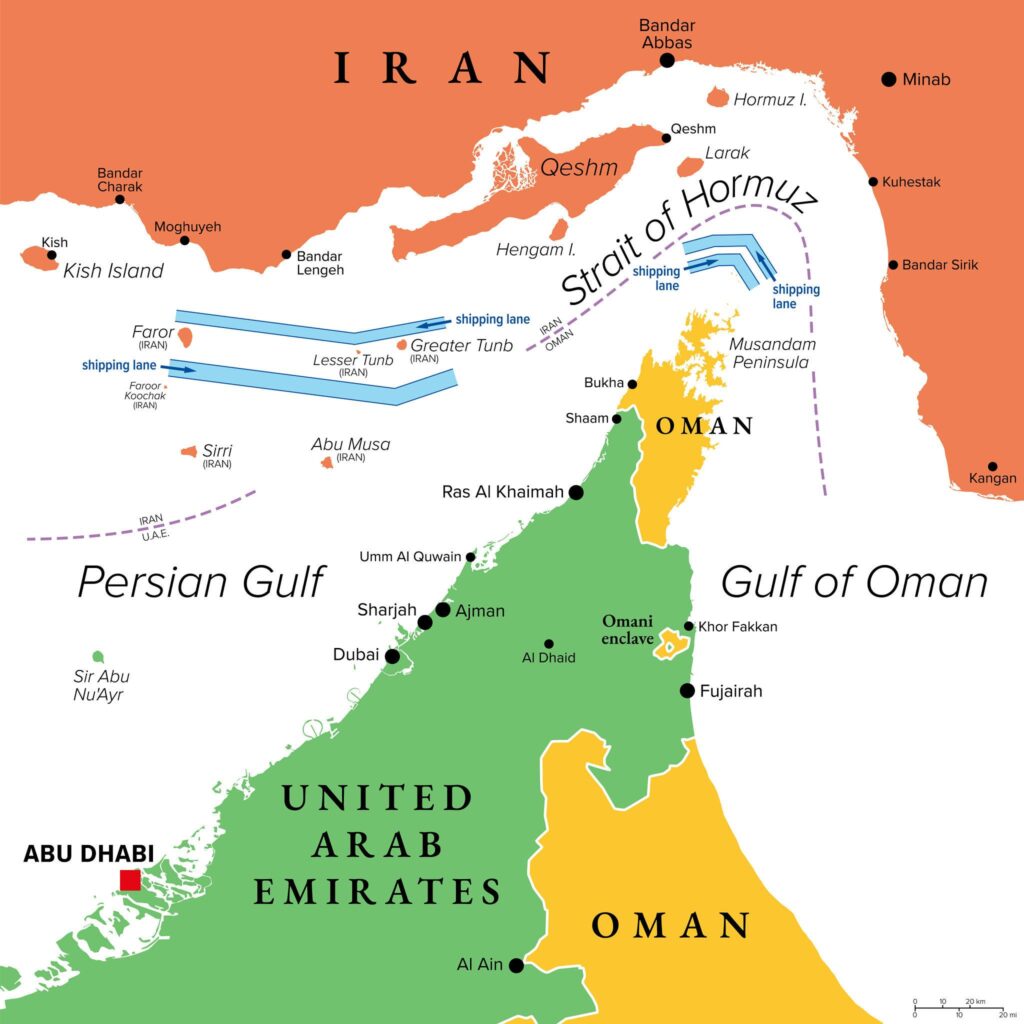
Of particular importance is the proximity of the exercises to the Strait of Hormuz—a key artery of the global energy market. The strengthening of Russian-Iranian interaction in this zone increases Tehran’s capacity to exert pressure on freedom of navigation. Moscow, in turn, gains an opportunity to expand its naval presence beyond its traditional spheres of influence. This format of cooperation enhances the strategic autonomy of both countries from the West. For the United States, it means the need to reallocate resources and reinforce its military presence to preserve the balance of power.
The exercises also carry a symbolic dimension, signaling the emergence of an alternative center of power. They undermine Washington’s diplomatic efforts to isolate Iran and Russia. Taken together, these developments constitute a long-term challenge to American military, energy, and geopolitical influence in the region.
In recent years, Iran and Russia have consistently expanded their military and economic cooperation. Moscow uses its partnership with Tehran as a tool to counter Western sanctions and international isolation. Iran, for its part, seeks support in strengthening its defensive capabilities and modernizing its naval forces. The Sea of Oman and the northern Indian Ocean are key zones of global trade, while the Strait of Hormuz serves as a critical transit route for a large share of the world’s energy resources. The United States has traditionally ensured the security of navigation in this region through a permanent naval presence. Any increase in alternative military presence alters the balance of power.
Joint Russian-Iranian maneuvers may include exchanges of operational experience, tactical practices, and communications systems, laying the groundwork for coordinated action in potential conflicts. The deepening of military cooperation is occurring in parallel with growing economic and energy ties. Both countries are developing mechanisms to circumvent sanctions and alternative financial instruments. Against the backdrop of tense negotiations over Iran’s nuclear program, such actions strengthen Tehran’s bargaining position.
These joint exercises are taking place in waters of strategic importance to the United States, where American forces have traditionally enjoyed superiority. Coordinated action by the two fleets enhances their ability to operate as a single operational element, reducing the effect of U.S. dominance and complicating the freedom of maneuver of the U.S. Navy.
The exercise area is directly linked to the transportation of oil and gas. The strengthening of Iran’s naval capabilities with Russian support increases the ability to block or disrupt shipping, creating risks for global energy markets. As the primary guarantor of maritime security, the United States comes under additional pressure.
The maneuvers allow Iran and Russia to practice coordination, intelligence sharing, and command procedures, forming the basis for potential joint operations in crisis conditions. Such interoperability complicates U.S. response options and boosts the confidence of both sides in confronting the West.
Military cooperation complements economic and energy interaction between Moscow and Tehran, creating alternative channels of support under sanctions. As a result, the effectiveness of U.S. pressure is weakened. In the long term, this reduces the impact of sanctions as a deterrence tool.
The presence of multiple naval forces in the region increases the likelihood of accidental encounters. Even a localized incident could escalate into a broader conflict, thereby raising the overall level of global instability.
Through naval interaction, Russia and Iran demonstrate their ability to operate jointly outside the Western security architecture. This model is likely to attract other states critical of the United States to similar formats of cooperation. Over time, this process contributes to the emergence of a multipolar military configuration, eroding U.S. global preeminence.
These exercises are not a one-off event but part of a systematic rapprochement between two sanctioned states. The gradual expansion of coordination is forming a durable alignment in a critically important region and requires additional resources and diplomatic effort from the United States. As a result, the strategic burden on U.S. security policy continues to grow.
Strategic Geography as Coercive Leverage
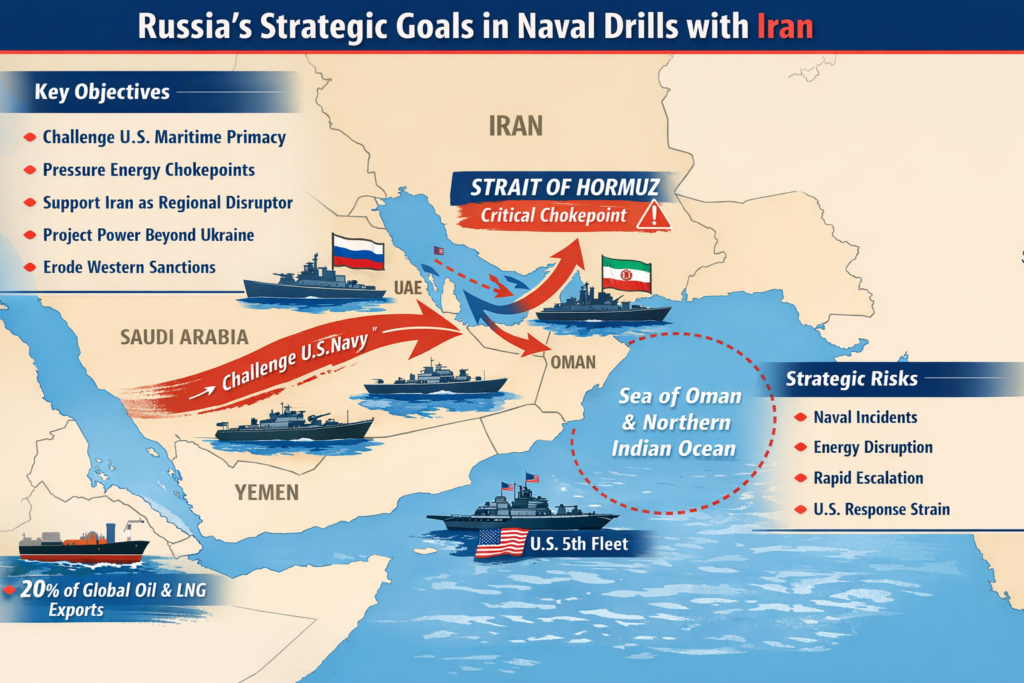
The exercise area’s proximity to the Strait of Hormuz is central. Roughly one-fifth of globally traded oil and a substantial share of LNG exports transit this chokepoint. By operating jointly in its vicinity, Tehran and Moscow reinforce Iran’s long-standing strategy of leveraging geography as coercive power, while Russia adds symbolic and operational depth to that posture. This combination amplifies perceived risks for global energy markets without requiring immediate kinetic escalation.
Erosion of U.S. Deterrence Monopoly
For decades, the United States—primarily through U.S. Navy forward deployment and the U.S. Fifth Fleet—has functioned as the uncontested guarantor of maritime security in the Gulf and adjacent waters. Russian-Iranian naval coordination does not match U.S. capabilities quantitatively, but it introduces qualitative uncertainty. Even limited interoperability complicates U.S. operational planning, increases reaction time requirements, and dilutes deterrence clarity in crisis scenarios.
Operational Interoperability and Crisis Readiness
Joint drills enable both sides to rehearse command-and-control alignment, communications protocols, and maritime domain awareness sharing. Over time, this reduces friction in potential real-world contingencies—ranging from harassment of commercial shipping to gray-zone naval incidents. For the U.S. and its allies, this means that future crises may involve coordinated multi-flag actions rather than isolated Iranian provocations, raising escalation risks and complicating attribution.
Strategic Depth for Russia, Strategic Insurance for Iran
For Moscow, naval cooperation with Iran provides an avenue to project relevance beyond traditional theaters (Black Sea, Baltic, Mediterranean) at relatively low cost. It signals that Russia remains a global military actor despite battlefield constraints in Ukraine. For Tehran, Russian participation functions as strategic insurance—deterring unilateral U.S. or Israeli escalation by increasing the potential cost and complexity of military action near Iran’s maritime perimeter.
Sanctions Evasion and Alliance Consolidation
Military coordination reinforces parallel economic and energy cooperation between two heavily sanctioned states. Joint naval activity helps normalize their partnership and supports the broader construction of alternative logistics, financial channels, and energy arrangements. Over time, this weakens sanctions as a coercive instrument by embedding them within a wider ecosystem of mutual support, reducing Western leverage.
Escalation and Accident Risk
The growing density of naval forces—including U.S., allied, Russian, and Iranian vessels—raises the probability of miscalculation. Close-proximity operations, differing rules of engagement, and political signaling increase the likelihood that a tactical incident could escalate rapidly. Even a limited confrontation would have disproportionate global effects via energy prices, insurance markets, and supply-chain disruptions.
Systemic Implications: Toward a Multipolar Maritime Order
By demonstrating the ability to coordinate outside Western security frameworks, Russia and Iran offer a model attractive to other states dissatisfied with U.S. dominance. While not constituting a formal alliance bloc, such cooperation contributes incrementally to a multipolar maritime security environment, where U.S. superiority is increasingly contested through coordination rather than parity.
Long-Term Burden on U.S. Strategy
These exercises are not episodic but part of a sustained convergence between Moscow and Tehran. For Washington, this implies a long-term requirement to allocate additional naval, intelligence, and diplomatic resources to preserve deterrence and reassure partners. The cumulative effect is strategic overstretch: maintaining dominance becomes costlier, while adversaries exploit asymmetry and coordination to offset U.S. advantages.
Russian-Iranian naval exercises near the Strait of Hormuz do not immediately overturn U.S. naval supremacy, but they incrementally undermine it. By blending geography, coordination, and political signaling, Moscow and Tehran increase strategic ambiguity, raise escalation risks, and challenge the effectiveness of U.S. deterrence and sanctions. Over time, this dynamic threatens to reshape the maritime balance in one of the world’s most critical regions.
Russia’s Main Goals in the Joint Naval Drills with Iran
Strategic Signaling to the United States
Russia uses the drills to demonstrate that it can challenge U.S. dominance indirectly in regions critical to Washington—even while its main forces are tied down in Ukraine. Operating near the Strait of Hormuz sends a message that Russia can influence global energy security without confronting the U.S. directly in Europe.
Effect: Raises U.S. strategic anxiety and complicates deterrence planning.
Implication: Forces Washington to consider secondary theaters when allocating naval resources.
Creation of a Secondary Pressure Front
Moscow seeks to stretch U.S. military bandwidth by contributing to instability risks in the Middle East and Indian Ocean. Even limited Russian naval involvement amplifies Iran’s leverage and creates a perception of coordinated pressure.
Effect: Increases the cost of U.S. focus on Ukraine and Europe.
Implication: Encourages strategic overstretch rather than direct confrontation.
Maintaining the Image of a Global Naval Power
Despite losses and constraints from the war in Ukraine, Russia aims to prove it remains a blue-water actor. Participation in Indian Ocean drills allows Moscow to preserve its great-power narrative.
Effect: Counters narratives of Russian military decline.
Implication: Supports domestic legitimacy and external credibility with non-Western states.
Strengthening Iran as a Strategic Proxy Partner
Russia views Iran as a regional disruptor capable of imposing costs on the U.S. and its allies. By improving Iranian naval confidence and interoperability, Moscow enhances Tehran’s ability to act as a pressure multiplier.
Effect: Iran becomes bolder in maritime brinkmanship.
Implication: Russia gains leverage without being the primary escalator.
Normalizing a Sanctioned Military Axis
The drills are part of a broader effort to institutionalize cooperation among sanctioned states. Naval exercises publicly legitimize Russian-Iranian military ties and reduce the stigma of operating outside Western security frameworks.
Effect: Weakens the isolating power of sanctions.
Implication: Encourages other U.S.-skeptical states to engage in similar formats.
Access to Regional Operational Knowledge
Russia gains practical intelligence on operating in Gulf-adjacent waters—navigation patterns, communications, deconfliction procedures, and regional responses—at minimal cost.
Effect: Improves Russia’s situational awareness in a critical maritime theater.
Implication: Enhances future contingency planning and arms cooperation.
Undermining U.S. Freedom of Maneuver
Even symbolic coordination with Iran forces the U.S. Navy and U.S. Fifth Fleet to plan for multi-actor contingencies instead of single-state threats.
Effect: Reduces U.S. operational flexibility in crisis scenarios.
Implication: Raises escalation risks and decision-making complexity.
Long-Term Multipolar Positioning
Russia is laying groundwork for a multipolar maritime order, where U.S. superiority is contested through coordination rather than parity. The drills serve as a prototype for future ad-hoc coalitions.
Effect: Gradual erosion of U.S.-centric security architecture.
Implication: Higher long-term costs for maintaining American primacy.
For Russia, these drills are low-cost, high-impact strategic theater:
- No need to defeat the U.S. Navy
- Only to complicate, distract, and multiply risks
- While reinforcing Iran as a regional pressure tool
They are less about naval combat readiness and more about geopolitical leverage, signaling, and systemic disruption.
Comparison: Russia–Iran Drills vs. BRICS+ South Africa Naval Exercises
| Aspect | Russia–Iran Drills (Sea of Oman & N. Indian Ocean) | BRICS+ Naval Drills (Including South Africa) |
| Scope & Location | Focused on Gulf-adjacent energy chokepoints near Strait of Hormuz, critical global oil routes where Russia and Iran are actively expanding cooperation. | Held off the coast of South Africa (Cape Town/Simon’s Town), in waters linking the Atlantic and Indian Oceans—far from Middle Eastern energy chokepoints but strategic for global maritime trade routes. |
| Leadership & Initiative | Driven by bilateral strategic cooperation, with Iran initiating annual exercises and Russia increasing involvement as part of its broader security outreach. | Largely China-led under “BRICS+” framework, with South Africa as host and participation from multiple states including Russia, raising regional diplomatic sensitivity. |
| Participants | Russia + Iran (and potentially China in linked formats) focusing on direct interoperability between the two. | BRICS+ grouping: China, Russia, Iran, South Africa, United Arab Emirates; observers from countries like Brazil, Egypt, Ethiopia, Indonesia. |
| Stated Purpose | Officially for joint naval coordination, civilian shipping safety, and maritime security operations. | Presented as cooperation for ensuring maritime safety and economic shipping security. |
| Implicit Geopolitical Signal | Strong send to U.S. and allies that Russia and Iran can expand their strategic reach and challenge Western dominance near critical energy routes. | Emerging alternative security cooperation model under BRICS, emphasizing multipolar engagement and cooperation beyond Western maritime frameworks. |
| Regional Sensitivity & Reactions | Heightened U.S.–Iran tensions and U.S. presence in the region give these drills high geopolitical risk for escalation and strategic signaling. | South Africa faced diplomatic backlash and domestic controversy—including probes into Iran’s participation—reflecting pressure from partners like the U.S. and concerns about non-alignment. |
| Operational Focus | Enhancing bilateral interoperability, tactical coordination, communications, and shared maritime operations—all with potential crisis escalation implications. | Focused on joint maritime safety procedures, interoperability drills, and coalition cooperation among multiple navies within BRICS+ framework. |
| Long-Term Strategic Utility | Expands a Russia-Iran military axis in a key geopolitical region; enhances Iran’s deterrence leverage and showcases Russian global presence. | Advances multilateral naval cooperation under BRICS+, serving China’s push for alternative security networks and boosting South Africa’s defense profile while navigating relations with both West and East. |
Key Differences in Strategic Emphasis
Geopolitical Context
- Russia–Iran drills are embedded in the Middle Eastern security competition and U.S.–Iran tension. They signal direct geopolitical substance aimed at power projection near energy chokepoints.
- BRICS+ drills in South African waters are part of a broader coalition framework, aiming more at relationship-building among emerging powers and not primarily targeted at U.S. forces.
Mission & Messaging
- The Russia–Iran exercises carry a deterrence and strategic pressure dimension; implicitly signaling that Russia and Iran can operate in highly sensitive waters despite Western naval presence.
- The BRICS+ exercises emphasize shared maritime security, safety of shipping lanes, and collective interoperability within a multilateral economic bloc’s context.
Political Sensitivity
- Russia and Iran cooperating near the Strait of Hormuz directly complicates U.S. military calculations.
- South Africa’s hosting of BRICS+ drills—especially with Iranian participation—sparked internal political debate and international criticism, focusing more on diplomatic balance than direct strategic confrontation.
What the Contrast Reveals Strategically
- Russia–Iran drills are a bilateral security leverage tool with immediate geopolitical implications in a contested theater.
- BRICS+ naval exercises are multilateral engagements driven by broader economic-diplomatic alignments (not exclusively military confrontation).
Together they show two strands of Russian naval engagement: Bilateral pressure partnerships Multilateral naval diplomacy embedded in broader geopolitical blocs