

The press service of Russia’s Foreign Intelligence Service (SVR) published a press release accusing the United Kingdom and France of intending to covertly supply Ukraine with nuclear weapons and their delivery systems, including the possible transfer of a compact warhead from the M51.1 ballistic missile used on submarines.
The publication on the website of Russia’s Foreign Intelligence Service under such a headline is a classic example of a psychological operation aimed at both Western audiences and Russia’s domestic public. The SVR has a long history of disseminating fabricated intelligence claims, such as allegations about a “dirty bomb” supposedly set to be transferred to Ukraine in 2022 or about “secret biological laboratories,” none of which were ever confirmed.
- None of these claims has received any confirmation. The purpose of such information injections is to cast doubt on the necessity of continued military support for Ukraine.
- Russian propaganda operates through mirroring: it often accuses others of actions that Russia itself is planning. The publication of such “pseudo-intelligence” creates a pretext for Russia to claim the need to carry out a “pre-emptive strike” or to justify the use of its own tactical nuclear weapons by framing this as a response to an “existential threat” allegedly posed by Ukraine and its allies.
- The United Kingdom and France are signatories to the Nuclear Non-Proliferation Treaty (NPT). Accusing them of transferring nuclear warheads to a third party is an attempt to portray leading global democracies as “terrorist states” that undermine the global security architecture.
This report constitutes information noise designed to sustain the Kremlin’s rhetoric of nuclear blackmail. Its appearance is likely linked to another phase of increased military assistance to Ukraine (for example, the transfer of longer-range missiles or new aircraft), which the Kremlin is attempting to frame as “nuclear escalation.”
The statement by Russia’s foreign intelligence service emerged precisely at a time when the European Union had begun actively discussing the creation of a “European nuclear shield” independent of the United States. Moscow is attempting to discredit this idea at its inception.
Timeline: Russia’s “Dirty Bomb” Allegations
2008 – Georgia
- Claim: Russian officials suggested Georgia might be preparing radiological provocations during the war over South Ossetia.
- Context: Five-day war with Georgia; heavy information warfare.
- Outcome: No evidence presented; claims faded after hostilities ended.
2015–2017 – Syria
- Claim: Russia repeatedly accused Syrian opposition groups (and their alleged Western backers) of preparing “dirty bomb” or chemical-radiological provocations.
- Context: Russian military intervention in Syria.
- Outcome: No independent verification; claims used to justify Russian and Syrian government actions.
October 2022 – Ukraine
- Claim: Russia accused Ukraine of preparing a “dirty bomb” to stage a false-flag nuclear incident.
- Context: Major Ukrainian counteroffensives; Russian battlefield setbacks.
- Outcome:
- The IAEA conducted inspections at Ukrainian sites.
- No evidence found.
- Assessment: Widely viewed as an attempt to deter Western military support and prepare escalation narratives.
2023 – Ukraine (Renewed Claims)
- Claim: Russian officials and state media revived allegations of Ukrainian radiological or nuclear provocations.
- Context: Continued Western military aid; debates over long-range weapons.
- Outcome: No proof; repetition of 2022 narratives.
2024 – NATO / Ukraine (Expanded Framing)
- Claim: Russia implied that Ukraine, allegedly with NATO assistance, could prepare radiological provocations.
- Context: Discussions about advanced Western weapons and security guarantees.
- Outcome: No corroboration; framed as part of NATO “escalation.”
2025–2026 – United Kingdom & France
- Claim: Russia’s Foreign Intelligence Service (SVR) accused United Kingdom and France of covert plans to supply Ukraine with nuclear weapons or components, including references to warheads linked to submarine-launched missiles.
- Context:
- Increased Western support for Ukraine
- EU discussions on a more autonomous European nuclear deterrence concept
- Outcome: No evidence; claims widely characterized as psychological operations.
Pattern Analysis (Key Takeaways)
- Timing is consistent: Claims emerge during moments of Russian military pressure or Western policy shifts.
- Targets escalate: From local adversaries → Ukraine → NATO states.
- Function:
- Create fear of nuclear escalation
- Undermine Western public support for aid
- Establish rhetorical justification for “pre-emptive” Russian actions
- Verification:
- No allegation has been substantiated by international inspectors or independent bodies.
Strategic Interpretation
Russia’s “dirty bomb” accusations form a recurrent information-warfare playbook, deployed to justify escalation, intimidate Western audiences, and shift responsibility for nuclear risk away from Moscow.
Russia prefers “dirty bomb” stories in information warfare because they sit at a uniquely effective intersection of fear, plausibility, deniability, and escalation control.
Why “Dirty Bomb” Narratives Are a Preferred Russian Tool
1. Maximum Fear, Minimum Technical Proof
A “dirty bomb” (radiological dispersal device) triggers nuclear fear without requiring:
- a nuclear warhead,
- missile delivery systems,
- or detectable preparations.
For audiences, radiation equals nuclear catastrophe, even if the actual effects would be limited. This allows Russia to evoke nuclear panic without crossing nuclear thresholds.
2. Plausible Deniability Against Verification
Dirty bomb allegations are extremely hard to disprove conclusively:
- Radiological materials exist in civilian medicine, industry, and research.
- Almost any nuclear facility can be falsely framed as “dual-use”.
Even inspections by International Atomic Energy Agency can only say “no evidence found”, not “impossible”.
Russia exploits this epistemic gap to keep suspicion alive even after debunking.
3. Lower Escalation Cost Than “Nuclear Weapons” Claims
Accusing an opponent of planning:
- nuclear weapons transfer → triggers legal, treaty, and alliance backlash
- dirty bomb preparation → sounds urgent but stays below treaty thresholds
This lets Russia signal nuclear danger while avoiding:
- direct accusations under the NPT,
- automatic NATO deterrence responses.
4. Justification Framework for “Preventive” Action
Dirty bomb narratives help Russia manufacture legal-political pretexts:
“We acted to prevent a radiological catastrophe.”
This framing can be used to:
- justify strikes on infrastructure,
- rationalize escalation,
- normalize extreme military measures without admitting aggression.
5. Mirror Accusation (Psychological Projection)
A core feature of Russian information warfare is mirroring:
- accuse others of what Russia is considering, preparing, or signaling.
Dirty bomb stories:
- shift attention away from Russia’s own nuclear rhetoric,
- pre-emptively blame others for escalation,
- confuse attribution in a crisis.
This tactic is especially useful when Russia itself is increasing nuclear signaling or exercises.
6. Public Persuasion Advantage in the West
For Western audiences:
- “dirty bomb” sounds technically credible but morally outrageous,
- media amplification is almost automatic,
- public fear can pressure governments to “avoid escalation”.
Russia uses these narratives to:
- erode public support for Ukraine,
- frame military aid as reckless,
- deepen divisions between policymakers and voters.
7. Legacy Playbook from Soviet Disinformation
The tactic has roots in Soviet active measures, which frequently:
- accused adversaries of preparing banned weapons,
- framed the USSR as the “reluctant responder” to Western provocation.
Dirty bomb stories are a modernized version of this Cold War approach—updated for social media and 24-hour news cycles.
Why Not Chemical or Biological Claims Instead?
Russia does use them—but dirty bombs are superior because they:
- invoke nuclear taboo without nuclear use,
- are easier to fabricate plausibly,
- generate broader civilian fear than chemical weapons,
- carry stronger symbolic weight.
Strategic Bottom Line
Russia relies on “dirty bomb” narratives because they deliver nuclear-level psychological impact without nuclear escalation, are difficult to falsify decisively, and provide a flexible justification framework for intimidation, deterrence, or pre-emptive action—making them one of the most cost-effective tools in Moscow’s information-warfare arsenal.
Comparison: Modern Russian “Dirty Bomb” Claims vs. Soviet-Era Disinformation
Core Continuity
Russia’s current use of “dirty bomb” stories is not an innovation. It is a direct descendant of Soviet active measures, updated for the post–Cold War media environment.
1. Weaponization of Fear: Nuclear vs. Radiological Panic
Soviet era
- The USSR repeatedly warned of U.S. nuclear provocations, “first strikes,” or secret weapons programs.
- Goal: mobilize public fear of nuclear war and present the USSR as a defensive actor.
Example patterns:
- Claims about NATO preparing nuclear escalation in Europe.
- Accusations that the West was destabilizing global nuclear balance.
Modern Russia
- Substitutes radiological weapons (“dirty bombs”) for nuclear warheads.
- Same emotional payload (radiation panic), lower evidentiary burden.
Continuity:
Fear of radiation is used to short-circuit rational debate and dominate the narrative.
2. Accusation Without Proof: The “Unfalsifiable Claim” Model
Soviet era
- Claims were often framed so they could not be conclusively disproven.
- “Secret laboratories,” “classified NATO plans,” “covert preparations.”
Example:
- Persistent Soviet allegations of Western biological or chemical weapons programs without evidence.
Modern Russia
- Dirty bomb claims rely on dual-use ambiguity (medical, industrial, nuclear facilities).
- Even international inspections can only say “no evidence found”, not “impossible”.
Continuity:
Disinformation is designed to survive debunking.
Mirror Accusation (Projection)
Soviet era
- The USSR often accused the West of planning actions the USSR itself was prepared to take.
- This created moral equivalence and confusion in crises.
Example:
- Accusations of Western “provocations” during Soviet military interventions.
Modern Russia
- Accuses Ukraine or NATO states of preparing radiological escalation while Russia increases nuclear signaling.
- Shifts blame for escalation before escalation happens.
Continuity:
Projection remains a central psychological defense mechanism.
Pretext Construction for “Preventive” Action
Soviet era
- Disinformation was used to justify:
- troop movements,
- invasions,
- suppression of uprisings,
framed as preventive or stabilizing actions.
Example:
- Claims of Western-backed threats used to rationalize interventions in Eastern Europe.
Modern Russia
- Dirty bomb narratives create rhetorical space for:
- “pre-emptive strikes,”
- escalation justification,
- normalization of extreme measures.
Continuity:
Disinformation prepares the legal–moral battlefield in advance.
Target Audiences: Then and Now
Soviet era
- Primary targets:
- Western peace movements,
- non-aligned states,
- domestic Soviet population.
Distribution:
- Print media, diplomatic channels, front organizations.
Modern Russia
- Targets:
- Western publics (fear of escalation),
- domestic Russian audience (siege mentality),
- Global South (moral equivalence framing).
Distribution:
- State media, social platforms, official intelligence statements.
Change:
Speed and amplification have increased—but the logic is unchanged.
6. Escalation Management Through Information
Soviet era
- Nuclear fear was used to freeze Western decision-making.
- “Escalation equals catastrophe” messaging discouraged support for confrontation.
Modern Russia
- Dirty bomb stories aim to:
- slow or block Western military aid,
- frame assistance as reckless,
- shift responsibility for escalation to the West.
Continuity:
Disinformation functions as a deterrence adjunct, not a substitute for force.
Key Differences (What Has Changed)
| Soviet Era | Modern Russia |
| Nuclear war focus | Radiological/nuclear-adjacent focus |
| State-controlled media | Hybrid media ecosystem |
| Slower narrative spread | Instant global amplification |
| Ideological framing | Security & “existential threat” framing |
Russia’s “dirty bomb” narratives are a modernized continuation of Soviet active measures: they weaponize fear of radiation, exploit unfalsifiable claims, project escalation onto adversaries, and construct pretexts for “preventive” action. What has changed is not the strategy, but the speed, reach, and technical plausibility of the narrative.
Mapping Soviet Nuclear Scare Campaigns → Russia’s 2022–2026 Claims
1. Operation RYAN (1981–1984) → “Dirty Bomb” Allegations Against Ukraine (2022–2024)
Soviet case
- Operation RYAN (РЯН – Raketno-Yadernoe Napadenie):
A KGB-led intelligence operation premised on the belief that the U.S. and NATO were secretly preparing a first nuclear strike. - Soviet leadership circulated claims that:
- NATO exercises were cover for nuclear attack preparation.
- The West was hiding escalation intentions.
- Purpose:
- Justify heightened alert posture
- Prepare political ground for “preventive” Soviet actions
- Shift blame for escalation risk to NATO
Russian parallel (2022–2024)
- Russia accused Ukraine of preparing a radiological “dirty bomb”, allegedly with Western assistance.
- Claims surfaced during:
- Russian battlefield setbacks
- Western debates on heavier military aid
- IAEA inspections found no evidence, mirroring how Operation RYAN relied on assumption, not proof.
Structural continuity:
Fear of hidden nuclear escalation → narrative used to legitimize pre-emptive logic.
2. NATO “Able Archer 83” Nuclear Panic → Western Aid Framed as Nuclear Escalation
Soviet case
- During Able Archer 83, the USSR framed NATO command-post exercises as potential cover for real nuclear launch.
- Soviet media and intelligence fed narratives of imminent Western nuclear aggression.
- Purpose:
- Mobilize domestic fear
- Constrain Western political space
- Justify elevated Soviet readiness
Russian parallel (2022–2025)
- Russia framed:
- long-range missiles,
- advanced aircraft,
- intelligence sharing
as steps toward nuclear escalation, even when systems were conventional.
- “Dirty bomb” stories function as a civilian-friendly substitute for nuclear war language.
Structural continuity:
Exercises / aid → reframed as covert nuclear preparation.
3. Soviet Claims of U.S. Nuclear Provocations in Europe → Claims Against UK & France (2025–2026)
Soviet case
- The USSR repeatedly accused the U.S. of:
- secretly preparing nuclear escalation in Western Europe,
- manipulating allies to host nuclear weapons.
- France and the UK were portrayed as irresponsible nuclear actors undermining peace.
Russian parallel (2025–2026)
- Russia’s Foreign Intelligence Service accused the UK and France of planning to covertly supply Ukraine with nuclear weapons or components.
- Claims emerged amid:
- EU discussions of a more autonomous European deterrence posture.
- No evidence presented.
Structural continuity:
Discredit Western nuclear states → undermine alliance cohesion → present Moscow as “reluctant guardian of stability.”
4. Soviet Biological & Radiological Disinformation → “Dirty Bomb” Narrative Design
Soviet case
- The USSR frequently alleged:
- Western biological weapons programs,
- secret laboratories,
- covert contamination plots.
- These accusations were designed to be unfalsifiable.
Russian parallel (2022–2026)
- Dirty bomb claims rely on:
- dual-use facilities,
- civilian nuclear infrastructure,
- ambiguous materials.
- Even inspections cannot “prove absence,” only lack of evidence.
Structural continuity:
Choose weapons narratives that cannot be conclusively disproven.
5. Justifying “Preventive” Soviet Action → Pretext for Russian Escalation
Soviet case
- Nuclear scare narratives were used to:
- legitimize troop deployments,
- rationalize interventions,
- portray the USSR as acting defensively.
Russian parallel
- Dirty bomb claims:
- prepare rhetorical ground for “pre-emptive strikes,”
- justify nuclear signaling,
- normalize escalation language.
- The narrative shifts responsibility for risk away from Moscow.
Structural continuity:
Information warfare precedes kinetic or coercive action.
Comparative Summary Table
| Soviet Era Tactic | Soviet Case | Russian 2022–2026 Equivalent | Strategic Function |
| Nuclear first-strike paranoia | Operation RYAN | Dirty bomb accusations vs Ukraine | Escalation justification |
| Exercise-as-attack framing | Able Archer 83 | Aid framed as nuclear escalation | Deterrence via fear |
| Discredit Western nuclear states | Anti-NATO rhetoric | Claims vs UK & France | Alliance erosion |
| Unfalsifiable WMD claims | Bio/radiological labs | Dirty bomb narratives | Narrative persistence |
| Preventive action logic | “Defensive socialism” | “Existential threat” | Moral inversion |
Russia’s 2022–2026 “dirty bomb” allegations are not ad hoc propaganda but a direct continuation of Soviet nuclear scare campaigns. The same logic—unfalsifiable accusations, projection of escalation, and pre-emptive justification—has been retained, while the narrative has been modernized to exploit post–Cold War sensitivities around radiological threats.
Core Goals of Russian Claims
Deterrence Through Fear (Without Crossing Nuclear Thresholds)
Russia uses radiological and “dirty bomb” narratives to:
- invoke nuclear-level fear,
- without formally threatening nuclear war.
This keeps escalation psychological rather than kinetic, aiming to make Western policymakers and publics risk-averse.
Effect sought: slow decisions, hesitation, self-deterrence.
Constraining Western Military Support for Ukraine
Claims typically appear:
- before or during discussions on new weapons transfers,
- when longer-range systems, aircraft, or deeper integration are debated.
The message is implicit:
“Further support risks nuclear escalation.”
Effect sought: delay, limit, or fragment Western aid packages.
Pre-emptive Narrative Framing for Escalation
By accusing others first, Russia:
- shifts responsibility for escalation,
- prepares justification for “preventive” or “defensive” action.
If Russia escalates later, it can claim:
“We warned you. We acted to prevent catastrophe.”
Effect sought: moral and political cover for future actions.
Information Saturation & Confusion
Even false claims:
- force denials,
- trigger inspections,
- dominate media cycles.
This creates information noise, where truth competes with repetition.
Effect sought: blur accountability, exhaust fact-checking mechanisms, weaken narrative clarity.
Projection (Psychological Mirroring)
Russia frequently accuses others of:
- actions it is considering,
- escalation it is signaling,
- risks it is creating.
This:
- diverts attention from Russia’s own nuclear rhetoric,
- equalizes blame,
- creates moral equivalence.
Effect sought: normalize Russian behavior as “reactive,” not aggressive.
Domestic Audience Mobilization
Inside Russia, these claims:
- reinforce siege mentality,
- justify militarization,
- frame the conflict as existential.
Effect sought: sustain public compliance and suppress dissent.
7. Undermining International Institutions
Repeated accusations—even when disproven—aim to:
- discredit inspectors,
- portray verification bodies as biased,
- erode trust in international oversight.
Effect sought: weaken mechanisms that could constrain Russia.
8. Fracturing Alliances
By targeting:
- individual NATO or EU states,
- specific weapons systems,
- national publics differently,
Russia tries to:
- exploit internal disagreements,
- create divergent threat perceptions.
Effect sought: reduce unity, slow collective action.
What These Claims Are Not Intended to Do
- They are not meant to trigger immediate military responses.
- They are not designed to withstand technical scrutiny.
- They are not isolated statements—each fits a broader escalation-management strategy.
Strategic Bottom Line
Russia’s claims about “dirty bombs” and covert nuclear escalation are designed to deter Western action through fear, pre-emptively justify Russian escalation, fracture alliances, and shift responsibility for nuclear risk away from Moscow—functioning as a low-cost, high-impact tool of escalation management and information warfare.
Why the Russian SVR Makes Public Claims That Damage Its Credibility
The SVR Is No Longer Optimized for Credibility
During the Cold War, Soviet intelligence prized plausible deniability and long-term credibility. Today, the Foreign Intelligence Service of Russia is not primarily an intelligence service in the Western sense—it is a political instrument.
Its task is not to be believed by experts.
Its task is to:
- inject narratives,
- shape political debate,
- support Kremlin escalation management.
Credibility among analysts is irrelevant to that mission.
Audience Misalignment Is Intentional
The SVR’s public statements are not aimed at you (or NATO analysts).
They are aimed at:
- Russian domestic audiences,
- Western publics with low technical literacy,
- policymakers sensitive to escalation risk,
- Global South audiences already skeptical of Western narratives.
For these audiences, technical absurdity matters less than emotional framing.
The SVR Is Competing Inside the Russian Power System
Russian intelligence agencies now operate in a court-politics environment.
Public claims serve to:
- demonstrate loyalty to the Kremlin,
- show ideological alignment,
- avoid being accused of insufficient vigilance.
In this system, silence is more dangerous than error.
Making extreme claims signals:
“We see threats everywhere. We are alert. We are loyal.”
Information Warfare Prioritizes Volume Over Accuracy
Russian doctrine increasingly treats information as a battlefield, not a truth domain.
The goal is:
- to flood the space,
- force reactions,
- consume attention.
Even if a claim is debunked, it still:
- dominates news cycles,
- forces inspections,
- introduces doubt.
From this perspective, being disproven is not failure—it is engagement.
Self-Discrediting Can Be a Feature, Not a Bug
Counterintuitively, making exaggerated claims can:
- normalize extreme rhetoric,
- lower the threshold for future escalation language,
- desensitize audiences.
What seems absurd today makes tomorrow’s escalation sound familiar.
SVR Claims Prepare the Narrative Battlespace
These statements are often pre-positioning moves.
They:
- establish prior warning,
- shift blame in advance,
- create a paper trail of “concern”.
If Russia escalates later, officials can say:
“We warned about this risk. No one listened.”
This is legal–political positioning, not intelligence reporting.
Internal Feedback Loops Are Broken
In authoritarian systems:
- bad information flows upward,
- dissent is punished,
- loyalty is rewarded.
Over time, agencies begin to believe their own narratives or, at minimum, repeat them reflexively.
The SVR’s public posture reflects:
- ideological capture,
- institutional isolation,
- erosion of professional standards.
What This Tells Us About the Russian System
- The SVR is acting less like an intelligence service and more like a strategic messaging arm.
- Public absurdity does not indicate weakness—it indicates regime consolidation and fear of dissent.
- Discrediting itself abroad is an acceptable cost if it maintains relevance and favor at home.
Bottom Line
The Russian SVR makes publicly implausible claims not because it misunderstands how intelligence credibility works, but because credibility is no longer its priority. In today’s Russian system, intelligence agencies are rewarded for loyalty, narrative aggression, and escalation framing—not analytical rigor—making public self-discrediting a rational behavior within an irrational political environment.
s a Russian False-Flag “Dirty Bomb” Plausible?
Assessment
- Plausibility: Low–Medium
- Intent risk: Medium
- Capability: High
- Deterrents: High (but not absolute)
This places a false-flag radiological incident in the category of high-impact / low-probability events.
Why the Risk Exists at All
1. Narrative Pre-Positioning
Russia has repeatedly and publicly accused others of preparing a “dirty bomb.” In information warfare, this often serves to:
- pre-assign blame,
- normalize the concept in public discourse,
- create rhetorical cover for future claims.
This mirrors historical patterns where accusations precede justification.
2. Escalation Management Logic
A radiological incident:
- triggers nuclear-adjacent fear,
- without crossing the threshold of a nuclear detonation,
- allows escalation framing without automatic alliance responses.
That makes it theoretically attractive as a coercive signal.
3. Capability Without Exposure
Russia:
- has full access to radiological materials,
- controls territory where attribution could be contested,
- has experience shaping post-incident narratives.
By contrast, attribution would rely on bodies like the International Atomic Energy Agency, whose findings—even if clear—take time to disseminate and accept politically.
Why It Is Still Unlikely
Attribution Risk Is Higher Than Moscow Admits
Unlike covert disinformation:
- radiological signatures,
- isotopic tracing,
- sensor networks,
- allied intelligence fusion
make plausible deniability fragile, especially against states like Ukraine backed by Western partners.
A false flag that collapses under scrutiny would be strategically catastrophic for Russia.
2. Loss of Narrative Control
A real radiological incident:
- introduces uncontrollable variables,
- risks civilian harm beyond intended signaling,
- could force Western responses Moscow wants to avoid.
Information warfare prefers reversible, deniable tools. A dirty bomb is not easily reversible.
3. Better, Safer Alternatives Exist
Russia can achieve similar coercive effects through:
- rhetorical nuclear threats,
- exercises and alerts,
- conventional escalation,
- information saturation.
These options carry lower risk and higher controllability.
When the Risk Would Increase (Key Indicators)
Watch for convergence, not single signals:
- Abrupt narrative shift
- from “they might do it” → “it is imminent”
- Diplomatic pre-emptive messaging
- warnings issued to multiple forums simultaneously
- Restrictions on inspectors or monitoring
- limits on access, delays, or legal obstruction
- Operational stalling elsewhere
- Russia seeking leverage when conventional options stall
- Domestic mobilization rhetoric
- framing escalation as unavoidable and defensive
No single indicator is decisive; pattern convergence matters.
What a False Flag Would Be Meant to Achieve (If Attempted)
Not battlefield advantage, but:
- shock Western publics,
- force pauses in aid decisions,
- reframe escalation responsibility,
- open diplomatic pressure channels under fear.
It would be an information–political weapon, not a military one.
A Russian false-flag “dirty bomb” is possible in theory but unlikely in practice. While Moscow has the capability and has pre-positioned narratives, the attribution risks, loss of escalation control, and availability of lower-risk coercive tools make such an operation strategically dangerous. The primary function of “dirty bomb” claims remains psychological deterrence and narrative preparation rather than imminent action.
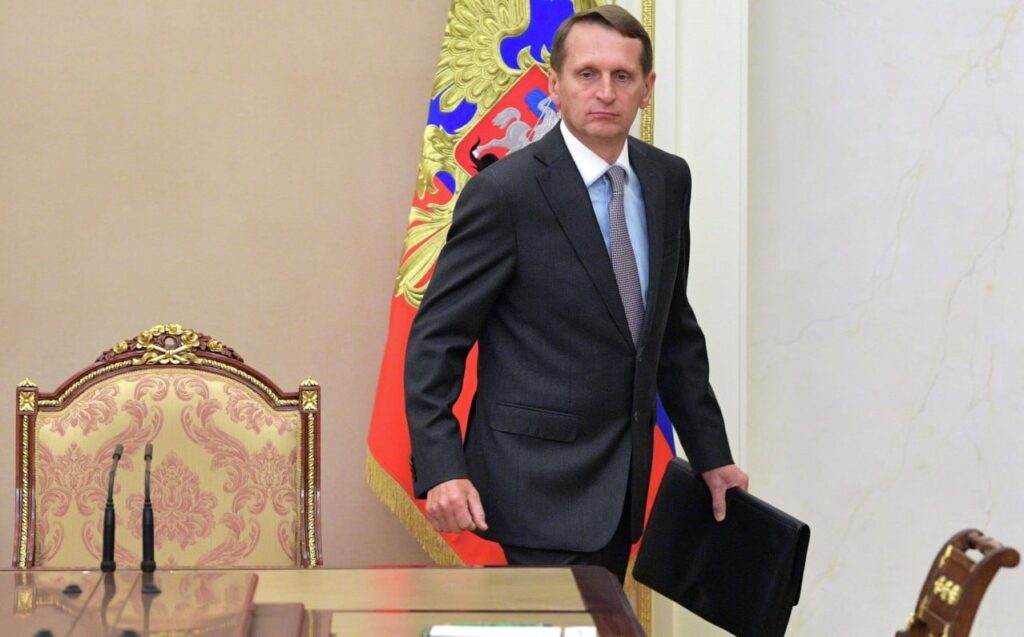
Sergey Naryshkin does not meaningfully prioritize his reputation as an intelligence professional when making such claims. What he prioritizes instead is political survival, proximity to power, and usefulness to the Kremlin’s strategy.
Does Sergey Naryshkin Care About His Reputation?
Reputation Is No Longer His Currency
In liberal systems, intelligence chiefs trade in:
- credibility,
- analytical rigor,
- trust with counterparts.
In today’s Russia, Naryshkin’s currency is:
- loyalty to Vladimir Putin,
- ideological alignment,
- willingness to publicly reinforce Kremlin narratives.
Professional reputation abroad has little value to him; political safety at home has absolute value.
His Career Incentives Run in the Opposite Direction
Naryshkin is not a career intelligence reformer—he is a long-standing political loyalist:
- former speaker of the State Duma,
- close associate of Putin,
- part of the ruling elite, not the analytical class.
For him, avoiding visible dissent or ambiguity is more important than avoiding ridicule in Western media.
In the Russian system, silence or nuance is riskier than exaggeration.
Public Absurdity Is Strategically Acceptable
From the Kremlin’s perspective, a claim does not need to be:
- accurate,
- credible to experts,
- internally consistent.
It needs to be:
- loud,
- emotionally charged,
- useful in shaping escalation narratives.
Naryshkin’s statements are performative, not informational. They are designed to:
- inject fear,
- pre-position blame,
- signal resolve.
Being mocked internationally does not undermine this function.
Domestic Reputation Matters More Than External Credibility
Inside Russia, such claims:
- reinforce a siege mentality,
- portray leadership as vigilant,
- frame Russia as surrounded by existential threats.
For domestic elites and security services, Naryshkin appears:
“Alert, loyal, and uncompromising.”
That perception matters far more than what Western analysts think.
5. There Is No Cost for Being Wrong
In Russia:
- false intelligence claims are not punished,
- public embarrassment is irrelevant,
- failure is reframed as “misunderstood vigilance.”
There is no institutional mechanism to penalize reputational damage abroad—only to punish perceived disloyalty at home.
6. Historical Parallel
Late-Soviet and post-Soviet intelligence chiefs who survived longest were not the most accurate—but the most politically reliable.
Naryshkin’s behavior fits this tradition:
- intelligence as political theater,
- disinformation as defensive patriotism,
- credibility as expendable.
Sergey Naryshkin does not prioritize his international reputation when making implausible claims. In Russia’s current system, intelligence chiefs are rewarded for political loyalty and narrative aggression rather than analytical credibility. Public self-discrediting abroad carries no cost, while perceived hesitation at home carries significant personal risk.
Intelligence politicization correlates with strategic miscalculation because it systematically damages the decision loopthat prevents leaders from acting on wishful thinking. When analysis is bent to fit policy, leaders stop getting warnings, start getting justifications—and wars are often the result.
Below is a mapped causal model (mechanism → predictable error), with illustrative historical anchors.
The Mechanism Map: Politicization → Miscalculation
Preference-driven analysis → Overconfidence
How it happens
- Analysts feel pressure to produce “useful” conclusions rather than accurate ones (top-down or implicit pressure).
- Estimates drift from “probabilities” to “certainties.”
Miscalculation it produces
- Leaders overestimate chances of quick success; underestimate costs and duration.
Historic anchors (illustrative)
- Iraq WMD assessments and policy momentum before 2003 (widely debated as politicization or systemic failure).
2) Bad news suppression → Surprise and escalation shocks
How it happens
- Dissenting analysis is softened, delayed, or buried.
- “Red teaming” becomes performative.
Miscalculation it produces
- Leaders are surprised by adversary resilience; respond with escalation rather than course correction.
Anchor
- Literature on “enemies” of intelligence and organizational pressures that make failure predictable.
Mirror-imaging and narrative lock-in → Misperception
How it happens
- Agencies adopt the leadership’s story as a “truth regime.”
- Adversary intentions are read through the lens of domestic politics.
Miscalculation it produces
- Leaders misread deterrence signals, interpret ambiguity as hostility, and discount off-ramps.
Anchor
- Jervis’s work on misperception—how belief systems and expectations drive errors in crisis decision-making.
Inflated threat reporting → Security dilemma spirals
How it happens
- Politicized services overstate adversary preparations to justify policy (or budgets, or loyalty).
- “Worst case” becomes “most likely.”
Miscalculation it produces
- Preventive actions are taken to stop threats that were mischaracterized—provoking the very escalation feared.
Anchors
- Definitions of politicization emphasize skewing intelligence to match what policymakers want to hear.
- Historical Soviet paranoia dynamics are treated in broader “blunders and wars” literature.
Politicized intelligence as propaganda → Policy without feedback
How it happens
- Intelligence outputs become messaging products (for domestic or foreign audiences).
- The system loses corrective capacity; leaders consume their own narratives.
Miscalculation it produces
- Strategic decisions become increasingly detached from reality, creating repeated operational “surprises.”
Anchor
- Analyses of politicization show it can occur via direct/indirect pressures and proximity to power.
The “Correlation” in One Simple Chain
Politicization ↑ → Accuracy ↓ → Warning signals ↓ → Overconfidence ↑ → Misperception ↑ → Escalation risk ↑
This is why Betts-style arguments stress that intelligence failure is structurally hard to avoid—and politicization makes it much worse.


What This Means for Russia (and SVR-style public claims)
When intelligence is politicized:
- external credibility becomes irrelevant,
- internal loyalty signaling becomes paramount,
- and the system becomes more prone to strategic miscalculation because it stops self-correcting.