
A large-scale U.S.–Israel ground invasion of Iran is unlikely in the near term. What is plausible—and already being signaled in open reporting—is a limited “ground-enabled” campaign: air/missile strikes combined with Kurdish (and potentially other peripheral) armed groups opening pressure fronts, raids, or border penetrations designed to stretch Iranian security forces, disrupt command and logistics, and amplify internal instability.
The core strategic question is not “Will the U.S. invade Iran?” but rather: Will Washington and Israel operationalize Kurdish groups as a second-front lever for regime pressure—at scale—despite severe regional blowback risk?
What is being discussed/observed publicly
Open-source reporting indicates:
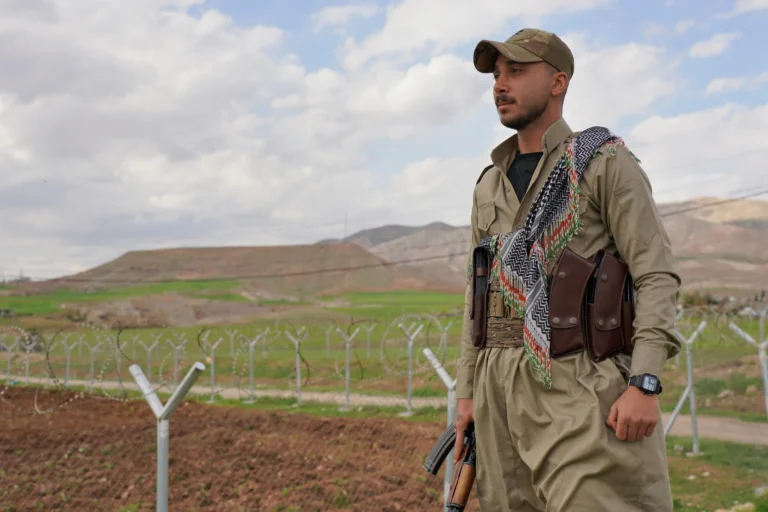
- Kurdish Iranian dissident groups in northern Iraq (e.g., PAK, Komala; often referenced alongside KDPI/PDKI networks) claim preparations for cross-border activity and discussions involving U.S. interlocutors, while Kurdish regional leaders remain cautious due to fear of Iranian retaliation.
- Reuters reports U.S.–Kurdish discussions around a potential operation as U.S./Israel strikes continue, with Kurdish groups training for attacks intended to weaken Iranian forces.
- Reporting also describes intensified strikes along the Iran–Iraq border and claims that U.S./Israel coordination with Kurdish forces aims to open a new pressure front—paired with warnings about destabilizing effects and Turkey/Iraq sensitivities.
- Analytic briefs note Iran has already struck areas in Iraqi Kurdistan it alleges host militant elements and frames this as pre-emption/containment along the western frontier.
Plausible aims of using Kurdish forces
A. Military aims (limited, realistic)
- Fix and divert IRGC/internal security forces away from key urban nodes and strategic sites.
- Create “multi-front stress” to degrade Iran’s ability to coordinate retaliation and internal control.
- Disrupt border logistics corridors and IRGC lines of communication in western Iran (short-range disruption rather than strategic conquest).
B. Political aims (high leverage, high risk)
- Catalyze regime instability by signaling momentum and encouraging defections—especially during leadership uncertainty and wartime shock.
- Create bargaining leverage (de-escalation on favorable terms) by demonstrating Iran’s internal vulnerability.
Probability: what is likely vs. unlikely (next 1–3 months)
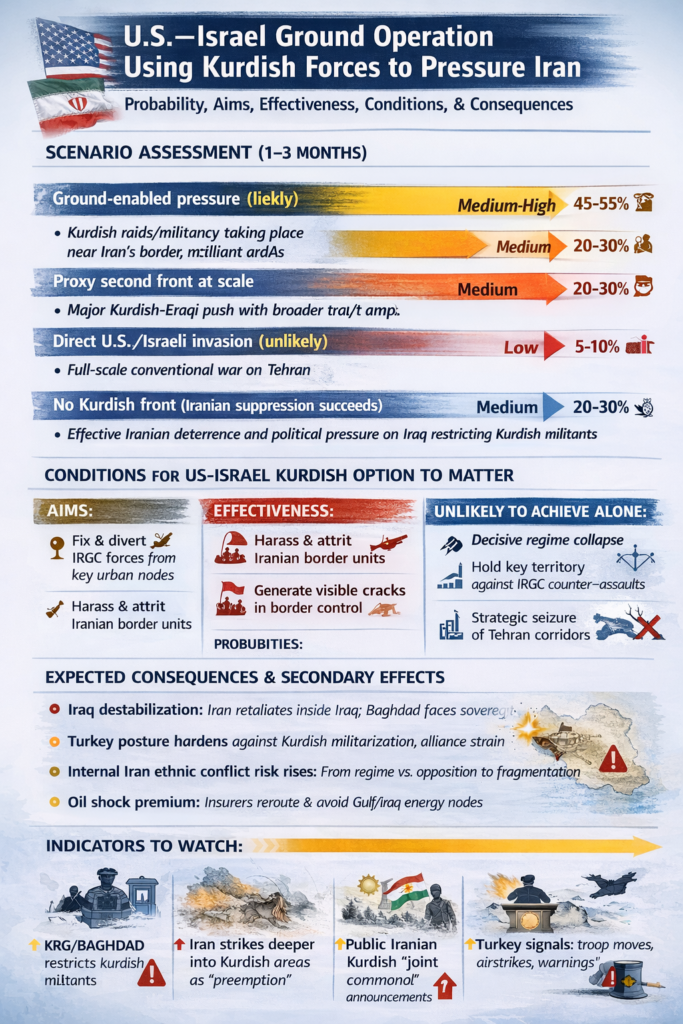
Scenario matrix (near-term)
Scenario 1 — “Ground-enabled pressure” (most likely)
Description: Kurdish groups conduct limited cross-border raids, sabotage, or harassment with external intelligence enabling and selective air support; no deep occupation.
Probability: Medium–High (~45–55%)
Why: Fits current signals while limiting U.S. footprint and political risk.
Scenario 2 — “Proxy second front at scale” (escalated Kurdish campaign)
Description: Sustained Kurdish push with greater territorial/operational ambition (attempts to hold areas), becoming a major theater.
Probability: Medium (~20–30%)
Why not higher: Requires Iraqi Kurdish political green-light and tolerating major Iranian retaliation; also invites Turkey intervention dynamics.
Scenario 3 — “Direct U.S./Israel ground incursion (conventional invasion)” (unlikely)
Description: Large conventional ground invasion targeting Tehran regime change.
Probability: Low (~5–10%)
Why: Would require massive troop commitments and likely produce insurgency blowback; major analyses argue such a path is strategically prohibitive.
Scenario 4 — “No Kurdish front (suppression/containment succeeds)”
Description: Baghdad/KRG restrict Kurdish militants; Iran’s deterrence strikes and political pressure contain cross-border activity.
Probability: Medium (~20–30%)
Why: Iraq’s central government has incentives to prevent its territory being used as a launchpad; fear of Iranian retaliation is real.
Effectiveness: what Kurdish forces can realistically deliver
Likely effective at:
- Harassment and attrition of Iranian border units
- Forcing Iranian redeployments and expanding internal security workload
- Generating psychological pressure inside Iran by demonstrating porous borders
Unlikely to achieve alone:
- Decisive regime collapse (without elite fracture in Tehran)
- Holding major territory against IRGC counteraction
- Strategic seizure of Tehran corridors (too escalatory; too logistically exposed)
Bottom line: Kurdish forces are a disruption multiplier, not a regime-change instrument by themselves.
Conditions required for a Kurdish-enabled ground outcome to matter strategically
- Political cover and access in Iraqi Kurdistan (KRG) and toleration by Baghdad—otherwise the rear area collapses politically.
- External enabling (ISR, comms, limited air cover) to prevent rapid IRGC suppression.
- Iranian elite distraction or fragmentation (succession struggle, IRGC factionalism). Without this, Tehran can concentrate force.
- Turkey’s reaction management: Ankara historically treats empowered Kurdish armed actors as a direct security threat; escalation risks Turkish intervention or blockade dynamics.
Consequences and second-order effects (high confidence)
Regional consequences
- Iraq destabilization risk rises sharply: Iran retaliates on Iraqi soil, Baghdad faces sovereignty crisis, U.S. bases become higher-value targets.
- Turkey hardens posture against any Kurdish militarization near its borders; alliance cohesion becomes harder to manage.
- Iran internal conflict risk increases: empowering ethnic/separatist fronts can broaden conflict beyond regime vs. opposition into center–periphery fragmentation.
Oil market consequences
Even without a full Hormuz closure, a Kurdish-front escalation tends to increase:
- risk premium (insurance, routing hesitancy)
- volatility via retaliation cycles across the Gulf and northern Iraq energy nodes
This pushes prices higher through uncertainty rather than pure supply loss.
Russia angle: what this signals about “ally protection”
If U.S./Israel can openly explore a Kurdish-enabled second front while striking Iran, it reinforces the pattern you flagged in your broader work: Moscow’s inability to protect partners from U.S.-led escalation (Syria → Venezuela → Iran). In this case, Russia can protest diplomatically, but it cannot credibly deter or shield Iran’s internal periphery from becoming an arena of external pressure—especially when Russia is strategically overstretched elsewhere.
Early-warning indicators to watch (next 2–6 weeks)
- KRG/BAGHDAD posture changes: arrests, relocations, border closures, public warnings.
- Increase in Iranian strikes into Iraqi Kurdistan framed as “pre-emption.”
- Public coalition statements from Iranian Kurdish groups about joint command or “new phase,” and evidence of larger mobilization near the border.
- Turkey signals (troop movements, diplomatic ultimatums, air operations).
A Kurdish-enabled “ground component” is plausible as a pressure tool (raids, disruption, diversion), but a decisive ground route to regime change is unlikely unless Iran’s internal elite cohesion collapses. The strategic trade-off for Washington/Israel is stark: higher internal pressure on Tehran comes with higher risk of regional fragmentation—especially in Iraq—and a larger, longer oil risk premium.
Kurdish participation in a conflict involving the United States and Israel against Iran could reshape the long-standing but fragile relationship between Washington and Kurdish political-military actors. The outcome would depend on the scale of Kurdish involvement, political backing from Washington, and reactions from regional states—especially Turkey, Iraq, and Iran.
The relationship between the U.S. and Kurdish forces has historically been instrumental and tactical rather than institutional. Kurdish groups have repeatedly served as effective partners for U.S. operations—from Iraq in 2003 to the anti-ISIS campaign—but they have also experienced periods of abandonment when broader geopolitical priorities shifted.
1. Strategic Background of U.S.–Kurdish Cooperation
The modern U.S.–Kurdish partnership emerged strongly during the fight against the Islamic State when Kurdish forces—particularly the Syrian Democratic Forces and Iraqi Kurdish Peshmerga—became key U.S. ground partners.
Washington valued Kurdish forces because they:
- were highly motivated and cohesive fighters
- possessed deep local knowledge of terrain
- could operate effectively with U.S. intelligence and air support
However, the partnership has always faced structural limits:
- Kurdish political goals (autonomy or independence) often conflict with regional states.
- The U.S. prioritizes regional stability and alliances, especially with NATO partner Turkey.
This tension defines how Kurdish participation in a new conflict would affect the relationship.
2. Potential Positive Effects on U.S.–Kurdish Relations
A. Deeper Military Cooperation
If Kurdish forces successfully assist in operations against Iran:
- U.S.–Kurdish military coordination could deepen significantly.
- Kurdish forces could receive advanced intelligence support, training, and equipment.
This would resemble the operational model used against ISIS.
B. Increased Kurdish Strategic Value
Participation in a major regional conflict could position Kurdish forces as:
- the most reliable U.S. partner force in the Middle East
- a potential buffer against Iranian influence
This could elevate Kurdish actors’ role in U.S. regional strategy.
C. Potential Political Leverage
Kurdish leaders could attempt to convert battlefield cooperation into political concessions, such as:
- stronger international recognition of Kurdish autonomous structures
- economic aid and reconstruction support
- expanded political legitimacy.
Major Risks to U.S.–Kurdish Relations
A. Kurdish Expectations vs. U.S. Strategic Limits
History shows that Kurdish groups often expect political rewards for military cooperation.
Examples include:
- Kurdish expectations after the 1991 Gulf War
- Kurdish disappointment following the 2019 U.S. withdrawal from northern Syria
If Kurdish groups believe Washington is using them instrumentally again, trust could erode.
B. Turkish Backlash
Any Kurdish military empowerment could provoke strong reactions from Turkey, which views many Kurdish armed groups as security threats.
Potential consequences:
- Turkish military pressure on Kurdish regions
- diplomatic tensions within NATO
- constraints on U.S. ability to deepen cooperation with Kurdish forces.
C. Iraqi Sovereignty Crisis
If Kurdish forces launch operations into Iran from Iraqi territory:
- Baghdad could accuse Kurdish groups of violating Iraqi sovereignty.
- This could create internal political crisis between the central government and Kurdish regional authorities.
Such tensions would complicate U.S.–Iraq relations.
Iranian Retaliation Against Kurdish Regions
Iran possesses significant leverage against Kurdish areas, particularly through:
- cross-border missile and drone strikes
- intelligence operations
- pressure on Kurdish political factions.
Tehran has previously struck Kurdish militant bases in Iraqi Kurdistan and would likely escalate retaliation if Kurdish forces participate in operations against Iran.
This could make Kurdish territories frontline zones in a regional war.
Long-Term Strategic Scenarios
Scenario 1: Strategic Partnership (Moderate Probability)
If Kurdish involvement proves effective and the conflict remains limited:
- Kurdish forces become a semi-permanent U.S. regional partner
- security cooperation expands.
Scenario 2: Tactical Partnership Followed by Disappointment (Most Likely)
More likely, Kurdish forces assist operationally but receive limited political gains afterward.
This would replicate past patterns where:
- the U.S. values Kurdish military assistance
- but avoids political commitments that could destabilize relations with regional states.
Scenario 3: Strategic Backlash (Low–Moderate Probability)
If Kurdish participation triggers large regional escalation:
- Kurdish regions could face retaliation from Iran or Turkey.
- Washington might distance itself to avoid broader war.
This scenario would significantly damage Kurdish trust in the United States.
Strategic Conclusion
Kurdish involvement in a U.S.–Israel operation against Iran would likely strengthen short-term military cooperation but also amplify long-term political tensions.
The key structural dilemma remains unchanged:
- Kurdish forces seek political recognition and autonomy.
- The United States seeks regional stability and flexible alliances.
Unless these goals align, U.S.–Kurdish relations will remain transactional rather than strategic—characterized by strong operational cooperation but limited political commitment.
More on this story: Probability of a U.S. strike on Iran (late Jan 2026)