
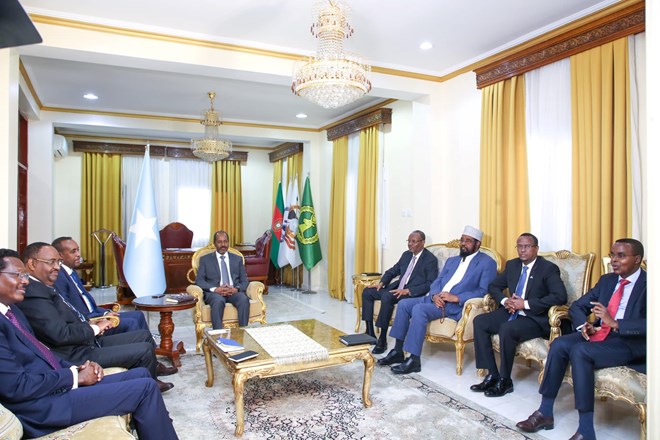
Somalian Lawmakers have overwhelmingly approved the national Constitution after a “sweeping” review of critical chapters, hailing the vote as a historic milestone toward finalizing the country’s constitutional framework and strengthening its democratic institutions.Somalia has operated under a Provisional Constitution adopted in 2012, which marked the formal end of the transitional period after decades of civil war and state collapse.
However, the document was never finalized and left many critical issues unresolved, including:
the distribution of power between the federal government and regional states, the electoral system, the role and authority of the president and prime minister, the overall structure of Somalia’s federal system.
As a result, constitutional reform has been debated for more than a decade, culminating in a new series of votes in parliament between 2024 and 2026.
Reasons for Changing the Constitution
Several structural and political factors explain the push to revise the constitution.
Transition from clan-based politics to universal suffrage
Somalia’s political system has traditionally been based on clan power-sharing arrangements, where clan leaders select members of parliament who then elect the president.
Recent reforms aim to introduce direct elections and universal suffrage, replacing this clan-based system.
Supporters argue this is necessary to:
- strengthen democratic legitimacy, reduce corruption in indirect elections, create political parties instead of clan blocs.
Need to finalize the “provisional” constitution
The 2012 constitution was explicitly designed as a temporary framework, pending later revision and approval through referendum.
Many legal ambiguities remain unresolved, such as:
- federal vs regional powers, electoral mechanisms, institutional responsibilities.
This has led successive governments to push for a completed constitutional structure.
Political control and electoral timing
Another motivation is the political calendar.
Recent amendments could delay elections and potentially extend the mandates of current leaders, which has become one of the most controversial elements of the reform.
Opposition politicians argue that the constitutional process is being used to reshape the political system before elections.
Security and state-building challenges
Somalia still faces major instability, including insurgency by al-Shabaab, weak institutions, and fragile governance.
Supporters of reform claim that:
- stronger central institutions
- a clearer constitutional framework
are necessary for state consolidation and long-term stability.
Who Initiated the Constitutional Changes
The constitutional reform initiative has largely been driven by the federal government under President Hassan Sheikh Mohamud.
Key initiators include:
- President Hassan Sheikh Mohamud, the Federal Government of Somalia
- the Independent Constitutional Review and Implementation Commission (ICRIC), which drafted amendment proposals.
The process involved debates in both chambers of Somalia’s bicameral parliament before final votes on the amendments.
Who Supported the Changes
Federal government and presidential allies
The main supporters are:
- President Hassan Sheikh Mohamud,
- members of the ruling political coalition,
- government ministers and pro-government parliamentarians.
They argue the reforms are necessary to modernize Somalia’s political system and move toward direct democratic elections.
Some political reform advocates
Certain political actors support reforms because they believe the existing system:
- entrenches clan elites,
- prevents the development of national political parties.
For these actors, the constitutional reform represents a transition toward a modern democratic system.
Who Opposes the Changes
Opposition to the reforms has been strong and includes multiple actors.
Opposition politicians
Many opposition lawmakers claim the amendments:
- concentrate power in the presidency, undermine democratic processes, extend the political mandates of current leaders.
Some lawmakers even disrupted parliamentary sessions during debates on the reforms.
Regional federal states
Some semi-autonomous regions, especially Puntland, strongly oppose the constitutional overhaul.
Puntland authorities accuse the federal government of:
- centralizing power;
- weakening federal autonomy.
After the 2024 amendments, Puntland even withdrew recognition of the federal government temporarily.
Civil society and international observers
Some observers and analysts have raised concerns about:
- lack of consensus among political actors
- insufficient consultation with federal states
- potential risks to Somalia’s fragile political balance.
What Is New in the Constitutional Changes
Several significant institutional changes have been proposed or approved.
6.1 Direct elections
One of the most important changes is the move toward universal suffrage, allowing citizens to vote directly rather than relying on clan-based representation.
Changes to presidential powers
The amendments could:
- strengthen executive authority
- allow the president greater control over government appointments.
Critics say this risks expanding presidential power at the expense of parliament.
Changes to political party system
Proposals include limiting the number of political parties to encourage a more structured national political system.
Potential extension of political mandates
Recent votes may delay elections and extend the term of political leaders, which is one of the most controversial aspects of the reform.
Political and Strategic Consequences
Increased political tensions
The constitutional vote has deepened divisions between:
- the federal government;
- opposition parties;
- regional administrations.
These tensions could destabilize Somalia’s already fragile political system.
Risk of federal fragmentation
If disputes continue, regions like Puntland could further distance themselves from Mogadishu.
This would weaken Somalia’s federal structure.
Delayed elections
The reforms could delay national elections because the electoral framework must first be redesigned.
This could prolong the current political leadership.
Impact on counter-terrorism and stability
Political disputes may weaken the government’s focus on fighting al-Shabaab.
Institutional instability often benefits insurgent groups operating in fragile states.
Strategic Assessment
The constitutional vote represents one of the most significant political reforms in Somalia since 2012, but it has also exposed deep structural tensions in the country’s political system.
The reforms attempt to achieve three major goals:
- transition from clan-based politics to direct democracy
- strengthen federal institutions
- consolidate national political authority.
However, without broad political consensus, the constitutional changes risk triggering renewed political crises or regional fragmentation, undermining the very state-building process they are meant to advance.