
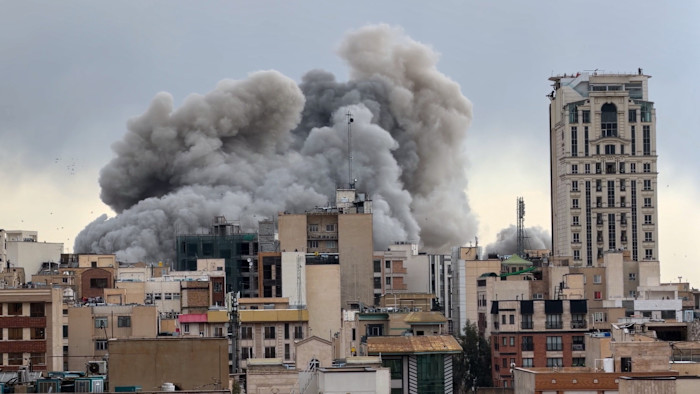
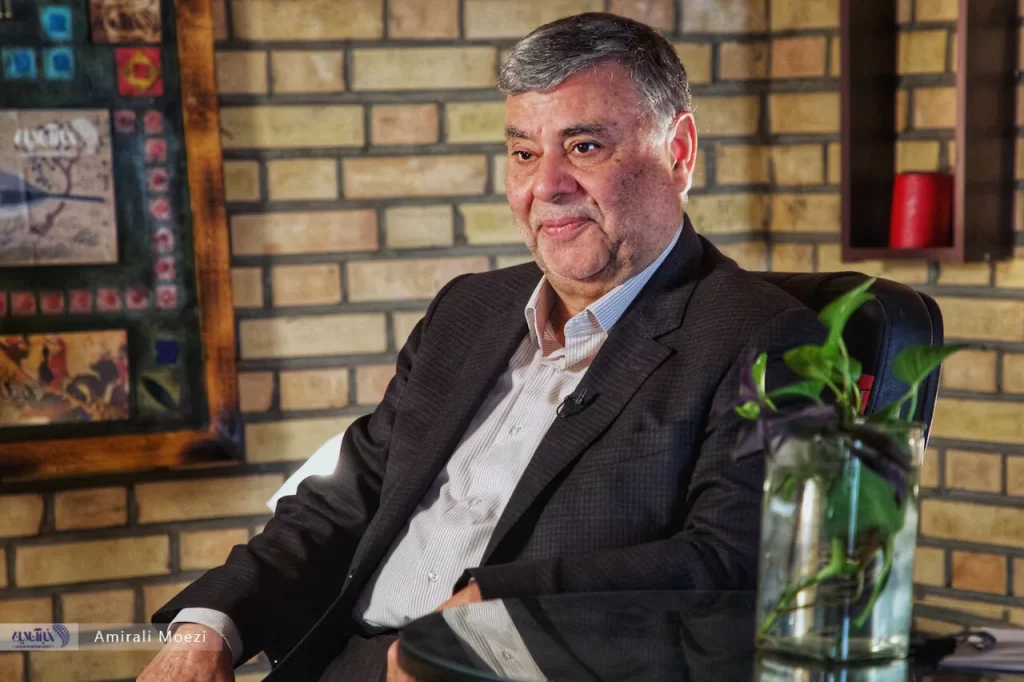
In an interview published by NBC News, Iran’s Foreign Minister Abbas Araghchi stated (timestamp 14:07–14:57) that Russia and China are providing Iran with political and other forms of assistance in its confrontation with the United States and Israel.
His remarks appeared to signal that support from Tehran’s partners may extend beyond diplomatic statements and symbolic expressions of solidarity.
Araghchi emphasized that military cooperation between Tehran and Moscow has been ongoing for many years. However, when directly asked by the journalist whether Russia is providing military assistance in the current conflict, the Iranian minister avoided giving a direct answer.
“I am not going to reveal the details of our cooperation with other countries during wartime,” Araghchi stated.
Araghchi’s carefully worded response reflects a strategy of deliberate ambiguity. By acknowledging “political and other assistance” while refusing to disclose specifics, Tehran sends a dual message.
First, the statement signals deterrence toward Washington and Jerusalem by implying that Iran is not isolated and may receive meaningful support from major powers. Even without confirming military aid, the suggestion alone increases uncertainty for Iran’s adversaries.
Second, the ambiguity allows both Moscow and Beijing to maintain strategic deniability. Russia and China can continue providing diplomatic backing, economic support, intelligence cooperation, or technological assistance without formally acknowledging involvement in the conflict.
Third, the remarks underscore the growing alignment among revisionist powers confronting U.S. influence. While neither Russia nor China is likely to intervene directly in the conflict, their support could take several indirect forms:
- diplomatic protection in international institutions, economic channels to mitigate sanctions pressure, intelligence or technological cooperation, arms or dual-use technology transfers via indirect mechanisms.
The refusal to clarify whether Russia is supplying military assistance is particularly notable given the existing military partnership between Tehran and Moscow, which has expanded significantly since the start of Russia’s war against Ukraine.
Taken together, Araghchi’s comments appear designed to reinforce the perception of a strategic bloc opposing the United States and its regional allies, even if the exact scope of cooperation remains deliberately opaque.
Russia could realistically help Iran militarily in indirect, deniable, and limited ways—but the evidence so far points away from any direct Russian intervention. Reuters reported on March 5 that Russia and China were largely standing aside, offering only limited diplomatic support, while the Kremlin also said Iran had not requested Russian arms supplies. That fits the structure of the January 2025 Russia–Iran strategic pact, which deepened defense cooperation but did not include a mutual-defense clause obliging Moscow to fight for Iran.
The most realistic military support from Russia would be technical and advisory support, not combat forces. Reuters reported in 2025 that senior Russian missile specialists had visited Iran, including experts with backgrounds in air defense, rocketry, and artillery. That strongly suggests Moscow has the networks and expertise to help Iran with battle damage assessment, reconfiguration of air-defense coverage, missile-force survivability, and technical troubleshooting—even if neither side publicly confirms it. This is an inference from the existing pattern of cooperation, not proof of current wartime transfers.
A second realistic channel is intelligence-sharing. The 2025 strategic partnership explicitly broadened cooperation between the two countries’ security services, and Reuters summarized the pact as covering closer defense coordination, joint drills, port visits, and officer training. In practice, that creates a framework for Russia to share warning data, target-pattern analysis, air-defense lessons, and operational assessments drawn from its own war experience—even if Moscow avoids visible weapons shipments.
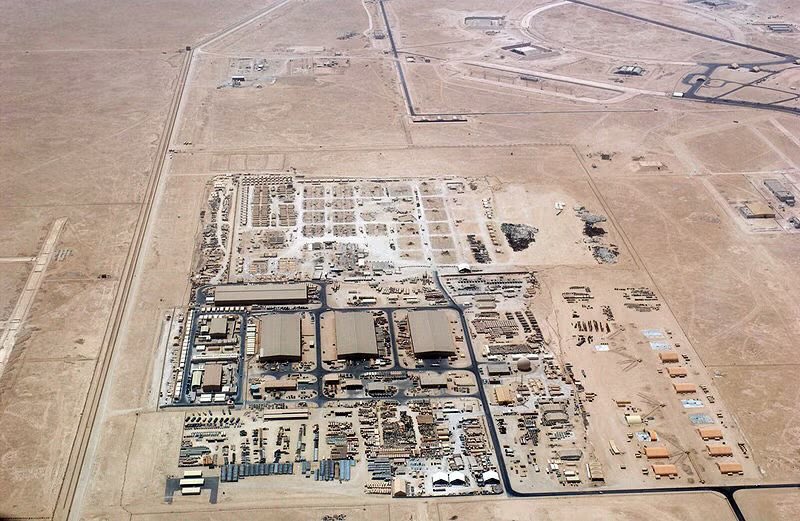
More on this story: INTELBRIEF: Russian Involvement in Iranian Strikes on U.S. Military Targets
A third avenue is spare parts, maintenance assistance, and limited systems support for Iranian equipment with Russian links or Russian-derived architecture. That is more plausible than Russia sending large new weapons packages while it is heavily committed in Ukraine. Reuters’ current reporting that Moscow is overextended and avoiding deeper involvement makes major rearmament less likely, but small-scale sustainment support is consistent with longstanding defense ties and easier to conceal.
Russia could also provide electronic-warfare know-how, drone-defense lessons, and hardening advice. This would be one of the cheapest and most deniable forms of help, especially because Russia has accumulated extensive experience defending bases and infrastructure from missiles and drones during the Ukraine war. Again, the public record does not prove those transfers are happening now, but it is one of the most plausible forms of “other assistance” short of overt intervention. Reuters’ reporting on Russian missile and air-defense specialists visiting Iran supports that possibility. According to our information, which is corroborated by reporting from The Washington Post, Russia is providing Iranwith intelligence data to facilitate strikes against United States forces.
What Russia is least likely to do is send combat aircraft, air-defense battalions, or expeditionary troops to fight for Iran. Reuters’ March 5 reporting says Moscow is making a pragmatic calculation: it is distracted by Ukraine, wants to preserve ties with Gulf states, and is avoiding direct confrontation with the United States and Israel. The absence of a mutual-defense clause in the bilateral treaty reinforces that limit.
There is also a political reason for restraint: Russia can still benefit from the crisis without entering it directly. Reuters noted that rising oil prices help Russia’s war economy, while Moscow can still posture as a diplomatic backer or mediator. That means the Kremlin has incentives to keep support below the threshold that would trigger direct costs or escalation with Washington.
Thus, : if Russia helps Iran militarily, it is most likely to do so through advisers, intelligence, technical assistance, sustainment, and deniable support networks—not through a visible military intervention. Moscow has the channels to help Iran become more resilient, but current reporting suggests it is trying to avoid becoming a co-belligerent.
China’s approach to the war involving Iran, the United States, and Israel is defined by strategic restraint. Beijing condemns military escalation and calls for negotiations, but it has avoided military involvement and limited its response largely to diplomacy.
This cautious posture reflects China’s broader geopolitical priorities: protecting energy security, maintaining balanced relations across the Middle East, avoiding direct confrontation with Washington, and positioning itself as a potential mediator.
China’s Core Strategic Interests in the Iran Conflict
Energy security
China is the world’s largest oil importer, and the Middle East is a critical supplier. A major escalation threatens shipping routes such as the Strait of Hormuz, through which a significant share of global oil passes. Disruptions have already pushed prices higher and raised energy-security concerns for Asian economies.
China relies heavily on discounted oil from sanctioned producers, including Iran and Russia, making regional stability essential for its economy.
Implication:
Beijing seeks to prevent a prolonged regional war that could disrupt oil flows and damage global markets.
Strategic diversification in the Middle East
China’s regional strategy is built on balanced relationships rather than exclusive alliances. Beijing maintains economic and diplomatic ties not only with Iran but also with Saudi Arabia, the United Arab Emirates, Turkey, and Israel.
Unlike traditional security alliances, China’s policy is based on economic connectivity and political neutrality, enabling it to cooperate with rival states simultaneously.
Implication:
China cannot openly support Iran militarily without risking relationships with other major Middle Eastern partners.
Why China Avoids Military Support for Iran
Avoiding confrontation with the United States
China’s primary strategic competition is with the United States in the Indo-Pacific, particularly regarding Taiwan and the South China Sea.
Entering a military confrontation in the Middle East would:
- stretch Chinese military resources, escalate tensions with Washington, distract from China’s core strategic theater.
Protecting global economic stability
China’s economic model depends on stable trade flows and predictable energy markets. Large-scale conflict in the Persian Gulf would threaten shipping lanes and increase global economic volatility.
Maintaining diplomatic credibility
China promotes itself as an advocate of dialogue and negotiation in international conflicts. Chinese leaders have urged an immediate end to military strikes and called for diplomatic solutions to the crisis.
Supporting Iran militarily would undermine Beijing’s narrative of being a responsible global mediator.
What China Gains From Strategic Restraint
Observing U.S. military operations
China benefits from analyzing how the United States conducts high-intensity operations against Iranian infrastructure and missile forces. This provides valuable insights into:
- U.S. strike doctrines, missile defense performance, precision strike technologies.
These lessons are relevant to potential future conflicts in East Asia.
Expanding influence through diplomacy
By positioning itself as a mediator, China can present an alternative to the U.S.-led security order. Analysts note that Beijing’s Global Security Initiative aims to promote a new framework for regional conflict management.
This diplomatic positioning strengthens China’s influence in the Middle East without requiring military intervention.
Leveraging economic opportunities
If Iran weakens economically or politically during the conflict, China could gain additional leverage over Iranian energy resources and infrastructure investments through existing long-term cooperation agreements.
A 25-year strategic partnership between China and Iran already envisions major Chinese investment in exchange for stable oil supplies.
Potential Forms of Chinese Support to Iran
Although direct military intervention is unlikely, China could still provide indirect support:
Diplomatic support
- blocking or softening UN resolutions, advocating negotiations.
Economic lifelines
- continued oil purchases, financial channels mitigating sanctions pressure.
Technology and dual-use materials
- components and materials used in missile or drone programs have historically been linked to Chinese supply chains.
These mechanisms allow China to help Iran without becoming a belligerent.
Strategic Risks for China
Energy supply disruption
If conflict escalates and shipping through the Persian Gulf collapses, China could face major supply shortages despite strategic reserves.
Regional polarization
Open support for Iran could damage relations with Gulf monarchies that are important economic partners.
U.S. pressure
Washington may increase diplomatic and economic pressure on Beijing to reduce purchases of Iranian oil and distance itself from Tehran.
Likely Chinese Strategy
China’s most probable approach combines four elements:
- Public condemnation of military escalation, Calls for negotiations and mediation
- Limited economic support to Iran, Avoidance of direct military involvement
This allows Beijing to protect its interests while minimizing risks.
China’s strategy in the Iran conflict reflects a broader pattern in its foreign policy: maximize geopolitical influence while minimizing direct exposure to military risk.
Beijing benefits from maintaining Iran as a strategic partner and energy supplier, but its primary priorities—economic stability, balanced regional relations, and avoiding confrontation with the United States—make overt military support highly unlikely.
Instead, China will likely pursue a hybrid strategy of diplomatic positioning, economic engagement, and strategic observation, seeking long-term geopolitical advantage without entering the conflict itself.
Russia and Iran Today vs. the USSR and Nasser’s Egypt: A Historical Comparison
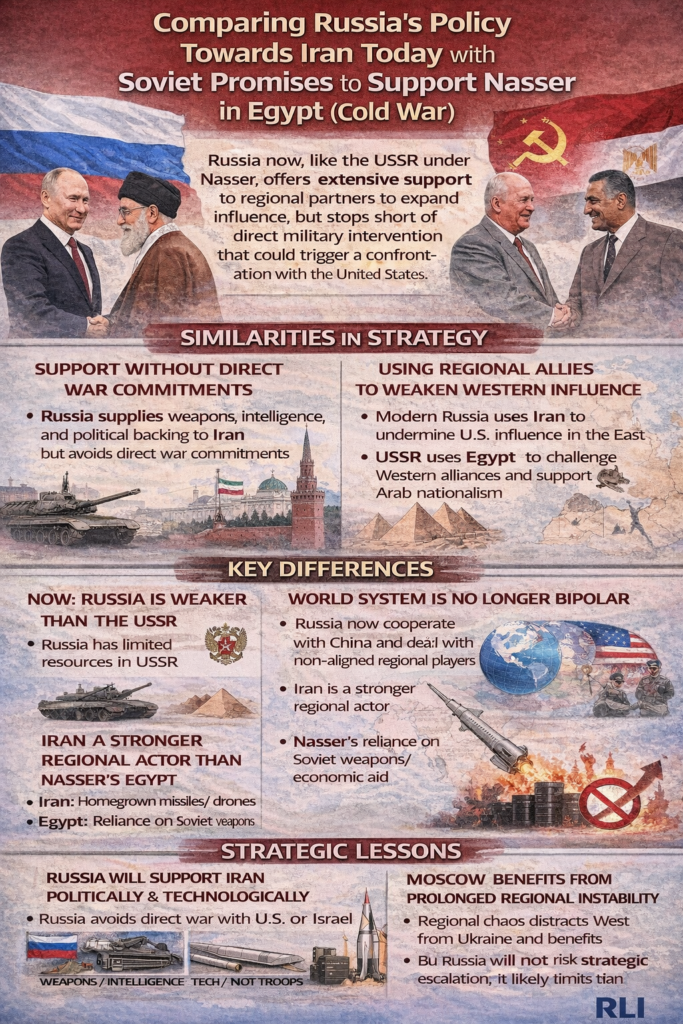
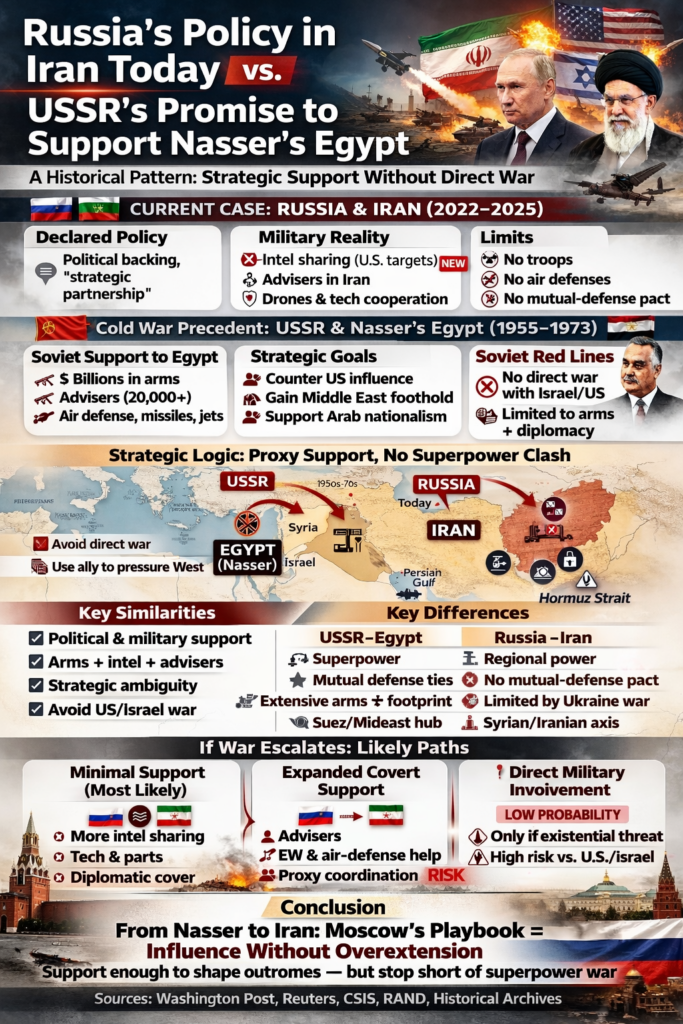
Russia’s cautious stance toward Iran today resembles the Soviet Union’s behavior toward Egypt under Gamal Abdel Nasser during the Cold War. In both cases, Moscow offered political backing, weapons cooperation, and strategic signaling, but stopped short of committing to direct military defense of its partner when war risked escalation with the United States.
The comparison reveals a recurring pattern in Russian foreign policy: support allies enough to expand influence, but avoid commitments that could trigger direct superpower confrontation.
The Soviet–Nasser Relationship During the Cold War
In the 1950s–1960s, Gamal Abdel Nasser positioned Egypt between the United States and the Soviet Union, leveraging superpower competition for military and economic support.
Massive Soviet support
The USSR became Egypt’s main military partner through the 1955 Egyptian–Czechoslovak arms deal, supplying tanks, aircraft, and other weapons worth tens of millions of dollars.
Over time, Soviet support expanded dramatically:
- billions of dollars in economic assistance, large-scale arms deliveries, thousands of military advisers in Egypt, major infrastructure projects such as the Aswan High Dam.
The Soviet Union saw Egypt as a strategic foothold in the Middle East to counter Western influence and support anti-Western Arab nationalism.
But Moscow still imposed limits
Despite this extensive support, the USSR consistently refused direct military involvement against Israel or the United States.
For example, when Nasser asked Moscow to assume direct responsibility for Egypt’s air defense in 1970, Soviet leaders resisted because it could trigger a crisis with Washington.
Thus, Soviet support for Egypt was extensive but carefully controlled.
Russia’s Behavior Toward Iran Today
Russia’s relationship with Iran follows a similar strategic logic.
Moscow and Tehran maintain close cooperation in:
- missile and drone technologies, arms transfers, intelligence coordination
- regional operations (e.g., Syria).
However, Russia has not entered the current conflict directly and avoids confirming any military support during wartime.
This mirrors Soviet caution during the Cold War.
Strategic Similarities
A. Support without direct war commitment
Both Moscow today and the Soviet Union during the Cold War:
- supplied weapons and military expertise, offered diplomatic protection
- used regional partners to challenge Western influence.
But they avoided becoming co-belligerents in regional wars.
This reflects a longstanding Russian strategic principle:
proxy leverage without direct confrontation with the United States.
B. Using regional allies to weaken Western influence
During the Cold War, the USSR used Egypt and other Arab states to counter Western alliances in the Middle East.
Similarly, Russia today views Iran as a key partner in:
- challenging U.S. influence in the Middle East, weakening Western sanctions systems, expanding anti-Western geopolitical alignment.
C. Strategic ambiguity
Both Soviet and Russian policies rely heavily on strategic ambiguity.
In the Cold War Moscow supported Arab states but avoided formal alliance obligations.
Today Russia and Iran cooperate militarily but lack a mutual-defense treaty.
Ambiguity allows Moscow to influence conflicts without assuming full responsibility for them.
Key Differences Between the Two Cases
A. Russia is weaker than the USSR
The Soviet Union was a global superpower with massive military and economic capacity.
Russia today:
- is economically weaker, is heavily committed to the war in Ukraine,
- has fewer resources for large-scale foreign military assistance.
Therefore, Moscow’s support for Iran is likely more limited than Soviet support for Egypt.
B. The geopolitical system has changed
The Cold War was a bipolar world dominated by U.S.–Soviet rivalry.
Today’s system is more complex:
- Russia cooperates with China; regional actors have greater autonomy; conflicts involve multiple overlapping alliances.
C. Iran is a stronger autonomous actor than Nasser’s Egypt
Nasser depended heavily on Soviet weapons and economic aid.
Iran today has its own missile and drone industries, maintains independent regional proxy networks, relies less on external arms suppliers.
This reduces Moscow’s leverage over Tehran compared with Soviet leverage over Egypt.
Strategic Lessons from the Historical Comparison
The Soviet–Egypt precedent suggests several likely patterns for Russia’s behavior today.
Russia will support Iran politically and technologicall. But it will avoid any step that could lead to direct war with the United States or Israel.
Moscow benefits from prolonged regional instability
Regional conflict:
- distracts the West from Ukraine, raises oil prices (benefiting Russia’s economy),
- divides Western attention across multiple crises.
But Russia will not risk strategic escalation
Just as the USSR avoided direct confrontation with Washington during Arab–Israeli wars, Russia today will likely limit its involvement to indirect support.
The comparison between Soviet support for Nasser’s Egypt and Russia’s current policy toward Iran reveals a consistent strategic doctrine.
In both cases, Moscow uses regional partners to expand influence and challenge Western power, while carefully avoiding commitments that could drag it into a direct superpower conflict.The Soviet Union provided Egypt with massive assistance but still refused to fight Israel directly. Likewise, Russia today may assist Iran diplomatically, technologically, or through intelligence cooperation—but it is unlikely to intervene militarily in a way that risks a direct clash with the United States.