
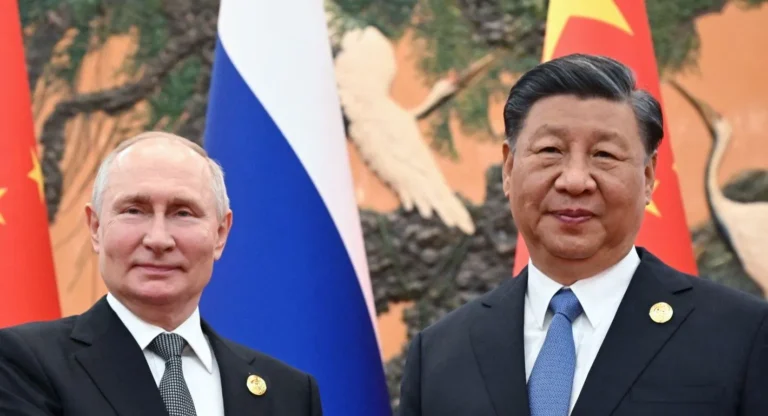
The recent statement by Chinese Foreign Minister Wang Yi highlights a strategic reality that is increasingly difficult for Washington to ignore: Russia now possesses in China a powerful external pillar that enables it to sustain long-term pressure on U.S. global positions. For the United States, this development is particularly troubling because Moscow no longer appears as an isolated revisionist actor. Instead, it is increasingly part of a broader geopolitical alignment that challenges Washington’s ability to define the political, legal, and economic rules of the international system.
The risk for the United States lies not only in the existence of cooperation between the two states but in the political framing of that relationship. Beijing and Moscow increasingly portray their ties as an alliance “as solid as a rock,” characterized by high mutual trust, “back-to-back” strategic support, and close coordination on key international issues. Such rhetoric signals an attempt to institutionalize strategic alignment without the formal obligations of a military alliance.
For Moscow, this partnership provides a crucial mechanism for compensating for its structural weaknesses. Since the beginning of Russia’s confrontation with the West following the Russian invasion of Ukraine, the Kremlin has sought ways to mitigate the impact of sanctions, diplomatic isolation, and economic pressure. China’s support offers Russia an alternative economic corridor, diplomatic backing in international institutions, and political legitimacy in parts of the Global South. This relationship allows Moscow to conduct its geopolitical confrontation with the United States from a significantly stronger strategic rear.
Beijing’s role extends beyond economic cooperation. China provides Russia with political cover for promoting a narrative against what both governments describe as “unilateral hegemony.” Within this framework, Beijing and Moscow advocate a reinterpretation of international law that weakens Western influence and promotes the emergence of a so-called multipolar order in which U.S. dominance would be reduced. Consequently, their cooperation represents not simply a tactical convergence but the emergence of a durable political alignment aimed at reshaping the global balance of power.
Both capitals carefully frame their partnership as more than a temporary response to Western pressure. Beijing and Moscow repeatedly describe their relationship as a new model of interaction between major powers—one that does not require formal alliances but nevertheless allows for coordinated defense of shared geopolitical interests. This narrative is reinforced through historical symbolism, particularly references to the legacy of the World War II and the foundations of the postwar international order. By invoking this historical narrative, China and Russia attempt to present their cooperation as a continuation of a historical mission rather than merely a pragmatic political arrangement.
For Moscow, this historical framing serves an important strategic purpose: it allows the Kremlin to present itself not as an isolated challenger to the international system but as a defender of what it claims to be the original principles of the postwar order. For Beijing, the partnership reinforces its aspiration to shape the norms of the emerging global system. In this context, rhetoric about multipolarity functions not as a neutral description of international dynamics but as a deliberate political instrument designed to redistribute global influence.
China’s public emphasis on the strength of its relationship with Russia also reduces the political cost of Moscow’s confrontation with the West. Russian leadership can argue domestically and internationally that even under intense external pressure it retains the support of a major global power. As a result, the isolation strategy traditionally employed by the United States becomes less effective. Chinese support transforms Russia’s resilience from a symbolic gesture into a tangible strategic factor that complicates Western pressure campaigns.
The partnership also expands Russia’s diplomatic maneuverability among states that prefer to avoid dependence on the United States. China helps Moscow frame its policies not as the defiant actions of a rule-breaker but as part of a broader struggle against Western dominance. This narrative resonates with governments seeking strategic autonomy or balancing strategies among major powers. Under these conditions, Russia finds it easier to cultivate political partnerships and economic ties outside the Western bloc. For Washington, this significantly complicates the competition for influence among neutral or non-aligned states.
For the Kremlin, the concept of a multipolar world serves as more than rhetorical convenience. It functions as an ideological instrument designed to erode the legitimacy of American leadership. The message promoted by Moscow is that global governance should no longer depend primarily on decisions made in Washington. China gives this narrative the scale, economic weight, and global credibility that Russia alone lacks. As a result, Moscow gains greater capacity to persuade other states that a redistribution of global power is both inevitable and desirable. For the United States, this signals a potentially prolonged and resource-intensive struggle to preserve its international status.
The use of historical narratives—particularly references to the Second World War—allows Moscow and Beijing to frame their current geopolitical ambitions within a broader historical context. By invoking the legacy of wartime cooperation and the creation of the postwar order, both governments attempt to present themselves as guardians of the true foundations of international stability. For Russia, this approach helps recast its current policies not as violations of international rules but as a defense of their supposedly correct interpretation. China reinforces this narrative, amplifying Russia’s message and giving it global resonance. For the United States, this dynamic introduces a new dimension of competition: not merely over geopolitical influence but over the authority to define the principles of international order itself.
Finally, the increasingly close political coordination between Moscow and Beijing raises the strategic costs of any international crisis involving either country. Even without a formal military alliance, the partnership creates a structural linkage between the two powers. Any major confrontation involving one side automatically raises the risk of indirect involvement or strategic support from the other. This dynamic complicates the traditional American strategy of deterrence, which historically relied on confronting adversaries individually rather than as part of a coordinated geopolitical alignment.
For the Kremlin, such a situation is advantageous. The emerging partnership disperses American strategic attention and resources across multiple theaters. Washington must now consider not only the independent actions of Russia or China but also the potential consequences of their growing interaction. Even without a formal alliance, the deepening strategic coordination between the two powers creates a geopolitical environment in which the United States faces a more complex and prolonged contest for global influence.
Policy Implications for the United States
The United States should treat China-Russia coordination as a long-term structural challenge rather than a temporary alignment of convenience. That means moving beyond crisis-by-crisis responses and building a strategy that addresses how the partnership functions across diplomatic, economic, military, and informational domains.
First, Washington should avoid policies that unintentionally drive Moscow and Beijing into even tighter strategic dependence on one another. The objective should not be to split them through unrealistic expectations, but to identify and exploit asymmetries in their interests. Russia and China are aligned against U.S. dominance, yet they are not identical actors and do not share perfectly overlapping goals. U.S. strategy should focus on widening the gaps where they exist, especially in Central Asia, Arctic governance, technology dependence, arms markets, and long-term influence over the Global South.
Second, sanctions policy must be recalibrated to account for China’s role as a resilience provider for Russia. Pressure on Moscow alone is insufficient if Beijing can absorb part of the shock. The United States should therefore put greater emphasis on enforcement networks, third-country intermediaries, dual-use supply chains, financial routing mechanisms, and entities that facilitate Russian adaptation. This does not mean maximal confrontation with China across all domains, but it does require more disciplined targeting of channels through which Chinese support materially prolongs Russian strategic endurance.
Third, Washington should compete more effectively in the political arena of the Global South. Russia and China are gaining traction not only through coercion or trade, but through narrative. They frame their agenda as a defense of sovereignty and a correction of Western imbalance. The United States cannot answer this only with warnings. It needs a more credible political offering: practical infrastructure partnerships, more flexible development finance, stronger diplomatic engagement, and a language of international order that resonates beyond the transatlantic space.
Fourth, U.S. deterrence planning should increasingly assume linked crises. A confrontation in Eastern Europe can no longer be viewed in total isolation from developments in the Indo-Pacific, and vice versa. The United States must ensure that force posture, logistics, munitions planning, and alliance management are designed for the possibility that Russia and China will coordinate politically or strategically during simultaneous or overlapping crises.
Finally, the United States should invest more heavily in institutional legitimacy. Because Moscow and Beijing are contesting not only power but the right to define international rules, Washington needs to defend its position through both strength and credibility. Selective consistency on international law, coalition-building, and visible commitment to burden-sharing will matter as much as military capability in this competition.
Policy Implications for NATO
For NATO, the main implication is that the Euro-Atlantic theater can no longer be analyzed in isolation from wider systemic rivalry. Russia remains the Alliance’s most direct military threat, but Russia’s capacity to sustain confrontation is increasingly shaped by China’s support. NATO therefore has to adapt not only to Russian behavior, but also to the strategic depth Beijing gives Moscow.
NATO should begin by further integrating its assessment of Russian military risk with analysis of Chinese political and economic enabling functions. This does not require NATO to redefine China as an identical threat to Russia, but it does require the Alliance to understand how Chinese trade, technology access, diplomatic signaling, and strategic distraction affect Russia’s endurance and calculations.
The Alliance should also strengthen its resilience against multi-theater pressure. One of the advantages of China-Russia coordination is that it can force the West to divide attention and resources. NATO members therefore need stronger industrial readiness, larger ammunition reserves, more robust critical infrastructure protection, and faster political decision-making in crises. A long war of attrition in Europe becomes more dangerous when paired with instability or military signaling in Asia.
NATO’s deterrence posture on its eastern flank should continue to move from symbolic reassurance to credible denial. If Russia believes Chinese backing gives it a stronger strategic rear, the Alliance must reduce any expectation in Moscow that time, pressure, or Western fatigue will weaken NATO resolve. Forward presence, air and missile defense, logistics corridors, and reinforcement planning all become more important in that context.
The Alliance should also deepen coordination with Indo-Pacific partners, especially in areas such as intelligence-sharing, maritime awareness, cyber defense, sanctions enforcement, and protection of technology supply chains.NATO does not need to become an Indo-Pacific alliance, but it does need to recognize that Euro-Atlantic security is increasingly affected by developments beyond Europe.
Finally, NATO must compete more effectively in the domain of political narrative. Moscow and Beijing are trying to portray themselves as defenders of a fairer multipolar order while depicting the West as hegemonic and outdated. NATO should respond by emphasizing not abstract claims of superiority, but concrete evidence: collective defense, rule-based cooperation, protection of sovereignty, and the practical security benefits that alliances provide to member states and partners alike.
The central challenge for the United States and NATO is not simply that Russia and China are growing closer. It is that their partnership is making strategic competition with the West more sustainable, more coordinated, and more global in scope. Moscow gains endurance; Beijing gains leverage; and both benefit from a more fragmented international environment in which U.S. power is harder to translate into decisive outcomes.
The appropriate response is not panic and not rhetorical overreach. It is a disciplined long-term strategy: strengthen deterrence, tighten sanctions enforcement, compete harder in the Global South, prepare for linked crises, and defend the legitimacy of the rules-based order with greater consistency and credibility.
Key Strategic Risks
Economic Resilience for Russia
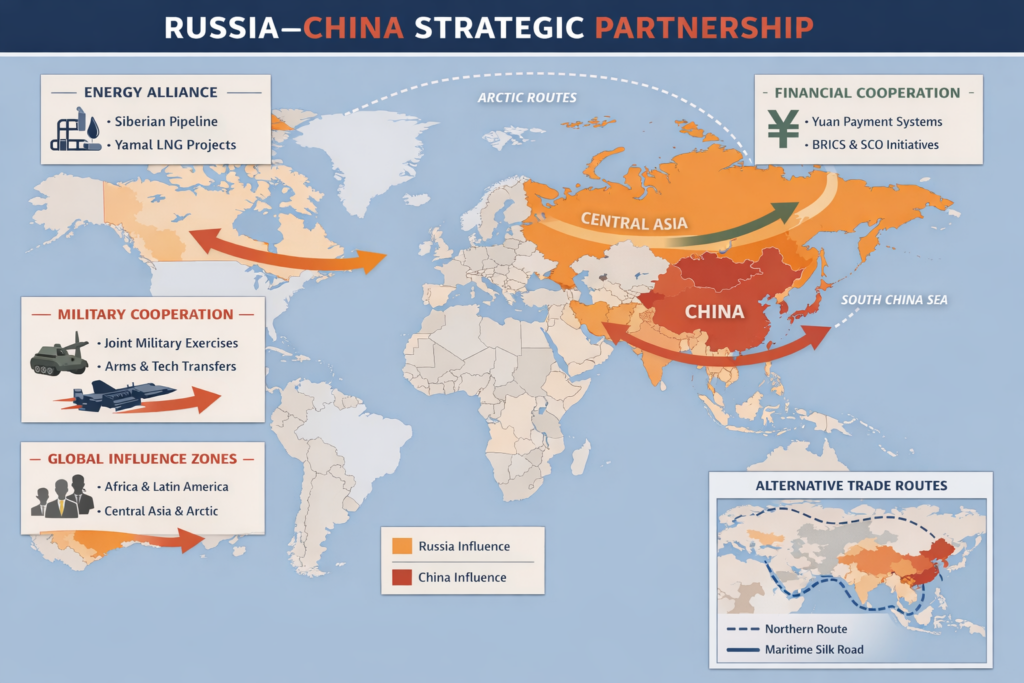
China is likely to remain the primary economic backstop for Russia under Western sanctions. Expanded energy trade, yuan-based settlements, and alternative logistics routes will allow Moscow to partially offset restrictions imposed by Western financial systems.
For the United States and NATO, this means sanctions will remain useful but less decisive than in past geopolitical confrontations.
Coordinated Pressure on U.S. Strategic Bandwidth
Russia and China increasingly benefit from strategic simultaneity: tensions in one theater can amplify pressure in another.
A major European security crisis involving Russia could coincide with military pressure by China in the Indo-Pacific, forcing the United States to allocate resources across two major theaters.
This creates one of the most dangerous scenarios for U.S. planners between 2026 and 2030.
Gradual Erosion of Western Institutional Influence
Both Moscow and Beijing promote narratives of multipolarity and sovereign equality while criticizing Western dominance in global governance.
Through institutions such as BRICS and expanded Global South partnerships, they are attempting to reframe global governance debates.
The result may not be the collapse of Western institutions but a more fragmented international order.
Military-Technological Cooperation
Russia and China have steadily increased military coordination through joint exercises and technology exchanges.
Areas of potential expansion include:
- missile technologies
- aerospace systems
- cyber capabilities
- artificial intelligence for military applications.
Even limited cooperation in these areas could complicate NATO’s technological edge.
Opportunities for the United States and NATO
Despite the growing alignment, the partnership also contains structural weaknesses.
Asymmetry of power
China’s economy is far larger than Russia’s, creating a relationship in which Moscow risks becoming the junior partner.
Over time, this imbalance could produce friction.
Diverging regional interests
Potential areas of competition include:
- Central Asia
- Arctic shipping routes
- influence over post-Soviet states.
These tensions may limit the depth of long-term strategic integration.
Strategic Outlook (2026–2030)
The Russia–China partnership will likely remain flexible rather than formalized. Both sides benefit from cooperation but prefer to avoid the obligations of a treaty alliance.
However, even without a formal alliance, the alignment already creates a geopolitical environment in which:
- Russia gains strategic endurance against Western pressure
- China gains strategic leverage against the United States
- the United States faces a more complex multi-theater competition.
The key risk for Washington and NATO is therefore not a formal Russia–China military bloc, but the persistent strategic coordination between the two powers that gradually reshapes the balance of influence in the international system.