
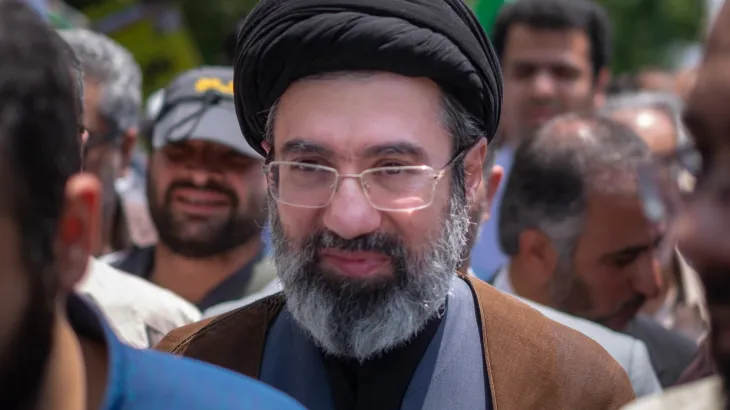
The appointment of Mojtaba Khamenei as the third Supreme Leader of the Islamic Republic marks the most significant leadership transition in Iran since 1989. Selected by the Assembly of Experts in March 2026 after the death of his father Ali Khamenei, Mojtaba inherits a state under extreme geopolitical pressure and domestic strain.
Unlike previous leaders, Mojtaba rose to power largely through informal networks inside the security establishment, especially within the Islamic Revolutionary Guard Corps. His leadership is therefore expected to rely heavily on the Revolutionary Guards and conservative clerical factions.
His rule will likely produce:
- hardline continuity toward the United States and Israel,
- deepening cooperation with Russia and China,
- continued reliance on regional proxy networks,
- greater influence of the IRGC inside the Iranian political system.
Rather than initiating reform, Mojtaba Khamenei’s leadership is likely to further militarize the Iranian state and consolidate power among security elites.
1. Power Structure of the New Supreme Leader
The Supreme Leader is the central authority in Iran’s political system, controlling the armed forces, judiciary, media apparatus, and broad strategic policy directions.
Mojtaba Khamenei assumed power after years operating behind the scenes as a gatekeeper within his father’s office, where he built alliances with conservative clerics and the IRGC.
His accession represents two structural shifts:
Security elite consolidation
His strongest support base lies within the Revolutionary Guards, whose political power has steadily increased since the 2000s.
Dynastic precedent
For the first time since the 1979 Islamic Revolution, Iran experienced a quasi-hereditary succession, which signals the dominance of security institutions over traditional clerical hierarchy.
. Policy Toward the United States
Mojtaba Khamenei is expected to maintain a highly confrontational strategic posture toward the United States.
Ideological foundations
Iran’s revolutionary ideology defines the U.S. as the main geopolitical adversary.
Strategic objectives
Under Mojtaba Khamenei, Tehran is likely to pursue:
- continued asymmetric deterrence
- expansion of missile and drone programs
- pressure on U.S. positions in the Middle East.
Negotiation outlook
While tactical negotiations may occur (particularly regarding sanctions), they will likely follow the model used under his father:
- prolonged negotiations
- strategic delay
- maintaining nuclear and military leverage.
Policy Toward Israel
Iran’s policy toward Israel will almost certainly remain ideologically hostile and strategically confrontational.
Key elements include:
Proxy warfare
Iran will continue to rely on regional partners to pressure Israel indirectly.
Major actors include:
- Hezbollah
- Hamas
- Iraqi Shiite militias
- Yemeni Houthis.
Missile deterrence
Iran will continue expanding its missile and drone capabilities to deter Israeli strikes.
Regional escalation
Under Mojtaba Khamenei, escalation risks may actually increase, particularly if Israel continues targeting Iranian nuclear or military infrastructure.
4. Policy Toward Russia
Iran’s strategic partnership with Vladimir Putin is likely to deepen.
Key areas of cooperation include:
Military cooperation
Russia and Iran have already expanded cooperation in:
- drones
- missile technology
- defense production.
Energy coordination
Iran and Russia may increasingly coordinate:
- energy exports
- sanctions circumvention networks.
Strategic alignment against the West
Both countries share a common interest in weakening U.S. influence in Eurasia and the Middle East.
However, this partnership will remain pragmatic rather than ideological, as Russia ultimately prioritizes its own geopolitical flexibility.
5. Policy Toward Iranian Proxy Networks
Iran’s proxy strategy—sometimes called the “Axis of Resistance”—will remain central to Mojtaba Khamenei’s foreign policy.
Key partners include:
- Hezbollah in Lebanon
- Shiite militias in Iraq
- the Assad regime in Syria
- Houthis in Yemen.
These networks allow Iran to:
- pressure adversaries without direct confrontation
- expand influence across the Middle East
- maintain deterrence against Israel and the United States.
Mojtaba Khamenei is expected to increase funding and coordination of these groups, especially during periods of direct confrontation.
Allies Inside Iran
Clerical allies
Although Mojtaba lacks the senior clerical rank traditionally expected of a Supreme Leader, he is supported by conservative clerics aligned with his father’s legacy.
Important factions include:
- conservative clerical networks in Qom
- political elites tied to the Supreme Leader’s office.
IRGC power base
The most important pillar of Mojtaba Khamenei’s authority will likely be the Revolutionary Guards.
Key institutions include:
- the IRGC command structure
- the Quds Force, responsible for foreign operations
- IRGC-controlled economic networks.
For these actors, Mojtaba represents continuity and protection of institutional privileges.
7. Domestic Challenges
Despite institutional support, Mojtaba Khamenei faces several internal risks.
Legitimacy crisis
His dynastic succession may undermine the Islamic Republic’s ideological legitimacy.
Economic instability
Sanctions, inflation, and unemployment remain major sources of public dissatisfaction.
Social unrest
Iran has experienced repeated waves of protests in recent years.
To maintain control, the regime may rely even more heavily on security forces and repression.
Strategic Outlook
The leadership of Mojtaba Khamenei will likely produce greater militarization of Iran’s political system.
Three strategic trends are likely:
- IRGC dominance over the political system
- more aggressive regional deterrence strategy
- closer alignment with anti-Western powers
In geopolitical terms, Iran is likely to evolve into a more security-driven state, where ideological continuity is maintained but the balance of power increasingly favors military elites.
The rise of Mojtaba Khamenei signals continuity rather than transformation in Iranian strategic policy. However, the structure of power around him—centered on the Revolutionary Guards—may make the Iranian state more securitized, less clerically dominated, and more willing to escalate regional confrontation.
For the United States, Israel, and regional actors, this leadership transition therefore represents not simply a change of personnel but a potential shift toward a more militarized and security-driven Iranian regime.
Psychological Profile of Mojtaba Khamenei
If Mojtaba Khamenei were to consolidate power as Supreme Leader, his leadership would likely reflect a security-centric, secretive, and network-based style of governance. Unlike his father, Ali Khamenei, who built authority gradually through religious legitimacy and decades of political experience, Mojtaba’s authority would depend heavily on elite alliances inside the Islamic Revolutionary Guard Corps (IRGC) and conservative clerical circles.
Psychologically, Mojtaba appears to fit the profile of a power broker rather than a public ideological leader. His political behavior suggests preference for operating behind the scenes, managing elite networks, and exercising influence through trusted intermediaries rather than direct public authority.
This type of leadership style often produces a more centralized and security-driven decision-making structure, with high reliance on loyal institutions and a strong emphasis on regime survival.
Core Personality Traits
Strategic Secrecy
Mojtaba Khamenei has historically maintained a very low public profile, rarely appearing in media or delivering public speeches.
This suggests:
- preference for informal power structures,
- emphasis on controlled information flows,
- reliance on personal networks rather than public legitimacy.
Leaders with this profile tend to favor elite consensus-building within closed circles, especially security institutions.
Institutional Loyalty Orientation
His career has been deeply tied to the power structures surrounding the Supreme Leader’s office.
As a result, his political worldview is likely shaped by:
- regime preservation
- distrust of political reform movements
- belief in strong centralized authority.
Such leaders typically view political dissent primarily through the lens of security threats rather than political pluralism.
Security-First Strategic Thinking
Because Mojtaba’s strongest alliances are within the IRGC and intelligence apparatus, his policy instincts are likely aligned with security institutions.
This implies:
- prioritization of military deterrence,
- support for proxy warfare strategies,
- willingness to use coercive tools to manage internal instability.
In psychological terms, this reflects a defensive strategic mindset, focused on survival and deterrence.
Leadership Style
Network-Based Leadership
Mojtaba’s leadership style is expected to rely heavily on patronage networks rather than ideological charisma.
Key characteristics:
- reliance on trusted intermediaries,
- decision-making within small elite circles,
- strong loyalty expectations.
This structure often produces tight elite cohesion but limited transparency.
Indirect Authority
Unlike charismatic revolutionary leaders, Mojtaba’s authority would likely derive from:
- institutional control,
- alliance management,
- elite consensus.
Such leaders often prefer strategic ambiguity, allowing them to maintain flexibility and avoid direct responsibility for controversial decisions.
Risk Orientation
Moderate External Risk
Iranian leadership traditionally balances ideological confrontation with strategic caution.
Mojtaba is likely to follow this pattern:
- aggressive rhetoric toward adversaries
- indirect conflict through proxies
- avoidance of direct large-scale war.
This reflects a controlled risk-taking strategy.
Low Tolerance for Internal Instability
On domestic issues, Mojtaba is expected to display low tolerance for dissent.
Leaders with strong security backing often respond to internal unrest with:
- surveillance,
- repression,
- tighter political control.
The primary psychological driver is fear of regime erosion rather than ideological confrontation.
Decision-Making Patterns
Collective Security Decision-Making
Major strategic decisions are likely to involve:
- IRGC leadership,
- security intelligence bodies,
- trusted clerical advisors.
This creates a security council-type decision structure, where consensus among security elites becomes essential.
Long-Term Strategic Patience
Iranian leadership traditionally employs long strategic timelines.
Mojtaba is likely to maintain:
- gradual expansion of regional influence,
- patient diplomatic negotiations,
- incremental strategic pressure.
This suggests a deliberate rather than impulsive decision-making profile.
Psychological Vulnerabilities
Despite strong institutional backing, Mojtaba’s leadership would face several psychological pressures.
Legitimacy deficit
Unlike his father, Mojtaba lacks:
- senior clerical rank,
- broad revolutionary credentials.
This may create persistent concern about elite loyalty and public legitimacy.
Dependence on the IRGC
Because his authority relies heavily on the Revolutionary Guards, Mojtaba must maintain their support.
This dependence may gradually increase the military’s influence over state policy.
Behavioral Forecast
Based on these psychological indicators, Mojtaba Khamenei’s leadership is likely to exhibit the following patterns:
Foreign policy
- continued confrontation with the United States,
- indirect conflict with Israel through proxy actors,
- strategic alignment with Russia and China.
Domestic governance
- stronger role of security institutions,
- tighter control of political dissent,
- reduced space for reformist movements.
Mojtaba Khamenei represents a new type of Iranian leader: a security-network strategist rather than a revolutionary cleric.
If he consolidates power, the Islamic Republic is likely to evolve further into a security-dominated state in which military and intelligence elites play an increasingly decisive role in shaping national policy.
Rather than radical change, his leadership would likely produce continuity with gradual militarization of the Iranian political system.
Decision-Making Model of Iran’s Leadership under Mojtaba Khamenei
Iran’s leadership under Mojtaba Khamenei is expected to operate through a hybrid decision structure combining clerical authority with security-institution dominance, particularly the influence of the Islamic Revolutionary Guard Corps (IRGC).
Although the Supreme Leader formally holds ultimate authority, real decision-making is likely to emerge from a small security elite coalition consisting of:
- the Supreme Leader’s office
- IRGC command leadership
- intelligence institutions
- selected political and clerical loyalists.
Mojtaba’s rise to power has been strongly supported by the IRGC and security apparatus, meaning his leadership will likely depend heavily on their backing and influence.
Core Decision-Making Structure
Strategic Authority Layer
Supreme Leader (Central Authority)
The Supreme Leader remains the ultimate decision authority for:
- nuclear policy
- war and peace decisions
- military doctrine
- intelligence strategy
- appointment of key officials.
However, under Mojtaba Khamenei the role may function more as a strategic coordinator among security elites rather than a purely clerical authority.
Security Decision Layer
IRGC Strategic Command
The IRGC is likely to become the dominant policy-shaping actor, especially in security and foreign policy.
Major roles include:
- strategic military planning
- missile and drone development
- regional proxy coordination
- internal security operations.
Analysts note that Mojtaba’s power base comes largely from close ties with the IRGC and security institutions.
Intelligence Community
Two key bodies influence decision-making:
- IRGC Intelligence Organization
- Ministry of Intelligence.
Functions:
- threat assessments
- counter-intelligence
- monitoring internal dissent.
Their assessments often shape how leadership interprets domestic unrest or foreign threats.
Strategic Advisory Layer
Supreme National Security Council (SNSC)
Supreme National Security Council
This council coordinates:
- military strategy
- foreign policy responses
- crisis management.
Members typically include:
- the president
- IRGC representatives
- military chiefs
- intelligence leaders.
Under Mojtaba, this body would likely function as a formal platform for decisions already negotiated among security elites.
Political Legitimacy Layer
Clerical Establishment
Institutions like the Assembly of Experts and the Guardian Council provide religious and constitutional legitimacy.
However, under Mojtaba their role may increasingly be:
- symbolic legitimacy
- ideological justification
- electoral filtering.
Real policy influence may decline relative to security institutions.
Decision-Making Flow Model
Stage 1 — Threat Identification
Actors involved:
- intelligence agencies
- IRGC strategic planning units.
Output:
- threat reports
- security assessments.
Stage 2 — Elite Consultation
Actors involved:
- Supreme Leader’s office
- IRGC commanders
- key political figures.
This stage determines:
- whether a crisis requires escalation
- potential strategic responses.
Stage 3 — Strategic Decision
The Supreme Leader formally authorizes major decisions such as:
- proxy operations
- missile strikes
- diplomatic responses
- nuclear program escalation.
In practice, decisions may reflect consensus among security elites.
Stage 4 — Operational Execution
Actors responsible:
- IRGC
- Quds Force
- intelligence services.
Execution often occurs through:
- regional proxy networks
- covert operations
- asymmetric warfare.
Crisis Decision Model
During high-intensity crises (war or regime threats), decision-making may shift toward a compressed security command structure.
Emergency Decision Core
- Supreme Leader
- IRGC Commander-in-Chief
- Quds Force leadership
- intelligence chiefs.
This small group likely makes rapid strategic decisions without broader consultation.
Strategic Characteristics of the System
Security-Dominated Governance
Because Mojtaba’s power base lies in security institutions, the system may evolve into a military-security oligarchy under clerical leadership.
Consensus among Hardliners
Evidence suggests Mojtaba’s appointment reflects broad elite agreement among hardliners and security institutions, indicating strong internal cohesion in the short term.
Limited Reformist Influence
Reformist political factions are likely to remain excluded from strategic decision-making.
Their influence is mostly limited to:
- controlled electoral participation
- public messaging.
Strategic Implications
Foreign policy
Decision-making will likely favor:
- indirect conflict through proxies
- strategic confrontation with Israel and the United States
- continued partnerships with Russia and China.
Domestic governance
Policy will likely emphasize:
- internal stability
- suppression of protests
- expanded role for security institutions.
Structural Weaknesses in the Model
Despite elite cohesion, the system contains potential vulnerabilities.
Over-dependence on IRGC
Heavy reliance on the Revolutionary Guards could increase their ability to shape policy independently.
Internal factional competition
Different IRGC factions or political elites may compete for influence.
Legitimacy challenges
Mojtaba’s dynastic succession may create long-term legitimacy issues among clerical and public constituencies.
Strategic Assessment
Under Mojtaba Khamenei, Iran’s leadership is likely to shift toward a security-dominated governance model in which the Supreme Leader coordinates rather than fully controls a coalition of military and intelligence elites.
This system prioritizes:
- regime survival
- deterrence through asymmetric warfare
- consolidation of hardline power inside the state.