
Greek Shipowners and Russia’s Shadow Fleet
Greek shipowners launched a large-scale campaign to resell high-capacity tankers that had previously transported Russian cargoes. Nevertheless, major Greek shipping corporations continue to play a key role in the operation of Russia’s shadow fleet.
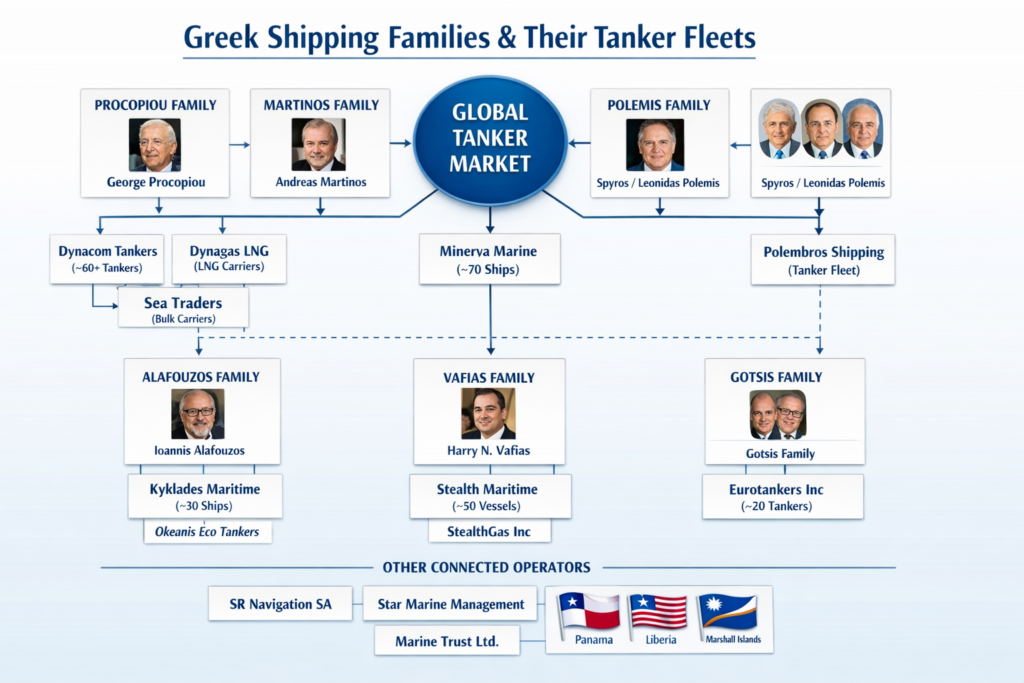
Among the companies that operated tankers transporting hundreds of millions of tons of Russian oil in 2025 are Dynacom Tankers Management Ltd, Minerva Marine Inc, Polembros Shipping Ltd, Kyklades Maritime Corp, New Shipping Ltd-Lib, Stealth Maritime Corp SA, Marine Trust Ltd-Mai, Star Marine Management Inc, Eurotankers Inc, and SR Navigation SA.
Despite substantial publicly available evidence showing that dozens of vessels operated by these companies violated sanctions restrictions, they have largely avoided inclusion in sanctions lists. At the same time, they remain influential lobbyists for Kremlin interests within the European Union.
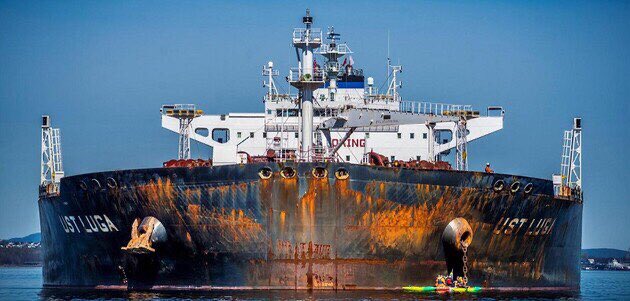
For example, the Athens-based company Dynacom Tankers Management Ltd used the tanker Eleni (IMO 9432062) last year to transport oil from Ust-Luga to the Indian port of Paradip. The tanker’s crew was partly recruited through Russian-controlled Crimean crewing agencies such as Sydyma.
Dynacom Tankers Management Ltd (DTM), registered under IMO number 1527598, was founded in 1991 as a subsidiary of a corporation established in 1974. The company currently controls at least 74 tankers and employs more than 5,000 seafarers.
DTM maintains two corporate “clones,” one registered in Glyfada near Athens and another in Monrovia, Liberia. The company is owned by Greek shipping magnate George Procopiou, who also controls Dynagas Ltd and Sea Traders S.A., companies operating LNG carriers and bulk cargo vessels respectively.
Procopiou’s fortune was estimated at $3.7 billion in 2024, and he has increasingly invested maritime profits in the real-estate sector. In February 2025 he acquired the Greek hotel group Astir Palace Vouliagmenis. In 2023 he was named Greek Shipping Personality of the Year, and later ranked 14th on Lloyd’s List of the most influential figures in global shipping.
At the same time, Procopiou is known for publicly criticizing policies aimed at reducing the use of petroleum fuels and actively lobbying against decarbonization initiatives within the International Maritime Organization (IMO) and EU regulatory frameworks. His four daughters—who are already active in maritime business along with their spouses—are expected to inherit his shipping empire. One example is Marielena Procopiou, who now controls the tanker company Akrotiri Tankers.
Another major participant in Russia’s shadow fleet is the Athens-based Minerva Marine Inc, founded in 1996 and registered in the Marshall Islands (IMO 1774869). The company operates more than 70 vessels. It was founded by Greek shipping magnate Andreas J. Martinos and is now controlled by his son Andreas A. Martinos, whose fortune is estimated at around €2 billion.
Other vessels belonging to the Martinos family, operated through Thenamaris Inc, transport petroleum products between the United States, Canada, and France using “clean” tankers under Greek and Maltese flags. Minerva Marine itself originally emerged from the broader Thenamaris corporate network.
Minerva Marine tankers have often operated under the Maltese flag, and the company’s involvement in Russian oil transportation in recent years has generated criticism from sectors of Malta’s maritime industry.
In late 2025, Maltese media linked the Martinos family’s business activities to the corporation Alkagesta Ltd, controlled by Azerbaijani businessmen Adnan Ahmadzada and Kamran Agaev, which trades oil in the Mediterranean region. Reports also indicate that Minerva Marine controls the Liberian company Rourke Services Ltd, through which it conducts certain operations.
The executive director of Minerva Marine is Athanasios J. Martinos, who also owns the maritime corporation Eastern Mediterranean Maritime Limited, which controls 74 tankers. The network of shipping enterprises associated with the Martinos family demonstrates the concentration of ownership within extended family structures.
Minerva Marine subsidiaries operate not only in the Greek islands of Chios and Kalymnos but also in Manila and Odessa, where they function as crewing agencies responsible for recruiting seafarers. One such subsidiary is Minerva Manning Agency, established in 2007 in Odessa.
Another Greek corporation closely linked to the Russian tanker trade is Polembros Shipping Ltd, founded in Athens in 1974 and currently operating dozens of tankers. For nearly half a century the company was controlled by Spyros M. Polemis, a member of the Andros shipowning family.
Polemis’s influence within the maritime sector was demonstrated when he was elected president of both the International Chamber of Shipping (ICS) and the International Shipping Federation (ISF) in 2006.
Polembros Shipping has also collaborated with the energy trading firm Gunvor, a company historically associated with Russian oil trading networks. The Polemis family had earlier financial exposure to the Russian market as well, investing heavily in Russian government bonds during the 1990s.
After the Russian financial crisis of 1998, the family lost significant capital and engaged in long legal disputes with JPMorgan Chase in London. Following the death of Spyros Polemis in 2024, control of the company passed to his son Leonidas S. Polemis.
The Polemis family also controls New Shipping Ltd-Lib, a corporation registered in Piraeus and Liberia that operates up to 15 tankers, many of which serve routes to China.
Another participant in the Russian shadow fleet is Kyklades Maritime Corp, founded in 1985 and controlled by the Alafouzos family, which operates approximately 30 vessels under Greek and Marshall Islands flags.
The family’s influence extends beyond shipping. Aristides Alafouzos, who founded the company, also acquired the Greek newspaper Kathimerini in 1988. The family later developed Skai Group, a major Greek media corporation controlling television channels, radio stations, news websites, and publishing businesses.
His son Ioannis Alafouzos currently leads the maritime business and also served as president of the Greek football club Panathinaikos F.C.
Other Greek companies participating in Russian oil transportation include Stealth Maritime Corp SA, which operates roughly 50 vessels, including gas carriers and tankers, and Marine Trust Ltd-Mai, which controls a fleet of about 20 tankers.
Further operators include Star Marine Management Inc and Eurotankers Inc, the latter controlled by the Gotsis family. Some Eurotankers vessels were previously sanctioned by the United States for transporting Venezuelan oil.
Another company involved in transporting Russian oil is SR Navigation SA, which operates around ten tankers through a network of Panama-registered companies.
Greek shipowners remain a central component of Russia’s shadow fleet.
The family-based ownership structure of these shipping corporations, combined with their deep influence in Greek politics, media, and the global maritime infrastructure—as well as their extensive connections in the United States and the United Kingdom—makes them highly resistant to traditional sanctions mechanisms.
At the same time, this family-centered structure creates a critical vulnerability: personal sanctions against the ultimate beneficial owners of these companies could significantly alter their willingness to support Russia’s oil-export system and its broader war economy.
Greek Shipping Families and Historical Links to Soviet/Russian Oil Trade Structural Background: Soviet Reliance on Western Shipping
During the Cold War, the Soviet Union relied heavily on foreign tanker fleets to export crude oil. Soviet shipping capacity was limited, and Moscow therefore chartered vessels from international shipping companies.
Greek shipowners became particularly important partners because:
- Greece controlled one of the largest tanker fleets in the world,
- Greek shipping companies often operated through flags of convenience (Liberia, Panama, Malta),
- many Greek firms maintained commercial flexibility with both Western and Eastern markets.
This created a long-standing commercial relationship between Greek shipping houses and Soviet energy export systems.
Greek Shipping Families and Soviet Trade Networks
The Polemis family
The Polemis family has historically been active in global oil shipping.
In the 1990s, after the collapse of the Soviet Union, family investment structures were involved in financial activities connected to the Russian market, including investments in Russian government securities. These investments were handled through Western financial institutions.
The episode illustrates how Greek shipping capital was partially integrated into the post-Soviet financial opening of Russia, although it does not indicate direct political alignment with Moscow.
The Martinos family
The Martinos shipping group, including companies such as Thenamaris and Minerva Marine, has long operated tankers transporting oil globally.
Greek tanker operators have historically chartered vessels for oil trading houses that deal in Russian crude. In global energy markets, Russian oil has been transported through intermediaries such as:
- trading companies,
- oil majors,
- commodity brokers.
Thus the connection between Greek shipowners and Russian oil flows is often indirect and commercial rather than political.
The Procopiou family
Shipping companies controlled by George Procopiou operate large fleets of crude and LNG carriers.
Greek tanker fleets have traditionally transported oil from many exporting states, including Russia. Because Russian crude remains a major global commodity, many shipping firms have participated in transporting it under legal contracts prior to sanctions regimes.
The Alafouzos family
Companies associated with the Alafouzos family have been active in maritime transportation for decades. Like other Greek shipping houses, their fleets have historically operated on global charter markets where Russian cargoes were commonly traded.
Again, this reflects commercial market participation rather than necessarily political alignment with Russian interests.
Post-Soviet Transformation (1991–2000)
After the collapse of the Soviet Union, Russian energy exports became increasingly integrated into global markets.
During this period:
- Western banks financed Russian energy trade
- commodity traders expanded their role
- international tanker fleets—including Greek operators—transported Russian crude.
This phase created many commercial relationships between Russian exporters and international shipping companies, including Greek firms.
Russian Oil and the Modern “Shadow Fleet”
After the 2022 sanctions regime, Russia increasingly relied on a so-called shadow fleet to transport oil outside Western regulatory systems.
Greek shipping companies have been involved in several ways:
- Selling older tankers that were later used in sanctions-evasion fleets,
- Chartering vessels to traders handling Russian cargoes,
- Operating ships in legal grey zones before sanctions enforcement tightened.
- However, many major Greek companies have also reduced or ended Russian cargo transportation under pressure from EU and U.S. sanctions regimes.
Influence of Greek Shipping in EU Policy
Greek shipping interests have historically been influential in European maritime regulation.
Because Greece controls a large portion of the global tanker fleet, Greek shipping companies have often lobbied for:
- flexible sanctions enforcement
- protection of maritime trade flows
- gradual energy transition policies.
This lobbying influence sometimes intersects with geopolitical debates around Russian energy exports.
Strategic Assessment
The relationship between Greek shipping families and Soviet/Russian energy trade should be understood primarily as commercial rather than ideological.
Key points:
- Soviet and Russian oil exports historically depended on international tanker fleets,
- Greek shipowners have long been major participants in global oil transportation,
- financial and commercial interactions with Russia increased after the Soviet collapse.
However, these connections do not necessarily imply political alignment with the Kremlin. In most cases they reflect the structural role of Greek shipping in global energy logistics.
Why Soviet Intelligence Was Interested in Shipping
The Soviet Union depended heavily on foreign maritime logistics, especially during the Cold War. Soviet intelligence agencies such as the KGB closely monitored global shipping because maritime networks were crucial for:
- exporting Soviet oil and raw materials,
- acquiring restricted Western technology,
- circumventing trade restrictions and embargoes,
- gathering intelligence in foreign ports.
Large tanker operators, including Greek fleets, therefore became objects of intelligence attention, even if only as commercial partners.
Greek Shipping’s Unique Role in the Global Oil Trade
Greek shipowners controlled a very large portion of the world’s tanker capacity from the 1960s onward. During the Cold War:
- Greek companies transported oil from the Middle East, USSR, and other exporters
- many operated under flags of convenience (Liberia, Panama, Cyprus)
- their fleets worked with traders from both Western and Eastern blocs.
Because Soviet shipping capacity was limited, Moscow sometimes chartered foreign tankers, including Greek vessels, through state trading organizations.
These transactions were commercial, not intelligence cooperation.
Known Soviet Methods in the Maritime Sector
Soviet intelligence historically used several maritime-related methods:
Commercial cover companies
Soviet state trading firms sometimes functioned as fronts or contact points for intelligence officers.
Recruitment of port or shipping insiders
Intelligence agencies occasionally tried to recruit:
- port officials,
- shipping brokers,
- maritime engineers.
Monitoring shipping markets
The KGB and Soviet economic intelligence services tracked:
- tanker availability
- freight prices
- shipping routes.
This information was valuable for Soviet energy export planning.
Evidence Regarding Greek Shipping Families
There are no confirmed declassified documents or credible investigations showing that the major Greek shipping families discussed earlier were KGB collaborators.
However, there are several historical realities:
- Greek shipowners did transport Soviet oil cargoes in some cases
- Soviet trading companies chartered Western tankers
- Greek shipping businesses maintained contacts with Soviet commercial organizations.
These interactions were typical commercial relationships within the global shipping market.
Organized Crime Overlap in the Post-Soviet Period
In the 1990s, after the collapse of the USSR, some international shipping and trading networks intersected with post-Soviet financial and criminal structures.
Figures such as Semion Mogilevich operated financial networks in Central Europe during that period.
However, linking such networks directly to Greek shipowners requires specific evidence and should not be assumed.
Strategic Assessment
The most realistic interpretation is that:
- Soviet intelligence monitored and interacted with global shipping networks, including Greek companies,
- Greek tanker operators sometimes carried Soviet cargoes through commercial contracts,
- There is no reliable public evidence that leading Greek shipping families were intelligence collaborators.
In intelligence analysis terms, these relationships should be described as commercial interaction with possible intelligence observation, not proven cooperation.
Bottom line:
Greek shipowners were important players in the maritime system that transported Soviet and later Russian oil, which naturally attracted the attention of Soviet intelligence. But no verified evidence currently shows that the major Greek shipping families themselves cooperated with the KGB.
Legal Cases and Controversies Involving Major Greek Shipping Families
The Polemis Family
The Polemis family has been active in global shipping for decades through companies such as Polembros Shipping and related maritime enterprises.
Financial litigation after the Russian default (1998)
One of the most notable legal disputes involving the family arose after the Russian financial crisis of 1998. Investments linked to the family’s shipping revenues had been placed in Russian government securities (GKOs and related instruments). These investments were managed through major international financial institutions, including JPMorgan Chase.
After Russia’s sovereign default, the Polemis family pursued legal action in London courts against financial institutions over losses connected to those investments. The litigation lasted several years but ultimately did not succeed. The dispute was a commercial financial case rather than a criminal investigation.
Maritime disputes
Like many shipping companies, Polembros vessels have periodically been involved in:
- insurance claims
- cargo disputes
- chartering disagreements.
Such litigation is common in international maritime law and is usually handled through arbitration.
The Martinos Family
The Martinos family controls major shipping companies including Minerva Marine and Thenamaris.
Taxation and regulatory scrutiny
Greek shipping has historically operated under a special tax regime, and shipping magnates—including members of the Martinos family—have occasionally been mentioned in public debates in Greece about taxation and wealth transparency.
However, there are no widely documented criminal convictions against the Martinos family related to their shipping activities.
Maritime regulatory controversies
Companies connected with the family have sometimes faced scrutiny regarding:
- vessel registration under foreign flags
- environmental compliance
- shipping safety regulations.
These matters typically involve administrative or regulatory issues, not criminal charges.
The Procopiou Family
Shipping magnate George Procopiou controls several major maritime companies including Dynacom, Dynagas, and Sea Traders.
Commercial litigation
Companies within the Procopiou shipping group have occasionally been involved in:
- contract disputes
- shipbuilding disagreements
- chartering claims.
These are typical disputes in global shipping markets and are usually resolved through maritime arbitration.
Environmental policy lobbying
Procopiou has publicly opposed certain international environmental regulations related to shipping emissions and decarbonization. While controversial, such lobbying activity is not a legal violation.
The Alafouzos Family
The Alafouzos family controls shipping interests through companies such as Kyklades Maritime and also owns the Greek media group SKAI.
Football governance investigations
Ioannis Alafouzos, owner of the Greek football club Panathinaikos, has been involved in several disputes within Greek football governance structures. Some investigations concerned:
- alleged corruption within football administration,
- financial irregularities in sports management.
These cases were widely reported in Greek media but were largely resolved without major criminal convictions related to shipping activities.
Tax-related investigations
As with other prominent business figures in Greece, there have been periodic tax investigations related to high-net-worth individuals. These inquiries did not result in major criminal rulings against the family.
Broader Context: Why Shipping Families Often Appear in Legal Disputes
Large maritime corporations frequently appear in legal proceedings due to the nature of the industry. Common areas of litigation include:
- charter contracts,
- maritime accidents,
- insurance claims,
- environmental compliance.
- ship financing.
Such cases are generally handled through commercial courts or arbitration bodies such as the London Maritime Arbitrators Association.
Strategic Assessment
The available public record indicates that:
- the major Greek shipping families discussed have participated in commercial litigation and regulatory disputes, which is normal in global shipping;
- no consistent pattern of major criminal convictions related to their maritime activities has been widely documented;
some controversies surrounding these families relate more to tax policy debates, media influence, or sports management disputes rather than shipping operations.
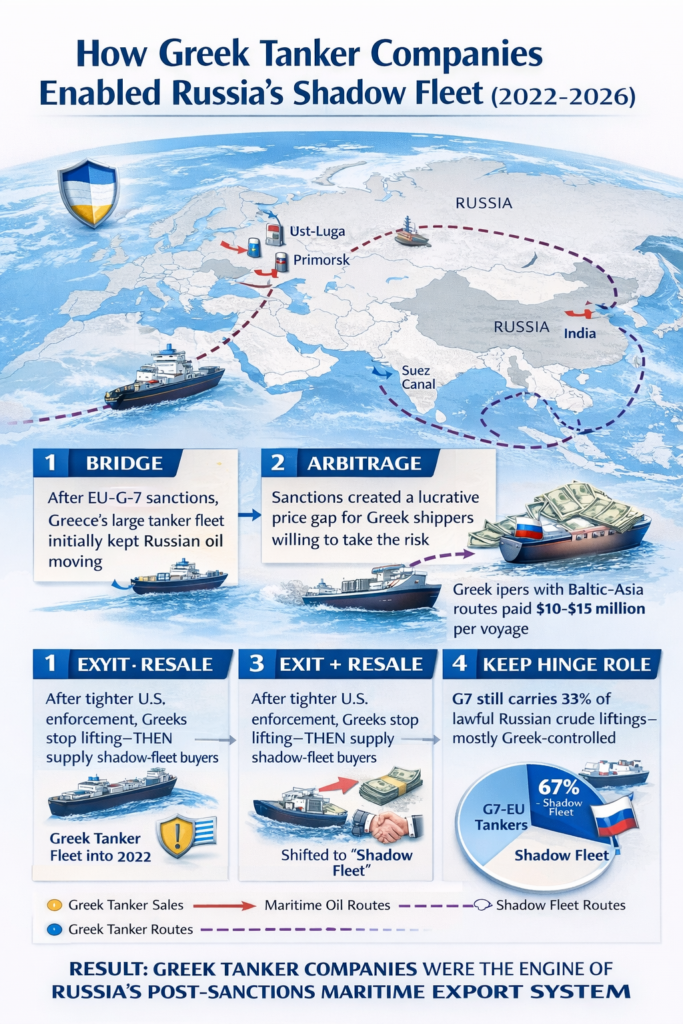
Greek tanker operators became central to Russia’s post-2022 oil logistics for three main reasons: they initially kept lawful access open under the G7 price-cap regime, they later monetized the transition by selling older tonnage into opaque markets, and they remained politically important because Greek shipping still controlled a meaningful share of compliant capacity long after Russia began building a shadow fleet.
Greek shipowners filled the immediate transport gap after the embargo
When the EU embargo on seaborne Russian crude and the G7 price cap came into force in late 2022, Russia did not suddenly lose all access to Western shipping. The cap still allowed Western shipping and insurance services if the oil was sold below the capped price. In practice, this created a large legal grey zone in which experienced tanker operators could continue lifting Russian cargoes while claiming compliance. Reuters reported that in January 2023 EU-owned vessels, primarily Greek, moved more than 2 million tonnes of Urals crude from Baltic and Black Sea ports, and that Greek-owned ships handled at least 21 voyages that month.
This mattered because Greece had exactly the kind of fleet Russia needed: large numbers of aframax and suezmax tankers, deep experience in crude shipping, and established commercial ties with traders, ports, and insurers. In the first phase after sanctions, Greek firms were not yet the shadow fleet itself; they were the bridge that prevented a sudden collapse in Russian seaborne exports while Moscow reorganized its logistics.
The price cap created profits strong enough to keep Greek firms engaged
The sanctions regime did not ban all transport; it changed the risk premium. Reuters reported that Russian oil routes became highly lucrative, with freight for voyages from Baltic ports to India reaching as much as $15 million per tanker voyage during the early phase of the cap. That made Russian trade attractive for shipowners willing to tolerate sanctions risk and compliance complexity. Reuters also noted that several major Greek firms continued transporting Russian oil even after many other Western operators withdrew.
So Greek involvement was not only about legacy ties or fleet availability. It was also about commercial arbitrage. The combination of long-haul routes to India and China, elevated freight rates, and a sanctions framework that still permitted “compliant” shipping meant that Greek owners could profit while Russia bought time to assemble a more opaque fleet architecture.
Greek owners helped build the shadow fleet by selling older tankers
The decisive shift came when Russia and its intermediaries began acquiring older tankers outside the mainstream compliance ecosystem. A Brookings paper states that Western shipowners, especially Greek ones, enabled the growth of the shadow fleet by selling older oil tankers to opaque buyers at attractive prices, because Russia was paying top dollar for export capacity outside the G7 cap. The paper argues that this loophole should have been closed when the cap was introduced, but it was not.
This is the key structural reason Greek firms became central. They did not just carry Russian oil in the early phase; they also helped create the fleet that later displaced them. Once older Greek- and Western-linked vessels were sold into shell-company structures under flags of convenience, Russia could move larger volumes without relying on reputable Western insurers, owners, or service providers. That turned Greek shipping from a transport intermediary into a major upstream enabler of the shadow fleet’s expansion.
Enforcement pressure pushed Greek operators out of some trades, but not out of the system
By late 2023, U.S. enforcement tightened. Reuters reported that three major Greek shipping firms stopped accepting Russian crude loadings after Washington began sanctioning vessels that appeared to violate the cap. That marked a turning point: direct Greek participation in Russian crude transport began to shrink as legal and reputational risks increased.
But this did not mean Greek influence disappeared. On the contrary, it showed that the system had matured. Once mainstream Greek operators pulled back from some routes, shadow-fleet vessels could step in using the secondhand capacity already transferred into opaque ownership chains. In other words, Greek firms helped Russia survive phase oneby carrying compliant cargoes, and helped Russia survive phase two by supplying the ships that made non-transparent trade possible.
Even after shadow-fleet growth, Greek-controlled tonnage still mattered
Russia’s shadow fleet did not fully replace mainstream shipping overnight. Lloyd’s List reported in February 2026 that EU-owned or EU-controlled tankers still accounted for 19% of Russian liftings, with the vast majority of those tankers controlled by Greek entities. CREA similarly found that in February 2026 G7+ tankers still carried 33% of Russian crude, even though sanctioned shadow vessels carried the majority.
That means Greek shipping remained central not because it dominated the whole trade, but because it sat at the hinge between the compliant and non-compliant systems. Greece mattered in both worlds: as the largest remaining pool of mainstream European crude-shipping capacity still willing to operate where legal, and as a historic source of older tankers that had already migrated into opaque shadow structures.
Why Greek companies were unusually well placed
Greek shipping companies were especially suited to this role because the industry is highly concentrated, family-controlled, and globally networked. Greek owners control one of the world’s largest crude-tanker ecosystems, with dense relationships across brokers, insurers, registries, crewing networks, and commodity traders. That gave them four advantages after 2022:
- they had ships of the right size and age profile,
- they knew the Russian crude routes and buyers,
- they could move quickly through offshore corporate structures,
- and they had enough market power to shape EU debate on shipping sanctions.
Brookings explicitly argues that lobbying from countries with large tanker fleets helped prevent early restrictions on tanker resales, while Lloyd’s List reported Greek pushback against new EU maritime-service bans.
Greek tanker companies became central to Russia’s shadow fleet not because they were uniquely pro-Russian, but because they were uniquely positioned at the intersection of fleet capacity, legal permissibility, commercial incentives, and sanctions loopholes. They helped Russia in sequence: first by carrying capped oil when that was still allowed, then by selling aging vessels into opaque ownership chains, and finally by continuing to provide part of the remaining compliant tanker capacity while the shadow fleet absorbed the rest. The main policy implication is that sanctions aimed only at cargoes or insurers are not enough. Any serious effort to weaken Russia’s maritime oil-export system has to target the vessel-supply chain itself: secondhand tanker sales, beneficial ownership opacity, flag-hopping, and the corporate intermediaries that allow mainstream tonnage to become shadow tonnage.