
Russia is embedding itself deeply in Iran’s nuclear infrastructure.
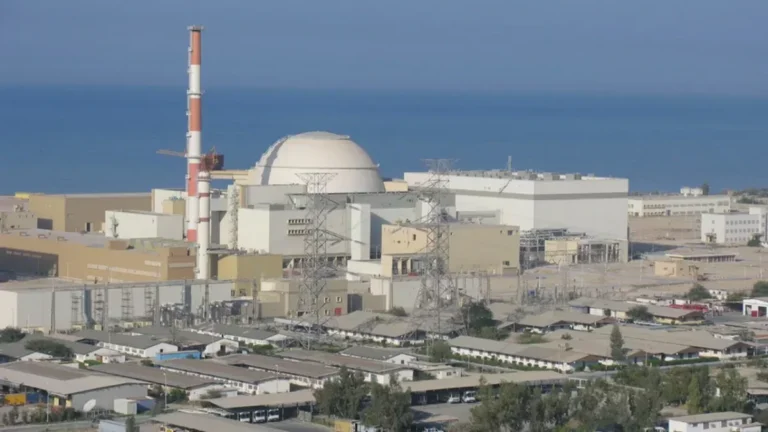
Through its state nuclear corporation Rosatom, Moscow is consolidating a long-term presence at the Bushehr Nuclear Power Plant, including personnel deployment, reactor construction, fuel supply arrangements, and technical servicing. These projects create structural dependence that can bind Iran to Russian nuclear technology and expertise for decades.
Russian involvement raises the political and operational cost of U.S. pressure.
The continued presence of Russian engineers and infrastructure projects complicates potential U.S. or allied actions targeting Iranian nuclear facilities. Any escalation around these sites risks involving Russian personnel and interests, increasing diplomatic, military, and reputational costs for Washington.
Rosatom’s engagement weakens the effectiveness of Iran’s international isolation.
By maintaining and expanding nuclear cooperation even during periods of sanctions and geopolitical tension, Russia signals that Iran is not fully isolated from advanced technological partnerships. This perception may encourage other states to maintain or expand engagement with Tehran despite Western pressure.
Russian support strengthens Iran’s negotiating posture.
Tehran’s leadership may feel less compelled to concede to U.S. demands if it believes that critical sectors—particularly nuclear energy—retain external backing. This reduces the psychological leverage of sanctions and coercive diplomacy in shaping Iran’s strategic calculations.
Nuclear cooperation provides Moscow with additional geopolitical leverage against the United States.
By embedding itself within a critical component of Iran’s state infrastructure, Russia gains a durable instrument to complicate U.S. regional strategy and introduce additional constraints on Washington’s policy options in the Middle East.
Russia, through the state corporation Rosatom, is helping Iran maintain its position in the nuclear sector at the very moment when the United States is trying to narrow Tehran’s capabilities through missile strikes, sanctions, and international isolation. What matters here is not only the rhetoric but also what Moscow is actually doing on the ground.
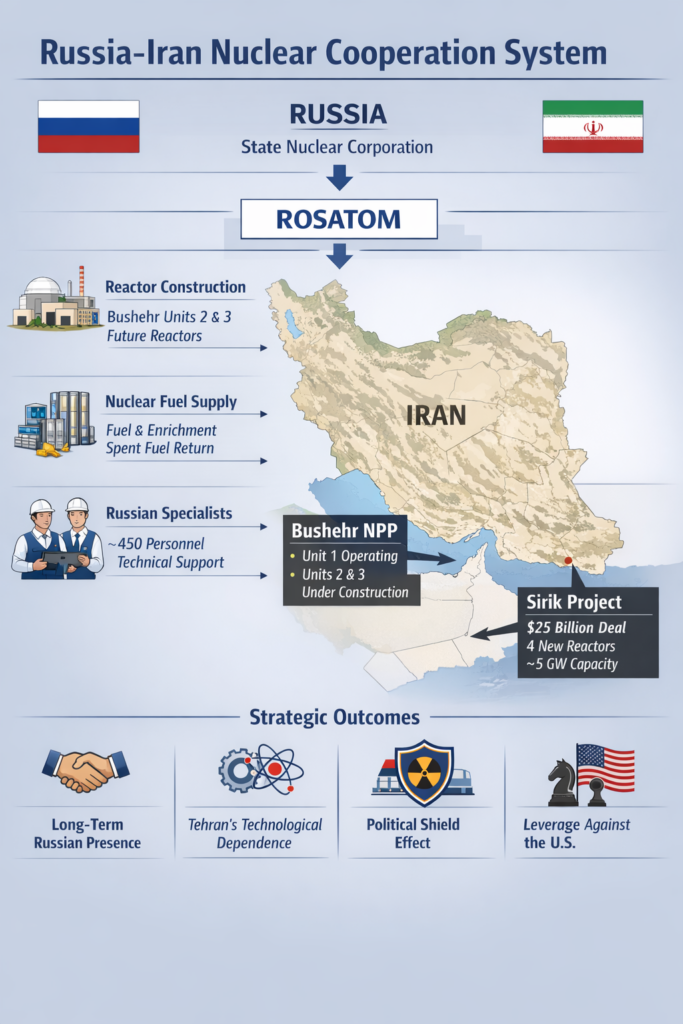
Following a partial evacuation, approximately 450 Rosatom employees remained at the Bushehr nuclear site. Another 150 personnel were evacuated through Armenia, but work on the second and third power units has not been halted. On the contrary, Rosatom Director General Alexey Likhachev made it clear that this direction remains a priority for the corporation.
This indicates that Moscow is not merely holding on to a profitable contract but is deliberately entrenching itself in one of the most sensitive sectors of the Iranian state.
This is not a one-time development. Russia has already constructed the first power unit at the Bushehr nuclear power plant, and the existing agreement allows for the construction of up to eight units. Last year the sides also announced a $25 billion agreement for four additional power units with a combined capacity of 5 gigawatts, as well as a memorandum regarding small modular nuclear power plants.
This is precisely where the problem arises for the United States. While Washington is attempting to weaken Iran, Moscow is helping it maintain one of the key pillars of its state resilience. As a result, any further U.S. move against Iran’s nuclear infrastructure becomes more costly, riskier, and politically more complicated.
Russian-Iranian nuclear cooperation has long gone beyond a single project or contract. Such agreements are long-term by nature, binding a country not only to the construction itself but also to fuel supply, technical maintenance, personnel training, and the continuous presence of specialists on site.
For Tehran, this is not merely an issue of energy. It is also a way to avoid being left without external support in one of the most sensitive sectors at a moment when it faces sanctions, military strikes, and international isolation. Through such projects, Russia secures a long-term foothold in an important segment of the Iranian state system and gains the ability to influence developments not episodically, but continuously.
For this reason, the nuclear linkage between Moscow and Tehran should be viewed more broadly than simple energy cooperation. It is one of the mechanisms through which Russia helps Iran withstand external pressure and avoid complete isolation.
The presence of Russian personnel at Iranian nuclear facilities complicates any hard-line pressure scenario for the United States around this infrastructure. As long as Rosatom employees remain on site and work on new power units continues, any escalation would no longer involve Iran alone but also the Russian factor.
This raises the political and security cost of new steps by Washington. Iran thus gains an additional margin of protection in precisely the area where the United States would prefer to apply the most pressure.
Rosatom’s continued participation in Iranian projects also undermines the logic of American isolation of Tehran. When a major Russian state corporation does not withdraw from such a sensitive sector even during wartime conditions, it demonstrates that the regime of complete international toxicity around Iran does not function without exceptions.
This signal is visible not only to Tehran but also to other external actors. As a result, it becomes more difficult for the United States to maintain a strict and unambiguous policy of international isolation against Iran.
Russian support also affects the internal behavior of the Iranian leadership itself. When a key external partner does not step away during a moment of conflict, Tehran has fewer reasons to fear complete isolation under external pressure. This reduces the willingness of the Iranian regime to make the concessions that Washington seeks.
In effect, American coercive leverage weakens at the level of Iran’s own political calculations.
Moscow’s decision not to scale down sensitive nuclear cooperation with Iran also sends an important signal across the Middle East. It demonstrates that Russia is prepared to stand by an ally even during direct escalation and does not retreat where the stakes are high.
For regional actors, this appears as a demonstration of resilience and political reliability. Against such a backdrop, American pressure no longer appears as a tool that automatically forces hostile regimes to yield.
Nuclear cooperation with Iran also provides Moscow with another lever in its broader strategic competition with the United States. The deeper Russia embeds itself in critical Iranian sectors, the more opportunities it gains to complicate Washington’s maneuvering not only in the region but also in broader geopolitical bargaining.
In this framework, Iran becomes not merely a partner but also an additional pressure point on American interests, creating another node of tension that the United States cannot ignore.
Russia’s Nuclear Shield for Iran: How Rosatom Complicates U.S. Pressure on Tehran
Russia, through its state nuclear corporation Rosatom, is helping Iran preserve its strategic position in the nuclear sector precisely at a time when the United States is attempting to constrain Tehran’s capabilities through sanctions, military pressure, and diplomatic isolation. What matters in this case is not rhetorical support but Moscow’s concrete actions on the ground.
Following a partial evacuation, roughly 450 Rosatom employees remained at the nuclear power plant in Bushehr Nuclear Power Plant, while another 150 personnel were evacuated through Armenia. Crucially, construction work on the second and third power units has not been suspended. On the contrary, Rosatom’s chief executive Alexey Likhachev publicly emphasized that Iranian projects remain a strategic priority for the corporation.
This signals that Moscow is not merely defending a profitable infrastructure contract. Instead, Russia is deliberately consolidating its presence inside one of the most sensitive pillars of the Iranian state.
Strategic Entrenchment Rather Than Commercial Cooperation
Russia has already completed the first power unit at Bushehr, Iran’s only operational nuclear power reactor. Existing agreements allow for the construction of up to eight nuclear units. In addition, Moscow and Tehran recently announced a $25-billion agreement covering four additional reactors with a combined capacity of approximately five gigawatts, alongside a memorandum on small modular reactors.
Such nuclear agreements are inherently long-term strategic arrangements rather than conventional energy projects. They create structural dependency by tying the host country to the supplier through multiple channels:
- Fuel supply chains
- Technical maintenance and upgrades
- Training of nuclear engineers and operators
- Permanent on-site presence of foreign specialists
Through these mechanisms Russia embeds itself deeply into Iran’s nuclear infrastructure for decades. This creates a durable strategic linkage that goes far beyond construction or technology transfer.
For Tehran, this partnership serves a broader political function. At a moment when Iran faces sanctions, military pressure, and diplomatic isolation, Russian nuclear cooperation ensures that one of the regime’s most sensitive sectors retains a powerful external guarantor.
A Complication for U.S. Strategic Pressure
For Washington, the implications are significant. U.S. strategy toward Iran relies heavily on economic isolation and coercive pressure designed to weaken the regime’s strategic capabilities. Yet Russian involvement in Iran’s nuclear infrastructure complicates that approach in several ways.
First, the continued presence of Russian personnel creates a de facto political buffer around Iranian nuclear facilities. Any escalation targeting these sites risks potential Russian casualties or confrontation with Moscow, raising the diplomatic and security costs of military options.
Second, Russia’s participation weakens the credibility of the international isolation narrative surrounding Iran. When a major nuclear power continues to expand cooperation with Tehran—even during periods of heightened tension—it signals that Iran is not completely cut off from global technological and strategic partnerships.
This perception matters not only for Tehran but also for other international actors. Countries observing the situation may conclude that engagement with Iran remains possible despite Western pressure, undermining the effectiveness of Washington’s containment strategy.
Impact on Iranian Political Calculations
Russian backing also shapes decision-making inside Iran itself.
When a key external partner continues cooperation even during periods of conflict and sanctions, Tehran’s leadership has fewer incentives to make concessions demanded by the United States. The perceived risk of complete international isolation diminishes.
In strategic terms, this weakens the psychological component of American coercion. If Iran believes that Russia—and potentially other partners—will continue supporting critical sectors of its economy and technology base, the Iranian leadership may become less responsive to pressure and more willing to resist negotiations on unfavorable terms.
Regional Signaling in the Middle East
Moscow’s decision to maintain and expand nuclear cooperation with Iran also carries a broader geopolitical message for the Middle East.
It signals that Russia is prepared to stand by its partners even under conditions of intense geopolitical pressure. For regional actors, this can be interpreted as evidence that Russia is a durable and politically reliable strategic partner, particularly in contrast to perceptions of fluctuating U.S. commitments in the region.
Such signaling may influence the calculations of other states seeking strategic autonomy from Western pressure. Nuclear cooperation projects, because of their long-term nature, function as visible symbols of strategic alignment.
A Geopolitical Lever Against Washington
Beyond the regional dimension, nuclear cooperation with Iran provides Moscow with an additional instrument in its broader geopolitical competition with the United States.
The deeper Russia embeds itself within critical Iranian sectors—from nuclear energy to infrastructure—the greater its capacity to complicate American policy options. Each new project increases the political costs for Washington of pursuing aggressive pressure against Tehran.
In effect, Iran becomes not only a partner for Moscow but also a strategic pressure point within the global confrontation between Russia and the United States.The result is the emergence of an additional geopolitical constraint for Washington: confronting Iran’s nuclear ambitions increasingly means confronting a network of Russian strategic interests embedded within that infrastructure.
More on this story: Rosatom violates non-proliferation treaty in Iran

More on this story: Undoing the Agreement: How Iran and Russia Are Redefining the Nuclear Order