


Russia’s Foreign Intelligence Service of Russia has transformed Vienna into a hub for electronic and satellite intelligence operations. Moscow has turned the Austrian capital into a center of satellite espionage, using diplomatic facilities to collect sensitive information.
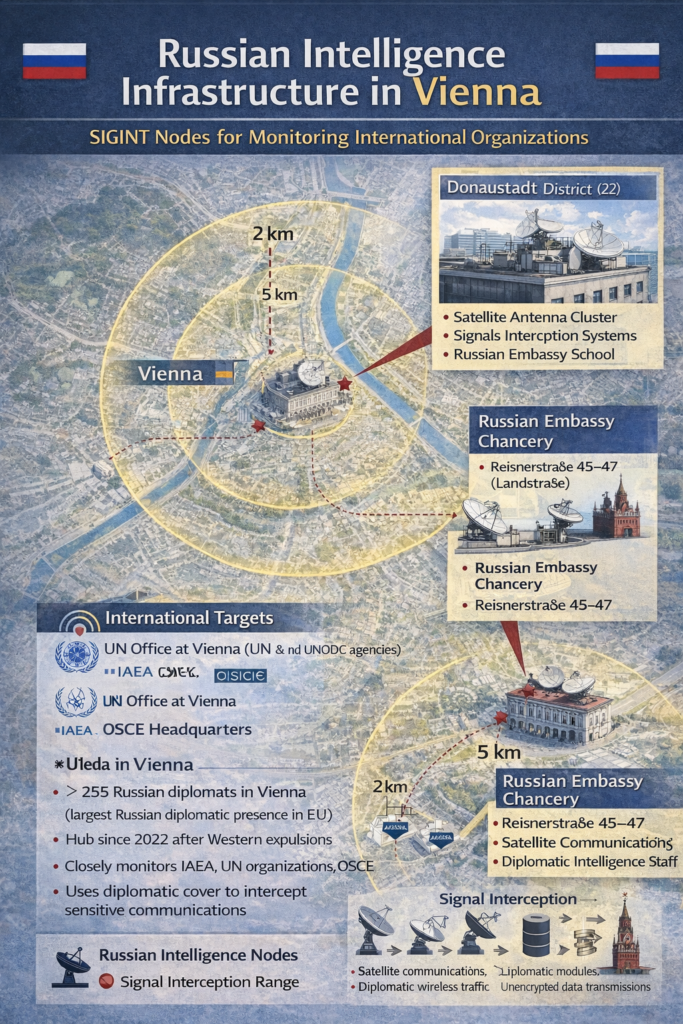
Numerous satellite antennas have been identified on the rooftops of Russian properties in the Donaustadt district and in the city center. These antennas are regularly repositioned in order to intercept communications from international organizations.
Austria’s Federal Ministry for European and International Affairs has announced its intention to take measures to address the issue. In an official statement, the ministry noted that “we remain in intensive contact with the Russian embassy (most recently last week), but cannot yet disclose operational details. Together with security authorities, we are working persistently to thin the forest of antennas.”
Spy equipment at the Embassy of Russia in Vienna began to expand significantly after Russia launched its full-scale invasion of Ukraine. Eight antennas are currently installed on the embassy roof, one of which intercepts signals not intended for Russian communications.
At present, 225 Russian diplomats are accredited in Vienna. Although Austria has expelled eleven Russian officials, the city remains a critical operational point for Russian intelligence. This is especially the case after similar listening infrastructures in Belgium and Netherlands were significantly weakened when Russian diplomats were mass-expelled in spring 2022 over espionage allegations.
Vienna’s Strategic Importance for Russian Intelligence
Vienna holds exceptional strategic value for Russian intelligence services because of the unique concentration of international organizations located there. The city hosts headquarters and offices of the Organization for Security and Co-operation in Europe, multiple United Nations agencies, the International Atomic Energy Agency, and dozens of other international institutions.
This concentration makes the Austrian capital one of the world’s major diplomatic hubs. For Russian intelligence agencies, it provides the opportunity to simultaneously monitor the activities of diplomats, security experts, and international officials. As a result, Vienna becomes a key node for collecting sensitive political and technological information.
Austria’s traditionally soft policy toward foreign diplomatic missions has also created a favorable operational environment for Russian intelligence activities. More than two hundred Russian diplomats are accredited in Vienna, and European intelligence agencies estimate that a significant proportion of them perform intelligence functions.
Such a large official presence enables Moscow to maintain an extensive network of contacts, information sources, and operational capabilities. Consequently, Vienna has become one of the most important centers of Russian intelligence activity in Europe.
Vienna’s Growing Role After the Invasion of Ukraine
Following Russia’s full-scale invasion of Ukraine, Vienna’s importance for Russian intelligence increased further. Many Russian espionage structures across the European Union were dismantled or severely restricted, particularly in Belgium and the Netherlands.
Under these circumstances, the Austrian capital became an alternative platform for restoring and coordinating intelligence operations. Gradually, Vienna is turning into one of the main hubs of Russian espionage activity within the European Union.
Satellite Antennas as Part of Signals Intelligence Infrastructure
The numerous satellite antennas detected on the rooftops of Russian diplomatic facilities represent a key element of signals intelligence infrastructure.
Such devices are capable of intercepting:
- satellite communications
- wireless transmissions
- digital data signals in the surrounding area
The ability to reposition antennas allows operators to tune them to different signal sources, including communications of international organizations.
In practice, this creates a technical infrastructure for covert monitoring of diplomatic activity.
The location of this equipment in Vienna is particularly significant due to the proximity of international institutions. Within just a few kilometers operate thousands of diplomats, experts, and international officials. This means signal interception systems could potentially access large volumes of communications and technical data.
Such a situation creates serious security risks for international organizations as well as for Austria’s partners within the European Union.
Damage to Austria’s International Reputation
Russia’s signals intelligence activity in Vienna also affects Austria’s international reputation. The country traditionally presents itself as a neutral diplomatic platform for global dialogue.
However, the use of diplomatic buildings for espionage operations undermines confidence in the security of this environment. International organizations may therefore reconsider their approaches to information protection and cooperation with Austrian institutions.
The Austrian government has already signaled its intention to restrict the technical infrastructure used by Russian diplomatic facilities. Officials acknowledge the problem and state that they are working together with security agencies to reduce the number of suspicious antennas.
This step reflects Vienna’s attempt to regain control over the situation and protect its diplomatic reputation. At the same time, the effectiveness of these measures will largely depend on Austria’s willingness to reconsider its traditionally cautious approach toward the Russian presence.
A Broader Pattern of Intelligence Activity
The situation surrounding Russian antennas in Vienna illustrates a broader pattern of Moscow’s use of diplomatic cover for intelligence activities.
Russia systematically employs diplomatic missions as platforms for:
- intelligence collection,
- cyber operations,
- influence campaigns.
Combined with technical interception capabilities, this creates a multilayered system for gathering information.
For European Union countries, the case serves as a warning that stronger oversight of Russian diplomatic missions may be necessary.
Vienna as a Signals Intelligence Hub: Russia’s Expanding Surveillance Infrastructure in Europe
Introduction
Russia’s Foreign Intelligence Service of Russia has increasingly turned Vienna into a key platform for signals intelligence (SIGINT) operations in Europe. By installing sophisticated satellite and communications interception equipment on diplomatic premises, Moscow has created a technical infrastructure capable of monitoring sensitive communications within one of the world’s most important diplomatic centers.
The presence of numerous movable satellite antennas on the rooftops of Russian diplomatic buildings—particularly in the Donaustadt and central Vienna—suggests the existence of a coordinated signals intelligence network designed to intercept communications from international organizations, diplomatic missions, and nearby government institutions.
This development reflects a broader adaptation of Russian intelligence strategy following the mass expulsion of Russian diplomats from European countries after the 2022 invasion of Ukraine.
Vienna’s Unique Strategic Value for Intelligence Operations
Vienna occupies a unique position in the global diplomatic system. The city hosts a dense concentration of international organizations, including the Organization for Security and Co-operation in Europe, multiple agencies of the United Nations, and the International Atomic Energy Agency.
This institutional ecosystem brings together thousands of diplomats, nuclear experts, intelligence officials, and international civil servants from across the world. From an intelligence perspective, the proximity of these actors creates an environment exceptionally rich in political, technological, and strategic information.
For Russian intelligence services, Vienna offers a rare opportunity to simultaneously observe:
- multilateral diplomacy,
- nuclear oversight discussions,
- sanctions negotiations,
- international security debates,
Few cities provide such a dense concentration of global decision-making processes.
Austria’s Diplomatic Environment as an Operational Opportunity
Austria’s long-standing policy of neutrality and its traditionally permissive approach toward diplomatic missions have unintentionally created favorable conditions for foreign intelligence operations.
More than 225 Russian diplomats are accredited in Vienna, making it one of the largest Russian diplomatic contingents in Europe. European intelligence services have repeatedly warned that a significant portion of these diplomats perform intelligence functions under diplomatic cover.
Such a large diplomatic presence enables Moscow to sustain a broad operational ecosystem consisting of:
- intelligence officers operating under diplomatic status
- technical specialists managing surveillance equipment
- networks of contacts within diplomatic and business circles
- logistical support for intelligence operations
This combination of diplomatic cover and technical infrastructure allows Russian intelligence to operate in Vienna with considerable flexibility.
Vienna as a Replacement Intelligence Hub After 2022
The importance of Vienna for Russian intelligence increased dramatically after the coordinated expulsion of hundreds of Russian diplomats across Europe in 2022.
Countries such as Belgium and Netherlands, which previously hosted major Russian intelligence stations, significantly reduced Moscow’s operational capacity. In Brussels, the expulsion of Russian diplomats severely weakened intelligence operations targeting NATO and EU institutions.
In response, Russian intelligence agencies appear to have consolidated remaining capabilities in locations where their presence remained comparatively intact. Vienna, with its large Russian diplomatic contingent and favorable legal environment, became a natural alternative hub.
This relocation reflects a broader pattern in Russian intelligence strategy: when operations become constrained in one location, they are shifted to jurisdictions where diplomatic protections and local policies create fewer obstacles.
Signals Intelligence Infrastructure and Its Capabilities
The satellite antennas observed on Russian diplomatic buildings are not merely communications equipment; they represent key components of signals intelligence systems.
Such systems can intercept a wide range of communications, including:
- satellite transmissions
- microwave and wireless communications,
- digital data flows between diplomatic facilities,
- potentially unencrypted institutional networks.
The ability to reposition antennas is particularly significant. By adjusting their orientation, operators can target different signal sources across the city, including communications originating from nearby international organizations.
In practical terms, this creates a persistent technical surveillance environment around Vienna’s diplomatic district.
The concentration of international institutions within a relatively small geographic radius means that interception systems can potentially access large volumes of diplomatic communications, technical discussions, and sensitive policy information.
Implications for International Security
The existence of a signals intelligence infrastructure in Vienna raises several important security concerns.
First, it poses a direct risk to the confidentiality of diplomatic negotiations conducted within international organizations. Discussions related to sanctions regimes, nuclear non-proliferation, and regional conflicts could potentially be monitored.
Second, it threatens the integrity of technical exchanges between international agencies. Institutions such as the IAEA regularly handle sensitive nuclear data, safeguards discussions, and technical reporting.
Third, the presence of such surveillance infrastructure could undermine trust among international partners operating in Vienna.
If diplomats and international officials suspect that their communications are being systematically monitored, they may alter their operational behavior, reduce information sharing, or shift sensitive discussions to other venues.
Impact on Austria’s International Reputation
Austria has traditionally cultivated an image as a neutral diplomatic platform capable of hosting sensitive negotiations and international institutions.
However, the discovery of extensive Russian surveillance infrastructure challenges that reputation.
If Vienna becomes widely perceived as a major intelligence monitoring hub, international organizations may reconsider their communication security practices and diplomatic engagement within the city.
This would not only affect Austria’s diplomatic prestige but could also weaken Vienna’s role as a global center for multilateral dialogue.
Austria’s Policy Response
The Federal Ministry for European and International Affairs has acknowledged the issue and stated that it is working with security agencies to reduce the number of suspicious antennas installed on Russian diplomatic buildings.
Officials have indicated that they are in ongoing dialogue with the Embassy of Russia in Vienna, although operational details have not been disclosed.
This cautious response reflects Austria’s balancing act: addressing security concerns while maintaining diplomatic relations and adhering to international conventions governing diplomatic missions.
However, the effectiveness of these measures will largely depend on whether Austria is willing to adopt a stricter policy toward foreign intelligence activities conducted under diplomatic cover.
A Broader Pattern of Russian Intelligence Strategy
The case of Vienna illustrates a broader feature of Russian intelligence doctrine: the systematic use of diplomatic infrastructure as a platform for multi-layered intelligence operations.
Russian diplomatic missions frequently serve as bases for:
- human intelligence (HUMINT) recruitment,
- cyber operations,
- signals intelligence collection,
- influence and information campaigns.
By combining technical interception capabilities with traditional intelligence networks, Moscow can create integrated intelligence platforms capable of collecting political, technological, and strategic information.
Russia’s expansion of signals intelligence infrastructure in Vienna highlights the continuing importance of diplomatic cities as intelligence battlegrounds.
Despite the large-scale disruption of Russian intelligence networks across Europe after 2022, Moscow has demonstrated an ability to adapt by consolidating operations in locations where diplomatic protections remain strong.
Vienna’s unique concentration of international organizations makes it an especially attractive target for such activities.
For European policymakers, the episode underscores the need to reassess how diplomatic privileges, urban geography, and modern surveillance technologies interact within major international hubs. Without stronger oversight mechanisms, cities that serve as centers of global diplomacy may also become centers of covert intelligence competition.
Timeline: Shift of Russian Intelligence Hubs in Europe (2022–2025)
2022 — Collapse of Major Russian Intelligence Networks in the EU
February 2022
Russia launches its full-scale invasion of Ukraine.
March–April 2022
European governments begin mass expulsions of Russian diplomats suspected of espionage.
Countries conducting large expulsions include:
- Poland
- Germany
- France
- Italy
- Belgium
- Netherlands
More than 400 Russian diplomats are expelled across Europe in the first months.
Impact
Russian intelligence networks in Brussels, Prague, and Warsaw suffer major disruptions.
2022–2023 — Collapse of the Brussels Intelligence Hub
Before the war, Brussels was one of the most important Russian intelligence centers in Europe.
Targets included:
- European Union institutions
- North Atlantic Treaty Organization headquarters
After expulsions:
- many GRU and SVR officers were forced to leave
- Russian intelligence networks lost key access points to EU and NATO structures.
Russia began relocating operations.
2023 — Vienna Becomes the Main Diplomatic Intelligence Hub
Russian intelligence shifted focus to Vienna.
Reasons:
- Austria expelled relatively few Russian diplomats
- Vienna hosts major international organizations:
- International Atomic Energy Agency
- Organization for Security and Co-operation in Europe
- UN agencies
Russia maintained one of the largest diplomatic missions in Europe in Vienna.
Intelligence activity expanded through:
- signals intelligence equipment
- diplomatic cover officers
- monitoring of international organizations.
2023–2024 — Emergence of Belgrade as an Operational Coordination Hub
Belgrade became an important location for Russian intelligence operations.
Reasons:
- Serbia did not impose sanctions on Russia
- Russian diplomats expelled from EU states were relocated
- Belgrade offered logistical freedom for intelligence activity.
Functions of the Belgrade hub:
- coordination of Balkan intelligence operations
- safe meeting location for agents
- logistics and financial operations.
2024 — Creation of a Distributed Intelligence Network
Russian intelligence adapted by creating a multi-hub structure across Europe.
Key hubs:
Primary hubs,
- Vienna (diplomatic intelligence),
- Belgrade (coordination and logistics).
Secondary hubs
- Budapest
- Istanbul
- Athens
These cities provide operational flexibility due to political or geographic factors.
2025 — Hybrid Intelligence Architecture
Russian intelligence networks increasingly combine:
- diplomatic cover officers
- cyber operations
- covert agents
- sabotage and influence networks.
Instead of relying on a few large embassy-based stations, Moscow now operates a distributed intelligence ecosystem across Europe.
Strategic Conclusion
After the 2022 expulsions, Russian intelligence did not disappear from Europe—it reorganized geographically.
The operational center shifted:
Brussels → Vienna → Belgrade
creating a decentralized but more flexible intelligence architecture.Vienna now functions primarily as a diplomatic and signals intelligence hub, while Belgrade serves as a logistics and coordination center for operations across the continent.

More on this story: Russia’s Intelligence Infrastructure in Mexico: