
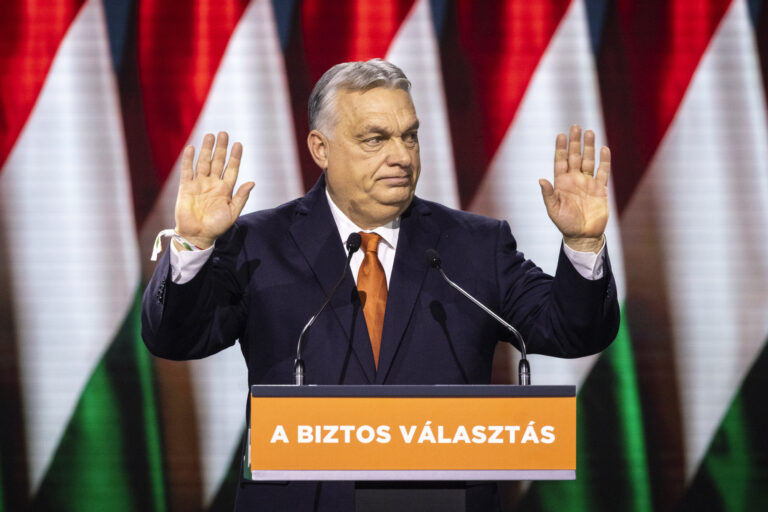
The Kremlin is openly assisting Hungary’s ruling Fidesz party in its election campaign, effectively turning the April parliamentary elections into a vote on whether the country will move closer to the European Union or to Russia.
Hungarian investigative journalist Szabolcs Panyi from the portal VSquare, citing sources in European intelligence services, reported that a team of three political strategists from Russia had arrived in Hungary to help Viktor Orbán secure re-election. In Russia, these individuals are known as political consultants who have organized Vladimir Putin’s electoral victories for decades.
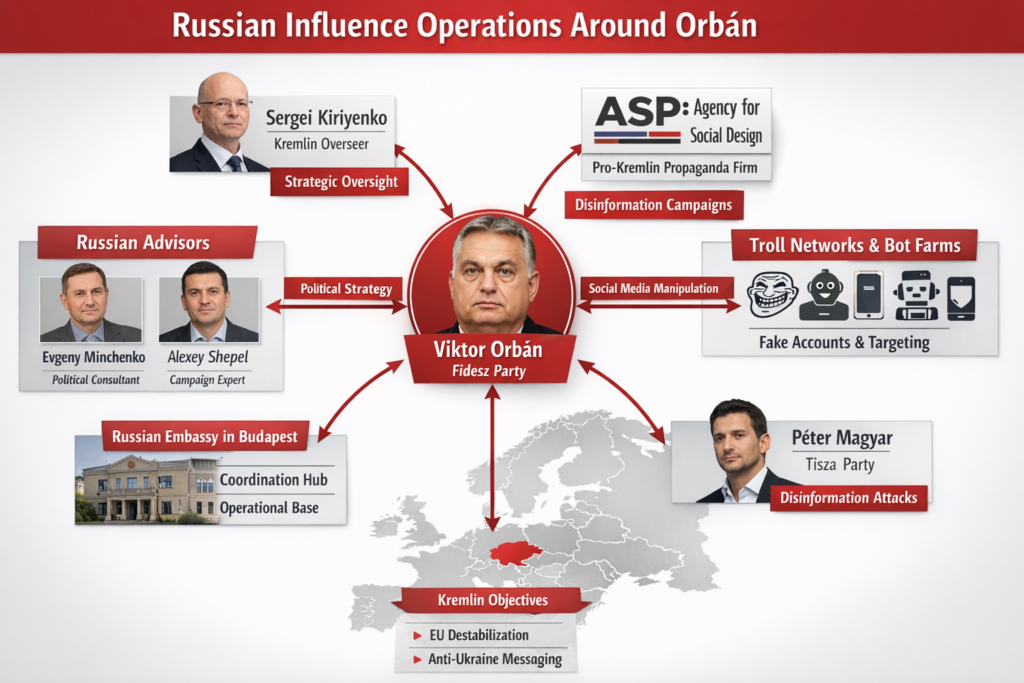
According to the report, the Russian team is allegedly working under the supervision of Sergei Kiriyenko. Their task is to organize a social media campaign against Péter Magyar and his party Tisza Party.
The group reportedly aims to assist Orbán through the use of troll networks, algorithm manipulation, and the creation of high-quality online content designed to elevate the campaign to a new level.
Péter Magyar has accused Orbán of inviting representatives of the GRU to Hungary. According to him, their task is to influence the elections.
Magyar also stated that an active disinformation campaign is expected to focus particularly on TikTok, reflecting tactics Russia has allegedly used recently during elections in Moldova, Romania, and other countries.
Meanwhile, the Financial Times reported that the Kremlin hired the Moscow-based IT and propaganda firm Agency for Social Design (ASP) to assist Orbán’s election campaign. The agency is known in Russia for organizing disinformation campaigns and is currently under sanctions imposed by the EU, the United States, and other countries.
Hungary’s main opposition figure, Péter Magyar, strongly criticized Russian interference in the elections and addressed the Russian ambassador in Budapest, stating:
“We Hungarians are heirs to the freedom fighters of 1956. No one can intimidate or blackmail us.”
Magyar, leader of the Tisza Party, expressed confidence that the majority of Hungarians would vote on April 12 for Hungary’s place within the European Union.
He also called on Viktor Orbán to convene the National Security Council and explain to citizens “what is really happening,” referring to reports about Moscow’s influence in Budapest.
According to available information, Russian specialists are currently operating from the building of the Embassy of Russia in Budapest. Their presence reportedly contributes to the anti-Ukrainian rhetoric used by Orbán during the campaign.
In this context, the Kremlin appears to be using Hungary’s elections as an instrument of foreign policy pressure on Ukraine through a member state of the European Union.
Russian Political Technologists in Hungary: Kremlin Support for Orbán’s Electoral Campaign
Russian Advisors and the Kremlin’s Election Playbook
Investigative reports indicate that Russia has deployed political consultants to support the electoral campaign of Hungary’s ruling party Fidesz ahead of the parliamentary elections. According to sources cited by investigative journalists and European security officials, Moscow sent a team of political strategists to Budapest to assist Orbán’s re-election efforts.
The operation is reportedly overseen by Sergei Kiriyenko, one of President Vladimir Putin’s closest political managers and the architect of Russia’s domestic “political technology” system. Kiriyenko has been responsible for designing Kremlin influence campaigns both inside Russia and abroad.
European intelligence sources cited in investigative reporting suggest that the same operational model used by Russia in elections in Moldova has now been adapted for Hungary.
Structure of the Russian Campaign Assistance
Russian political technologists typically operate through a three-layer system developed during Putin’s electoral campaigns.
1. Digital Influence Operations
The Kremlin-linked propaganda firm Agency for Social Design reportedly designed an online campaign to support Orbán’s narrative and attack opposition leader Péter Magyar.
The campaign reportedly includes:
- coordinated social-media messaging;
- pro-government memes and viral content;
- disinformation narratives about the opposition;
- amplification through local influencers.
The strategy avoids obvious Russian branding in order to conceal the origin of the campaign and reduce political backlash.
Troll Networks and Algorithm Manipulation
The Russian team is believed to rely on techniques previously used in elections in Eastern Europe and the Balkans.
These tactics include:
- bot networks and troll farms;
- manipulation of platform algorithms;
- AI-generated content and deepfakes;
- targeted disinformation campaigns;
Analysts warn that these tactics could intensify as the Hungarian election approaches.
Embassy-Based Operational Coordination
Investigative reporting suggests that some of the operational coordination may take place through the Embassy of Russia in Budapest, which has allegedly served as a logistical base for the campaign.
The presence of Russian operatives in Budapest has raised concerns among European intelligence services that Hungary may be becoming a platform for broader Russian political influence inside the European Union.
Strategic Objectives of the Kremlin
Russia’s support for Orbán’s campaign appears to be driven by several geopolitical objectives.
Maintaining a Pro-Russian Government Inside the EU
Orbán has consistently opposed several EU policies toward Russia, including:
- stricter sanctions
- military assistance to Ukraine
- Ukraine’s EU accession process
Maintaining Orbán in power provides Moscow with a sympathetic government inside EU decision-making structures.
Weakening EU Political Unity
Hungary has repeatedly delayed or diluted EU sanctions against Russia.
From Moscow’s perspective, Orbán’s continued leadership increases the likelihood that internal EU divisions will persist.
Influencing the Strategic Orientation of Hungary
The upcoming elections are widely seen as a geopolitical choice between two competing orientations:
- deeper integration with the European Union
- closer alignment with Russia
Russian involvement suggests that the Kremlin views the Hungarian election as strategically significant for the broader political balance in Central Europe.
Domestic Campaign Architecture
Orbán’s campaign also relies on a domestic political communication structure built over more than a decade.
One key figure in this system is Árpád Habony, an informal adviser widely described as the architect of Fidesz’s media and messaging strategy.
Habony’s network helped develop the Hungarian government’s aggressive communication tactics, including anti-immigration campaigns and coordinated media messaging.
The reported cooperation between Hungarian political strategists and Russian advisers suggests an overlap between domestic propaganda infrastructure and Kremlin-style influence operations.
Evidence and Intelligence Concerns
Several European intelligence agencies have reportedly shared information about the Russian operation with allied governments.
These concerns include:
- coordination between Russian political technologists and Hungarian campaign actors
- the use of digital disinformation tools
- potential links to Russian intelligence structures
Opposition figures in Hungary have also accused Moscow of attempting to influence the election through disinformation campaigns and cyber operations.
Strategic Implications for the European Union
If confirmed, Russian involvement in Hungary’s election would represent one of the most direct attempts by Moscow to influence politics inside an EU member state since the beginning of the war in Ukraine.
The implications could include:
- increased distrust within EU political institutions
- heightened scrutiny of Hungary’s relations with Russia
- stronger counter-intelligence monitoring of Russian influence operations in Europe.
The Hungarian election therefore risks becoming not only a domestic political contest but also a test case for the resilience of democratic processes inside the European Union.
The Agency for Social Design (ASP): Kremlin Contractor for Information Warfare
Origins and Structure
The Agency for Social Design (ASP) is a Moscow-based political technology and digital influence firm that has become one of the Kremlin’s most important contractors for information operations abroad. Investigations by European media and intelligence services indicate that the agency operates as a private intermediary implementing propaganda and disinformation campaigns on behalf of the Russian state.
The organization is linked to Russian political technologist Ilya Gambashidze, who founded the Social Design Agency and related companies within the “Struktura” group. These entities are believed to operate extensive networks of fake media websites and coordinated social-media accounts designed to mimic legitimate news outlets.
ASP is widely viewed as part of the broader ecosystem of Russia’s outsourced information warfare infrastructure, where nominally private companies execute influence campaigns that align with Kremlin geopolitical objectives.
Major Operations and Campaigns
Operation “Doppelgänger”
One of the most well-documented ASP operations is the Doppelgänger disinformation campaign, launched in 2022 after Russia’s full-scale invasion of Ukraine.
The campaign involved creating clone versions of well-known Western media outlets, including European and American news organizations. These fake websites published fabricated articles designed to undermine Western support for Ukraine and promote pro-Russian narratives.
Key narratives disseminated through Doppelgänger included:
- claims that Western sanctions against Russia were ineffective;
- portrayals of Ukraine as controlled by extremist forces;
- narratives suggesting Ukrainian refugees were a burden to European societies;
- attempts to present Western governments as corrupt or hypocritical.
The operation relied on networks of automated social-media accounts and coordinated advertising campaigns to amplify the fake content across Europe and North America.
Influence Operations in Europe
Investigations into ASP activities reveal that its campaigns have targeted several European countries.
Countries affected by ASP disinformation operations include:
- Germany,
- France,
- Ukraine,
- the United States,
- other European states.
These campaigns often seek to amplify social polarization and weaken public support for Ukraine among Western audiences.
Rather than promoting overtly pro-Russian messaging, many of the narratives are designed to exploit existing political divisions within European societies.
Techniques Used by ASP
ASP campaigns typically combine several digital influence techniques.
1. Fake Media Ecosystems
The agency created dozens of fake websites designed to imitate legitimate news platforms.
These sites publish fabricated stories that appear credible at first glance and are then spread through social media networks.
2. Social Media Manipulation
ASP campaigns rely heavily on:
- bot networks
- troll farms
- coordinated meme campaigns
- targeted digital advertising.
These tools allow operators to artificially amplify narratives and create the illusion of widespread public support.
3. Memetic Warfare
Leaked documents revealed that ASP produced viral memes, falsified videos, and manipulated political contentdesigned to spread quickly through social media platforms.
In several cases, content originating from these operations was widely shared online before being identified as disinformation.
Integration with Russian State Strategy
Although ASP operates as a private company, its campaigns are widely believed to be coordinated with Russian state structures.
Investigations suggest that its activities align closely with the strategic communication objectives of the Kremlin, particularly in the context of the war against Ukraine.
Russia’s information warfare doctrine increasingly relies on such private contractors to conduct influence operations abroad while maintaining plausible deniability.
This model reflects a broader shift in Russian information operations after 2022, when sanctions and restrictions forced Moscow to reorganize its propaganda infrastructure and rely more heavily on covert networks and private actors.
Potential Role in European Elections
Given ASP’s expertise in digital influence campaigns, analysts believe the agency could also play a role in shaping political debates during elections in Europe.
Its operational methods — including targeted disinformation, meme campaigns, and algorithm manipulation — are particularly effective in social-media environments such as:
- TikTok
- X (Twitter)
- Telegram.
These platforms allow foreign influence operations to reach millions of users while remaining difficult for authorities to detect in real time.
Strategic Implications
The activities of the Agency for Social Design illustrate the growing sophistication of Russia’s information warfare capabilities.
Rather than relying solely on traditional state media such as RT or Sputnik, Moscow now operates through a decentralized ecosystem of private propaganda contractors, digital marketing firms, and covert influence networks.
This model allows Russia to continue conducting information operations even after many of its official media outlets were banned or restricted in Europe.
As a result, European elections and political debates remain vulnerable to manipulation through digitally coordinated disinformation campaigns.
Links Between the Agency for Social Design (ASP) and Russian Intelligence
Political Oversight from the Kremlin Administration
The Agency for Social Design (ASP) is widely believed to operate under the strategic supervision of Sergei Kiriyenko, who oversees domestic political management and external influence operations for the Kremlin.
Kiriyenko’s office coordinates Russia’s “political technology” ecosystem — a network of consultants, media strategists, and digital propaganda contractors used to influence both Russian and foreign political environments.
Within this framework, ASP functions as a contractor executing digital influence operations aligned with Kremlin political objectives.
2. Personnel Overlap with Russian Political Technology Networks
The agency is associated with Russian political strategist Ilya Gambashidze, who has worked within the Kremlin’s political consulting ecosystem.
Russian “political technologists” often move between:
- Kremlin political management structures
- government-linked consulting firms
- disinformation and propaganda organizations.
This blurred boundary between political consulting and state operations allows the Kremlin to conduct influence campaigns while maintaining plausible deniability.
3. Operational Role in Russian Information Warfare
ASP has reportedly participated in several major Russian disinformation operations, including the Doppelgänger disinformation campaign, which targeted European audiences with cloned versions of Western news websites.
These operations used:
- fake media websites
- bot networks
- coordinated social-media campaigns
- targeted advertising.
The strategic narratives promoted by these campaigns closely match messaging used by Russian state propaganda outlets.
4. Integration with Russian Hybrid Warfare Strategy
Russian intelligence doctrine increasingly relies on outsourced information warfare networks rather than direct state institutions.
Under this model:
Kremlin political leadership
↓
Presidential Administration (Kiriyenko)
↓
Private propaganda contractors (ASP)
↓
Digital influence networks
↓
Troll farms / bot networks
↓
Foreign political narratives
This structure allows Russian intelligence services such as the Federal Security Service, Foreign Intelligence Service, and GRU to integrate information operations into broader geopolitical strategies.
5. Financial and Organizational Links
Several investigations have indicated that companies connected to ASP received contracts linked to state-aligned organizations and political structures in Russia.
These connections reinforce the view that ASP operates within the state-directed ecosystem of Russian strategic communications and influence operations.
6. Sanctions and International Assessments
Because of its role in disinformation campaigns, ASP has been placed under sanctions by:
- the European Union
- the United States
- other Western governments.
Sanctions documents describe the agency as a central node in Russia’s digital propaganda and influence infrastructure.
Strategic Assessment
The Agency for Social Design represents a new generation of Kremlin information-warfare infrastructure.
Instead of relying exclusively on state media outlets such as RT or Sputnik, Russia now uses private political-technology firms to conduct influence operations abroad.
This model provides several advantages for Moscow:
- plausible deniability
- operational flexibility
- ability to bypass sanctions and media bans
- integration with social-media ecosystems.
As a result, organizations like ASP have become critical instruments in Russia’s hybrid warfare strategy targeting Western democracies.