
Cuba is currently experiencing one of the most severe economic and social crises since the collapse of the Soviet Union in the early 1990s. The country faces an acute shortage of fuel, repeated nationwide power outages, food scarcity, and rising public dissatisfaction. In March 2026 the island experienced a complete collapse of the national power grid, leaving millions without electricity and highlighting the fragility of the country’s infrastructure.
These developments have triggered protests and increased speculation about the stability of the political system led by President Miguel Díaz‑Canel and the ruling Communist Party of Cuba.
Current Drivers of Political Instability
Economic Collapse
Cuba’s economic crisis is driven by several structural factors:
- severe shortages of fuel and electricity;
- declining foreign currency reserves;
- reduced oil imports;
- long-standing inefficiencies in the state-controlled economy.
Recent U.S. pressure and restrictions on oil supplies have dramatically reduced Cuba’s fuel imports, worsening shortages and disruptions in essential services.
As a result:
- transportation systems are disrupted;
- food distribution networks are weakening;
- hospitals and water systems face shortages.
The country’s aging energy infrastructure has become particularly vulnerable, with many power plants over four decades old and prone to failure.
Energy Crisis and Infrastructure Collapse
The energy crisis is a central trigger of public unrest. In recent years Cuba has experienced repeated nationwide blackouts, including several major outages between 2024 and 2026.
The March 2026 blackout affected nearly the entire population and disrupted essential services such as water supply, banking systems, and internet access.
For many Cubans, daily life now includes power outages lasting up to 15 hours or more in some regions.
Growing Social Unrest
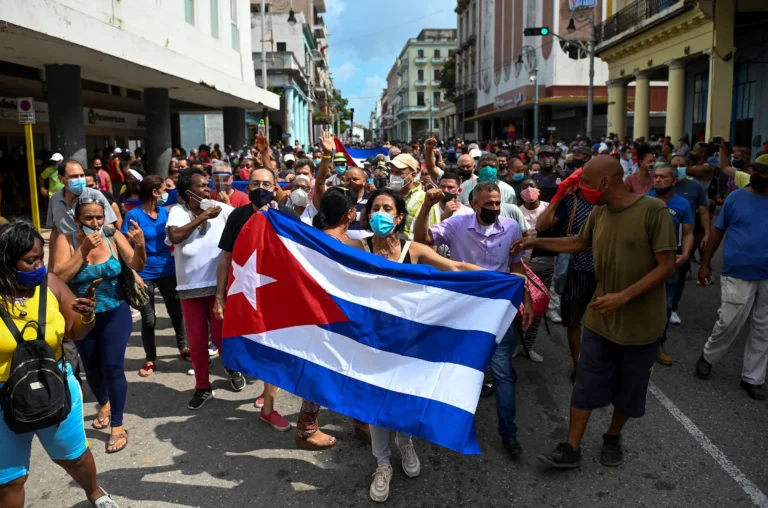
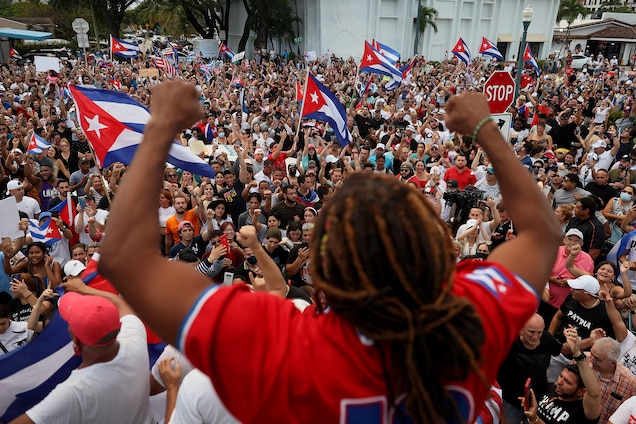
Public frustration has increasingly translated into protests.
Recent demonstrations have been triggered by:
- electricity shortages;
- food scarcity;
- declining living standards.
In March 2026 protesters vandalized a local Communist Party office in Morón during a blackout protest, reflecting rising anger toward the authorities.
Independent observers estimate that thousands of protests and public complaints have occurred in recent years, indicating a growing level of social dissatisfaction.
Structural Factors Limiting Immediate Power Change
Despite the worsening crisis, the probability of an immediate regime collapse remains relatively low.
Control of Security Forces
The Cuban government retains tight control over key institutions, including:
- the armed forces;
- internal security services;
- the police.
Historically, the Cuban state has responded to protests with rapid repression and arrests. Hundreds of activists and protesters have been detained in recent years.
The loyalty of the military remains one of the regime’s most important pillars of stability.
Lack of Organized Opposition
Another limiting factor is the absence of a unified opposition movement.
Although various dissident groups exist, they face:
- heavy surveillance;
- restrictions on political organization;
- limited access to media.
Protests in Cuba tend to be spontaneous and localized rather than coordinated nationwide movements.
Emigration as a Safety Valve
Mass migration has also reduced internal pressure on the regime. In recent years Cuba has experienced one of the largest migration waves in its modern history, with a significant share of the population leaving the island.
This outflow of dissatisfied citizens acts as a “pressure release valve,” reducing the likelihood of large-scale revolutionary mobilization.
Scenarios of Political Change
Although an immediate regime collapse appears unlikely, several scenarios could unfold over the next few years.
Scenario 1: Regime Hardening (Most Likely)
The government may respond to growing unrest by strengthening internal control.
Possible measures include:
- stricter censorship
- stronger surveillance
- expanded repression of activists.
In this scenario the regime survives but becomes increasingly authoritarian.
Scenario 2: Controlled Economic Reform
Facing economic collapse, the government may gradually expand market reforms.
Potential reforms could include:
- legalization of more private businesses;
- greater foreign investment;
- partial liberalization of the economy.
Such reforms would aim to stabilize the system without introducing political pluralism.
Scenario 3: Elite-Driven Political Transition
A more dramatic change could occur if divisions emerge within the political elite or military leadership.
A combination of economic collapse, mass protests, and elite fragmentation could trigger a controlled transition of power.
However, analysts generally view this scenario as less likely in the short term.
4. Geopolitical Implications
Political developments in Cuba would have important implications for international relations.
Impact on the United States
The United States remains Cuba’s most significant external pressure factor. Washington’s sanctions policy and economic restrictions play a major role in shaping Cuba’s economic conditions.
A political transition in Cuba could lead to:
- negotiations over sanctions relief;
- economic normalization with the United States.
Role of External Partners
Cuba also maintains relationships with several external partners, including:
- Russia;
- China;
- Venezuela.
These countries provide varying levels of economic or political support that help stabilize the Cuban government.
However, Venezuela’s declining capacity to supply subsidized oil has weakened this support network.
Migration and Regional Security
If the crisis deepens, migration from Cuba could increase significantly.
Large migration waves could affect:
- the United States
- Mexico
- Caribbean states.
Migration pressures could become a major regional security issue.
Cuba is entering a period of profound economic and social instability. Severe energy shortages, deteriorating infrastructure, and rising public frustration are eroding living conditions across the island.
However, despite these pressures, the probability of an immediate regime change remains limited due to the government’s control over security institutions, the fragmented nature of the opposition, and the continued emigration of dissatisfied citizens.
The most likely short-term outcome is a continuation of the current system combined with economic hardship and periodic protests.
Over the longer term, however, sustained economic collapse could gradually increase the probability of political transformation—particularly if elite divisions emerge within the ruling system.
Opposition Leadership and External Pressure Scenarios in Cuba
Potential Leaders of the Cuban Opposition
Cuba’s opposition landscape is fragmented, decentralized, and heavily constrained by state repression. Unlike many post-authoritarian transitions, the Cuban opposition does not currently have a single figure capable of unifying disparate movements across the island. Nevertheless, several individuals and networks have emerged as influential actors.
María Corina Machado–style leadership does not exist in Cuba, but several figures play similar roles
Among the most visible figures is José Daniel Ferrer, leader of the Patriotic Union of Cuba. Ferrer has long been involved in organizing protests and dissident networks in eastern Cuba. However, his influence remains geographically limited and frequently disrupted by arrests and government pressure.
Another prominent activist is Berta Soler, leader of the Ladies in White. This group became internationally recognized for protests against political imprisonment in Cuba. While influential symbolically, it lacks the organizational capacity to mobilize nationwide political change.
A newer generation of activists emerged during the 2021 protests, including figures associated with the San Isidro Movement and independent journalists operating online. These networks rely heavily on digital communication and diaspora support.
However, several limitations weaken the opposition’s leadership potential:
- frequent arrests and harassment of activists
- limited internet access during protests
- fragmentation between exile and domestic opposition groups
- absence of legal political parties outside the ruling Communist Party of Cuba.
For these reasons, the Cuban opposition currently resembles a decentralized protest network rather than a structured political movement.
The Role of the Cuban Diaspora
The Cuban diaspora, particularly in the United States, plays a significant role in shaping opposition narratives.
Cities such as Miami have become hubs for Cuban exile political organizations and media platforms critical of the Cuban government. Diaspora networks provide:
- financial support to dissident groups
- international advocacy campaigns
- digital platforms amplifying protest movements.
However, the relationship between domestic activists and exile groups is complex. Some opposition figures inside Cuba fear that overt association with exile organizations could allow the government to portray them as foreign agents.
Scenarios of U.S. Pressure on the Cuban Government
The United States has historically attempted to influence political developments in Cuba through a variety of mechanisms. Since the Cold War, these strategies have evolved from direct confrontation to economic and political pressure.
Today, several possible scenarios could shape U.S. involvement if political instability in Cuba increases.
Scenario 1: Intensified Economic Pressure
The most likely scenario involves continued economic pressure rather than direct intervention.
The United States maintains a long-standing sanctions regime against Cuba, which includes restrictions on trade, financial transactions, and investment.
Washington could intensify pressure through:
- stricter enforcement of sanctions;
- financial restrictions targeting Cuban state companies;
- limits on remittances or tourism flows.
The objective would be to weaken the Cuban government’s economic capacity while increasing incentives for political reforms.
However, such measures also risk worsening humanitarian conditions and fueling migration pressures.
Scenario 2: Support for Civil Society and Opposition
Another possible scenario involves expanding support for civil society organizations, independent media, and digital activism.
U.S. policy has historically included funding programs designed to:
- promote internet access in Cuba;
- support independent journalism;
- train activists and human rights organizations.
In this scenario, the goal would be to strengthen domestic civic networks capable of advocating political reform from within Cuban society.
This approach seeks gradual political change rather than abrupt regime collapse.
Scenario 3: Diplomatic Engagement and Negotiated Reform
A less confrontational scenario would involve renewed diplomatic engagement between Washington and Havana.
In this model, the United States might pursue negotiations aimed at:
- easing sanctions in exchange for political reforms
- expanding economic cooperation
- facilitating humanitarian assistance.
This approach was partially attempted during the Obama administration but later reversed.
If political conditions change in Cuba, a similar strategy could re-emerge.
Military Intervention: Extremely Unlikely
Direct U.S. military intervention in Cuba is considered highly improbable under current international conditions.
Several factors discourage such a scenario:
- strong international opposition to military intervention;
- potential regional destabilization;
- legal and diplomatic constraints;
- the risk of large migration flows.
Additionally, Cuba does not currently represent a strategic military threat comparable to Cold War conditions.
Strategic Outlook
While Cuba faces serious economic and social challenges, the likelihood of a rapid regime collapse remains relatively low.
Political change, if it occurs, is more likely to emerge through:
- gradual economic reform;
- generational leadership shifts within the ruling elite;
- slow expansion of civil society.
External actors such as the United States can influence these dynamics but are unlikely to directly determine the outcome.
For now, Cuba’s political trajectory will primarily depend on internal economic conditions and the cohesion of the ruling political elite.
Effects of a Venezuelan “Maduro-Collapse Scenario” on Cuba
Immediate Energy Shock for Cuba
The most direct consequence would be the loss of subsidized Venezuelan oil, which has long been the backbone of Cuba’s energy system.
For years, Venezuela supplied tens of thousands of barrels of oil per day to Cuba in exchange for Cuban security advisers, intelligence support, and medical personnel.
At its peak, this arrangement covered a large share of Cuba’s energy needs.
If the Venezuelan government changes and stops these deliveries:
- Cuba would lose its primary energy lifeline
- electricity shortages would intensify
- industrial production would decline sharply.
Recent reports already indicate that after Maduro’s removal oil shipments to Cuba were halted, contributing to severe blackouts and fuel shortages on the island.
This creates the risk of a systemic economic crisis comparable to Cuba’s “Special Period” of the 1990s after the collapse of the Soviet Union.
Political Shock to the Cuban Regime
The fall of Maduro would also weaken Cuba’s geopolitical support network.
For years, the Havana–Caracas alliance functioned as a mutual survival pact:
- Cuba provided intelligence, security, and political support;
- Venezuela provided oil and financial assistance.
Cuban advisers were deeply embedded in Venezuelan security structures and intelligence agencies.
If a new Venezuelan government removes Cuban personnel from these institutions:
- Cuba would lose influence in Venezuela
- Havana would lose access to intelligence networks and financial flows.
This would weaken the Cuban regime’s regional strategic depth.
3. Potential Domino Effect in the “ALBA Axis”
Maduro’s removal could trigger broader shifts among left-leaning governments historically aligned with Cuba.
Countries historically connected to the Cuba-Venezuela axis include:
- Nicaragua;
- Bolivia;
- Venezuela (formerly the economic pillar).
If Venezuela ceases to support these alliances financially, the regional ideological bloc supporting Havana could weaken significantly.
Increased U.S. Pressure on Cuba
The fall of Maduro would likely encourage stronger U.S. pressure on Cuba.
Washington has historically viewed Venezuela as the strategic economic pillar sustaining the Cuban regime.
Some U.S. policymakers have explicitly argued that removing Maduro would weaken Havana’s ability to maintain its political system.
In such a scenario, the United States could pursue:
- tighter economic sanctions;
- diplomatic isolation;
- stronger support for Cuban opposition networks.
This would intensify pressure on the Cuban leadership.
Rising Risk of Internal Instability in Cuba
Without Venezuelan oil and financial support, Cuba could face:
- prolonged electricity outages;
- food shortages;
- deeper economic contraction.
These factors already contribute to social unrest on the island. Recent protests have been linked to blackouts and economic hardship.
If the crisis deepens, the government could face:
- larger protests
- elite divisions
- increased emigration.
However, the Cuban regime still retains strong control over the security apparatus, which reduces the likelihood of rapid regime collapse.
6. Strategic Reorientation Toward New Partners
To compensate for the loss of Venezuelan support, Cuba would likely attempt to strengthen relations with other external partners.
Possible alternatives include:
- Russia;
- China;
- Mexico.
- Middle Eastern oil suppliers.
However, none of these partners can easily replace the scale of subsidized oil Venezuela once provided.
Scenario Outlook
Scenario 1 – Regime Survival Through Repression (Most Likely)
The Cuban government survives but faces severe economic hardship and periodic protests.
Scenario 2 – Gradual Reform
Economic collapse forces Havana to expand market reforms or seek rapprochement with the United States.
Scenario 3 – Political Transition
If economic collapse combines with elite divisions and mass protests, a controlled political transition could occur.
The removal of Maduro would represent one of the most serious geopolitical shocks to Cuba since the fall of the Soviet Union.
The consequences would include:
- loss of cheap oil
- weakening of regional alliances
- increased U.S. pressure
- rising economic instability inside Cuba.
While this would not automatically lead to regime change in Havana, it would significantly increase the probability of political transformation over the medium term.
More on this story: Cuba protests: Havana regime cracks but tries to keep afloat with outside help
More on this story: Cuba actively sabotaging Latin American democracies (audio)