
Russian Foreign Ministry spokesperson Maria Zakharova, speaking at a media briefing, accused the West of creating security threats to Russia in the Arctic and increasing its military activity in the region, which, in her view, raises the likelihood of military confrontation.
The statement was made at the conclusion of the large-scale Cold Response 2026 exercises, held from March 9 to 19, involving approximately 25,000 troops from 14 NATO member states. It also comes amid the deployment of a new military initiative, Arctic Sentry, aimed at strengthening security in the Arctic region.
The accusations directed at the West appear to be an attempt by Moscow to legitimize its own militarization of the region.
Claims that the West is allegedly creating threats to Russia in the Arctic are part of a broader effort to justify Russia’s military buildup and to assert control over the extraction and development of natural resources. In addition, Russia views the Northern Sea Route as part of its internal waters, whereas international law—particularly the United Nations Convention on the Law of the Sea—defines it as an international transit corridor.
NATO’s increased activity and the strengthening of security measures by its member states, including Arctic military exercises, are a direct response to Russia’s aggressive and provocative behavior in the region over many years, as well as to hybrid threats emanating from Moscow.
In recent years, Russia has remained a source of hybrid threats in the Arctic, including documented cases of deliberate damage to undersea communication cables near the coasts of Norway and Sweden. It has also disrupted navigation systems for civilian aviation and maritime traffic near Finland, Norway, and the Baltic states through the use of GPS spoofing and signal jamming.
Within the Kremlin, there is a growing perception that Russia’s monopoly over Arctic resources and logistics is gradually eroding. This is viewed as a strategic threat, prompting attempts to shift responsibility onto the West by accusing it of creating security risks for Russia.
Effective countermeasures to Russia’s expansion and influence in the Arctic require a transition from passive monitoring to active control over key logistical nodes and undersea infrastructure. This includes ensuring a постоянна presence of NATO forces under the Arctic Sentry framework. It is essential to deny Russia the ability to use the Northern Sea Route as an instrument of geopolitical coercion.
Recent intelligence assessments and statements by Norwegian military leadership in 2026 indicate a credible risk of direct Russian military aggression against the country’s territorial integrity. Such actions could aim to establish a “buffer zone” to protect nuclear bases on the Kola Peninsula, accompanied by preparations for sabotage against energy infrastructure. These developments have prompted Norway to develop contingency plans for the emergency evacuation of its northern regions.
Russia’s recent accusations against the West regarding alleged militarization of the Arctic should be understood not as reactive rhetoric, but as part of a deliberate strategic narrative aimed at legitimizing its own long-term military and economic ambitions in the region. Moscow is attempting to reshape the Arctic security discourse in order to justify both its expanding military footprint and its claims over critical infrastructure and maritime routes.
Narrative as Strategic Instrument
Statements by Maria Zakharova accusing NATO of escalating tensions in the Arctic are consistent with a broader Russian information strategy: preemptively framing defensive Western measures as aggressive acts.
The timing of these claims—following the NATO exercise Cold Response 2026 and the launch of Arctic Sentry—is not coincidental. It reflects an effort by Moscow to:
- delegitimize NATO’s presence in the Arctic
- create a perception of encirclement
- justify further militarization under the guise of defensive necessity.
This narrative approach mirrors Russian communication strategies used in other theaters, including Eastern Europe and the Black Sea.
Arctic Control as a Strategic Objective
At the core of Russia’s Arctic policy lies the ambition to establish de facto control over the region’s logistics and resources.
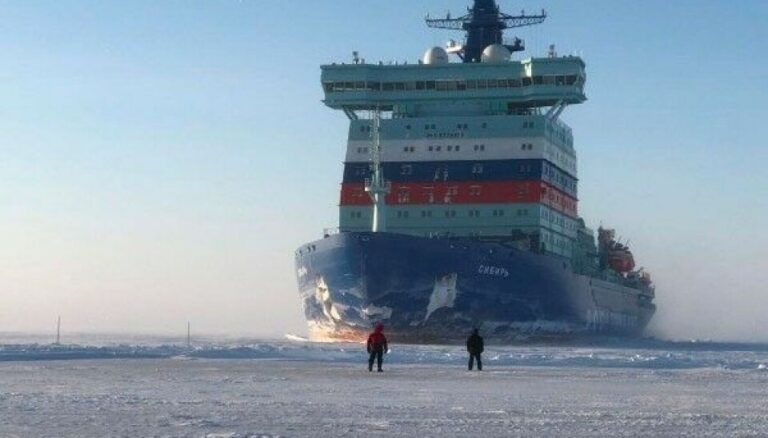
Central to this strategy is the Northern Sea Route, which Moscow seeks to treat as an internal transport artery rather than an international waterway. This position directly contradicts the legal framework of the United Nations Convention on the Law of the Sea, which defines such routes as subject to international transit rights.
Control over the Northern Sea Route would provide Russia with:
- leverage over global shipping between Europe and Asia
- economic advantages through transit regulation
- a tool of geopolitical pressure against Western states.
Thus, Russia’s rhetoric about “security threats” must be interpreted as part of a broader effort to normalize exclusive control over Arctic maritime space.
Hybrid Threat Environment in the Arctic
Contrary to Moscow’s claims, NATO’s increased activity in the Arctic is largely reactive to a growing pattern of Russian hybrid operations in the region.
Documented incidents include:
- damage to undersea communication cables near Norway and Sweden
- widespread GPS spoofing and signal jamming affecting aviation and maritime navigation near Finland, Norway, and the Baltic states
- increased surveillance and probing of critical infrastructure.
These actions indicate that Russia is already conducting low-intensity, deniable operations aimed at testing NATO’s resilience and response thresholds.
The Arctic is therefore evolving into a hybrid conflict zone, where competition occurs below the threshold of open military confrontation.
Erosion of Russia’s Arctic Monopoly
A key driver of Moscow’s increasingly assertive posture is the perception that its historical dominance in the Arctic is weakening.
Several developments contribute to this shift:
- Finland and Sweden’s integration into NATO
- increased Western investment in Arctic surveillance and infrastructure
- greater multinational coordination among NATO Arctic members.
For the Kremlin, this represents not only a military challenge but a strategic loss of influence over Arctic logistics, resources, and governance.
As a result, Russia is attempting to:
- reframe NATO’s actions as destabilizing
- justify its own military buildup
- preserve its strategic position through both hard and hybrid means.
Risk of Escalation: The Norwegian Vector
Recent intelligence assessments from Norway point to a credible risk of escalation in the High North.
Russian strategic planning may include:
- the creation of a “buffer zone” near the Kola Peninsula, where key nuclear assets are located
- sabotage operations targeting energy and communication infrastructure
- limited incursions designed to test NATO’s response mechanisms.
Such actions would likely remain below the threshold of full-scale war but could trigger localized crises with significant escalation potential.
Norway’s reported contingency planning for evacuating northern regions underscores the seriousness of this threat.
Implications for NATO Strategy
The evolving security environment in the Arctic requires a shift in NATO’s approach.
A purely reactive posture is no longer sufficient. Instead, the Alliance must move toward:
- persistent presence in key Arctic zones
- enhanced protection of undersea infrastructure
- improved monitoring of hybrid threats
- rapid-response capabilities tailored to Arctic conditions.
The Arctic Sentry initiative represents an important step in this direction, but its effectiveness will depend on sustained commitment and operational integration among member states.
The Arctic is transitioning from a zone of low tension to a strategically contested space shaped by competition over infrastructure, resources, and mobility corridors.
Russia’s actions suggest a long-term strategy aimed at:
- securing control over critical maritime routes
- maintaining dominance in regional resource extraction
- limiting NATO’s operational freedom.
At the same time, NATO’s growing presence reflects an emerging recognition that the Arctic is no longer insulated from broader geopolitical confrontation.
Russia’s accusations against the West are not merely rhetorical—they are part of a broader strategy to reshape the legal, political, and security architecture of the Arctic.
By framing NATO as the aggressor, Moscow seeks to legitimize its own militarization while advancing its claims over critical infrastructure and maritime routes.
The result is a gradual but clear transformation of the Arctic into a new frontier of strategic competition, where hybrid operations, legal disputes, and military posturing intersect.
For Western policymakers, the challenge lies in countering both the physical and narrative dimensions of Russia’s strategy, ensuring that the Arctic remains governed by international law rather than unilateral control.
Timeline: Russian Arctic Militarization (2007–2026)
2007 — Symbolic Claim: Flag on the Seabed
- Russia plants a titanium flag on the Arctic seabed during the Arktika 2007.
- Marks the beginning of modern geopolitical competition in the Arctic.
- Signals Moscow’s intent to claim extended continental shelf rights.
2008–2012 — Legal and Strategic Foundations
- Russia submits claims to expand its Arctic continental shelf under UNCLOS.
- Launch of Arctic strategy emphasizing:
- resource extraction
- control of the Northern Sea Route
- military presence.
2013–2014 — Military Re-entry into the Arctic
4
- Creation of specialized Arctic brigades.
- Reopening of Soviet-era bases across:
- Novaya Zemlya
- Franz Josef Land
- New Siberian Islands.
- Establishment of the Northern Fleet Joint Strategic Command (2014).
2015–2017 — Infrastructure Expansion
- Construction of advanced Arctic bases, including:
- Arctic Trefoil (Franz Josef Land)
- Nagurskoye airbase expansion.
- Deployment of:
- air defense systems (S-300 / S-400)
- radar and early-warning systems.
- Arctic becomes a permanent military operating environment.
2018–2020 — Operationalization and Power Projection
- Regular Arctic military exercises increase in scale.
- Development of ice-capable naval forces and submarines.
- Integration of Arctic into Russia’s nuclear deterrence posture, particularly via the Kola Peninsula.
2021 — Northern Sea Route Militarization
- Russia imposes stricter control over the Northern Sea Route:
- mandatory permits
- military escort requirements.
- NSR increasingly treated as internal Russian waters.
2022 — Post-Ukraine War Acceleration
- Following the invasion of Ukraine:
- Arctic gains importance as a sanctions-resilient logistics corridor.
- Western cooperation with Russia in the Arctic collapses.
- Increased militarization framed as defensive against NATO expansion.
2023–2024 — Hybrid Operations and Infrastructure Pressure
- Reports of:
- sabotage of undersea cables
- GPS spoofing in Nordic and Baltic regions.
- Arctic becomes a zone of hybrid warfare experimentation.
- Increased surveillance of NATO infrastructure.
2025 — Strategic Consolidation
- Expansion of Arctic logistics and military integration:
- dual-use infrastructure (civilian + military).
- Increased patrols and readiness of Arctic forces.
- Russia reinforces narrative of Western encroachment.
2026 — Escalation and Strategic Competition
4
- NATO conducts Cold Response 2026 (~25,000 troops).
- Launch of Arctic Sentry.
- Russia accuses the West of militarization while continuing its own buildup.
- Norwegian intelligence warns of:
- potential buffer zone strategy
- sabotage risks to energy infrastructure.
Key Phases of Russian Arctic Militarization
Phase 1: Symbolic Assertion (2007–2012)
- Legal claims and signaling intent.
Phase 2: Military Return (2013–2017)
- Base construction and force deployment.
Phase 3: Operational Control (2018–2021)
- Integration into nuclear and naval strategy.
Phase 4: Strategic Confrontation (2022–2026)
- Hybrid warfare + NATO counter-presence.
From Polar Frontier to Strategic Theater: Soviet vs. Russian Arctic Policy
Executive Comparison
While both the Soviet Union and modern Russia viewed the Arctic as strategically important, their approaches differ fundamentally:
- The Soviet Arctic was primarily a military-strategic buffer and industrial frontier.
- The Russian Arctic (post-2007) has evolved into a multi-domain geopolitical theater, combining military power, economic leverage, legal claims, and hybrid operations.
From Polar Frontier to Strategic Theater: Soviet vs. Russian Arctic Policy
Executive Comparison
While both the Soviet Union and modern Russia viewed the Arctic as strategically important, their approaches differ fundamentally:
- The Soviet Arctic was primarily a military-strategic buffer and industrial frontier.
- The Russian Arctic (post-2007) has evolved into a multi-domain geopolitical theater, combining military power, economic leverage, legal claims, and hybrid operations.
The Soviet Arctic strategy was driven by:
- nuclear deterrence (submarine bastions in the Barents Sea)
- protection of the northern flank against NATO
- development of Arctic industry and infrastructure
- support for internal logistics via the Northern Sea Route.
The Arctic functioned mainly as a rear strategic zone, not a contested global arena.
Modern Russia’s objectives are broader:
- control over Arctic resources (oil, gas, rare minerals)
- dominance of the Northern Sea Route
- geopolitical leverage over global trade routes
- limiting NATO access and influence
- maintaining nuclear deterrence via the Kola Peninsula.
The Arctic is now treated as a frontline strategic domain, not just a defensive zone.
Military Posture
Soviet Model: Heavy but Static
- Large, fixed military infrastructure
- Focus on submarine fleets and air defense
- Limited year-round operational flexibility
- Arctic viewed as a bastion for strategic forces.
Russian Model: Flexible and Persistent
- Reopened and modernized Arctic bases (post-2013)
- Deployment of mobile forces and Arctic brigades
- Integrated air, naval, and missile defense systems
- Regular exercises and continuous presence.
Russia has shifted toward a networked and expeditionary Arctic force posture.
Legal and Maritime Strategy
Soviet Approach: Limited Legal Contestation
- Relatively low emphasis on international legal claims
- Northern Sea Route used primarily for domestic purposes
- Less focus on global shipping control.
Russian Approach: Legal + Political Instrumentalization
Russia actively uses legal frameworks such as the
United Nations Convention on the Law of the Sea
to justify:
- extended continental shelf claims
- control over Arctic waters.
At the same time, Moscow asserts that the Northern Sea Route is effectively internal waters, contradicting international norms.
This reflects a strategy of “legal warfare” combined with military enforcement.
Economic Dimension
Soviet Union: State-Driven Development
- Arctic used for:
- mining
- military-industrial infrastructure
- centralized logistics.
- Limited integration into global markets.
Modern Russia: Resource Geopolitics
- Arctic seen as a global energy hub:
- LNG projects (e.g., Yamal)
- offshore drilling
- Integration into global energy markets
- Use of Arctic resources to offset sanctions pressure.
The Arctic has become a key pillar of Russia’s economic resilience strategy.
Hybrid and Non-Military Tools
Soviet Era: Minimal Hybrid Activity
- Focus on conventional and nuclear deterrence
- Limited use of covert or non-kinetic tools in the Arctic.
Modern Russia: Hybrid Warfare in the High North
Recent activities include:
- GPS spoofing and signal jamming
- suspected sabotage of undersea cables
- information campaigns targeting Arctic governance.
The Arctic is now part of Russia’s hybrid warfare toolkit, similar to other regions.
International Context
Soviet Period: Bipolar Stability
- Arctic divided between NATO and Warsaw Pact spheres
- Predictable military balance
- Limited multilateral governance.
Current Period: Multipolar Competition
Today’s Arctic includes:
- NATO expansion (Finland, Sweden)
- increased Western military presence
- growing interest from non-Arctic states (e.g., China).
This transforms the region into a contested geopolitical space.
Key Diffeences (Summary Matrix)
| Dimension | Soviet Union | Modern Russia |
| Strategic Role | Defensive buffer | Active geopolitical theater |
| Military Posture | Static, heavy | Flexible, persistent |
| Legal Strategy | Limited | Assertive, revisionist |
| Economic Role | Internal development | Global resource leverage |
| Hybrid Activity | Minimal | Active and growing |
| International Context | Bipolar | Multipolar competition |
The transition from Soviet to modern Russian Arctic policy reflects a shift from defensive containment to proactive strategic competition.
While the Soviet Union sought to secure its northern flank, modern Russia seeks to:
- dominate Arctic logistics
- control resource extraction
- reshape legal norms
- challenge Western influence.
The Arctic has thus evolved into a critical arena of 21st-century geopolitical rivalry, where military, economic, and hybrid tools are deployed simultaneously.
U.S. Risk Assessment: Implications of Russia’s Arctic Strategy
Executive Takeaways
- Russia is turning the Arctic into a controlled logistics and military corridor anchored on the Northern Sea Route.
- The U.S. faces rising risks across deterrence, infrastructure security, and freedom of navigation.
- The challenge is multi-domain: military, legal, economic, and hybrid.
Strategic Military Risk: Erosion of Deterrence Stability
Bastion Defense and Nuclear Posture
Russia’s Arctic posture centers on protecting its nuclear assets around the Kola Peninsula, home to key submarine forces.
Risk to the U.S.:
- Reduced visibility into Russian sea-based nuclear deterrent (SSBNs).
- Stronger anti-access/area denial (A2/AD) bubble in the High North.
- Increased survivability of Russian second-strike capability.
Implication:
The Arctic could become a “sanctuary zone” for Russian nuclear forces, complicating U.S. strategic planning and crisis stability.
Freedom of Navigation Risk
Russia increasingly treats the Northern Sea Route as internal waters, contradicting international law (UNCLOS).
Risk to the U.S.:
- Precedent for restricting global maritime commons.
- Potential requirement for:
- Russian permits
- mandatory escorts
- Constraints on U.S. naval and commercial access.
Implication:
If unchallenged, this could undermine global freedom of navigation norms, with ripple effects beyond the Arctic (e.g., South China Sea parallels).
Hybrid Threats to Critical Infrastructure
Undersea Cables and Energy Systems
4
Russia has demonstrated capabilities in:
- undersea cable interference
- GPS spoofing and signal jamming
- surveillance of offshore energy infrastructure.
Risk to the U.S.:
- disruption of transatlantic communications
- targeting of NATO infrastructure in Northern Europe
- escalation through deniable (“gray-zone”) operations.
Implication:
The Arctic becomes a low-threshold conflict zone, where attacks may not trigger full military response but still impose strategic costs.
Economic and Energy Risk
Arctic Resource Competition
Russia seeks dominance in Arctic:
- LNG production
- oil and gas reserves
- mineral extraction.
Risk to the U.S.:
- Russia securing long-term control over critical energy flows
- increased influence over global energy pricing
- ability to offset sanctions via Arctic exports.
Implication:
The Arctic could become a sanctions-resilient economic hub for Russia, weakening U.S. economic leverage.
Geopolitical Influence and Alliance Pressure
NATO’s Northern Flank
Russia’s actions directly affect U.S. allies:
- Norway (frontline Arctic state)
- Finland and Sweden (new NATO members).
Risk to the U.S.:
- need for greater military commitment in the High North
- increased burden-sharing tensions within NATO
- higher probability of localized crises.
Implication:
The Arctic becomes a new pressure point in NATO–Russia confrontation, stretching U.S. resources.
Legal and Normative Risk
Russia’s reinterpretation of Arctic governance challenges:
- UNCLOS principles
- freedom of transit
- multilateral Arctic governance.
Risk to the U.S.:
- erosion of international legal norms
- precedent for selective sovereignty claims over global commons.
Implication:
This weakens the rules-based order the U.S. relies on globally.
Escalation Risk: Gray Zone → Military Confrontation
Norwegian Scenario
Intelligence warnings suggest Russia may consider:
- creating a buffer zone near NATO territory
- limited incursions or sabotage operations.
Risk to the U.S.:
- miscalculation leading to Article 5 scenarios
- escalation from hybrid incidents to kinetic conflict.
Implication:
The Arctic could shift from competition → confrontation faster than expected.
Risk Matrix (Simplified)
| Risk Category | Probability | Impact | Assessment |
| Nuclear deterrence imbalance | Medium | Very High | Strategic |
| Freedom of navigation erosion | High | High | Systemic |
| Hybrid infrastructure attacks | High | Medium–High | Ongoing |
| Economic/resource leverage | Medium | Medium–High | Long-term |
| NATO escalation | Medium | Very High | Crisis-driven |
Strategic Bottom Line
Russia’s Arctic policy poses a compound risk to the United States:
- military (nuclear deterrence, A2/AD)
- economic (energy leverage)
- legal (erosion of maritime norms)
- hybrid (infrastructure disruption).
The Arctic is no longer a peripheral theater—it is emerging as a critical arena where great-power competition intersects with global systems (energy, communications, and trade).
Policy Insight
To counter these risks, the U.S. must shift from episodic Arctic engagement to:
- persistent presence;
- infrastructure protection;
- legal enforcement (freedom of navigation);
alliance-based deterrence.

More on this story: Man-made disasters lie in store over climate change in Russian Arctic Region