
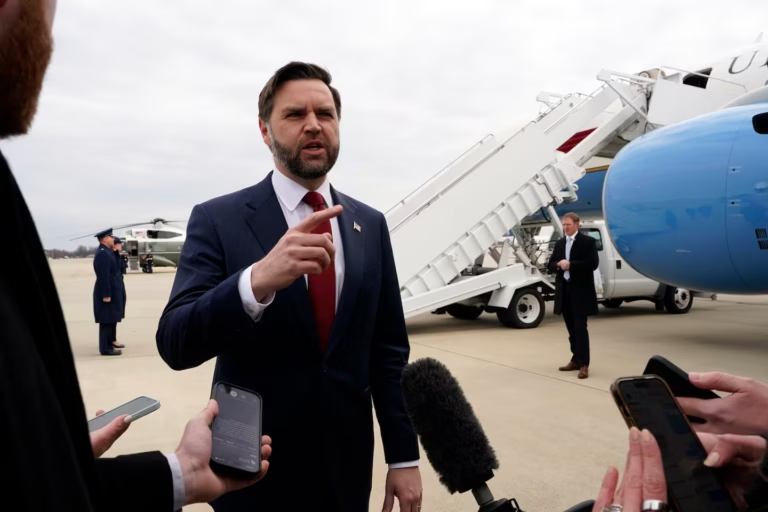
The risk of a politically motivated hostile act against the U.S. Vice President during a visit to Hungary should be assessed as elevated in terms of political sensitivity, but constrained by a high level of security measures.
The visit of J.D. Vance to Hungary in early April 2026 is already being discussed as politically significant amid Viktor Orbán’s difficult pre-election campaign ahead of the April 12 elections. Hungarian officials and international media have publicly referenced the visit. This makes it an event of high symbolic value for hostile actors seeking destabilization, provocation, or informational impact—particularly Russia, which may have an interest in exploiting such an opportunity.
The visit coincides with a moment when Orbán faces his most serious electoral challenge in years, while Hungary’s relations with the EU remain strained over Ukraine and Russia. At the same time, Orbán maintains close political ties with Moscow, and the Hungarian campaign is already accompanied by accusations of foreign influence, including concerns over Russian presence and election interference. This environment increases the risk that any incident—even failed or purely informational—could be used for domestic mobilization, external pressure, and escalation among allies.
Main Risk Categories
1. Symbolic Attack or Provocation Attempt
The most realistic scenario is not a complex conspiracy, but an action designed to create political and media shock:
- Disruption of events
- Panic provocation
- Interference with the motorcade
- False threats or forced evacuation
For hostile actors, the destabilization of a U.S. Vice Presidential visit itself carries strategic value.
2. Hybrid Operation with Plausible Deniability
Given concerns about Russian influence in Hungary and around the elections, a hybrid provocation cannot be ruled out:
- Limited or secondary physical component
- Primary effect: political chaos and mutual accusations
- Undermining trust between the U.S., Hungary, and European allies
This aligns with known Russian operational models involving ambiguity, intermediaries, and information support.
3. Attack by a Lone Radicalized Actor
A significant threat comes from:
- Individuals radicalized by polarization (Ukraine war, migration, U.S. politics, Hungarian elections)
This is one of the hardest risks to predict, as it requires minimal coordination and can emerge rapidly through online influence.
4. Digital and Informational Threat Layer
Even without physical violence, risks include:
- Route leaks or falsifications
- False bomb threats
- Deepfake materials
- Coordinated social media campaigns
- Crowd mobilization attempts
- Disinformation about organizers
U.S. protective structures emphasize protective intelligence and multilayered threat assessment, especially during international visits.
Actors Potentially Interested in Destabilization
1. Pro-Russian or Russia-linked networks
Their interest may not be physical harm, but:
- Disruption of the visit
- A scandal between Washington and Budapest
- Delegitimization of U.S. presence
- Blaming third parties (e.g., Ukraine)
- Forcing emergency political mobilization or election disruption
2. Domestic Radical Actors
In a pre-election environment, a high-profile foreign visit becomes a natural focal point for emotional mobilization.
3. External Provocateurs
Actors seeking international resonance—especially as elections approach and political tensions rise.
Factors Increasing Risk
- Pre-election polarization
- Russian influence factor in Hungarian politics
- Inter-allied tensions (EU–Hungary disputes over Ukraine)
- High symbolic value of the U.S. Vice President
- Public announcement of the visit
Factors Reducing Risk
The primary mitigating factor is the very high level of security:
- U.S. Secret Service
- Diplomatic Security
- Host nation coordination
This significantly reduces the likelihood of a successful complex attack, though not attempts at disruption or information destabilization.
Most Likely Scenarios
Most probable:
- False alarms
- Route leaks
- Managed protests
- Provocations at venues
- Coordinated information operations
Medium probability:
- Individual physical approach attempts
- Transport or route-related incidents
Low (but non-zero):
- A well-coordinated operation involving intermediaries
Potential Consequences
- For the U.S.: National security crisis and foreign policy shock
- For Hungary: Reputational damage and questions about security reliability
- For Orbán:
- Short-term: possible political leverage
- Long-term: damage to alliances and increased suspicion
- For NATO/EU: intensified debates on Russian influence and hybrid threats
Risk Mitigation Recommendations
- Minimize public exposure of routes and schedules
- Strengthen access control at open venues
- Monitor digital leaks and false alerts
- Real-time intelligence coordination (U.S.–Hungary)
- Enhanced security at diplomatic sites and transport hubs
- Early detection of online mobilization campaigns
Overall Assessment
- Probability of a successful complex attack: low, but not zero
- Probability of destabilization/provocation/hybrid incident: above average
Political Exploitation Scenario: Orbán’s Use of an Incident
Any serious incident during the visit could be used by Viktor Orbán to increase pressure on Ukraine politically, informationally, and within the EU.
Core Logic
Not direct accusations, but:
➡️ Creation of a narrative of “Ukrainian instability/risk”
Key Mechanisms
1. Narrative Construction
- Linking security risks to:
- War in Ukraine
- Weapons flows
- Spillover into the EU
Without direct accusations—through indirect framing.
2. Strengthening Anti-Ukrainian Messaging
Existing Orbán narratives:
- “Ukraine drags Europe into war”
- “EU pays the price”
The incident could reinforce:
➡️ Support for Ukraine = increased risk
3. Pressure on EU Decisions
- Blocking aid to Ukraine
- Delaying sanctions on Russia
- Emphasizing internal EU security
4. Zakarpattia Issue
Narrative:
➡️ “Ukraine cannot ensure internal stability → cannot guarantee minority rights”
5. Information Operation (Soft Framing)
Gradual perception shift:
- Ukraine = instability
- Ukraine = risk
Through media, expert commentary, and political messaging.
6. Domestic Mobilization
- Increased anti-Ukrainian sentiment
- Justification of government stance
- Distancing from EU policy
7. Geopolitical Maneuver
- Closer alignment with Moscow
- Maintaining formal neutrality
- Positioning Hungary as a “rational actor”
Constraints on Orbán
- Risk of backlash from the EU and U.S.
- Reputation as a pro-Russian actor
- Potential strengthening of pro-Ukraine support
Strategic Conclusion
Orbán would likely use the incident:
- Not for direct accusations
- But to reinforce narratives:
- Ukraine = instability
- Support for Ukraine = risk
➡️ The incident becomes a tool of informational pressure, not direct confrontation.
Domestic Political Impact
Shift to “Security Mode”
- Elections → security narrative
- Sovereignty rhetoric
- Consolidation of electorate
Expanded Control
- Possible emergency measures
- Restrictions on protests and opposition
Narrative Control
Three options:
- External destabilization
- Internal provocateurs
- Hybrid threat framing
Goal: control interpretation of the event
Electoral Impact
Short-term:
- Increased support among loyal voters
- “Rally around the flag” effect
Risks:
- Opposition mobilization
- Increased uncertainty
Most Likely Outcome
Not election cancellation, but:
- Tightened campaign control
- Security-focused narrative
- Limited opposition activity
Final Insight
The incident would serve:
➡️ Not as a tool to cancel elections
➡️ But as a mechanism for managing political dynamics in Orbán’s favor