
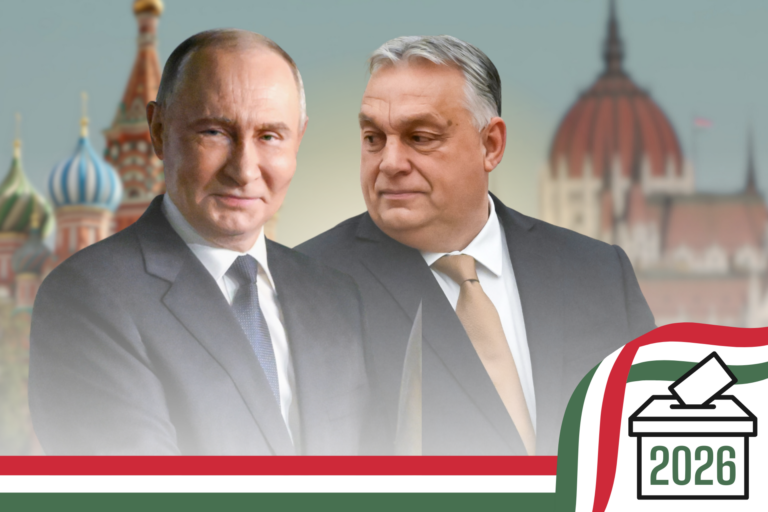
On the eve of Hungary’s parliamentary elections, Moscow grew increasingly concerned that Prime Minister Viktor Orbán might lose power. With the opposition Tisza Party and its leader Péter Magyar gaining ground, Russian leadership moved to support its ally. According to an investigation by The Washington Post, based on an internal document from Russia’s Foreign Intelligence Service (SVR), the agency proposed staging an assassination attempt on Orbán to “fundamentally change the election campaign’s paradigm.” The goal was to shift the debate from socio-economic issues into an emotional arena dominated by state security and political stability.
Although the attack never took place, the Kremlin’s consideration of such a scenario underscores the anxiety within both the Hungarian government and Russian leadership. Against the backdrop of a possible Tisza Party victory, Moscow launched an operation that initially appeared to escalate Hungarian-Ukrainian tensions but was in fact a carefully orchestrated information campaign designed to favor Orbán politically.
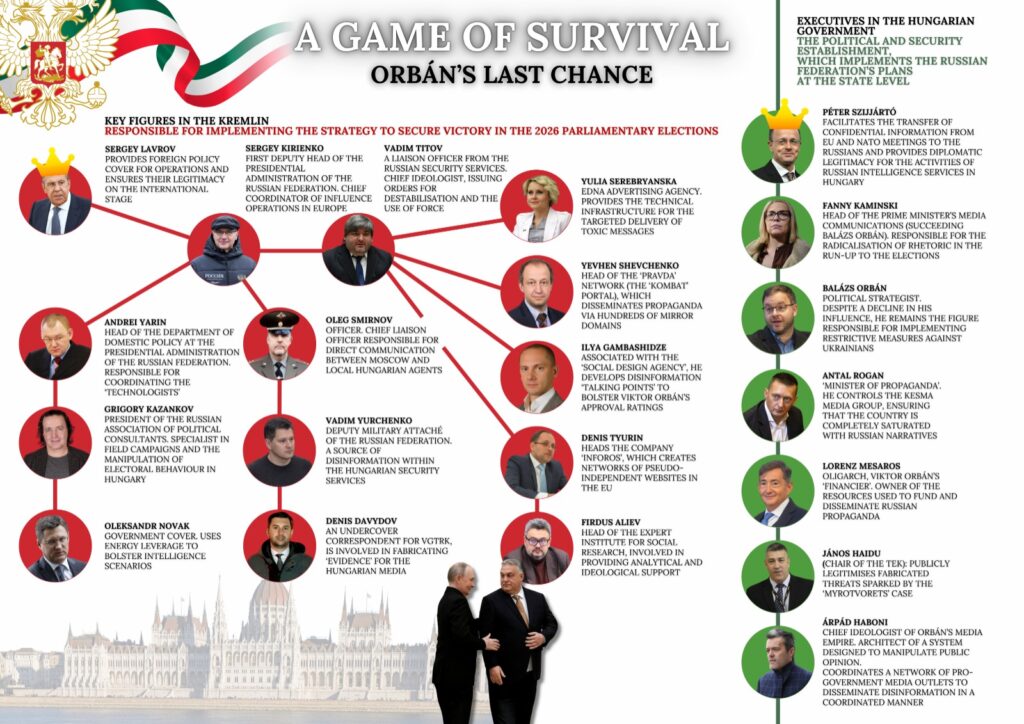
To implement this, Russian operatives built a multi-layered system that concealed Moscow’s involvement while integrating into Hungary’s domestic politics and aligning with Orbán’s communication strategy. Fanni Kaminski, who replaced Balázs Orbán shortly before the elections, took a central role in reshaping the prime minister’s messaging. Her appointment signaled a renewal of rhetoric as Orbán sought to adapt to new challenges and maintain control over the information space. In early March, the Financial Times reported that the Kremlin had approved a social media campaign developed by the consulting firm Social Design Agency. Its goal was to boost Orbán’s prospects while discrediting his main rival, Péter Magyar. The report exposed the operation, which involved senior Russian officials and intelligence officers. Oversight was handled by Sergey Kiriyenko, deputy head of the Russian presidential administration and an expert in managing electoral processes across the post-Soviet space. Andrey Yarin, head of the domestic policy department, assembled the technical teams, while Vadim Titov coordinated the scheme to block any rational dialogue between Kyiv and Budapest. Russian intelligence officers Vadim Yurchenko and Denis Davydov also directly assisted Orbán.
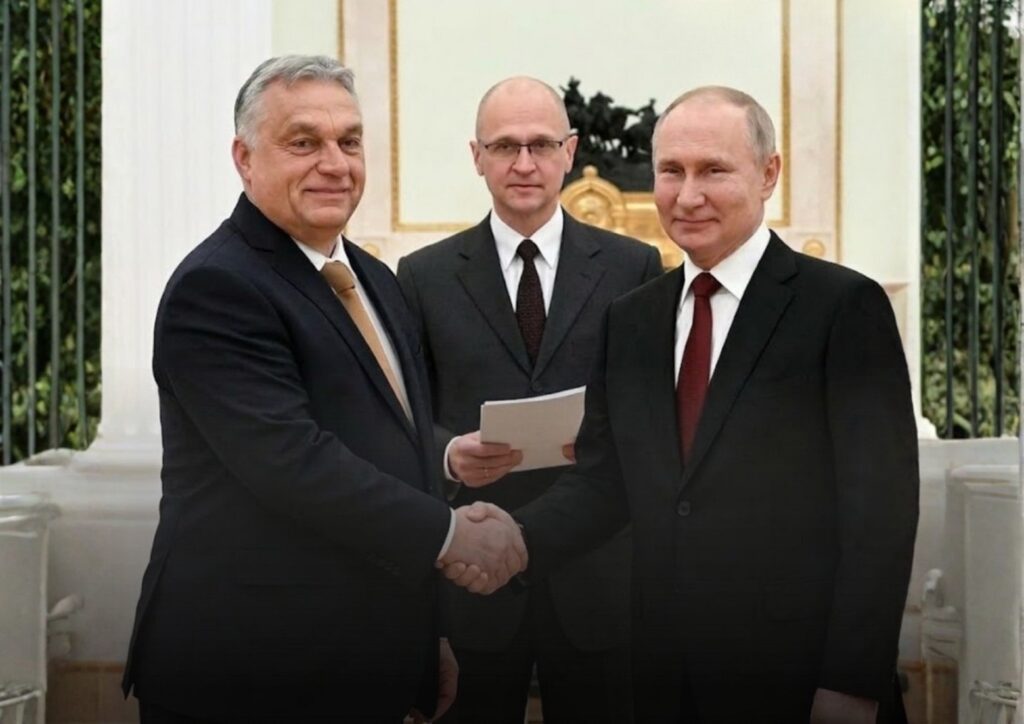
Amid reports of Russian involvement on Orbán’s side, the emergence of nearly 1,200 fake accounts—created in 2024 using AI-generated profile photos—appears far from coincidental. Their task was to artificially amplify support for Orbán’s party: bots boosted pro-government posts with likes so that Facebook’s algorithms would promote them as trending content. As reported by Telex, the hub of this network was the page Hajrá, Magyarország, linked to a foundation led by historian Mária Schmidt, while other nodes were controlled by MPs and candidates from the ruling Fidesz party.

This apparent joint Russian-Hungarian effort to secure Orbán’s position unfolded in a methodical, phased manner. At its core was the strategy of framing Ukraine as a hostile state toward Hungary and its people in order to boost Orbán’s ratings.
In early March, pro-Russian media constructed a media narrative portraying Ukraine as hostile, taking a remark by the Ukrainian president out of context and presenting it as a direct threat to Orbán. Then, on March 5, Hungarian security services took a high-profile step by seizing two armored vehicles belonging to Ukraine’s state bank Oschadbank, which were transiting through Hungary during a routine cash transfer from Austria to Ukraine. In Hungary and Russia, this ordinary banking operation was quickly framed as the transport of funds intended for the Hungarian opposition, allegedly preparing to destabilize the country and discredit Orbán.
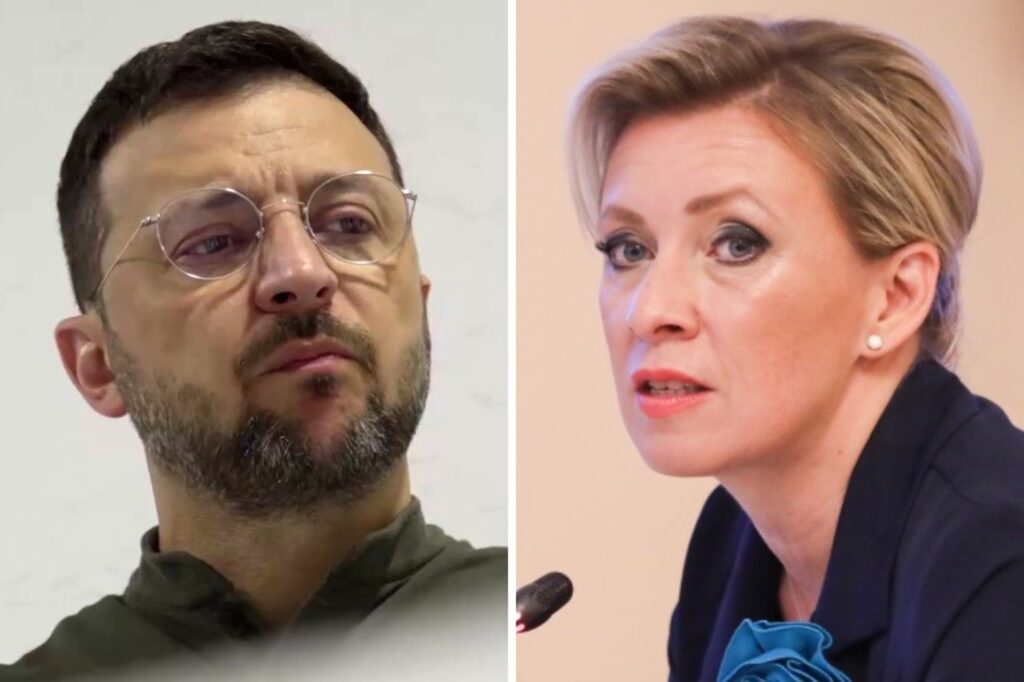
On March 10–11, the situation escalated further. Russian Foreign Ministry spokesperson Maria Zakharova labeled President Volodymyr Zelenskyy a “terrorist,” while pro-Kremlin analysts began discussing the possibility of an assassination attempt on the Hungarian prime minister. “An attempt on Orbán could be in preparation, as his stance provokes strong dissatisfaction. In such cases, even physical elimination cannot be ruled out,” said Russian commentator Alexander Perendzhiev.
March 12–13 marked the “Hungarian response” phase—the most critical stage of the campaign, as it was meant to create an appearance of credibility. Reports began to surface about alleged threats to Orbán’s family from Ukraine, and the Hungarian side responded swiftly. The prime minister’s political advisor, Balázs Orbán, dismissed claims of Russian interference as “political theater,” instead calling pressure from Kyiv and intimidation against the prime minister the real issue. Viktor Orbán himself accused Ukraine of threatening his children and grandchildren. Meanwhile, Hungarian analyst Zoltán Koskovich claimed that “Kyiv, together with Brussels, is attempting to influence Hungary’s elections in order to remove Orbán, and will not stop short of violent intervention or even a ‘color revolution.’” At the same time, the Myrotvorets database—used to document war criminals and their collaborators—was deliberately portrayed as a “kill list” following the inclusion of Counter-Terrorism Center director János Hajdu.
On March 18–19, the Hungarian government banned three Ukrainian citizens—two military personnel and one political analyst—from entering the country, accusing them of issuing threats against Orbán and his family. Following this, the campaign moved into its final phase, cementing the narrative of Ukraine as a “hub of international terrorism” coordinating sabotage abroad and posing a direct threat to Hungary’s leadership.
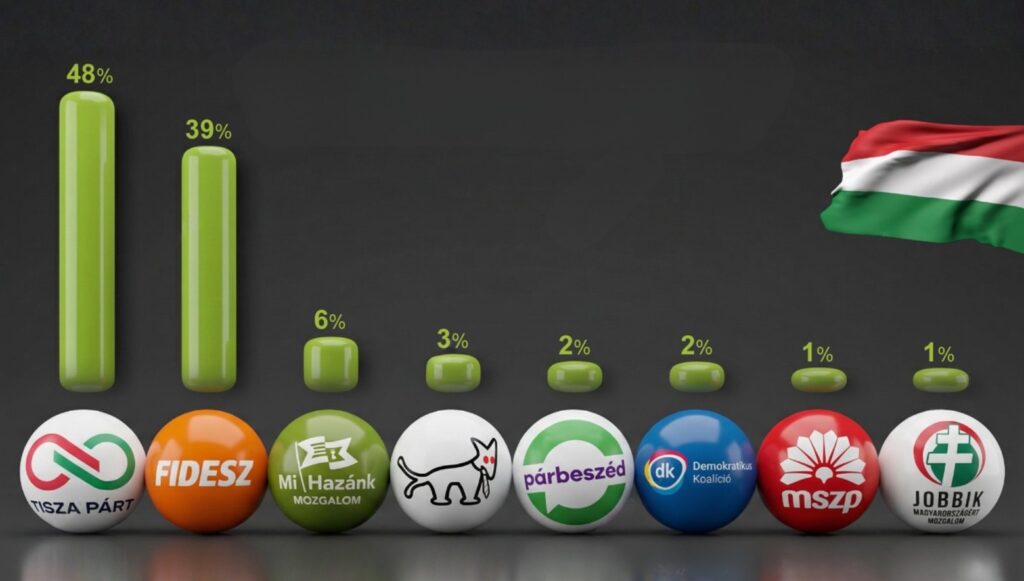
The entire operation surrounding the “Ukrainian threat” sought to lay the groundwork for a possible postponement or cancellation of the April 12 elections. Polling is unfavorable: the Tisza Party consistently leads Fidesz by 8–13 percentage points. A majority of Hungarian voters (52.3%) are dissatisfied with the state of the country, including rural areas (50.8%) that traditionally supported Fidesz. Economic difficulties, fatigue with authoritarianism, and corruption scandals created a challenging environment for Orbán. The only way to avoid defeat appeared to be replacing rational debate with emotional mobilization. The threat of physical harm to the leader and the presence of an external enemy are classic populist tools—effective from Budapest to Moscow.
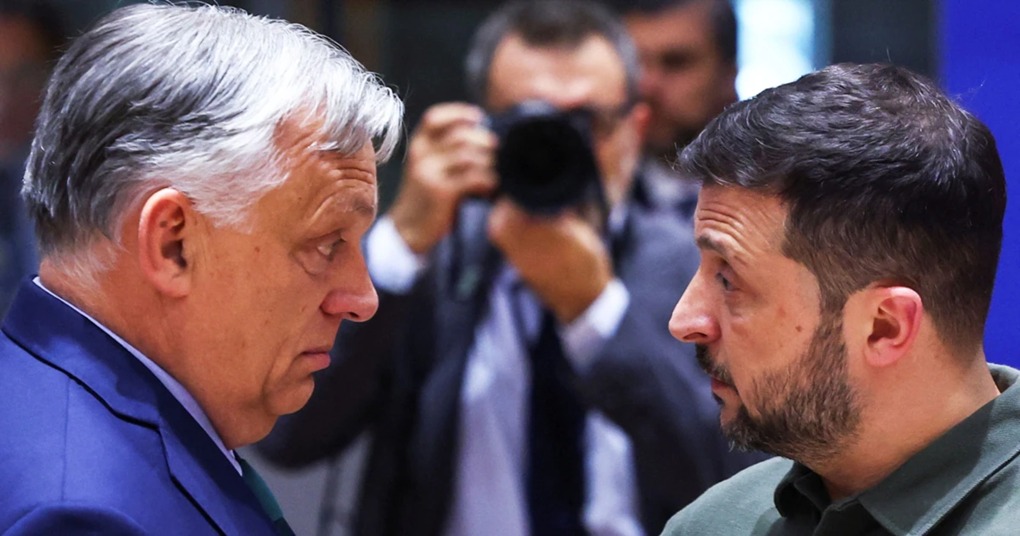
If the perception of an “external threat” is amplified enough, Orbán would have a pretext to take a more radical step, such as postponing or canceling the elections. States of emergency, national security threats, and the so-called “hand of Kyiv” are already part of his government’s rhetorical arsenal. Orbán clearly understands that if the elections are held as scheduled, current polling offers him little chance of success. He is therefore prepared to play on societal fears to retain power. The most advantageous scenario for him is one in which the elections are either canceled or held under entirely different circumstances. Moscow is more than willing to support him, as Hungary under Orbán represents its most valuable asset within the EU and NATO in this hybrid warfare theater.