
Russia’s push to expand energy cooperation with Vietnam is not a transactional economic move, but part of a systemic strategy to rebuild global leverage under sanctions pressure. By embedding itself in Vietnam’s energy sector, Moscow is simultaneously:
- Restoring long-term revenue streams
- Creating structural dependencies in critical infrastructure
- Undermining U.S. economic and geopolitical positioning in Southeast Asia
Vietnam, for its part, is not aligning with Russia, but leveraging great-power competition for strategic autonomy—a dynamic that increasingly limits Washington’s ability to enforce economic isolation against Moscow.
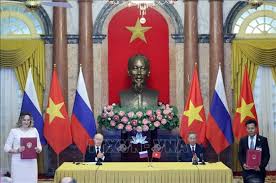
Moscow is positioning itself as an initiator of expanded energy cooperation with Vietnam, one of Asia’s leading economies. In particular, new energy agreements between Vietnam and Russia are expected to be signed during the visit of Prime Minister Phạm Minh Chính to Moscow. Russia is deliberately using energy diplomacy to expand its presence in Asia and offset losses caused by Western sanctions.
Russia is actively driving deeper cooperation by offering favorable terms, technology transfers, and political support to Vietnam. This approach allows Moscow to entrench itself in markets where the United States seeks to strengthen its own influence. For Washington, Russia’s advance in Vietnam signals a gradual restoration of Moscow’s global economic position, given Vietnam’s strategic importance in Asia.
Moreover, Moscow is demonstrating its ability to circumvent isolation through bilateral agreements with countries that have not joined the sanctions regime. Energy deals can provide Russia with long-term revenue streams and strategic footholds in Vietnam’s critical infrastructure, creating the risk of displacing American companies from regional markets.
Russia’s proactive role reinforces its image as a reliable energy partner for countries in the Global South. Agreements with Vietnam illustrate a systematic Kremlin policy aimed at undermining U.S.-led economic pressure. This directly complicates American containment strategy and reduces the effectiveness of sanctions.
Vietnam may also serve as a model for other states, encouraging cooperation with Russia and facilitating sanctions evasion.
Following the imposition of large-scale U.S. sanctions on Moscow in response to Russia’s full-scale invasion of Ukraine, the Kremlin has pursued an active policy of reorientation toward new markets, particularly in Asia. The energy sector has become a central instrument of this strategy, as it generates the bulk of state revenues.
Moscow is aggressively promoting its companies and offering long-term contracts to secure positions in strategically important countries. Vietnam represents a convenient partner due to historical ties and its pursuit of a multi-vector foreign policy. Russia is leveraging these factors to deepen cooperation and edge out competitors.
At the same time, the United States is attempting to strengthen its position in the Indo-Pacific region but faces limitations in its influence. In a broader global context, this trend signals the emergence of new economic networks beyond Western control. Russia’s actions in Vietnam are thus part of a wider strategy to build alternative systems of partnership.
The United States is increasingly forced to respond to a more assertive and flexible Russian foreign policy, which not only undermines sanctions mechanisms introduced by the White House but also leads to economic losses for American companies being pushed out of Asian markets.
Moscow is actively using energy as a tool of geopolitical influence, enabling it to compensate for sanctions-related losses, strengthen its international position, and establish long-term leverage. Through energy projects, the Kremlin embeds itself in the critical infrastructure of other states.
Russia’s role as both initiator and driver of new energy agreements with Vietnam demonstrates not isolation, but an active and adaptive foreign policy. Its growing activity in Southeast Asia undermines U.S. positions in the region, as Washington loses its monopoly on partnerships with key countries.
The expansion of Russia’s presence in Asia, particularly in Vietnam, poses a challenge to U.S. global influence. By engaging with Russia, Vietnam highlights the limits of American leverage and underscores that regional states prioritize pragmatic interests over alignment with U.S. geopolitical objectives.
Russia’s expanding presence in Southeast Asia complicates the implementation of U.S. containment strategy in the Indo-Pacific. Washington is now competing not only with China, but also with a more flexible and adaptive Russian policy—especially in sectors critical to U.S. interests.
Strengthening Russia’s position in Vietnam’s energy sector, and in Southeast Asia more broadly, is likely to result in tangible economic losses for U.S. businesses, as American companies risk being displaced from these markets.
The formation of alternative energy and trade networks reduces the effectiveness of sanctions as a tool of U.S. foreign policy. Russia’s expansion of such ties makes it more difficult for Washington to sustain global economic pressure.
The case of energy agreements between Hanoi and Moscow demonstrates that Russia relies not only on economic incentives, but also on political and historical arguments to advance its interests. This makes its offers particularly attractive to countries seeking to balance between major powers.
Energy Diplomacy as a Tool of Strategic Re-entry
Following Western sanctions imposed after the full-scale invasion of Ukraine, the Kremlin has recalibrated its external strategy toward selective deep partnerships in non-Western markets. Energy is central to this approach for three reasons:
- It remains Russia’s primary source of state revenue;
- It enables long-term contractual lock-in with partner states;
- It creates political leverage through infrastructure dependence.
Vietnam fits this strategy exceptionally well:
- Historical Soviet-era ties;
- A diversified (“multi-vector”) foreign policy;
- Rapidly growing energy demand.
Russia’s offer—combining technology, financing flexibility, and political non-conditionality—directly competes with Western models that are often slower, more regulated, and politically constrained.
From Transactions to Structural Influence
The expected agreements during Prime Minister Phạm Minh Chính’s visit to Moscow should be understood not as isolated deals, but as part of a long-term positioning strategy.
Key mechanisms of influence include:
- Infrastructure embedding: Russian involvement in energy projects creates durable access to strategic sectors;
- Revenue stabilization: Long-term contracts offset volatility caused by sanctions;
- Market displacement: Russian firms can undercut or outmaneuver U.S. and allied competitors;
Over time, this leads to a shift from commercial presence to structural influence, where Russia becomes difficult to replace without significant economic or political cost.
Sanctions Evasion Through Network Building
Russia is not simply bypassing sanctions—it is systematically weakening their effectiveness.
Vietnam illustrates a broader model:
- Bilateral agreements outside Western regulatory frameworks;
- Use of non-aligned or neutral states;
- Expansion of trade and energy networks beyond U.S. oversight.
This contributes to the emergence of parallel economic systems, where:
- Sanctions lose coercive power;
- Enforcement becomes fragmented;
- Compliance becomes politically negotiable.
In this sense, each agreement with Vietnam is not just economic—it is institutional erosion of the sanctions regime.
Strategic Implications for the United States
Russia’s advance in Vietnam presents a multi-layered challenge to U.S. strategy:
A. Loss of Market Position
American companies face:
- Competitive disadvantages in pricing and political access;
- Gradual displacement from key energy sectors;
- Reduced influence over regional infrastructure development.
B. Erosion of Containment Strategy
U.S. efforts to isolate Russia are weakened as:
- Moscow demonstrates resilience and adaptability
- Other states see viable alternatives to Western partnerships
- Sanctions appear less universally binding
C. Increased Strategic Competition
Washington is no longer competing only with China in the Indo-Pacific, but also with:
- A more agile Russian economic diplomacy
- A model based on fewer political conditions and faster execution
Vietnam’s Calculus: Pragmatism Over Alignment
Vietnam’s engagement with Russia reflects a broader regional pattern:
- States prioritize strategic autonomy over bloc alignment
- Economic diversification is valued over political loyalty
- Great-power rivalry is treated as an opportunity, not a constraint
By accepting Russian proposals, Vietnam is signaling:
- The limits of U.S. leverage
- The persistence of non-aligned strategic behavior
- A willingness to balance rather than choose
This dynamic significantly complicates U.S. regional strategy.
The Broader Geopolitical Shift
Russia’s activity in Vietnam is part of a larger structural transformation:
- The rise of alternative economic and energy networks
- The gradual fragmentation of the global economic order
- The decline of Western monopoly over strategic partnerships
In Southeast Asia, this translates into:
- A more multipolar competitive environment
- Reduced Western agenda-setting power
- Increased bargaining space for regional actors
Strategic Outlook
Russia’s expansion in Vietnam is unlikely to produce immediate geopolitical realignment—but it accumulates long-term advantages:
- Durable economic footholds;
- Political leverage in critical sectors;
- Demonstration effect for other Global South countries.
If replicated across multiple states, this model could:
- Systematically weaken sanctions regimes
- Redistribute global economic influence
- Force the United States into reactive rather than proactive positioning
Russia’s energy diplomacy in Vietnam is not a sign of resilience alone—it is evidence of a deliberate strategy to convert economic necessity into geopolitical opportunity, exploiting gaps in U.S. influence and the pragmatism of regional actors.
Policy Implications (U.S. Focus)
To counter this trend, the United States would need to:
- Compete economically, not just politically (faster financing, flexible terms),
- Strengthen private-sector positioning in Southeast Asia,
- Adapt sanctions strategy to network-based evasion models,
Engage partners like Vietnam through pragmatic incentives rather than alignment demands.