
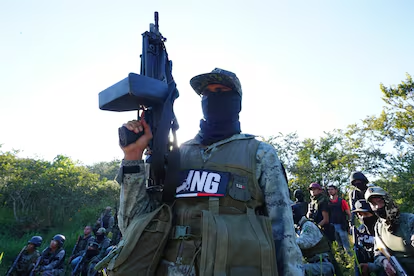
Federal prosecutors in Virginia have charged a group that attempted to supply the Mexican cartel CJNG with an arsenal worth €53.7 million. U.S. investigators have linked the central figure, Peter Mirchev, to cooperation with Russian arms dealer Viktor Bout. One of the scheme’s accomplices proposed obtaining additional weapons through a future agreement between the governments of Russia and Uganda.
The indictment describes an attempt to deliver a massive weapons package to the cartel, including 2,000 modernized Kalashnikov rifles, 68 grenade launchers, 60 PKM machine guns, surface-to-air missiles, counter-drone systems, unmanned aerial vehicles, armored vehicles, ZU-23 anti-aircraft guns, and tens of millions of rounds of ammunition—an arsenal capable of significantly elevating the threat to the United States.
U.S. prosecutors emphasize that the supply chain was structured through African government contacts, bribery, falsified end-user certificates, and forged delivery documentation.
The Mexican cartel CJNG’s access to intermediaries with Russian ties suggests that the threat facing the United States is no longer confined to drug trafficking and border violence. Access to such networks opens pathways not only to larger volumes of weapons but also to channels capable of disguising heavy arms shipments as interstate transfers.
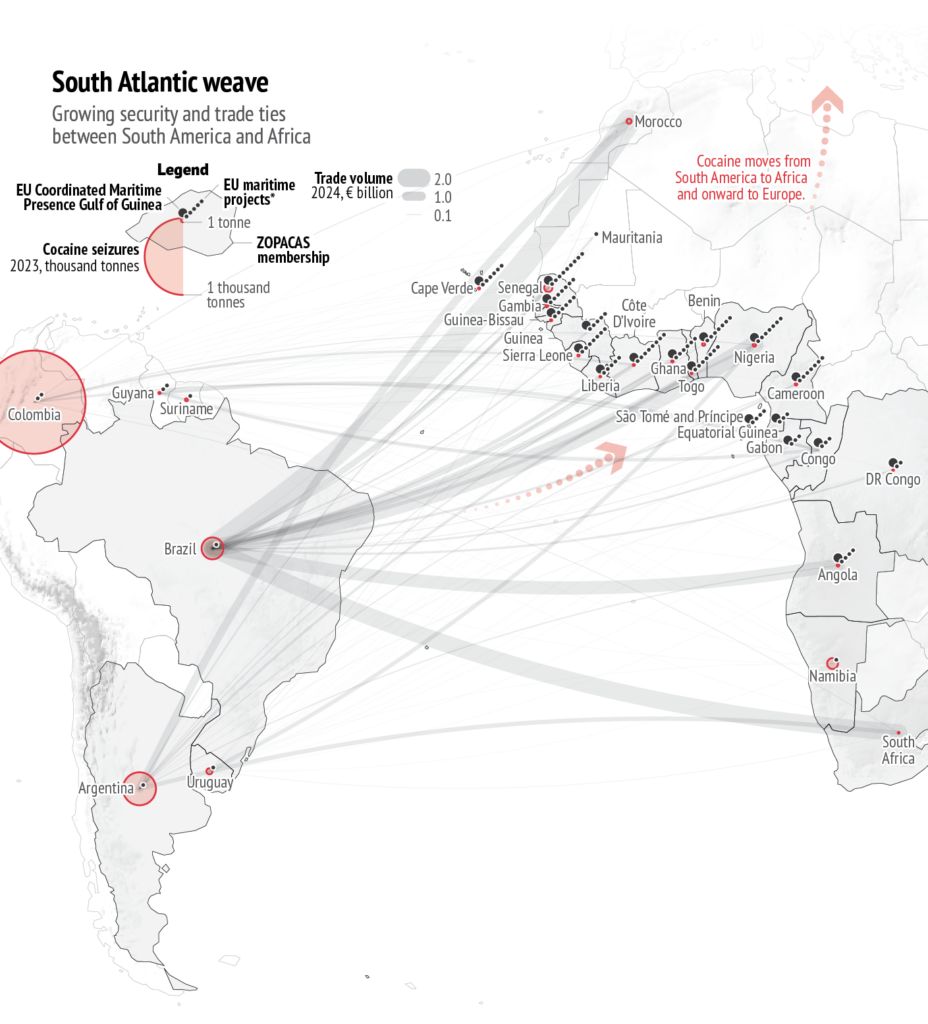
In this case, Africa serves as an operational environment where corruption and weak oversight become tools of concealment. The use of falsified end-user certificates highlights how international safeguards against illicit arms trafficking can themselves be exploited. Within this configuration, Russia functions as a source of networks and logistical routes that elevate the cartel’s access to advanced weaponry.
Under these conditions, the United States is confronting not merely a cartel, but a criminal structure capable of operating through transnational illicit arms supply chains.
The acquisition of both small arms and heavy weapons by CJNG raises the threat level to the United States substantially. A cartel equipped with such an arsenal gains the capacity to operate with greater intensity and to inflict higher casualties.
CJNG’s effort to procure large-scale weapons shipments signals a strategic shift toward the accumulation of combat resources. For the United States, this translates into a significant escalation of risks for law enforcement and government personnel engaged in counter-narcotics operations, as well as a likely surge in violence and deterioration of the domestic security environment.
- The connection between Peter Mirchev and Russian arms dealer Viktor Bout indicates that the cartel has accessed international channels capable of supplying heavy weaponry. The emergence of a Russian link in this case suggests that CJNG’s strengthening may have relied on networks that pose broader risks to U.S. interests.
- The involvement of individuals with access to African state structures demonstrates that illicit arms transfers can be routed through official institutions. This makes it considerably more difficult for U.S. agencies to disrupt schemes that are shielded by formal certification and ostensibly legal procedures.
- The convergence of Russian-linked networks, African intermediaries, and Mexican cartel demand expands the geographic scope of the threat. In this configuration, Washington is no longer facing a border security issue alone, but a globalized chain of illicit arms trafficking.
Executive Assessment
The Virginia indictment reveals more than an attempted arms deal—it exposes a structural shift in how major criminal organizations operate. The Mexican cartel CJNG is no longer confined to narcotics trafficking but is actively integrating into transnational illicit arms networks with links to Russian intermediaries and African state channels. This evolution marks a transition from a regional criminal threat to a hybrid security challenge with global supply chains.
Key Judgments
- CJNG is transitioning from a drug trafficking organization into a hybrid paramilitary-criminal actor with access to heavy weaponry.
- The involvement of individuals linked to Viktor Bout suggests access to legacy Soviet/Russian arms trafficking ecosystems, historically used in conflict zones.
- African government-linked intermediaries indicate systemic vulnerabilities in state institutions, enabling illicit flows under the cover of legality.
- The use of falsified end-user certificates demonstrates that global arms control mechanisms are being repurposed as tools of evasion, not prevention.
- The United States is increasingly confronting a networked threat that combines organized crime, corruption, and geopolitical infrastructure.
Structural Shift: From Cartel to Hybrid Actor
CJNG’s attempt to procure an arsenal of this scale signals a doctrinal shift. The inclusion of:
- surface-to-air missiles,
- anti-drone systems,
- armored vehicles,
indicates preparation not for criminal enforcement alone, but for high-intensity confrontations, potentially against state forces.
This aligns CJNG more closely with non-state armed groups seen in conflict zones rather than traditional cartels. The distinction is critical:
Cartels seek profit; hybrid actors seek operational dominance.
Russian-Linked Networks: Access to Strategic Supply Chains
The connection to Viktor Bout is not incidental—it is indicative of access to resilient, historically embedded arms trafficking networks that:
- specialize in deniable logistics,
- operate through front companies and falsified documentation,
- exploit jurisdictional fragmentation across Africa, the Middle East, and Eastern Europe.
These networks were originally designed to supply warzones under sanctions. Their adaptation to serve a cartel suggests a convergence between geopolitical gray-zone infrastructure and organized crime.
Implication: CJNG is no longer dependent on black-market fragmentation; it may now access systematized, scalable supply chains.
Africa as a Strategic Enabler
The scheme’s reliance on African government contacts is not accidental. Africa provides:
- weak enforcement of export controls,
- high corruption exposure in defense procurement,
- limited traceability of end-user certification systems.
In this case, African states function as logistical laundering hubs, where:
- weapons can be formally exported under state cover,
- documentation can be manipulated with official stamps,
- shipments can be re-routed with minimal scrutiny.
Africa becomes not just a transit zone, but a legal camouflage layer.
Weaponized Bureaucracy: Failure of Global Safeguards
The use of falsified end-user certificates is particularly significant. These certificates are the backbone of international arms control regimes.
Their manipulation demonstrates:
- institutional capture or corruption,
- insufficient verification mechanisms,
- over-reliance on state-level compliance.
The system is not being bypassed—it is being co-opted from within.
This represents a shift from illicit smuggling to quasi-legalized trafficking, where documentation creates a façade of legitimacy.
Escalation Dynamics: From Violence to Insurgency-Like Capacity
Access to this level of weaponry transforms CJNG’s operational ceiling:
- Surface-to-air systems threaten aviation and surveillance dominance.
- Anti-drone technologies neutralize modern law enforcement advantages.
- Heavy machine guns and grenade launchers increase lethality in urban and rural engagements.
This creates the conditions for:
- territorial control,
- state force attrition,
- localized destabilization resembling insurgency environments.
Implications for U.S. National Security
A. Transformation of the Threat Landscape
The U.S. is no longer facing:
- a border-centric cartel problem,
but: - a transnational illicit supply network with military-grade capabilities.
B. Increased Risk to Federal and Local Agencies
Enhanced cartel firepower raises:
- casualty risks for law enforcement,
- operational constraints in cartel-dominated zones,
- the need for militarized countermeasures.
C. Globalization of the Security Challenge
The convergence of:
- Russian-linked intermediaries,
- African state channels,
- Mexican cartel demand
creates a multi-regional threat architecture.
This complicates response mechanisms, requiring coordination across:
- law enforcement,
- intelligence agencies,
- diplomatic and sanctions frameworks.
Strategic Outlook
If such networks remain intact, CJNG could evolve into:
- a quasi-paramilitary organization,
- with sustained access to heavy weapons,
- capable of influencing security dynamics beyond Mexico.
This model may also be replicated by other criminal organizations, leading to:
the normalization of cartel access to global arms trafficking systems.
Policy Considerations (U.S. / NATO Focus)
- Expand monitoring of end-user certificate systems, particularly in high-risk regions (Africa).
- Target intermediary networks, not just end buyers, through sanctions and intelligence operations.
- Enhance interagency coordination between counter-narcotics and counter-proliferation frameworks.
- Treat advanced cartels as hybrid threats, integrating military-grade risk assessments into policy planning.
Why CJNG Could Be of Strategic Interest to Russia
For Moscow, engagement—direct or indirect—with a powerful cartel like CJNG is not about narcotics. It is about leveraging non-state actors as instruments of asymmetric pressure against the United States. CJNG represents a potential node within a broader ecosystem of deniable influence, disruption, and illicit logistics.
Asymmetric Pressure on the United States
Russia has consistently sought low-cost, deniable ways to challenge U.S. security without triggering direct confrontation.
CJNG offers:
- Geographic proximity to the U.S. homeland
- Capacity for violence escalation inside or near U.S. borders
- Existing infrastructure for smuggling, logistics, and corruption
Supporting or enabling such actors allows Russia to:
- indirectly increase internal security pressure on the U.S.,
- divert U.S. resources inward (law enforcement, border security),
- create a persistent background instability.
This fits within Russia’s broader doctrine of “active measures” and hybrid warfare.
Plausible Deniability and Proxy Utility
Unlike state proxies (e.g., militias), cartels provide maximum deniability.
- No formal command structure linking them to Moscow
- Activities can be framed as purely criminal
- Attribution becomes politically and legally difficult
This makes CJNG an ideal “gray-zone partner”:
- Russia can enable indirectly (networks, intermediaries, logistics)
- while avoiding escalation risks tied to state responsibility
Monetization and Sanctions Evasion Ecosystems
Russian illicit networks increasingly overlap with:
- arms trafficking
- resource smuggling (gold, oil)
- shadow financial systems
CJNG brings:
- cash liquidity (drug revenues)
- established laundering channels
- access to U.S. and Latin American black markets
Cooperation creates mutual economic value:
- Russia expands sanctions-resistant financial flows
- CJNG gains access to higher-grade weapons and logistics
This is less ideological and more transactional convergence of illicit economies.
Expansion of Russian Illicit Logistics Networks into the Western Hemisphere
Historically, Russian-linked arms networks have been strongest in:
- Africa;
- the Middle East;
- parts of Eastern Europe;
CJNG offers a gateway into:
- Latin America’s criminal ecosystems
- routes that extend into the United States
This enables Russia to:
- diversify operational geography
- reduce reliance on traditional routes under Western scrutiny
- establish new corridors for covert logistics and influence
Strategic Disruption via Violence Escalation
If CJNG gains access to:
- MANPADS (surface-to-air missiles)
- anti-drone systems
- heavy weapons
this could:
- increase lethality of cartel-state confrontations
- destabilize regions along the U.S. border
- potentially threaten aviation or infrastructure
Even without direct coordination, capability transfer alone creates strategic effects:
- higher insecurity
- increased political pressure on U.S. leadership
- amplification of domestic divisions around security policy
Intelligence and Access Opportunities
Criminal networks provide:
- access to routes, ports, and corrupt officials
- insights into law enforcement vulnerabilities
- potential channels for covert movement of goods or personnel
For Russian intelligence, CJNG-linked ecosystems could serve as:
- facilitation networks, not just partners
- especially valuable in denied or high-surveillance environments
Psychological and Information Warfare Dimension
The mere exposure of:
- Russian-linked arms networks
- cooperation with violent cartels
can:
- undermine public confidence in U.S. security
- fuel narratives of state weakness or loss of control
- amplify political polarization
This aligns with Russia’s broader goal of internal destabilization of adversaries.
CJNG is attractive to Russia not as a partner in crime, but as a strategic instrument within a hybrid warfare ecosystem.
It provides:
- deniability (non-state actor);
- access (U.S. proximity + logistics);
- impact (violence, instability, political pressure);
- profit channels (sanctions evasion overlap).
The convergence between Russian-linked networks and CJNG reflects a broader trend:
the merging of geopolitical competition with transnational organized crime.