
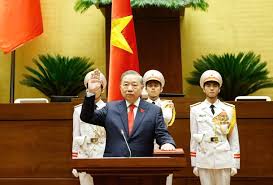
The April 2026 presidential election in Vietnam resulted in the unanimous appointment of Tô Lâm as State President, consolidating his simultaneous role as General Secretary of the Communist Party. This marks a historic departure from Vietnam’s collective leadership model and signals a shift toward centralized authority. While the election outcome was predetermined within the one-party system, its implications are profound: domestically, it strengthens political control and accelerates decision-making; internationally, it reinforces Vietnam’s pragmatic balancing strategy between major powers.
Nature of the Election System
Vietnam does not conduct competitive presidential elections. Instead:
- The President is elected indirectly by the National Assembly.
- Candidates are nominated by the Communist Party of Vietnam (CPV).
- In practice, there is only one approved candidate.
In 2026:
- Election date: 7 April 2026
- Votes: 495 out of 495 in favor (100%)
- Candidate: Tô Lâm (sole nominee)
This reflects a closed elite-selection system, not a pluralistic electoral process.
Results and Political Outcome
Key Result
- President elected: Tô Lâm
- Party: Communist Party of Vietnam
- Vote outcome: unanimous approval
Critical Development
For the first time in decades, Lâm holds both top positions:
- General Secretary (de facto supreme leader);
- President (head of state).
This creates a “dual-hat leadership” model, comparable to:
- Xi Jinping in China
Analysts note this breaks Vietnam’s long-standing “collective leadership” doctrine .
Why Tô Lâm Was Elected
Elite Consensus and Power Consolidation
Lâm’s election reflects:
- Internal consolidation after leadership instability (2023–2025 resignations)
- Victory of the security–bureaucratic faction within the Party
He previously:
- Served as Minister of Public Security
- Led major anti-corruption campaigns
These campaigns:
- Eliminated rivals
- Strengthened his internal legitimacy
Stability After Political Turbulence
Vietnam experienced:
- Multiple presidential resignations (2023–2024)
- Anti-corruption purges targeting elites
Lâm’s election signals:
- Restoration of political stability
- Centralization to avoid factional fragmentation
Economic Pragmatism
Lâm is perceived as:
- Pro-business but state-guided
- Supportive of both:
- Private conglomerates
- State-owned enterprises
He advocates:
- Transition from low-cost manufacturing
- High-tech and innovation-led growth
Expected Domestic Policy Direction
Political System
- Increased centralization of power
- Expansion of security apparatus influence
- Continued anti-corruption campaigns (selectively applied)
Assessment:
Likely movement toward a semi-authoritarian, China-like governance model
Economic Policy
Key priorities:
- Target: ~10% annual growth
- Digital transformation
- National “champion” corporations
- Industrial upgrading
Risks:
- Crony capitalism;
- Asset bubbles;
- State favoritism.
Governance Style
- Faster decision-making
- Reduced bureaucratic fragmentation
- Less internal dissent
Domestic Support and Opposition
Support Base
. Communist Party Core
- Central Committee
- Politburo elites aligned with security sector
Security Apparatus
- Ministry of Public Security
- Intelligence and internal control networks
Economic Elites
- State-linked corporations
- Large private conglomerates benefiting from state backing
Opposition (Indirect / Structural)
Vietnam lacks formal opposition, but resistance exists within:
Reformist Technocrats
- Concerned about:
- Over-centralization;
- Reduced institutional checks.
Party Traditionalists
- Prefer collective leadership model
- Fear erosion of internal balance
Civil Society (latent)
- Limited capacity due to authoritarian constraints
. Foreign Policy Outlook
Continuation of “Bamboo Diplomacy”
Vietnam’s strategy:
- Balance between:
- United States
- China
Core principle:
- Flexibility without alignment
Lâm is expected to:
- Maintain strategic ambiguity
- Expand partnerships without formal alliances
Foreign Actors: Winners and Losers
Beneficiaries
China
- Benefits from:
- Leadership centralization;
- Familiar governance model;
- Easier elite-to-elite coordination.
United States
- Gains from:
- Policy continuity;
- Stable investment environment.
Foreign Investors
- View Lâm as:
- Predictable;
- Growth-oriented.
Potentially Disadvantaged Actors
1. EU / Liberal Democracies
- Concern over:
- Democratic backsliding
- Human rights
2. Regional Rivals
- Stronger Vietnam could:
- Increase competition in ASEAN supply chains.
Strategic Implications
Internal Power Structure
- Shift from collective oligarchy → personalized leadership
- Increased role of security institutions in governance
Economic Trajectory
- Acceleration of:
- Industrial policy
- State-backed capitalism
Possible outcomes:
- Short-term growth boost
- Long-term structural inefficiencies
Regional Geopolitics
Vietnam will:
- Continue hedging between major powers;
- Avoid alignment blocs;
- Expand strategic autonomy.
Authoritarian Convergence Trend
Vietnam may gradually align with:
- Chinese governance practices;
- Centralized decision-making models.
Key Judgments (Intel Style)
- HIGH CONFIDENCE: Power consolidation under Tô Lâm marks a structural shift in Vietnam’s political system.
- HIGH CONFIDENCE: Foreign policy will remain stable and pragmatic.
- MODERATE CONFIDENCE: Economic policy will favor large national champions.
- MODERATE RISK: Increased authoritarianism could generate internal elite tensions.
- LOW RISK (short-term): No immediate instability due to strong party control.
The 2026 Vietnamese presidential election is less an electoral event than a strategic political reconfiguration. The elevation of Tô Lâm to dual leadership positions represents the most significant concentration of power in Vietnam in decades. While this enhances governance efficiency and stability, it also introduces risks associated with over-centralization, elite factionalism, and reduced institutional balance.In geopolitical terms, Vietnam remains committed to strategic neutrality—but with a more centralized leadership capable of executing faster and potentially more assertive policy decisions.