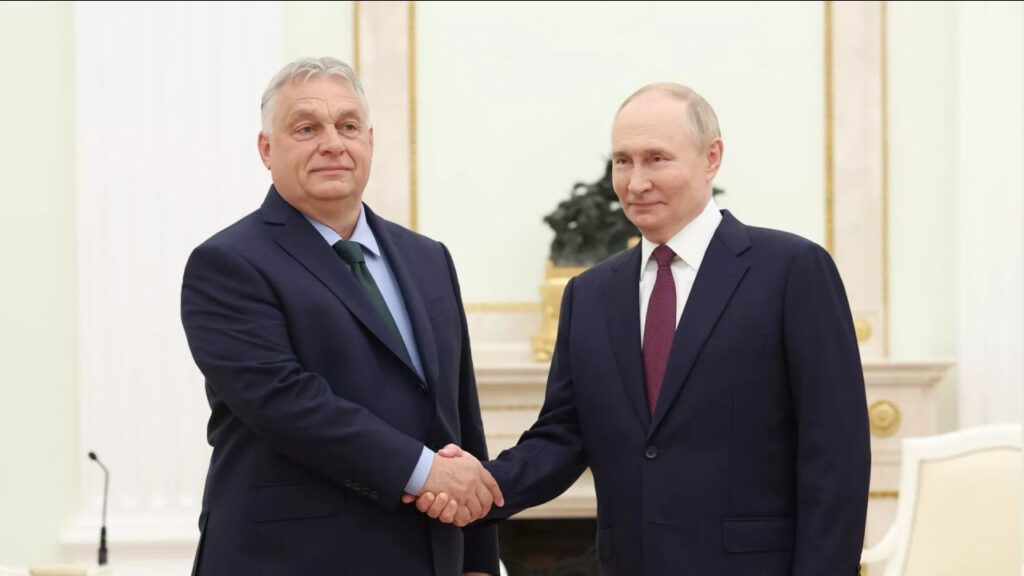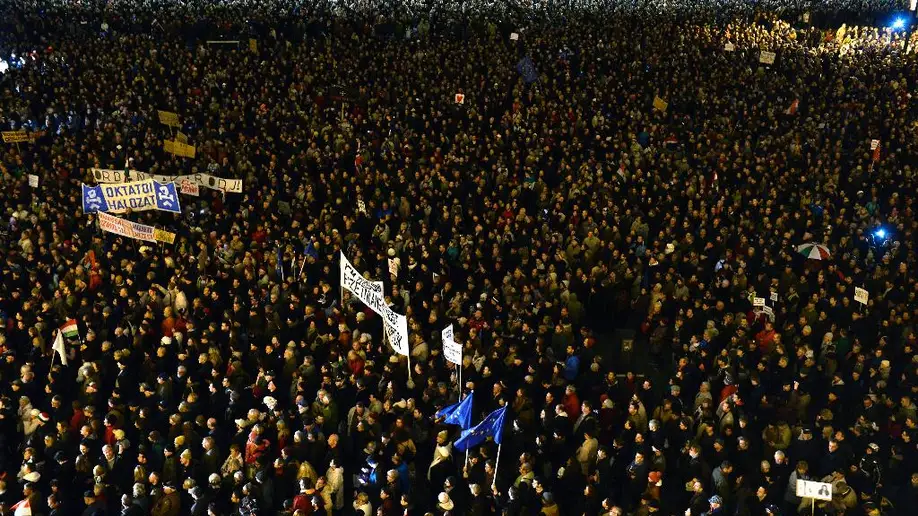

The closed-door negotiations in Budapest on April 7–8 between representatives of the U.S. administration and the Hungarian leadership created a favorable foreign-policy window for Prime Minister Viktor Orbán to implement a scenario of “preventive legitimation” of the elections: even before official conclusions from international observers are issued, the authorities seek to create the informational fact of a completed and indisputable victory for Fidesz. This tactic directly corresponds to Russian political technologies that the Kremlin has systematically used in controlled or dependent electoral processes. According to available information, Moscow dispatched political technologists to Hungary from among GRU and SVR officers who have experience organizing elections in countries within Russia’s sphere of influence and who previously operated under Wagner Group and the Africa Corps structures.
The Essence of the Current Scheme in Hungary
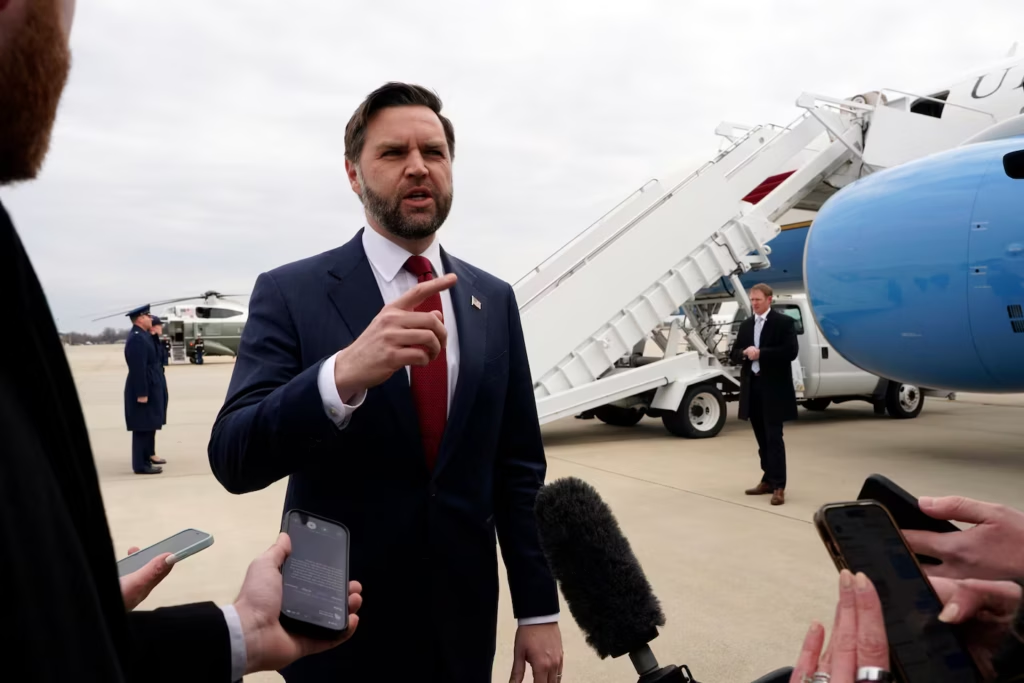
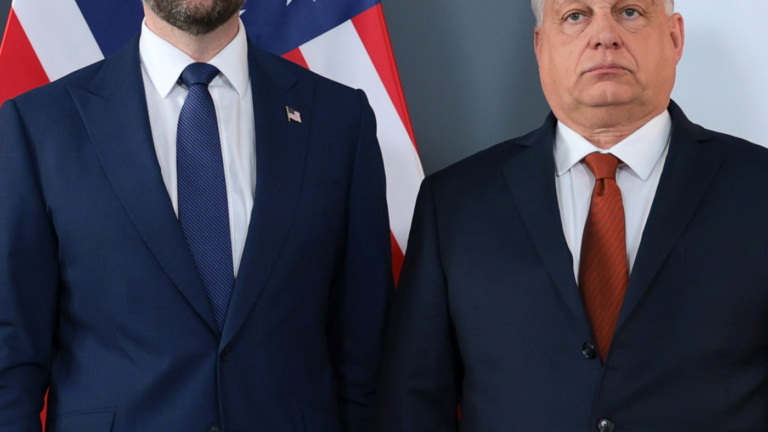
According to available information, during non-public negotiations in Budapest, U.S. Vice President J. D. Vance signaled Washington’s readiness to de facto accept a Fidesz victory regardless of the degree of transparency in the electoral process — provided that the result is presented as politically stabilizing.
This creates three critical consequences:
- The external restraining factor on Orbán is removed.
- Informational initiative shifts from international observers to government media.
- A time window is created for prematurely announcing “victory.”
This is why government-loyal centers — Nézőpont and Századvég — were instructed to prepare in advance sociological materials showing a “confident Fidesz victory” for synchronized release in Hungarian and American media.
The Russian Model: Why the Kremlin Pushes Victory Announcements Before Vote Counting Ends
The Russian electoral school uses the principle:
“Whoever declares victory first defines the legitimacy framework.”
This allows authorities to:
- demoralize the opposition;
- make any subsequent objections appear as “post-election protests by losers”;
- force international actors to react to an already established political fact.
In the Kremlin, this model has been refined over decades — from domestic Russian campaigns to electoral operations in post-Soviet states. In Russia itself, preliminary results and exit polls regularly shape public perception before official counting is complete; an example is the 2024 presidential election, when state exit polls declared Vladimir Putin the winner before the formal count was finalized.
Historical Campaigns Where Pro-Kremlin Candidates Declared Victory Before Official Counting Ended
A. Belarus, 2020 — Alexander Lukashenko
The official apparatus declared him the winner almost immediately after polling stations closed, before independent protocol verification was completed.
Objectives:
- block alternative vote counting;
- create an international signal that “the result is determined.”
B. Russia, 2024 — Vladimir Putin
State exit polls released a result of around 87% almost immediately after voting ended, before the full official count. This created an effect of irreversibility.
C. Armenia, 2013 — Serzh Sargsyan
Pro-government headquarters began declaring an “undisputed victory” before regional ballots had been fully processed, creating psychological dominance before OSCE reports appeared.
D. Moldova / Gagauzia — Several Regional Campaigns
In pro-Russian regional elections, Moscow-backed candidates repeatedly declared “victory” based on controlled exit polls before official Central Election Commission data appeared.
E. Occupied Territories of Ukraine (2014–2023)
In pseudo-elections in occupied territories, the Kremlin systematically:
- first launched media announcements of the desired candidate’s victory;
- only afterward formalized vote counting.
Why This Scenario Is Dangerous Specifically for Hungary
If Orbán declares victory before:
- official counting is completed,
- OSCE reports are issued,
- independent monitoring missions publish conclusions,
then an effect emerges:
“The Informational Point of No Return”
After that:
- international criticism will appear secondary;
- the opposition will be forced to refute an already established narrative;
- Washington will gain grounds to say: “We are merely recognizing the factual result.”
The Role of Russian Political Technologists in Orbán’s Campaign
The methodology bears classic Kremlin hallmarks:
- centralized control over polling data;
- synchronized launch of loyal pollsters;
- early media fixation of victory;
- discrediting independent observers as “politically biased.”
These tools were previously used in:
- Serbia,
- Belarus,
- Armenia,
- Kazakhstan,
- occupied Crimea.
The most likely scenario:
- Nézőpont and Századvég publish “convincing Fidesz victory” results within the first hours after polling stations close;
- American conservative media retransmit the thesis of “Orbán’s stability mandate”;
- official criticisms from international missions appear too late and lose political effect.
Hungary risks becoming the first EU case where a Kremlin technology of premature result declaration is imported almost unchanged into the electoral system of a member state.
If this scenario succeeds, it will create a precedent for other illiberal governments in Europe.
If Washington is indeed prepared to accept a Fidesz victory regardless of transparency, this is explained not by support for manipulation itself, but by a pragmatic combination of geopolitical, domestic political, and strategic motives.
Priority of Stability Over Procedural Purity
For part of the American establishment — especially the conservative wing — Orbán is seen
as a predictable partner.
Washington may operate under the logic:
“A stable, controllable Orbán is preferable to a political crisis in the center of the EU.”
The U.S. may believe:
- contesting elections could create chaos in a NATO country;
- instability in Hungary would benefit Russia more than Orbán himself.
Economic Reasons Behind Possible U.S. Policy
Hungary is a hub of American investment in Central Europe.
Large U.S. corporations operating in Hungary include:
- automotive supply chains,
- IT and defense subcontractors,
- pharmaceutical firms.
Washington may seek to avoid:
- political instability,
- post-election mass protests,
- risks to American capital.
For the U.S., a stable Orbán often appears preferable to a turbulent transfer of power.
In right-wing conservative circles in the United States, Viktor Orbán has long been regarded as a model of anti-liberal democracy, resistance to migration, and the defense of “traditional values.” J. D. Vance and part of the Republican camp may view Orbán as an ally in a broader global cultural and political struggle. For them, therefore, Orbán’s legitimacy is not merely a matter of foreign policy, but also an ideological one.
American Corporations Benefit Most From Orbán Remaining in Power
Those benefiting most are corporations dependent on:
- regulatory predictability;
- stability of state contracts;
- long-term agreements with the Hungarian government.
Major beneficiaries include:
Energy Sector:
- Westinghouse Electric Company
- GE Vernova
- Chevron Corporation
Defense Sector:
- Lockheed Martin
- RTX Corporation
Technology:
- Microsoft Corporation
- IBM
- Oracle Corporation
Healthcare:
- GE HealthCare
- Viatris
Manufacturing:
- Flex Ltd.
American Business Groups in Washington Could Lobby for International Recognition of Orbán’s Victory
Most likely actors:
- U.S.-Hungary Business Council (USHBC) — principal corporate coordination channel;
- American Chamber of Commerce in Hungary (AmCham Hungary);
- Westinghouse–Chevron energy bloc;
- Defense contractors (Lockheed / RTX);
- MAGA-aligned conservative donor networks.
Typical lobbying mechanism:
American corporations → USHBC / lobbying firms → Congressional allies / White House advisors → diplomatic “silent recognition” of election results.
The strongest push for international recognition of Orbán’s victory is likely to come not from ideologues, but from American corporate groups that already have major economic stakes in Hungary.
The U.S. may tolerate a politically questionable electoral scenario if Orbán guarantees:
- stability for American business,
- strategic contracts,
geoeconomic concessions.

More on this story: The Kremlin’s Battle for Budapest: Russia’s Hybrid War to Keep Orbán in Power