

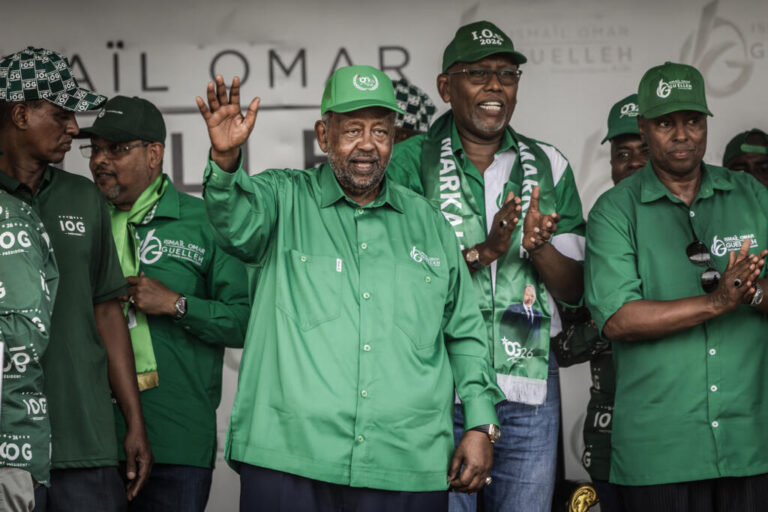
Djibouti’s 2026 presidential election, scheduled for 10 April 2026, is formally competitive but substantively structured to preserve the dominance of President Ismaïl Omar Guelleh, who is seeking a sixth term after a 2025 constitutional amendment removed the presidential age limit that would otherwise have barred his candidacy. The election is less a contest over power transfer than a managed reaffirmation of regime continuity.
The vote reflects three central dynamics:
- Consolidation of presidential longevity through constitutional engineering;
- Preservation of elite stability in a strategically indispensable Red Sea state;
- Balancing external powers—U.S., China, France, Gulf states—through regime continuity.
The likely outcome is another overwhelming victory for Guelleh, but beneath that apparent stability lie rising structural risks: succession uncertainty, youth unemployment, elite fragmentation, and growing pressure over democratic legitimacy.
I. Political Context
Djibouti occupies outsized geopolitical importance despite its small population:
- controls access near Bab el-Mandeb Strait;
- hosts foreign military bases from the U.S., China, France, Japan, and others;
- functions as Ethiopia’s maritime gateway.
Since 1999, Guelleh has maintained a highly centralized presidential system dominated by the ruling coalition:
Union for the Presidential Majority (UMP)
The 2025 constitutional amendment removing the upper age limit enabled his renewed candidacy, reinforcing perceptions that constitutional law in Djibouti serves regime preservation rather than institutional constraint.
Main Candidates
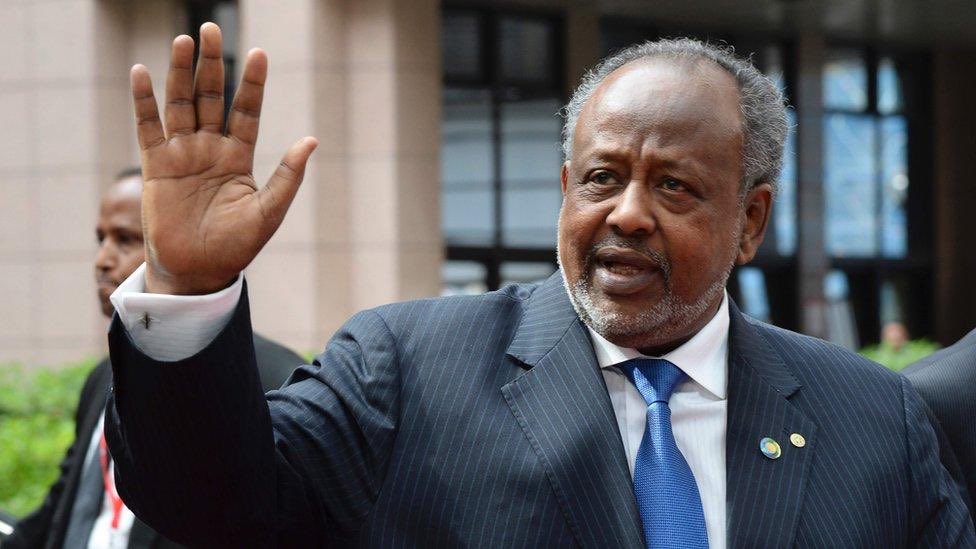
1. Ismaïl Omar Guelleh
Incumbent president since 1999.
Strengths:
- full state apparatus backing;
- control over patronage networks;
- dominance over security institutions;
- ruling party machinery.
Mohamed Farah Samatar
Opposition candidate from the Unified Democratic Center (CDU).
Limitations:
- low national visibility;
- weak organizational capacity;
- restricted media access;
- minimal institutional leverage.
The opposition remains fragmented and structurally disadvantaged.
Why Guelleh Is Expected to Win
A. Institutional Capture
The presidency dominates:
- electoral administration,
- judiciary,
- media regulation,
- security apparatus.
Although reforms introduced oversight language in 2026 electoral law, implementation remains controlled by state-linked institutions.
B. Fragmented Opposition
Djibouti lacks:
- unified opposition coalitions;
- strong independent electoral monitoring;
- equal campaign access.
This sharply reduces the competitiveness of the election.
C. Patronage Politics
Guelleh’s regime sustains loyalty through:
- clan balancing;
- public-sector employment;
- infrastructure spending;
- targeted elite patronage.
Domestic Support Base
Guelleh is supported by:
Issa Political Elite Networks
Core ruling coalition anchored in dominant clan structures.
Security Establishment
Military and intelligence services remain aligned with presidency.
State-Linked Business Class
Port logistics, telecom, customs-linked elites benefit from continuity.
Bureaucratic Middle Layer
Administrative elites depend on regime continuity for career survival.
Domestic Opposition Forces
Opposition to Guelleh comes from:
A. Reformist Urban Youth
Increasingly frustrated by:
- unemployment,
- inequality,
- lack of political opening.
B. Marginalized Afar Communities
Some regional grievances persist over representation.
C. Exiled Opposition Networks
Politically vocal but weak internally.
Foreign Actors and Their Interests
United States — Stability First
The U.S. maintains Camp Lemonnier in Djibouti:
Camp Lemonnier
Washington’s priority:
- uninterrupted military basing;
- maritime security;
- counterterrorism continuity.
Thus:
The U.S. benefits from predictable regime continuity rather than political uncertainty.
China — Strategic Infrastructure Continuity
China’s interests:
- PLA naval logistics base;
- Belt and Road investments;
- port and rail infrastructure.
Beijing strongly favors Guelleh continuity.
France
France seeks:
- military access retention;
- Francophone strategic influence.
Paris also benefits from continuity.
Gulf States (UAE / Saudi Arabia / Qatar)
Djibouti remains central to:
- Red Sea trade routes;
- Yemen conflict logistics;
- regional maritime positioning.
Strategic Implications of the Election
If Guelleh Wins (Most Likely Scenario)
Expected consequences:
- short-term regime stability;
- preserved foreign military basing arrangements;
- uninterrupted Chinese infrastructure expansion;
- postponed succession crisis—but not resolved.
Hidden Risk: Succession Crisis
The greatest long-term issue is no longer election legitimacy itself, but:
unresolved leadership succession.
Guelleh’s prolonged tenure creates:
- elite uncertainty over post-Guelleh transition;
- rivalry inside ruling coalition;
- risk of succession fragmentation.
This is Djibouti’s central latent instability variable.
Economic Dimension
Djibouti’s economy remains constrained by:
- heavy debt exposure;
- dependence on logistics rents;
- limited employment absorption.
Election continuity does not solve:
- youth unemployment;
- inflationary pressure;
- inequality.
Scenarios After the Election
Scenario 1: Managed Continuity (70%)
Guelleh wins comfortably; calm preserved.
Scenario 2: Low-Level Protest Mobilization (20%)
Urban opposition protests emerge but are contained.
Scenario 3: Elite Succession Fracture (10%)
Post-election internal ruling coalition divisions intensify.
Djibouti’s 2026 election is less a democratic contest than a strategic reaffirmation of the existing regime order.
The likely re-election of Ismaïl Omar Guelleh ensures:
- regime continuity,
- geopolitical predictability,
- external military stability.
But this stability is increasingly artificial:
beneath it lies an unresolved succession crisis that may become Djibouti’s defining political fault line after 2026.
More on this story: Djibouti’s Presidential Age Limit Abolition: Internal Dynamics and Implications
More on this story: Tensions in Ethiopia fulfil the instability in Djibouti