
Peru’s April 12, 2026 general election is taking place in a climate of severe institutional exhaustion: the country has had eight presidents since 2018, voter distrust is deep, violent crime has surged, and the party system is badly fragmented. With 35 presidential candidates on the ballot, no contender was expected to win outright in the first round, making a June 7 runoff highly likely. As of early April 13, with about 37% of ballots counted, Keiko Fujimori was narrowly ahead with 17.17%, followed by Rafael López Aliaga with 16.97%, though the count remains incomplete and the final runoff pair was still not fully settled.
The election is not just about who wins the presidency. It will also determine the composition of a restored bicameral Congress, including a new Senate with major powers over appointments and presidential removal. That means Peru’s next phase may still be marked by executive-legislative conflict even if the vote produces a clear presidential winner.
Situation Before the Election
The campaign unfolded against a backdrop of political whiplash. Peru entered the vote after years of impeachments, resignations, interim governments, and repeated leadership turnover. That instability intensified shortly before the election, leaving many Peruvians focused less on ideological programs than on who might restore a minimum level of order. Rising crime and corruption dominated the public mood. Reuters and AP both reported that violent crime, extortion, and insecurity were central campaign issues, while analysts described the electorate as disillusioned and highly volatile.
The scale of fragmentation was extraordinary. Peruvians faced a record field of 35 candidates, and even the front-runners were polling in the low-to-mid teens just days before the vote. Reuters reported on April 5 that Fujimori led one major poll with 14.5%, followed by Carlos Álvarez at 10.9% and Rafael López Aliaga at 9.9%, while other surveys differed on who was in second place. This indicated a race defined more by dispersion than by consolidation.
The mechanics of election day added another layer of uncertainty. Logistical failures delayed voting at multiple polling places, especially in Lima, and more than 52,000 people were granted extra time to vote on Monday. These delays sharpened fraud claims and prolonged uncertainty over the first-round outcome.
Main Candidates
The leading field before and during the first round clustered around a small number of better-known figures: Keiko Fujimori, Rafael López Aliaga, Carlos Álvarez, Ricardo Belmont, Jorge Nieto, Roberto Sánchez, and Alfonso López-Chau. Reuters, AP, and AS/COA all identified these names as the most relevant contenders in the final stretch, though the exact order varied by poll and over time.
Keiko Fujimori
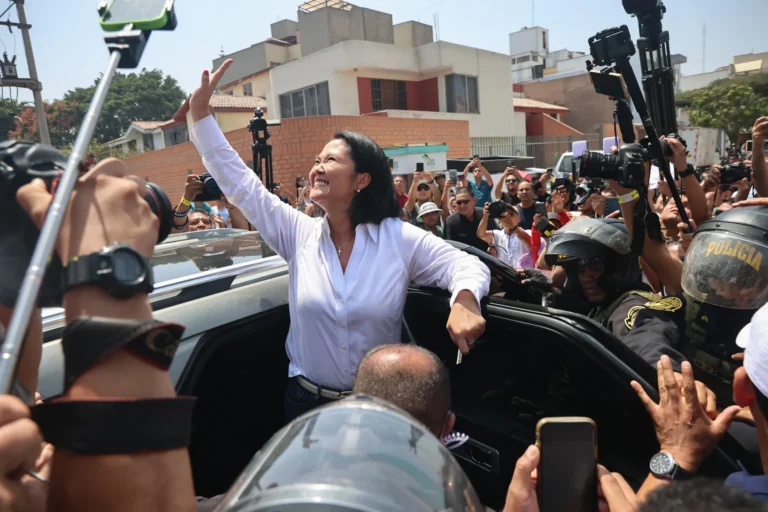
Keiko Fujimori entered the race as the best-positioned contender. Reuters reported she led all three major late polls and also led the early exit poll on election day. She is making her fourth presidential bid and remains the most nationally recognizable figure in the contest. Her base is rooted in Fujimorismo: conservative voters, hardline law-and-order constituencies, lower-middle and working-class sectors that still associate the Fujimori name with decisiveness, and segments of the right that value her congressional influence and organizational machinery. Her support is also strengthened by party infrastructure that most rivals lack.
Her vulnerabilities are equally clear. She carries heavy political baggage linked to her father Alberto Fujimori’s authoritarian legacy, and she has already lost three previous presidential runoffs. That makes her strong in a fragmented first round but potentially polarizing in a second round, where anti-Fujimori mobilization could again become decisive. This is a core structural feature of Peru’s electoral politics.
Rafael López Aliaga
Rafael López Aliaga, former mayor of Lima, represented the hard right. Reuters and AS/COA described him as one of the top conservative contenders, with a style frequently compared to Donald Trump. His electoral base rests on upper- and middle-income conservative voters, urban right-wing sectors, Catholic traditionalists, anti-left constituencies, and voters prioritizing punitive security responses. He is strongest where ideological conservatism and anti-establishment anger overlap.
His ceiling appears constrained by polarizing rhetoric. Reuters noted that his support slipped in late polling even while he remained competitive, and outside reporting described some voters as alienated by extremist rhetoric and misinformation. He is strong enough to reach a runoff but not broad enough, at least so far, to dominate the field.
Carlos Álvarez
Carlos Álvarez emerged as one of the campaign’s most interesting late movers. Reuters reported that he rose sharply in at least one major poll, and AS/COA described him as a conservative outsider whose media skills, national name recognition, and tough-on-crime message fit the public mood. His support base appears unusually cross-cutting: recent polling analysis suggested he performed comparatively well across both urban and rural settings and across socioeconomic groups. That makes him one of the few candidates with genuinely broad outsider appeal.
Álvarez’s advantage is that he is less tied to Peru’s discredited political class. His weakness is that he lacks deep party structure and governing experience. In a fragmented first round, outsider energy can be enough to surge. In a runoff or in office, institutional weakness becomes a liability.
Ricardo Belmont
Ricardo Belmont, another former mayor of Lima and media owner, appealed to anti-establishment and more heterodox voters, including some younger and protest-oriented segments. He was repeatedly mentioned among the stronger second-tier candidates, though not as a clear front-runner. His base appears to have been concentrated in urban protest voters and people seeking a familiar but nontraditional alternative to both Fujimorismo and the organized left.
Jorge Nieto
Jorge Nieto represented a more centrist, technocratic option. Reuters listed him among the notable center-left figures attracting voters across the ideological middle. His likely base consisted of educated urban moderates, institutionalists, and voters fatigued by both populist right-wing rhetoric and the discredited radical left. But in a security-dominated election, that lane looked narrower than in previous cycles.
Roberto Sánchez
Roberto Sánchez competed for left-leaning voters and was endorsed by imprisoned former President Pedro Castillo, under whom he had served as a minister. His support base therefore included parts of the rural and popular left, Castillo loyalists, and sectors alienated by Lima’s political establishment. But that base was limited by fragmentation and by the broader weakness of the left compared with 2021.
Alfonso López-Chau
Alfonso López-Chau was another relevant figure on the left-to-center-left. Reuters noted that he had earlier polled higher, even reaching second in some surveys, before slipping back by early April. His likely base included progressive urban voters, academic and technocratic circles, and citizens seeking a less populist left alternative. His decline suggested that the campaign environment increasingly rewarded name recognition and hardline security messaging over programmatic moderation.
Electoral Bases: The Broader Pattern
Peru’s 2026 race showed a rightward drift, but not a unified conservative bloc. Reuters described the field as tilting right, with Fujimori and López Aliaga consistently near the top and Álvarez gaining quickly. Yet these three candidates were competing for overlapping constituencies: crime-focused voters, anti-left voters, conservative Catholics, business-minded sectors, and citizens demanding tougher state authority. That overlap prevented any one right-wing candidate from breaking away decisively.
The left and center-left remained divided among Sánchez, Nieto, López-Chau, and others. That fragmentation weakened their ability to recreate the kind of consolidated anti-establishment surge that had once lifted Pedro Castillo. In effect, the 2026 first round became a competition between multiple right-leaning contenders with stronger media profiles and a left/center-left field too fractured to fully capitalize on public anger.
First-Round Results
The first-round result is still provisional. On election night, an early Ipsos exit poll put Keiko Fujimori first with 16.6%, followed by Roberto Sánchez with 12.1% and Ricardo Belmont with 11.8%. But as official counting advanced, Reuters reported that with 37% of ballots counted Fujimori remained ahead with 17.17%, closely followed by López Aliaga at 16.97%, while uncertainty persisted over who would ultimately qualify for the runoff. That discrepancy matters: Peru’s first-round picture is still evolving, and any serious analysis should distinguish between exit polls and official partial returns.
The safest conclusion at this stage is that Fujimori is well-positioned for the runoff, while the second slot remains or recently remained highly competitive. No candidate is remotely close to the 50% needed to avoid a second round.
Consequences of the Election
The immediate consequence is that Peru is very likely heading to a runoff on June 7. That extends uncertainty and gives anti-front-runner coalitions time to reorganize, something especially relevant if Fujimori remains in first place. Her political history suggests that she can dominate the first round yet still face a broad anti-Fujimori front in the second.
The deeper consequence concerns governability. Reuters and AP both stressed that whoever wins will face a fragmented Congress. The restored bicameral system raises the stakes: the new Senate has appointment powers and a lower threshold for presidential removal, which revives fears of renewed impeachment cycles and institutional paralysis.Peru could elect a president only to trap that person inside another hostile, transactional legislature.
Crime policy will also be central. Nearly all major candidates responded to insecurity with more punitive proposals, including military deployment, mega-prisons, faceless judges, or even the death penalty. That suggests the election could produce a tougher security state regardless of who wins, with significant implications for civil liberties and rule of law.
A further consequence is that structural issues may remain under-addressed. AP reported that illegal mining, now Peru’s largest illicit economy, barely featured in many party platforms despite its enormous economic and environmental importance. This gap suggests the next administration may continue focusing on visible urban crime while neglecting the illicit economies that increasingly shape regional power and corruption.
Foreign Actors and Their Influence
United States
The United States has intensified engagement with Peru ahead of the vote. Reuters reported that Washington, led by Ambassador Bernie Navarro, has launched one of its strongest recent pushes to rebuild influence in Peru as part of a broader effort to secure critical minerals, deepen defense cooperation, and counterbalance China. Peru was designated a major non-NATO ally in January, the U.S. approved support for modernization of a naval facility near Callao, and Lockheed Martin is competing to sell Peru fighter jets. The U.S. is therefore not neutral in strategic terms: it has a clear interest in a Peruvian government that is cooperative on security, mining, and investment conditions.
Washington’s influence is not primarily electoral in the narrow sense of backing one candidate openly. It is structural and strategic. The U.S. is signaling to Peruvian elites that closer defense and economic ties are available if Lima offers legal certainty, improved security, and a more reliable investment climate. That matters in a country where political volatility has become a core business risk.
China
China is the other major foreign actor and, in commercial terms, the stronger one. Reuters reported that China overtook the United States as Peru’s dominant trade partner, with bilateral trade reaching about $50 billion last year compared with roughly $19 billion with the U.S. Chinese influence is especially strong in mining and infrastructure, symbolized by the Chancay megaport and Chinese-owned mining assets such as Las Bambas. This gives Beijing a deep material stake in the election’s aftermath, even if it avoids explicit partisan intervention.
China’s leverage comes through trade dependence, infrastructure, and resource extraction rather than public ideological messaging. The next Peruvian president will likely try to avoid choosing between Washington and Beijing outright, but the campaign already reflected that Peru is becoming a contested strategic space between the two powers.
Other External Actors
Other states matter, but more selectively. Sweden and France are relevant through defense competition, since Reuters reported firms from those countries are also competing with Lockheed Martin for Peru’s fighter-jet procurement. Brazil remains indirectly significant because of the long shadow of Odebrecht corruption across Peru’s political class, though that is more a legacy factor than a current electoral intervention channel. Transnational criminal economies, rather than traditional states alone, are also influential through illegal mining and narcotics networks that shape regional security and corruption pressures.
The most likely near-term scenario is a runoff featuring Keiko Fujimori and another right-leaning or outsider candidate, though the second slot was still being contested in the partial count available early on April 13. A Fujimori runoff would almost certainly polarize the country between pro-order conservatives and an anti-Fujimori coalition of left, center, and protest voters.
Whoever wins, Peru is unlikely to get a clean reset. The country’s next president will inherit a public-security emergency, institutional mistrust, an empowered Congress, and sharper U.S.-China strategic competition. The election may choose a leader, but it may not resolve the deeper crisis of governability. If you want, I can turn this into a sharper think-tank format with sections like Key Judgments, Risk Scenarios, and Implications for the U.S., China, and regional stability.