
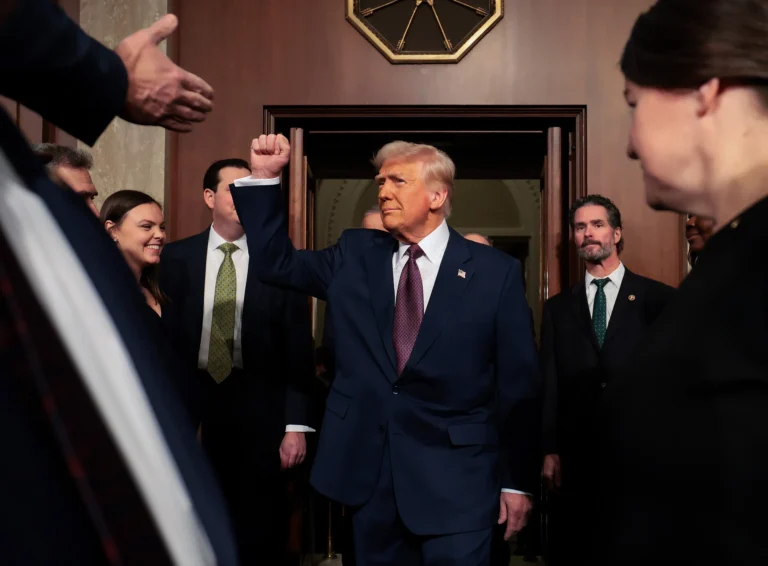
The modern foreign policy of Donald Trump represents a structural departure from the post–World War II American doctrine that emphasized alliances, democratic values, and institutional leadership. Instead, Trump’s approach prioritizes transactional deal-making, bilateral leverage, and short-term strategic gains over long-standing commitments to democracy, human rights, and multilateral cooperation.
This shift has produced three major consequences:
- Erosion of value-based leadership, weakening U.S. credibility among democratic allies;
- Normalization of illiberal partnerships, including support for leaders like Viktor Orbán;
- Strategic uncertainty, exemplified by controversial positions on Greenland and escalatory rhetoric toward Iran.
Taken together, these trends risk undermining the United States’ role as the leader of the free world, replacing it with a more narrow, interest-driven power lacking ideological cohesion.
From Values to Transactions: The Core Shift
For decades, U.S. foreign policy was anchored in:
- promotion of democracy, defense of human rights, alliance cohesion (NATO, EU partnerships) institutional leadership.
Under Trump, this paradigm shifted toward what can be described as:
“Foreign Policy as Negotiation”.
Key characteristics:
Trump repeatedly framed international relations in business terms:
allies must “pay their share,” agreements must produce “wins,” and partnerships must yield immediate returns.
This reflects a worldview where:
states are not communities of shared values, but competitors in a marketplace of power.
Trump’s Foreign Policy Is Deal-Oriented because Trump’s background in business shaped a mindset where relationships are fluid, loyalty is conditional, outcomes matter more than norms.
This translates into foreign policy as:
Domestic Political Incentives. Trump’s electoral base prioritizes:
- economic nationalism, sovereignty, skepticism toward global institutions. Thus:
- multilateral commitments are framed as constraints international norms are seen as negotiable.
The Trump doctrine reflects a broader U.S. trend:
- fatigue with foreign interventions, distrust of globalization, reduced appetite for democracy promotion.
This creates space for a post-ideological foreign policy.
The Orbán Case: Ideology Meets Pragmatism
The White House’s support—direct or indirect—for Viktor Orbán despite opposition momentum illustrates the fusion of transactional logic and ideological affinity.
Why Washington backed Orbán: Predictability over Democracy
Orbán offers:
- centralized authority,
- stable policy direction,
- control over domestic political environment.
For a deal-oriented administration, this is preferable to:
- uncertain coalition governments,
- fragmented opposition forces.
Ideological Convergence Trump-aligned circles view Orbán as defender of national sovereignty, opponent of migration, symbol of “illiberal democracy.”
Thus:
support is not only pragmatic—but ideological.
Orbán disrupts EU consensus. While transactional diplomacy can yield short-term gains, it introduces systemic risks.
Erosion of Alliance Trust
Traditional allies increasingly question:
- U.S. reliability,
- commitment to NATO,
- consistency of strategic guarantees.
This weakens:
- deterrence,
- collective security frameworks.
Mixed Signals to Authoritarian States
By prioritizing deals over values, Washington:
- reduces pressure on authoritarian regimes,
- legitimizes illiberal governance models.
This benefits:
- Russia,
- China,
- hybrid regimes globally.
Undermining Soft Power
U.S. influence historically relied on:
- credibility,
- moral leadership,
- normative authority.
Transactional policy replaces this with:
- coercive bargaining,
- economic leverage.
Result:
reduced attractiveness of the American model.
Greenland and Iran: Case Studies of Strategic Disorientation
A. Greenland Episode
Trump’s attempt to purchase Greenland signaled:
- a return to territorial transactionalism;
- disregard for allied sensitivities (Denmark);
- perception of diplomacy as real estate negotiation.
Impact:
- damaged trust with Nordic allies;
- raised questions about U.S. strategic coherence.
B. Iran Policy and Escalation Risks
Under Trump, tensions with Iran escalated sharply:
- withdrawal from the nuclear deal;
- increased sanctions;
- military signaling.
Consequences:
- allies feared uncontrolled escalation;
- policy oscillated between pressure and negotiation;
- lack of clear long-term strategy.
Disappearance of Strategic Landmarks
Traditional U.S. foreign policy relied on clear anchors:
- NATO solidarity,
- EU partnership,
- democracy promotion,
- predictable deterrence.
Under Trump:
- these landmarks became blurred or conditional;
- policy became leader-centric rather than system-based.
This creates:
strategic ambiguity not only for adversaries—but for allies.
Implications for U.S. Global Leadership
Risk of Losing “Leader of the Free World” Status
If U.S. policy:
- abandons value-based leadership,
- tolerates democratic erosion among allies,
- prioritizes deals over principles,
then:
its ideological leadership erodes.
Rise of Competing Models
China and Russia promote:
- sovereignty-first governance,
- non-interference,
- authoritarian stability.
Trump-era policy unintentionally:
- validates elements of this model.
Fragmentation of the West
Without shared values:
- alliances become transactional;
- unity weakens;
- coordination declines.
The Trump administration’s foreign policy marks a profound transformation:
From:
- values-based leadership
To:
- transactional deal-making
While this approach may yield tactical advantages, it carries strategic costs:
- weakening alliances,
- empowering illiberal actors,
- eroding U.S. global legitimacy.
The cases of Hungary, Greenland, and Iran illustrate a broader pattern:
policy without stable principles creates uncertainty, even among allies.
If sustained, this trajectory risks transforming the United States from:
the architect of the liberal international order
into
one powerful actor among many in a fragmented global system.
How Transactional Foreign Policy Threatens U.S. Global Leadership
The shift under Donald Trump from values-based diplomacy to deal-oriented foreign policy does not simply change style—it alters the foundations of American power. U.S. leadership has historically rested on a combination of hard power (military, economy) and soft power (values, trust, legitimacy). A purely transactional approach weakens the second pillar, which is often the decisive one in long-term global influence.
Below are the key ways this threatens U.S. leadership.
Erosion of Trust Among Allies
U.S. leadership depends less on coercion and more on voluntary alignment. Allies follow Washington not only because of power, but because they believe in:
- shared values,
- predictable commitments,
- long-term reliability.
When alliances are treated as negotiable deals:
- security guarantees appear conditional;
- commitments seem reversible;
- partners begin hedging.
For example, support for leaders like Viktor Orbán despite democratic concerns signals that:
alignment with U.S. values is no longer necessary—only usefulness matters.
Result:
Allies begin to ask:
“Will the U.S. stand by us tomorrow, or renegotiate?”
Collapse of Normative Leadership
The United States historically led not just through power, but through norm-setting:
- democracy,
- rule of law,
- human rights.
When Washington deprioritizes these:
- it loses moral authority;
- its criticism of authoritarian regimes becomes less credible;
- democratic movements abroad lose a key supporter.
Strategic consequence:
The U.S. stops being:
“the model to emulate”
and becomes:
“just another power pursuing interests.”
Empowerment of Strategic Rivals
Countries like:
- China,
- Russia.
benefit directly from this shift.
Why?
Because their model is already:
- sovereignty-first,
- non-ideological,
- transactional.
When the U.S. adopts similar behavior:
- it legitimizes their approach;
- it removes ideological contrast;
- it reduces the appeal of Western alignment.
Result:
The global competition shifts from:
values vs authoritarianism
to:
competing transactional powers;
—where the U.S. loses its unique advantage.
Fragmentation of Alliances
Value-based alliances are durable.
Transactional alliances are fragile.
Under a deal-based system:
- each issue becomes negotiable;
- collective commitments weaken;
- coalition-building becomes harder.
For example:
- NATO cohesion depends on trust, not pricing;
- EU–U.S. coordination depends on shared norms, not transactions.
Result:
Alliances shift from:
strategic communities → temporary coalitions
Strategic Uncertainty and Miscalculation
Clear principles create predictability.
Deals create ambiguity.
When U.S. policy becomes:
- leader-driven,
- situational,
- unpredictable,
both allies and adversaries struggle to interpret intentions.
Examples include:
- the Greenland proposal (perceived as opportunistic expansionism);
- fluctuating pressure and diplomacy toward Iran.
Risk:
- miscalculation by adversaries,
- overreaction by allies,
- escalation due to unclear red lines.
Decline of Soft Power
Soft power—credibility, attractiveness, legitimacy—is:
- slow to build,
- easy to lose.
Transactional diplomacy:
- replaces persuasion with bargaining;
- replaces inspiration with pressure.
Consequences:
- fewer countries voluntarily align with the U.S.;
- global public opinion shifts;
- American influence becomes more expensive (requires coercion or incentives).
Encouragement of Illiberal Governance Globally
When the U.S. signals that:
- democratic standards are secondary,
- authoritarian tendencies are tolerated,
other governments adapt.
Leaders conclude:
maintaining power matters more than maintaining democratic legitimacy.
Result:
- democratic backsliding accelerates;
- U.S. influence over governance norms declines;
- global political order becomes less aligned with U.S. interests.
Internal Contradiction: Power Without Purpose
A deal-based foreign policy maximizes flexibility, but weakens strategic identity.
Without a clear mission:
- policies become reactive;
- long-term goals disappear;
- leadership becomes inconsistent.
Strategic risk:
The U.S. becomes:
a powerful state without a coherent global project.
Transactional foreign policy threatens U.S. leadership because it removes the very element that made that leadership sustainable: trust grounded in shared values.
In the short term, deals can deliver tactical gains.
In the long term, they:
- weaken alliances,
- empower rivals,
- erode legitimacy,
- increase instability.
If this trajectory continues, the United States risks transitioning from:
leader of a rules-based international order
to:
one of several competing great powers in a fragmented, value-neutral system.
Continued transactional foreign policy would not break NATO, EU relations, or U.S.–China competition overnight. It would reshape them by making all three less value-based, less predictable, and more conditional on short-term bargaining. The result would be a weaker Western bloc, a more autonomous Europe, and a more contested but less coherent U.S. position vis-à-vis China. Recent events already point in that direction: NATO allies publicly refused to join Trump’s proposed Hormuz blockade, Turkey urged the alliance to prepare for reduced U.S. participation, and a senior White House official said Trump was considering pulling some U.S. troops from Europe.
NATO
If transactional policy continues, NATO would likely shift from a political-security community into a narrower, more conditional burden-sharing arrangement. In practice, that means allies would spend more on defense and hedge more against Washington at the same time. Trump’s pressure can force Europeans to rearm faster, but it also weakens confidence that U.S. commitments are durable when they depend on whether allies support a given White House demand, such as operations tied to Iran. That dynamic is already visible in the current dispute over Hormuz and in discussions about possible U.S. force reductions in Europe.
The likely medium-term effect is a “dual-track NATO”: formally intact, but strategically less cohesive. Europe would keep the alliance because no substitute can fully replace U.S. military power soon, yet European capitals would invest more heavily in autonomous planning, stockpiles, command arrangements, and regional defense-industrial capacity in case Washington becomes less reliable. Reuters’ reporting that NATO members are being urged to prepare for less U.S. involvement points exactly to this kind of phased adjustment.
The deeper risk is not legal withdrawal from NATO, but political hollowing-out. Even without exiting the alliance, Washington can weaken deterrence by reducing troop presence, making support look contingent, or forcing allies to choose between endorsing U.S. operations and preserving alliance unity. That kind of uncertainty is strategically useful to Russia because it blurs red lines and makes collective response less automatic.
EU relations
Transactional policy would also push the European Union toward a more independent and selective relationship with Washington. The EU would remain economically tied to the U.S., but political trust would erode if Brussels concludes that America now treats Europe less as a community of allies and more as a bargaining counterpart to pressure on trade, defense, and geopolitics. The recent European response to the Iran crisis shows this divergence: EU leaders welcomed the ceasefire and emphasized diplomacy, while key NATO allies rejected joining the U.S. blockade.
At the same time, the relationship would not simply collapse, because mutual interests still exist. Reuters reported that the EU and the U.S. are nearing a critical minerals arrangement aimed at reducing dependence on Chinese-controlled supply chains, and the European Parliament has advanced a trade deal with added safeguards. That suggests the future transatlantic relationship under a transactional model would become highly compartmentalized: more bargaining, more issue-by-issue deals, less strategic solidarity.
This creates a paradox. Europe may become more economically pragmatic with Washington while becoming less politically aligned with it. Spain’s increasingly independent China policy, which risks angering Trump, is a sign that some European governments are already testing greater room for maneuver between the U.S. and China rather than fully adopting Washington’s line.
If that trend deepens, the EU’s foreign policy will likely become more sovereign but also more fragmented. Some states will double down on alignment with Washington for security reasons, especially on Russia. Others will try to insulate trade and industrial policy from U.S. pressure, especially where China is important. The result would be a looser West, not a unified strategic bloc. That would diminish U.S. leverage because America historically led Europe best when it combined military power with a shared political narrative, not when it treated Europe as a client or competitor.
U.S.–China competition
Continued transactionalism would make U.S.–China competition harsher in some sectors but less coherent overall. On one hand, the U.S. is clearly still building anti-China supply-chain tools: the U.S. and Australia just expanded critical minerals financing by more than $3.5 billion to reduce dependence on Chinese refining, and Washington is pursuing similar coordination with Europe.
On the other hand, transactional policy weakens the coalition structure that gives the U.S. its main advantage over China. China cannot easily match America’s alliance network, but it benefits when Washington alienates allies and forces them to hedge. A more coercive, improvisational tariff policy and repeated shocks to alliance trust make it easier for Beijing to present itself to some partners as a steadier economic actor, even where concerns about China remain strong. Reuters’ reporting on Spain’s China outreach and on the likely Trump-Xi summit happening against unresolved structural disputes illustrates that rivalry is becoming both more intense and less strategically ordered.
The biggest strategic danger for Washington is that it may confuse pressure with leverage. Pressure can extract concessions in a specific negotiation. Leverage, by contrast, depends on networks, legitimacy, and coordination. In competition with China, the U.S. is strongest when it acts with allies on technology controls, critical minerals, financial standards, and maritime security. If transactional policy repeatedly damages allied confidence, the U.S. may still be tough on China, but it will be less effective because it will be acting with a thinner coalition.
The most likely scenario is not American retreat, but American conditionality. Under that model, NATO survives but becomes more Europeanized, the EU cooperates with Washington selectively while protecting room for autonomy, and U.S.–China competition becomes more economic and coercive but less alliance-centered. That would still leave the U.S. powerful, but no longer the undisputed organizer of a coherent Western camp.
A more adverse scenario is fragmentation. In that path, repeated U.S. pressure over defense, Greenland-style sovereignty disputes, Iran-related demands, and tariffs convince major allies that Washington is a volatile partner. Europe then accelerates strategic autonomy, some governments deepen commercial links with China, and NATO loses political cohesion even if its treaty structure remains. Recent tensions over Hormuz, troop withdrawals, and European irritation with Trump’s methods show how this path could emerge.
The best-case scenario for Washington is partial correction. Trump-style transactional pressure could still coexist with a more disciplined coalition strategy if the U.S. uses burden-sharing demands to strengthen, rather than humiliate, allies and if it keeps anti-China coordination anchored in durable industrial and security agreements. The critical minerals deals with Australia and the EU suggest that such a hybrid course is still possible. If continued, transactional foreign policy would reshape NATO into a more nervous alliance, EU-U.S. ties into a more selective partnership, and U.S.–China competition into a tougher but less coordinated struggle. America would remain powerful, but it would risk losing the specific kind of power that made it uniquely influential: the ability to organize other major democracies around a shared strategic project.