
A Strategic Challenge to U.S. National Security and Hemispheric Stability
Over the past decade, Mexico has become one of the most strategically important operational hubs for Russian intelligence in the Western Hemisphere. Moscow utilizes Mexican territory for clandestine meetings, data transfer, recruitment activities, and disinformation operations aimed at the United States and regional allies. Moscow’s intelligence services exploit Mexico’s geographic proximity to the U.S., extensive tourism flows, weak counterintelligence capacity, and political reluctance to confront Russian espionage. 2023, Mexico recorded approximately 42.15 million international visitor arrivals. According to recent data from the Mexican authorities for 2024, U.S. citizens top the list of foreign visitors. One source reports that in 2024 there were about 12.6 million U.S. visitors to Mexico. Partial-year data: for example, in the first half of 2024, about 7.61 million U.S. visitors reportedly traveled to Mexico. Based on that data: Historically (pre-pandemic 2019), U.S. tourists accounted for a similar share: the U.S. provided the majority of air arrivals to Mexico in many years.
If U.S. visits in 2024 totaled ~12.6 million — that implies U.S. tourists made up roughly 25–30% of all international arrivals (given total arrivals ~42–45 million).
Although Washington has repeatedly warned Mexican authorities about escalating Russian spy activity—providing specific names, dossiers, and operational histories—Mexico has systematically ignored or downplayed the threat. Only limited corrective steps were taken, and they have been insufficient to disrupt Moscow’s permanent network.
Russian operational priorities in Mexico accelerated dramatically after the 2022 invasion of Ukraine, when the majority of Russian intelligence officers were expelled from Western embassies. Moscow redeployed experienced operatives to Latin America, turning Mexico into a major post-Ukraine intelligence fallback zone.
Moscow’s Espionage Modus Operandi in Mexico
Russian intelligence officers—primarily from the SVR and GRU (mil intel)—deploy to Mexico under diplomatic or commercial cover. According to U.S. sources, CIA assembled a list of more than two dozen Russian officers posing as diplomats, but Mexico refused to expel them. In 2023, Washington secured only partial concessions, persuading Mexico to scrutinize new diplomatic accreditation requests by Russian nationals. Some were blocked from entry. However, previously deployed agents were allowed to remain, even after the presidential transition.
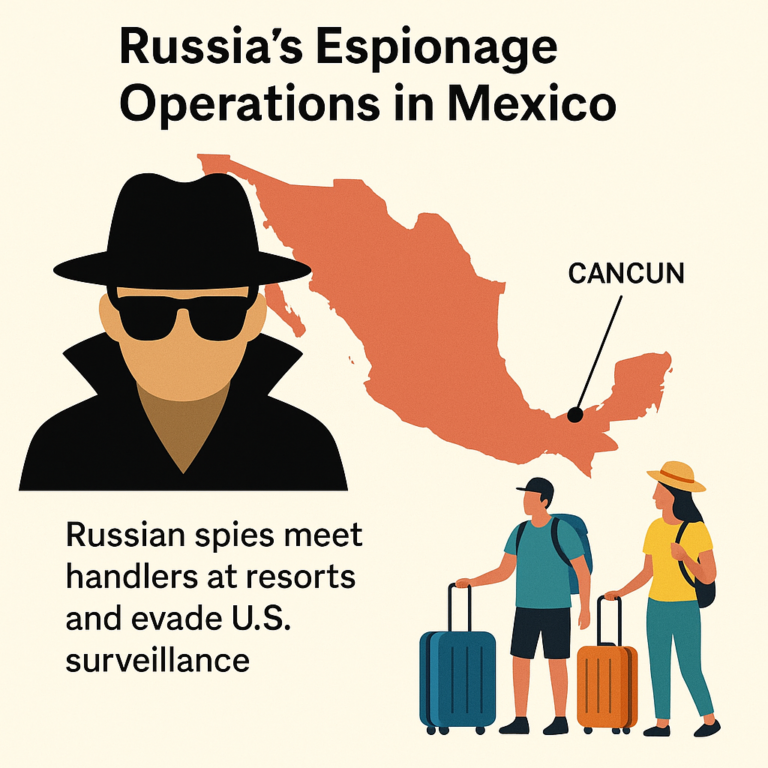
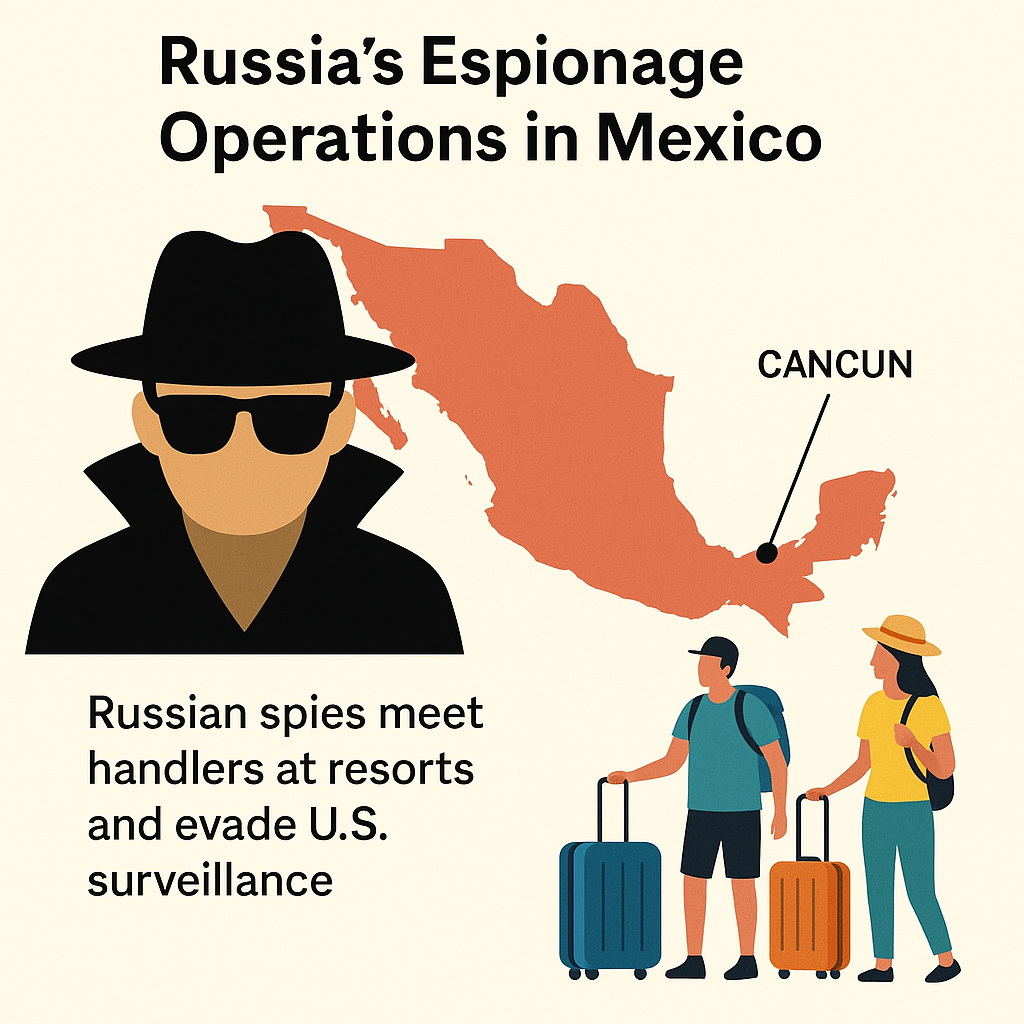
U.S. officials state that Russian operatives use Mexican resorts, particularly Cancun and Riviera Maya, as secure environments for covert exchanges:
- Thousands of American tourists provide natural cover and anonymity.
- Local businesses offer plausible logistical support (hotels, rentals, private rooms).
- Mexico’s counterintelligence services prioritize cartels and internal threats, creating a permissive operating environment.
Russian handlers and field operatives reportedly meet on beaches or in tourist facilities, transferring intelligence collected inside the United States, including technical data, recruitment material, and potentially cyber-obtained information. Meetings occur outside U.S. surveillance range, giving Moscow a stable back-channel for exfiltration.
Political Ambivalence in Mexico
Former president Andrés Manuel López Obrador (AMLO) publicly denied having evidence of Russian espionage. However, according to nine current and former U.S. and Mexican officials, his administration received repeated, detailed intelligence warnings. Three U.S. officials confirm that AMLO himself was briefed directly on the Russian threat.
Mexican reluctance to take action has several roots:
- Ideological suspicion of U.S. influence, especially within the ruling Morena party.
- Domestic priorities, especially the fight against cartels and corruption.
- Limited counterintelligence capacity, which Moscow exploits.
- Historical anti-intervention sentiment, which Russia manipulates to frame U.S. intelligence warnings as geopolitical pressure.
The lack of expulsions, even after leadership transition to President Claudia Sheinbaum, indicates that Mexico maintains a strategic neutrality posture toward Russian intelligence, treating espionage concerns as secondary to diplomatic interests.
Russian Disinformation and Political Influence in Mexico
U.S. officials assess that Moscow is not only running espionage networks, but has also intensified disinformation operations targeting Mexican society, especially via digital channels.
Objectives include:
- Undermining U.S.–Mexico security cooperation
- Generating anti-Western sentiment inside Mexican political circles
- Promoting narratives against sanctions on Russia
- Creating divisions between Mexico and Europe
The success of these campaigns has forced the U.S. Embassy to appoint a dedicated Russia monitoring officer, and France to add a counter-disinformation position in Mexico.
Disinformation is amplified by:
- Local pro-Kremlin legislators creating a “friendship committee” with Russia
- Russian military contingents invited to national parades
- Social media ecosystems sympathetic to anti-U.S. messaging
Moscow’s narrative architecture has grown strong enough that portions of Mexico’s domestic debate increasingly reflect Kremlin framing rather than Western priorities.
Embassy Infrastructure: A Strategic Intelligence Platform
The Russian embassy in Mexico City is now one of the largest Russian diplomatic missions in the world, with at least 85 diplomats—a number that far exceeds normal bilateral requirements. By contrast, Mexico has only 16 diplomats accredited in Moscow.
According to CIA, most embassy personnel are not standard diplomats, but individuals with documented operational backgrounds in Russia, Europe, or the United States. Their presence gives Moscow:
- Robust cover infrastructure
- Secure logistical support for regional operations
- Operational redundancy after expulsions from Europe
- Access to migration flows and supply routes
Mexico’s historical reputation as “the Vienna of Latin America”—a Cold War hub for intelligence tradecraft—has resurged, but now on a larger scale.
Operational Case Study
The 2020 arrest of Héctor Alejandro Cabrera Fuentes, a Mexican national recruited by Russian intelligence, illustrates Moscow’s recruitment and exfiltration pattern. Fuentes attempted to collect information on a confidential U.S. source working against Russia and was arrested in Miami.
After pleading guilty, he returned to Mexico, where he remains politically silent, reinforcing the notion that Mexico has no meaningful deterrent against such activities.
Escalation After 2022
Following the invasion of Ukraine, the U.S. and its allies expelled over 100 Russian intelligence officers globally. Moscow rapidly redeployed assets into Latin America—particularly Mexico—because:
- Local counterintelligence is fragmented and under-resourced
- U.S. surveillance jurisdiction is limited outside its territory
- Neutrality postures allow Moscow to operate discreetly
- Russian agents benefit from flows of tourists, migrants, and commerce
At the same time, U.S. officials warned that Russian intelligence may exploit migration channels, including Russian nationals entering Mexico, to infiltrate agents into the United States under non-diplomatic cover.
Russia’s Regional Strategy
Kremlin strategy in Latin America is not episodic, but designed to:
- Establish a permanent regional architecture of influence and access
- Challenge U.S. hemispheric leadership
- Create geopolitical bargaining chips against U.S. pressure in Europe
- Conduct cyber and offshore intelligence operations outside NATO perimeter
Russian Security Council Secretary Nikolai Patrushev has personally overseen regional expansion, stating that Latin America is “on the front line of the struggle for sovereignty.” This framing encourages Mexican elites to view Russian presence as a counterweight to U.S. dominance.
Russian activities also extend across Brazil, Venezuela, Cuba, Nicaragua, forming a multi-layered operational corridor, from disinformation centers to commercial and diplomatic platforms.
Intelligence Assessment
Why Moscow Uses Mexico
- Geographic proximity to United States
- Dense tourism environment that creates anonymity
- Weak counterintelligence prioritizing narcotics, not foreign espionage
- Political reluctance to expel Russian diplomats
- Local actors receptive to anti-American framing
- Historical Cold War familiarity with espionage tradecraft
Risks for the United States
- Unmonitored intelligence exfiltration
- Recruitment of assets on U.S. territory with exfiltration channels abroad
- Regional influence architecture challenging U.S. hemispheric control
- Disinformation shaping Mexico’s domestic political debate
- Migration routes exploited for insertion of agents
- Future covert logistics for cyber and hybrid operations
U.S. Policy Considerations
With the return of Donald Trump to office, it remains unclear whether Washington will continue to demand expulsions, or whether Russia policy will become transactional. However, U.S. national security architecture increasingly views Mexico as:
the primary vulnerability in Western Hemisphere counterintelligence
Therefore, Washington may consider:
- Expanded counterintelligence cooperation under new frameworks
- Conditionality in security assistance to Mexico
- Joint vetting of diplomatic accreditations
- Cyber-intelligence sharing
- A regional counter-disinformation coalition
Without such measures, Moscow’s military and intelligence footprint in Latin America will remain strategically durable.
For purposes like intelligence-analysis or logistical assessment (as in your earlier question about Russian spies using tourism flows):
- Even with conservative estimates, > 10 million annual U.S. visitors traveling to Mexico provides massive human-flow cover: plenty of movement across borders, airports, resorts, and transit points — facilitating covert operations, exfiltration, and blending in.
- Tourist demographics (seasonal surges, high turnover, anonymous transit, short stays) create ideal conditions for clandestine meetings, intelligence drop-offs, or safehouse rotations — especially in high-traffic resort zones.
- The volume also creates statistical noise, complicating counterintelligence efforts by blending legitimate tourists with potential operatives.
Strategic Outlook
Mexico’s permissive environment has enabled Russia to establish:
- A fallback intelligence logistics hub
- An operational gateway into the United States
- A regional influence center targeting public sentiment
- A post-Ukraine redeployment platform
Unless Mexico recalibrates its policy, Russian intelligence operations in the Western Hemisphere will continue to expand, potentially integrating cyber, criminal, and migration-based vectors.
Moscow correctly understands that:
containing the U.S. in its own neighborhood is the cheapest strategic countermeasure available to the Kremlin.
Warning Indicators of Escalating Russian Intelligence Operations in Mexico
I. Diplomatic & Personnel Indicators (High Confidence)
Early–Warning Triggers:
- Unusual increase in Russian diplomatic staffing at the embassy or consulates, especially in:
- political section,
- cultural attachés,
- commercial attachés,
- press officers.
(these categories often mask intelligence operatives)
- Accelerated requests for diplomatic immunity for newly arrived Russian nationals.
- Repeated refusal by Mexico to revoke or review diplomatic status of individuals identified by U.S. or allied intelligence.
- Sustained Russian demand for expansion of consular offices, honorary consuls, or trade missions in tourist-heavy regions.
- Unexplained rotation of mid-level diplomats and “technical specialists,” outside normal diplomatic cycles, suggesting operational refresh.
Operational Tradecraft Indicators (Medium–High Confidence)
Indicators of active espionage and exfiltration:
- Increased Russian presence in tourist cities (Cancun, Playa del Carmen, Puerto Vallarta) with:
- short-term rentals,
- private villas,
- conference room bookings without commercial logic.
- Repeated ingress/egress of Russian nationals from U.S. territory via Mexico, especially with:
- identical itineraries,
- short stays,
- no legitimate tourism profile.
- Use of Mexican real estate titles, corporate fronts, or shell companies owned by Russian nationals or dual citizens.
- Patterned meet-ups between Russian diplomats and private Russian or Mexican citizens in non-governmental locations:
- beach resorts
- golf clubs
- gated residential communities
- marinas and yacht rentals
- Spike in encrypted communications emanating from Russian diplomatic compounds, without proportional public-facing diplomatic activity.
- Procurement of commercial drones, satellite phones, secure routers, or crypto terminals by Russian nationals in coastal regions.
HUMINT & Recruitment Indicators (High Confidence)
Possible early signs of local recruitment operations:
- Unexplained outreach by Russian nationals to Mexican academics, energy sector specialists, cybersecurity workers, or journalists.
- Russian diplomats sponsoring cultural events, research grants, or academic exchanges with minimal transparency.
- Russian media operators or “independent journalists” establishing prolonged presence in Mexico without visible revenue.
- Russian cultural organizations offering fully funded international travel programs for Mexican elites or students (classic spot-and-assess pipeline).
- Growth of Russian-linked legal, financial, or property management firms offering unusually low-cost services to foreigners.
Disinformation & Information Operations Indicators (High Confidence)
Escalation triggers:
- Sudden amplification of anti-U.S. narratives on Mexican digital platforms, including:
- TikTok
- Facebook groups
- Telegram channels
- WhatsApp networks
- Coordinated political messaging attacking NATO, Ukraine, or sanctions, synchronized across Spanish-speaking platforms.
- Proliferation of “analysis” sites or podcasts with classic Russian IO framing:
- “U.S. destabilizes Mexico”
- “Ukraine war is NATO aggression”
- “Latin America must resist Western neocolonialism”
- Political mobilization around Morena or leftist currents opposing U.S. security cooperation and demanding “neutrality.”
- Rapid increase in bot accounts pushing identical narratives, especially during:
- U.S.–Mexico bilateral crises,
- migration negotiations,
- sanctions debates,
- coverage of Russia–Ukraine conflict.
- Emergence of Spanish-language channels reposting Russian state media content (RT, Sputnik, NTV, Tsargrad (GRU-affiliated) with localized branding.
Counterintelligence Risk Indicators (Medium Confidence)
Signals that Mexico may remain permissive:
- Mexican security agencies publicly downplaying Russian espionage or labeling U.S. warnings as “paranoia.”
- Repeated bureaucratic delays in responding to U.S. diplomatic intelligence requests.
- Loss, misplacement, or internal shelving of U.S. espionage dossiers by Mexican ministries.
- Absence of criminal or administrative penalties for individuals involved in foreign intelligence operations.
- Political backlash against embassy cooperation with U.S. counterintelligence (driven by nationalist or leftist factions).
- Legislative activity seeking to restrict intelligence collaboration with the United States or limit data sharing on foreign nationals.
Migration & Border Infiltration Indicators (High Confidence)
High-risk infiltration patterns:
- Sharp increase in Russian migrants entering Mexico on tourist or “digital nomad” visas, without economic explanation.
- Clusters of arrivals with similar patterns:
- same flights
- same hotels
- identical transit behavior
- repeated border crossings
- Russian nationals using Mexico as staging ground for illicit or indirect entry into the U.S., especially via:
- remote desert routes
- fake asylum profiles
- fraudulent employment sponsorships
- Migration law firms or NGOs suddenly specializing in Russian clients, without transparent funding.
- U.S. Border Patrol encountering individuals with suspicious technical expertise, inconsistent with claimed migration story.
Strategic Escalation Indicators (Medium–High Confidence)
These suggest Moscow intends to institutionalize operations, not merely maintain presence:
- Russian proposals for bilateral cyber cooperation, police training, or energy security agreements with Mexico.
- Expansion of Russia-linked fintech, crypto, or telecommunications firms offering secure channels.
- Russian military or security delegations conducting regular visits under non-transparent agendas.
- Creation of Russia-sponsored think tanks, cultural foundations, or media centers in Mexico City.
- Political lobbying inside Mexico proposing legal protections for “foreign observers” or diplomatic expansion.
- Russian attempts to purchase or lease facilities near:
- energy assets,
- ports,
- airports,
- fiber optic nodes,
- border zones.
Trigger Indicators Requiring Immediate U.S. Response (Critical)
If observed, these imply decisive operational escalation:
- Mexican refusal to cooperate on any future expulsions, regardless of intelligence dossiers.
- Expansion of Russian “technical teams” inside embassy beyond 100 personnel, without diplomatic justification.
- Identification of operational SIGINT, cyber, or HUMINT nodes run from tourist regions with encrypted uplinks.
- Russian cyber units operating from Mexico-based proxies, targeting U.S. systems or infrastructure.
- Russian intelligence leveraging Mexican migration pathways for covert entry into U.S. territory in structured waves.
- Russian-controlled local media influencing election cycles or referendum discourse in Mexico or Central America.
These indicators collectively demonstrate whether Russia is stabilizing its hemispheric espionage architecture or rapidly escalating toward offensive intelligence posture against the United States from Mexican soil.
The highest strategic danger for Washington is not the current operational level, but the emergence of a permanent dual-use infrastructure:
a fusion of diplomatic cover, tourism anonymization, migration infiltration, cyber nodes, and disinformation mechanisms in a country bordering the United States.
If even half of the critical indicators surface simultaneously, the Western Hemisphere would face the largest Russian intelligence forward hub outside Eurasia since the Cold War.
policy note for U.S. decision-makers: how to get Mexico to cooperate against Russian intelligence without triggering a big bilateral blow-up.
Guiding Principles
Before tools, Washington needs the right approach:
- Respect for Mexican sovereignty – everything is framed as:
“We’re helping you protect your institutions from foreign penetration,”
not “Do this because we say so.”
- Quiet pressure, loud partnership – hard messages delivered in private; public messages emphasize cooperation, not blame.
- No “with us or against us” rhetoric – that would feed Morena’s anti-U.S. narrative and help Russian disinformation.
- Link Russia problem to Mexican priorities – crime, cartels, corruption, digital safety, election integrity.
If it looks like an abstract NATO issue, Mexico will ignore it.
Track I – Deep, Quiet Counterintelligence Cooperation
Intelligence Sharing 2.0 (More Useful for Mexico)
- Move from “Here is our list of Russian spies, please expel”
to “Here is how these Russian networks intersect with your narco, money laundering, cybercrime, and corruption problems.” - Build joint cases: Russians using the same logistics as cartels, the same shell companies, same lawyers.
- Offer:
- detailed forensic intel packages,
- secure technical tools,
- training for Mexican CI, cyber and financial intelligence units.
Goal: make it clear that rolling up Russian networks isn’t a favor to Washington, it’s internal hygiene for Mexico.
Track II – Incentives and Conditionality (Without Public Threats)
Soft Conditionality on Security Assistance
Quietly tie extra benefits (not the basics) to cooperation on Russian networks:
- Priority access to some high-value equipment (forensics, surveillance tech, encrypted comms).
- Expanded joint task forces on cyber, money flows, and organized crime.
Message in private:
“We’re ready to go to the next level on security cooperation – but we need to know Russian intelligence isn’t sitting in the same space.”
No public linkage → no humiliation → less nationalist backlash.
Economic & Institutional Sweeteners
- Add a “Resilient Institutions & Digital Sovereignty” pillar under USMCA/near-shoring packages:
- support for cybersecurity and critical infrastructure protection,
- digital forensics labs,
- election integrity support.
- Present this as enhancing Mexican sovereignty against all foreign interference, not just Russia.
This allows Mexico’s leadership to say domestically:
“We’re modernizing the state and defending our independence,”
not “We caved to U.S. pressure.”
Track III – Multilateralizing the Pressure (So It’s Not Just “Yankees”)
Bring in EU, Canada, and Selected Latin American Partners
- Quietly coordinate with EU, Canada, possibly Chile, Colombia, Costa Rica:
- align talking points,
- share intelligence snapshots,
- encourage them to raise Russian activity with Mexico in their own bilateral channels.
- France already has a disinformation officer in Mexico – use that as an anchor.
Effect: Russia problem becomes a transatlantic & regional concern, not a U.S. obsession.
That reduces the reflexive “anti-Yanqui” response.
Use OAS / CELAC / regional fora
- Not to shame Mexico, but to frame Russian intelligence and disinformation as:
- a threat to Latin American sovereignty,
- a tool of neo-imperialist manipulation from Moscow.
The more this is seen as a Latin American agenda, the less room for Morena to claim it’s U.S. pressure.
Track IV – Narrative & Political Framing Inside Mexico
Reframe the Issue for Morena
Morena’s instinct:
“Russia = counter-weight to U.S. hegemony.”
Washington should quietly feed alternative narratives via:
- friendly journalists,
- think tanks,
- academic circles,
- behind-the-scenes conversations.
Key messages:
- Russian intelligence uses Latin American countries as expendable buffers, not partners.
- Russia treats Mexico as “the battlefield next to the U.S.”, not as an equal.
- Russian disinformation exploits Mexico’s history and social tensions for Moscow’s war with the West.
The line should be:
“Real sovereignty means keeping all foreign secret services – Russian, American, Chinese – under control. We’re offering you tools to do that.”
You don’t argue against nationalism – you redefine it.
Track V – Defensive Measures the U.S. Can Take Unilaterally
Even without Mexican cooperation, Washington can:
- Tighten U.S. visa screening for:
- Russian nationals using Mexican routes,
- Mexican citizens with suspicious travel or Russian ties.
- Enhance technical monitoring of:
- U.S.–Mexico border crossings,
- communications between known Russian operators and U.S.-based contacts.
- Quietly map Russian networks in Mexico using OSINT, SIGINT, financial intel.
Then, when engaging Mexican counterparts, the U.S. can present:
“We’re going to defend ourselves anyway. You can either be inside the room (and share benefits), or outside it.”
This creates pressure without open confrontation.
Track VI – Discreet “Naming and Shaming” Without Hitting Mexico Directly
Instead of hitting Mexico publicly, Washington can:
- Declassify and expose Russian methods and individual operatives, not Mexico’s failures.
- Release global Russia-in-LatAm intelligence briefs highlighting:
- Cuba, Venezuela, Nicaragua, Mexico, Brazil – all in one package.
- Let Mexican press and opposition draw conclusions themselves.
So the signal is:
“We’re calling out Russia, not humiliating Mexico.”
This can shift domestic debate without direct finger-pointing.
Red Lines and Crisis Management
To avoid a bilateral crisis:
- No public threat of sanctions against Mexico over Russian spies – that would backfire hard.
- Avoid language suggesting Mexico is complicit with Russian intelligence; stick to “permissive environment,” “resource constraints,” “shared challenge.”
- Always offer a face-saving path:
- e.g., Mexico expels a few Russians on “technical grounds” or for “administrative irregularities,” not “because the U.S. ordered it.”
If expulsions happen, let Mexico announce them first and define the narrative.
Concrete Action Menu (What Washington Could Actually Do)
- Create a U.S.–Mexico Joint Working Group on Foreign Interference
– umbrella format that includes Russia, China, and U.S. historical missteps, to reduce asymmetry. - Offer dedicated funding for Mexican CI modernization
– tied to joint target sets and information-sharing protocols. - Launch a quiet trilateral track: U.S.–Mexico–EU
– on disinformation and election security. - Pre-negotiated “discreet expulsion” mechanism
– small number of Russian officers quietly rotated out, with no media fanfare. - Support Mexican think tanks and journalists
– to study and publish on Russian activities. Local voices criticizing Moscow are more effective than U.S. statements. - Border & migration coordination
– offer tech and funds to better screen Russian nationals and mixed migrant flows, framed as protecting Mexico from organized crime + trafficking + foreign spies in one package.
To force (in practice) Mexican cooperation without a bilateral crisis, the U.S. should:
- Replace public pressure with deep, private, intelligence-driven engagement.
- Trade useful tools and status for measurable cooperation (expulsions, vetting, joint ops).
- Multilateralize the message so that Russia in Mexico = problem for Latin America, not just Washington.
- Make sure Mexico can claim sovereign agency and “win” politically when it acts against Russian networks.
The Soviet Union used Mexico as a major intelligence operating platform throughout the Cold War, and it played a strategic role very similar to Vienna or Berlin: a neutral, politically permissive environment near the United States, with large diplomatic staffs and weak counterintelligence pressure.
Geographic proximity to the U.S.
Being directly adjacent to the United States meant:
- Soviet officers could monitor the U.S. from close range
- conduct “near-border surveillance”
- recruit intermediaries for access to U.S. targets
- arrange covert border movement under civilian or business cover
Mexico provided a staging ground for operations against U.S. domestic targets, including industrial, political, and military espionage.
Diplomatic cover with large Soviet staff
Throughout the Cold War, the Soviet Embassy in Mexico City had:
- a disproportionately large number of accredited diplomats
- many of whom were actually GRU or KGB officers under cover
Mexico rarely questioned staff numbers, so it functioned as:
“the Vienna of Latin America”
This phrase appears in multiple U.S. intelligence histories and is repeated by several CIA officers in interviews after the Cold War.
Lax local counterintelligence
Mexican authorities were:
- focused on internal political security
- had minimal technical counter-espionage capabilities
- rarely mounted surveillance against Soviet diplomats
This gave Soviet intelligence long operational leashes:
- safe meetings
- secure communications
- relaxed travel conditions
- infiltration into business and cultural spheres
Operational patterns
Cold War Soviet ops in Mexico typically involved:
A. Safehouses & courier channels
Mexico served as a relay point for:
- captured intelligence from the U.S.
- contact with illegals (deep-cover Soviet officers)
- document and money transfer
Couriers could:
- meet Soviet handlers in Mexico
- or cross into the U.S. under civilian cover
B. Recruitment of intermediaries
Mexico was ideal for spotting:
- academics,
- activists,
- Latin American political figures,
- expatriates,
- migrants transiting into the U.S.
Some were steered toward U.S. universities, NGOs, media, or political movements, becoming low-visibility influence channels.
C. Communication hubs
Because the U.S. monitored Soviet diplomatic channels heavily,
Mexico provided:
- alternative encrypted radio links
- less scrutinized telephone or cable channels
- face-to-face meetings with reduced counterintelligence pressure
Intersection with Cuba
Cuba’s intelligence service (DGI), one of the world’s most aggressive during the Cold War, used Mexico as a forward platform, often jointly with the Soviets:
- Cuban officers posed as embassy staff or commercial officials
- Coordinated activities with KGB and GRU rezidents
- Engaged in:
- agent spotting
- political influence
- exfiltration support for movements across the border
Mexico City became a triangular intelligence zone:
U.S. targets ↔ Cuba ↔ Soviet handlers
Covert political influence
During the 1960s–1980s:
- Soviet and Cuban services cultivated journalists, left-wing activists, student movements, and trade union leaders in Mexico
- Objective:
- produce pro-Soviet narratives in Spanish language media
- weaken hemispheric alignment with Washington
- influence Latin American revolutionary groups transiting through Mexico
Mexico’s media openness made it a propaganda amplifier.
Classic Cold War case studies
While not always fully public, CIA historians describe:
- illegals entering the U.S. through Mexico
- couriers meeting KGB officers at beach resorts or safe houses
- deep-cover agents receiving funds or technical instructions in Mexico City
One well-documented pattern:
Soviet illegals stationed in Canada or the U.S. routinely traveled to Mexico for “sanitized” meetings with handlers.
This limited FBI visibility because:
- U.S. surveillance laws stopped at the border
- foreign meetings forced the FBI to rely on liaison reporting, which was limited
Post-Cold War continuity
After the Soviet collapse, Russian intelligence did not abandon Mexico.
Instead:
- Russia continued to maintain oversized diplomatic representation
- Making Mexico a regional hub for Latin America
- Supporting intelligence, disinformation, and covert business fronts
- And after 2022 expulsions in Europe, Russia shifted some experienced officers into Mexico
So Cold War patterns never fully disappeared — they were reactivated.
Strategic significance
During the Cold War:
Mexico = safe forward operating base against U.S. targets
Today:
Mexico = safe forward operating base again — but amplified by:
- mass tourism
- encrypted digital communication
- migration patterns
- weak counterintelligence
- permissive diplomatic posture
- resurgent Kremlin geopolitical ambitions
The logic is the same, the tools are updated.
Soviet (now Russian) intelligence systematically used Mexico during the Cold War and still does today.
makes Mexico one of the most valuable covert platforms in the Western Hemisphere outside Cuba.
Why Mexico Was Attractive for Soviet Espionage
- Proximity to the United States: Mexico shares a long land border with the U.S. and has well-developed air connections, making it a convenient staging ground for operations targeting U.S. territory.
- Diplomatic cover and large Soviet presence: Soviet diplomatic missions in Mexico (embassy, consulates) routinely hosted many more staff than would be justified by legitimate bilateral diplomatic needs, offering excellent cover for intelligence operatives
- Relatively permissive local counterintelligence environment: Compared to many countries, Mexican counterintelligence lacked the resources or political will to systematically monitor foreign embassy activities — giving Soviet agents a lower risk of detection
- Transit hub and anonymity via travel and tourism: Mexico’s busy international travel links and status as a tourist destination allowed Soviet operatives and agents of interest to move with anonymity, blending in with regular travelers and avoiding U.S.-centric surveillance. Scholars refer to Mexico as a “playground for international spies
🕵️ How the Soviet Union Used Mexico — Operational Patterns
• Use of Diplomatic Cover and “Embassy Rezidenturas”
- Early on, Soviet diplomatic presence in Mexico was used to host a “rezidentura” (i.e. a permanent intelligence station) — often under the formal cover of embassy or consular staff. Historical U.S. counterintelligence assessments recognized Mexico as long used by Soviet intelligence for precisely that purpose
- According to declassified CIA documents, successive U.S. administrations monitored Soviet embassy activity in Mexico, photographing entrants/exits in hopes of identifying spies. Notably, U.S. officials tracked entry of certain individuals — among them one who would later enter U.S. history via another infamous path
• Agent Transit and Illegal Networks Using Mexico as a Base
- Mexico was used to facilitate clandestine entry and exit of Soviet “illegals” (deep-cover agents) into the U.S. under the guise of civilian travelers — using visa waivers, tourist status, or legitimate-looking fronts. This dual location approach (Mexico → U.S.) allowed Soviet intelligence to avoid direct border scrutiny
- Example: During World War II and early Cold War, the Soviet NKVD (pre-KGB) used Mexico to attempt clandestine operations, including cover for escape or rescue missions of covert agents imprisoned abroad.
• Recruitment, Cover Establishment, and Safe Houses
- Mexico offered a favorable environment for “spotting” potential assets — students, left-wing activists, Latin American political émigrés, migrants, dual-citizens, expatriates — all of whom could be used for intelligence, propaganda, or influence operations targeting the U.S. and Latin America
- Soviet and Cuban intelligence (which often cooperated) exploited Mexico’s permissive environment to maintain safehouses, courier networks, document/asset transfers, and clandestine liaisons, especially when U.S. or European pressure made other venues inhospitable• Propaganda, Influence and “Active Measures”
- Beyond classic espionage, Soviet services used Mexico as a base for disinformation, influence operations, and ideological outreach — targeting Latin American communities, left-wing political groups, students, and media. Mexico’s freer media climate and relative openness compared to Soviet realms made it suitable for such work
- This “soft power” work was often combined with traditional intelligence collection, making Soviet presence in Mexico multifunctional (espionage + influence + logistical hub).
Documented Cases & Evidence
- According to an official U.S. intelligence summary, the Soviet Union used Mexico as an “intelligence base” over decades; the first Soviet ambassador to Mexico in the 1920s already doubled as an “intelligence chief
- Declassified files confirm the U.S. government (CIA) and Mexican authorities collaborated in Cold War-era counterintelligence and surveillance operations, indicating Mexican awareness and involvement — though local enforcement was often limited.
- A concrete example: a Mexican couple (Gilberto and Alicia) recruited by Soviet military intelligence (GRU) during the late 1960s–1970s, who then moved between Canada, the U.S., and Europe. Their case demonstrates how Mexico served as a recruitment and transit node for global Soviet espionage.
Why This History Matters Today — Continuity into the Post-Soviet Era
- The structural advantages that made Mexico a Soviet intelligence hub remain largely unchanged: proximity to U.S., large diplomatic cover, tourism and migration flows, relative weakness in domestic counterintelligence.
- Recent reporting notes a resurgence of similar Russian intelligence practices in Mexico — using embassy staffing, tourist-region cover, and local permissiveness to conduct espionage, disinformation, and influence operations
- Understanding Cold War-era Soviet practices helps to predicted likely tradecraft, methods, and vulnerabilities— useful for modern counterintelligence, policy planning, and geopolitical risk analysis.
- Because much of Soviet espionage was clandestine, many operational details remain classified or lost; so quantifying exactly how many operations were run out of Mexico is difficult.
- Some historical claims (especially about “illegals” transit) rely on defector memoirs, partial archives, and retrospective intelligence assessments — which must be treated with caution.
- The Soviet Union used Mexico as a major intelligence operating platform throughout the Cold War, and it played a strategic role very similar to Vienna or Berlin: a neutral, politically permissive environment near the United States, with large diplomatic staffs and weak counterintelligence pressure.
- Geographic proximity to the U.S.
- Being directly adjacent to the United States meant:
- Soviet officers could monitor the U.S. from close range
- conduct “near-border surveillance”
- recruit intermediaries for access to U.S. targets
- arrange covert border movement under civilian or business cover
- Mexico provided a staging ground for operations against U.S. domestic targets, including industrial, political, and military espionage.
- Diplomatic cover with large Soviet staff
- Throughout the Cold War, the Soviet Embassy in Mexico City had:
- a disproportionately large number of accredited diplomats
- many of whom were actually GRU or KGB officers under cover
- Mexico rarely questioned staff numbers, so it functioned as:
- “the Vienna of Latin America”
- This phrase appears in multiple U.S. intelligence histories and is repeated by several CIA officers in interviews after the Cold War.
- Lax local counterintelligence
- Mexican authorities were:
- focused on internal political security
- had minimal technical counter-espionage capabilities
- rarely mounted surveillance against Soviet diplomats
- This gave Soviet intelligence long operational leashes:
- safe meetings
- secure communications
- relaxed travel conditions
- infiltration into business and cultural spheres
- Operational patterns
- Cold War Soviet ops in Mexico typically involved:
- A. Safehouses & courier channels
- Mexico served as a relay point for:
- captured intelligence from the U.S.
- contact with illegals (deep-cover Soviet officers)
- document and money transfer
- Couriers could:
- meet Soviet handlers in Mexico
- or cross into the U.S. under civilian cover
- B. Recruitment of intermediaries
- Mexico was ideal for spotting:
- academics,
- activists,
- Latin American political figures,
- expatriates,
- migrants transiting into the U.S.
- Some were steered toward U.S. universities, NGOs, media, or political movements, becoming low-visibility influence channels.
- C. Communication hubs
- Because the U.S. monitored Soviet diplomatic channels heavily,
- Mexico provided:
- alternative encrypted radio links
- less scrutinized telephone or cable channels
- face-to-face meetings with reduced counterintelligence pressure
- Intersection with Cuba
- Cuba’s intelligence service (DGI), one of the world’s most aggressive during the Cold War, used Mexico as a forward platform, often jointly with the Soviets:
- Cuban officers posed as embassy staff or commercial officials
- Coordinated activities with KGB and GRU rezidents
- Engaged in:
- agent spotting
- political influence
- exfiltration support for movements across the border
- Mexico City became a triangular intelligence zone:
- U.S. targets ↔ Cuba ↔ Soviet handlers
- Covert political influence
- During the 1960s–1980s:
- Soviet and Cuban services cultivated journalists, left-wing activists, student movements, and trade union leaders in Mexico
- Objective:
- produce pro-Soviet narratives in Spanish language media
- weaken hemispheric alignment with Washington
- influence Latin American revolutionary groups transiting through Mexico
- Mexico’s media openness made it a propaganda amplifier.
- Classic Cold War case studies
- While not always fully public, CIA historians describe:
- illegals entering the U.S. through Mexico
- couriers meeting KGB officers at beach resorts or safe houses
- deep-cover agents receiving funds or technical instructions in Mexico City
- One well-documented pattern:
- Soviet illegals stationed in Canada or the U.S. routinely traveled to Mexico for “sanitized” meetings with handlers.
- This limited FBI visibility because:
- U.S. surveillance laws stopped at the border
- foreign meetings forced the FBI to rely on liaison reporting, which was limited
- Post-Cold War continuity
- After the Soviet collapse, Russian intelligence did not abandon Mexico.
- Instead:
- Russia continued to maintain oversized diplomatic representation
- Making Mexico a regional hub for Latin America
- Supporting intelligence, disinformation, and covert business fronts
- And after 2022 expulsions in Europe, Russia shifted some experienced officers into Mexico
- So Cold War patterns never fully disappeared — they were reactivated.
- Strategic significance
- During the Cold War:
- Mexico = safe forward operating base against U.S. targets
- Today:
- Mexico = safe forward operating base again — but amplified by:
- mass tourism
- encrypted digital communication
- migration patterns
- weak counterintelligence
- permissive diplomatic posture
- resurgent Kremlin geopolitical ambitions
- The logic is the same, the tools are updated.
- Soviet (now Russian) intelligence systematically used Mexico during the Cold War and still does today.
- makes Mexico one of the most valuable covert platforms in the Western Hemisphere outside Cuba.
- Why Mexico Was Attractive for Soviet Espionage
- Proximity to the United States: Mexico shares a long land border with the U.S. and has well-developed air connections, making it a convenient staging ground for operations targeting U.S. territory.
- Diplomatic cover and large Soviet presence: Soviet diplomatic missions in Mexico (embassy, consulates) routinely hosted many more staff than would be justified by legitimate bilateral diplomatic needs, offering excellent cover for intelligence operatives
- Relatively permissive local counterintelligence environment: Compared to many countries, Mexican counterintelligence lacked the resources or political will to systematically monitor foreign embassy activities — giving Soviet agents a lower risk of detection
- Transit hub and anonymity via travel and tourism: Mexico’s busy international travel links and status as a tourist destination allowed Soviet operatives and agents of interest to move with anonymity, blending in with regular travelers and avoiding U.S.-centric surveillance. Scholars refer to Mexico as a “playground for international spies
- 🕵️ How the Soviet Union Used Mexico — Operational Patterns
- • Use of Diplomatic Cover and “Embassy Rezidenturas”
- Early on, Soviet diplomatic presence in Mexico was used to host a “rezidentura” (i.e. a permanent intelligence station) — often under the formal cover of embassy or consular staff. Historical U.S. counterintelligence assessments recognized Mexico as long used by Soviet intelligence for precisely that purpose
- According to declassified CIA documents, successive U.S. administrations monitored Soviet embassy activity in Mexico, photographing entrants/exits in hopes of identifying spies. Notably, U.S. officials tracked entry of certain individuals — among them one who would later enter U.S. history via another infamous path
- • Agent Transit and Illegal Networks Using Mexico as a Base
- Mexico was used to facilitate clandestine entry and exit of Soviet “illegals” (deep-cover agents) into the U.S. under the guise of civilian travelers — using visa waivers, tourist status, or legitimate-looking fronts. This dual location approach (Mexico → U.S.) allowed Soviet intelligence to avoid direct border scrutiny
- Example: During World War II and early Cold War, the Soviet NKVD (pre-KGB) used Mexico to attempt clandestine operations, including cover for escape or rescue missions of covert agents imprisoned abroad.
- • Recruitment, Cover Establishment, and Safe Houses
- Mexico offered a favorable environment for “spotting” potential assets — students, left-wing activists, Latin American political émigrés, migrants, dual-citizens, expatriates — all of whom could be used for intelligence, propaganda, or influence operations targeting the U.S. and Latin America
- Soviet and Cuban intelligence (which often cooperated) exploited Mexico’s permissive environment to maintain safehouses, courier networks, document/asset transfers, and clandestine liaisons, especially when U.S. or European pressure made other venues inhospitable• Propaganda, Influence and “Active Measures”
- Beyond classic espionage, Soviet services used Mexico as a base for disinformation, influence operations, and ideological outreach — targeting Latin American communities, left-wing political groups, students, and media. Mexico’s freer media climate and relative openness compared to Soviet realms made it suitable for such work
- This “soft power” work was often combined with traditional intelligence collection, making Soviet presence in Mexico multifunctional (espionage + influence + logistical hub).
- Documented Cases & Evidence
- According to an official U.S. intelligence summary, the Soviet Union used Mexico as an “intelligence base” over decades; the first Soviet ambassador to Mexico in the 1920s already doubled as an “intelligence chief
- Declassified files confirm the U.S. government (CIA) and Mexican authorities collaborated in Cold War-era counterintelligence and surveillance operations, indicating Mexican awareness and involvement — though local enforcement was often limited.
- A concrete example: a Mexican couple (Gilberto and Alicia) recruited by Soviet military intelligence (GRU) during the late 1960s–1970s, who then moved between Canada, the U.S., and Europe. Their case demonstrates how Mexico served as a recruitment and transit node for global Soviet espionage.
- Why This History Matters Today — Continuity into the Post-Soviet Era
- The structural advantages that made Mexico a Soviet intelligence hub remain largely unchanged: proximity to U.S., large diplomatic cover, tourism and migration flows, relative weakness in domestic counterintelligence.
- Recent reporting notes a resurgence of similar Russian intelligence practices in Mexico — using embassy staffing, tourist-region cover, and local permissiveness to conduct espionage, disinformation, and influence operations
- Understanding Cold War-era Soviet practices helps to predicted likely tradecraft, methods, and vulnerabilities— useful for modern counterintelligence, policy planning, and geopolitical risk analysis.