
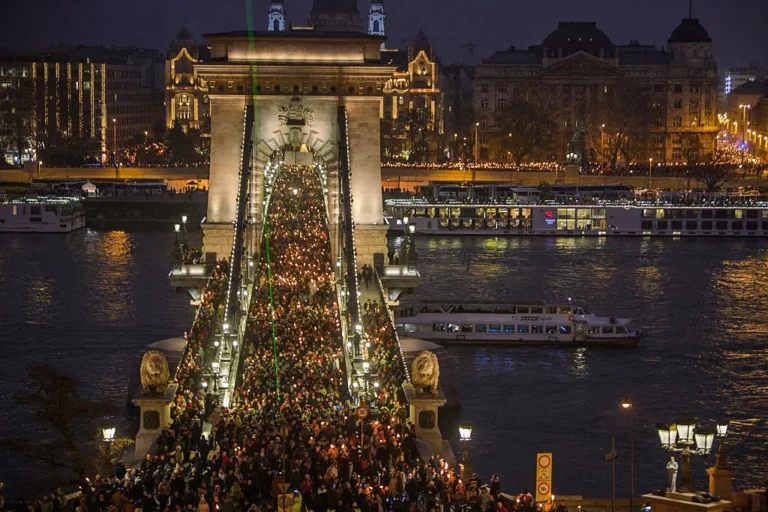
On 13 December 2025, a mass march took place in Budapest toward the office of Hungary’s prime minister on Castle Hill under the slogan “Protect the Children!”. Protesters carried torches and soft toys as symbols of solidarity with children who had become victims of abuse in a state-run institution. However, Viktor Orbán ignored the demands of Hungarian citizens and instead attempted to replace an internal crisis of trust in the authorities with external confrontation.
Hungary’s Prosecutor General’s Office reported the detention of seven individuals linked to a state juvenile care center in Budapest. Investigation files describe incidents in which staff physically abused adolescents. Prosecutors are also investigating the former director of the institution, who is suspected of sexual violence against children.
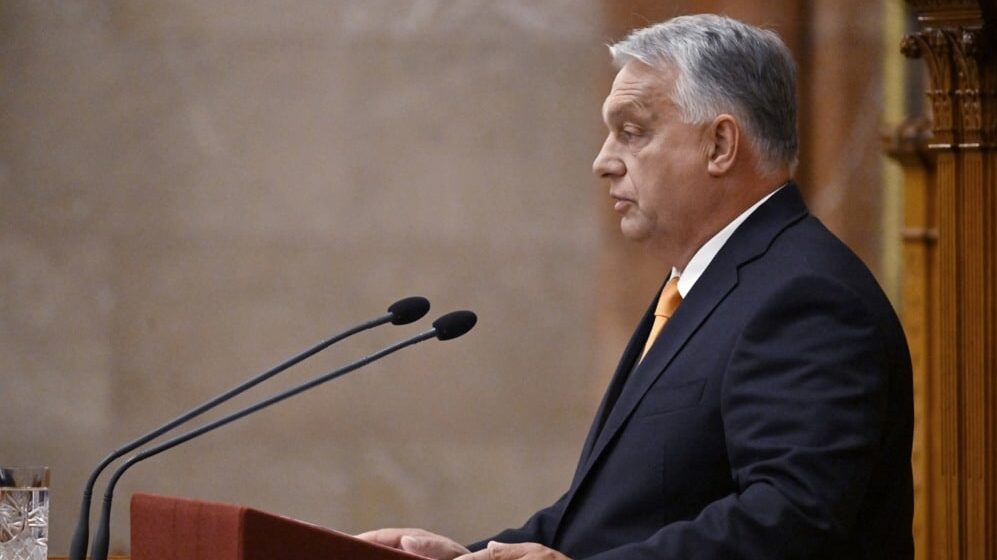
The Prime Minister’s Chief of Staff, Gergely Gulyás, admitted that previous oversight had been “insufficient” and had failed to prevent the crimes. In doing so, the authorities effectively acknowledged their own inaction—an admission politically damaging for Orbán. In response, the prime minister has sought through his public statements to shift attention toward alleged “external risks” facing the country.
In February 2024, Hungary was shaken by a scandal surrounding a presidential pardon connected to a children’s home in Bicske. It emerged that the pardon had been granted to an individual convicted of aiding in the concealment of sexual abuse of children. Public outrage was so strong that President Katalin Novák resigned. Responsibility was also borne by Justice Minister Judit Varga, whose signature was required for the pardon to take effect. The current protests in Budapest are therefore a continuation of a long-standing crisis of trust in the Hungarian authorities.
The 13 December march was led by Orbán’s main challenger in the current electoral cycle, Péter Magyar of the Tiszaparty. Magyar explicitly demanded Orbán’s resignation and directly linked the scandal to the issue of government responsibility. This is precisely why the current Hungarian leadership is determined to prevent the protests from turning into a prolonged “referendum” on the state’s responsibility for protecting children.
We assess that there is a credible threat to the safety and well-being of Péter Magyar from the prime minister and his entourage. There is also a risk that Budapest could seek assistance from Moscow in this matter, potentially involving specialists from the GRU or the FSB, agencies known for operations targeting opposition figures.
While Budapest’s streets filled with protesters over the scandal of child abuse within state institutions, Viktor Orbán’smain public focus shifted to Ukraine and Brussels. Instead of explaining why years of unchecked abuse occurred in facilities for minors, Orbán has amplified narratives about “dangerous EU decisions” and alleged “violations of law” related to frozen Russian assets and support for Ukraine.
This shift reveals the prime minister’s priorities: at the moment of intense domestic protest, he seeks to escalate confrontation with the European Union—the most mobilizing and emotionally charged issue for his electorate.
The EU agreed to freeze approximately €210 billion in Russian sovereign assets “for as long as necessary”, in order to avoid being subjected to repeated six-month sanction renewals and to bypass potential vetoes by individual member states, most notably Hungary. This significantly reduces Orbán’s ability to use Hungary’s vote on this issue as leverage within the EU.
Orbán is deliberately using the issue of Russian assets as a campaign instrument, rather than engaging in a substantive debate about his own violations of the rule of law. He frames the EU’s decision as proof that Budapest was “ignored,” drawing the conclusion that “the illusion of the rule of law in Brussels has collapsed.” The message to his electorate is clear: “we are being wronged, therefore we must mobilize.”
At the same time, Orbán warns his supporters about a supposed “third attempt by Brussels to win elections in Hungary,” an effort clearly aimed at diverting attention from domestic scandals and protests.In his statements, Orbán has also claimed that using frozen Russian assets to support Ukraine would amount to a “declaration of war,” echoing Moscow’s rhetoric, which labels such plans as “theft” and threatens a “harshest response.” In doing so, Orbán reinforces Russian narratives within Europe. Thus, at the very moment when Hungary is experiencing its largest protests, the prime minister is defending the Kremlin’s financial interests, criticizing the EU, and promoting Russia’s position.