
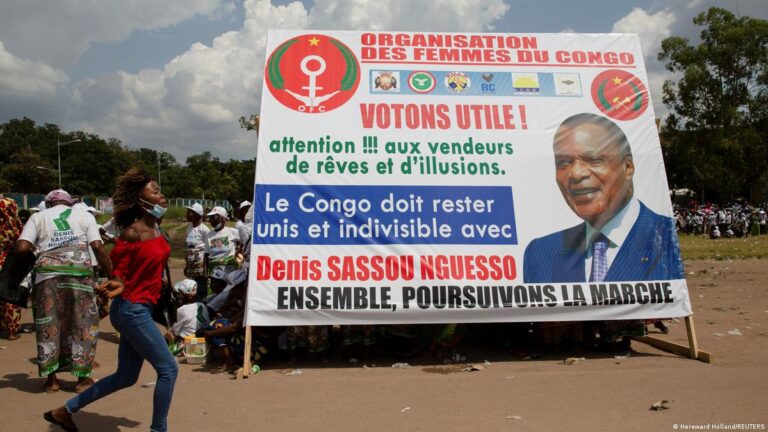
Presidential elections are scheduled in the Republic of the Congo in 2026. Incumbent president Denis Sassou Nguesso, in power continuously since 1997 (and earlier from 1979–1992), is widely expected to run again under the ruling Congolese Party of Labour (PCT)
The regime is classed by most observers as authoritarian:
- Freedom House gives the country a very low political-rights score, noting that Sassou has “maintained nearly uninterrupted power for over 40 years by severely repressing the opposition,” amid entrenched corruption and security-force abuses.
- The International IDEA “Global State of Democracy” tracker places Congo in the bottom 25% of countries on most democracy indicators.
The 2015 constitutional changes removed the presidential age limit and re-engineered term limits, allowing Sassou Nguesso to run again in 2016 and 2021. In the 2021 election, he officially won 88% of the vote in a context of repression and boycotts.
Ahead of 2026:
- The government unveiled a roadmap and electoral calendar in 2025, and the electoral commission is currently revising voter rolls and urging citizens to verify their registration.
- Opposition and civil-society actors already denounce a “criminogenic” and biased process that heavily favours the incumbent.
In short, the 2026 election is taking shape as a managed plebiscite in an authoritarian system rather than a genuine open contest.
Political field and candidates
Denis Sassou Nguesso and the ruling PCT
- Denis Sassou Nguesso (PCT) – incumbent president and de facto hegemon of Congolese politics since the 1970s. He is almost certain to be a candidate in 2026, either formally announced or “called” by his party and allied elites
- His power base relies on:
- the PCT party machine,
- control over state security forces,
- and tight control over the oil-based economy, which funds patronage networks.
There is also a dynastic dimension: Sassou’s son Denis-Christel Sassou Nguesso has been elected to the National Assembly and is widely seen as being groomed as heir, though it is unclear whether he will be pushed forward now or after one more Sassou mandate.
Opposition: fragmented but trying to unite
The traditional opposition has been weakened by years of repression, co-optation and exile. However, there are some structured efforts:
- In 2023, the Rally for Democracy and Development (RDD), Movement of Republicans (MR) and the People’s Party (PAPE) formed the Alliance for Democratic Alternation in 2026 (2AD2026) to present a common front against Sassou.
- The alliance’s exact single presidential candidate has not yet been clearly consolidated in open sources; internal bargaining and regime pressure both complicate this choice.
Another declared candidate:
- Lassy Mbouity, leader of Les Socialistes Congolais, publicly announced his intention to run but was kidnapped in May 2025 in Brazzaville – an incident widely interpreted as intimidation tied to his political ambitions.
The Pan-African Union for Social Democracy (UPADS)—historically the main southern-based opposition party—is institutionally weakened. It boycotted the 2021 presidential election and holds only a token presence in the Senate (one senator out of 72).
De facto candidates: the security apparatus and the clan
In an authoritarian system like Congo-Brazzaville, the real “candidates” are not only on the ballot:
- The Mbochi-dominated security elite and oil-sector barons around Sassou constitute an informal but decisive veto player
- Any scenario where an opposition figure wins, but these networks lose access to oil rents and impunity, entails very high coup/violence risks.
Ethnic dynamics and candidate bases
Ethnicity is not the only factor in Congolese politics, but it is structurally important and deeply intertwined with power.
Main groups
Recent estimates put the ethnic composition roughly as:
- Kongo/Bakongo: ~40–41%
- Teke: ~17%
- Mbochi: ~13%
- Sangha: ~5–6%
- Various smaller groups and indigenous (Pygmy) communities.
Historically:
- Mbochi (north) – form the core ruling elite around Sassou, particularly in the Cuvette and Plateaux regions (Oyo, Owando). They dominate the army officer corps and key economic sectors (especially oil).
- Kongo/Bakongo and Lari (south) – heavily concentrated around Brazzaville and the volatile Pool region; historically associated with opposition figures like Bernard Kolélas and with the Ninja militias.
- Teke and Kouyou – northern groups that often act as junior partners in the ruling coalition, relying on Mbochi leadership for access to patronage.
Which groups do the main actors represent?
- Denis Sassou Nguesso / PCT – embodies Mbochi rule within a broader northern coalition (Mbochi as “senior partner” with Teke and Kouyou as junior partners). His entourage and the upper reaches of the security and oil sectors are heavily Mbochi.
- Opposition alliance (2AD2026) – socially and geographically more southern and urban, drawing support from Kongo/Lari and segments of middle-class Brazzaville and Pointe-Noire. RDD historically ties back to ex-president Joachim Yhombi-Opango (Kouyou, north), giving the alliance at least nominal cross-regional credentials.
- UPADS and older opposition networks – rooted in southern groups (notably Bembe, Lari/Bakongo), though some leaders have been co-opted or neutralized.
The structural problem is that the largest group, Bakongo/Lari, remains marginalized in power, while the smaller Mbochi dominate the state, security sector and oil wealth. This is a major background driver for any post-electoral unrest.
Foreign actors and their electoral preferences
France: pragmatic continuity
France remains one of Congo’s closest economic partners:
- Historically, French oil major Elf/Total has been central to Congo’s oil sector and to the financial underpinnings of the Sassou regime.
- France remains a major trade partner and investor; French diplomacy treats Brazzaville as a familiar, if difficult, client state.
- Paris is unlikely to openly back the opposition. French interests are best served by stability and contractual continuityin oil and infrastructure. They may quietly encourage limited reforms and “managed” pluralism, but not regime change by electoral upset.
China: financial lifeline and de facto regime sponsor
China has become arguably the most important external economic actor:
- It is now the primary importer of Congolese petroleum and timber and a major creditor to the regime.
- In 2024–2025, Brazzaville and Beijing concluded major deals:
- large energy/infrastructure commitments (airport, RN1 highway, etc.);
- a US$23bn cooperation pact to double Congo’s oil output and finance gas, solar and hydro projects by 2030.
China has every incentive to see Sassou or a controlled successor remain in power:
- It needs contract stability and a predictable oligarchic partner.
- It has little interest in unpredictable democratic change that might reopen debt or contract negotiations.
Russia and Wagner/Africa Corps
Russian engagement is more opaque but real:
- Wagner and now Russia’s rebranded “Africa Corps” have operated in multiple African states, including Congo-Brazzaville, providing security, training and political warfare in support of friendly elites.
Moscow’s goals:
- maintain a friendly, sanctioned-resistant oil exporter,
- use Brazzaville as a diplomatic and possibly logistical node in Central Africa,
- protect contracts and mining/security interests via influence over the presidency and security elite.
Russia will almost certainly favour Sassou’s continuity and could discreetly support repression or counter-coup operations if needed.
EU and US: normative concern, limited leverage
- The EU frames relations in terms of diversification away from oil, governance, and human rights, but provides limited hard leverage.
- The US sees Congo as an oil-rich but peripheral security actor; recent advocacy pieces even frame Brazzaville as a hub enabling terror/criminal networks, criticising the Sassou regime’s role.
Western actors might rhetorically support cleaner elections and human-rights monitoring, but no major power is currently investing serious resources to engineer regime change. That again favours an incumbent victory.
Risks of ethnic tension, violence and coups after the elections
Ethnic tensions
Risks are rooted in:
- the structural dominance of the Mbochi minority in political, military and economic power;
- historic grievances and prior conflicts involving Kongo/Lari groups and the Pool region (Ninja insurgency, wars of the 1990s, renewed conflict 2016–17).
Potential triggers:
- Perceived massive fraud in 2026;
- Arrest of opposition leaders and activists from southern groups;
- Heavy-handed military deployments in Pool, Brazzaville’s southern arrondissements, or Pointe-Noire.
Short-term, this could lead to:
- protests turning into ethnically coded clashes,
- roadblocks and attacks on state offices,
- revival of small armed groups in Pool or other southern zones.
5.2 Coup risk
Congo is not the Sahel, but its coup risk is non-trivial:
- The military is dominated by Mbochi officers loyal to Sassou, but loyalty is also linked to rents.
- If a succession battle (e.g., over Denis-Christel Sassou Nguesso) divides the ruling clan, factions in the army could be tempted to manage succession via a “palace coup”.
External influences:
- Russia might back the existing elite against any “uncontrolled” military move, if its interests are threatened.
- France and China would likely oppose a chaotic coup, but could live with a “soft” internal reshuffle that preserves continuity.
Short-term coup scenarios are more likely to be intra-regime rather than democratic “corrective” interventions.
Scenarios of destabilisation linked to the elections
Scenario 1 – Managed Authoritarian Continuity (most likely)
Description
Sassou Nguesso wins on the first round with an implausibly high margin. The opposition cries fraud, but protests are fragmented and quickly contained.
Features
- Security forces disperse demonstrations with some arrests and limited but serious human-rights abuses.
- Opposition parties fracture between those calling for boycott, those negotiating co-optation, and those going into exile.
- Foreign actors (France, China, Russia, EU) issue ritual statements but accept the result de facto.
Risks
- Low-intensity repression and continued marginalisation of southern and urban groups.
- Structural grievances deepen, but no immediate large-scale violence.
This is essentially a continuation of the post-2016 pattern: a “stable” but brittle authoritarian system.
Scenario 2 – Post-Election Protests and Localised Ethnic Violence
Description
Evidence (or perception) of heavy fraud plus a particularly arrogant victory narrative from the regime triggers waves of protest in Brazzaville and southern regions.
Dynamics
- Protests in southern Brazzaville and Pool take on ethnic and regional overtones (north vs. south, Mbochi vs. Kongo/Lari).
- Security forces—dominated by Mbochi—respond violently, reinforcing perceptions of ethnic repression.
- Localised clashes erupt; looting and attacks against perceived regime sympathisers occur.
Risks
- The Pool region, already traumatised by previous conflicts, could see the re-emergence of armed bands or “self-defence” groups.
- Displacement, economic disruption around Brazzaville and Pointe-Noire, and heightened mistrust between communities.
Foreign reaction would likely be limited to calls for dialogue, sanctions against a few individuals, and some humanitarian funding.
Scenario 3 – Elite Succession Crisis and “Palace Coup”
Description
Either:
- Sassou’s health fails,
- or the push to promote Denis-Christel triggers splits in the clan and army.
A faction in the security apparatus intervenes, removing the president or blocking the dynastic succession in the name of “stability” or “constitutional order”.
Dynamics
- Coup leaders claim continuity and promise future elections, but in practice maintain the same power networks.
- They may seek Russian, Chinese and French tacit approval by guaranteeing contracts and security cooperation.
Risks
- Short-term uncertainty, potential clashes among rival units, and targeted arrests.
- Over the medium term, this does not resolve ethnic or governance issues—it merely reshuffles elites.
This scenario is less visible from outside but quite plausible given the regime’s age and personalization.
Scenario 4 – Hybrid Destabilisation: Terror/Criminal Hub + Electoral Crisis
Some analysts already warn that Congo-Brazzaville is evolving into a hub for illicit and terror-linked networks, with regime complicity alleged in some cases.
Combined with an electoral crisis, this could produce:
- intensified sanctions from Western actors;
- financial pressure on the regime;
- more reliance on Russia and China;
- and increased use of criminal or paramilitary actors to manage unrest.
In the worst case, the country could drift into a low-grade hybrid instability: not open civil war, but a mix of:
- politicised criminality,
- localised armed incidents,
- and heavy foreign penetration of security, oil and logistics sectors.
An election inside a controlled system
Congo-Brazzaville’s 2026 presidential election is unlikely to be a genuine contest. It is best understood as:
- a ritual of regime renewal for an ageing but adaptable authoritarian system;
- a moment of heightened risk for ethnic tensions and intra-elite competition;
- and a test of how far foreign actors (China, France, Russia, the EU) are willing to support continuity versus tolerating controlled change.
The most probable outcome is Sassou’s re-election with limited but real repression (Scenario 1), yet the underlying structural factors—Mbochi dominance, oil-based kleptocracy, and frustrated southern majorities—mean that scenarios 2 and 3 cannot be excluded.

