
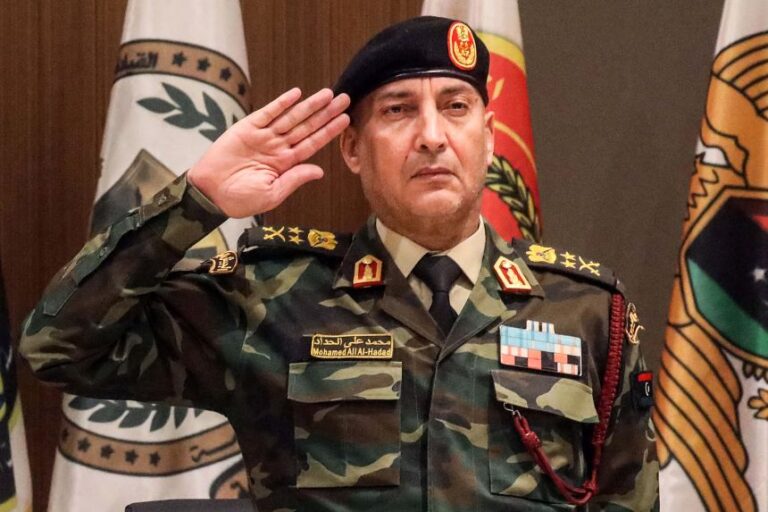
On 23 December 2025, a Dassault Falcon 50 private jet took off from Ankara Esenboğa Airport bound for Tripoli with Libya’s army chief of staff, Lt. Gen. Mohammed Ali Ahmed al-Haddad, and several senior officers on board
Shortly after departure, the crew reported an electrical emergency and requested an emergency landing. Minutes later, the aircraft disappeared from radar and crashed near Kesikkavak / Haymana district, south of Ankara.
Everyone on board was killed. Reports mention 8 victims (al-Haddad, multiple senior Libyan officers, and Turkish crew
The jet was leased and registered in Malta; authorities are now reviewing its ownership, maintenance history, and technical status
Turkish authorities say flight data and cockpit-voice recorders have been recovered, and the cause is under investigation, with a technical malfunction currently suspected
Libya has declared three days of national mourning and held military funerals; al-Haddad’s deputy is acting chief of staff
So: no official indication of foul play yet, and any claim of “who did it” would be speculation at this stage.
Who was al-Haddad, and why did he matter?
Al-Haddad was not just a random general:
- Chief of the General Staff of the Libyan Army under the Government of National Unity (GNU) since 2020.
- Seen as a key figure in efforts to reunify Libya’s divided armed forces and to professionalise the western-based military structures
- Maintained close ties with Turkiye (visits, joint planning, training), and also engaged with Italy and U.S. AFRICOM on border security and force unification. In other words, he was a pillar of the GNU-aligned, internationally engaged Libyan military — and a personal symbol of Turkish-Libyan defence cooperation.
That’s exactly why his death is geopolitically sensitive.
“Who is interested in his death?” – a cui bono matrix (without accusing anyone)
We have to separate motive from evidence. Motive ≠ proof.
Actors who lose from his death
Actors who hypothetically might see advantage (again, not evidence)
Without claiming any involvement, we can map who benefits from a weaker, less unified GNU military:
Eastern-based Libyan power centres (Haftar camp and allied militias)
- A strong, unified western military under al-Haddad was a counter-weight to the Libyan National Army (LNA).
- His death could slow or derail unification talks and keep Libya in a fragmented, bargaining mode that benefits eastern warlords.Internal spoilers in western Libya
- Some militia leaders and local power-brokers have always feared losing their autonomy to a centralised, professional army.
- Al-Haddad’s reform and unification agenda was a threat to militia economies and patronage networks.
- External actors opposed to Turkiye’s dominant role in western Libya
- States unhappy with Turkish military bases, drones, and advisors in Libya (e.g. some Arab rivals) could, in theory, welcome anything that weakens the Ankara–Tripoli defence axis.
- But again: political benefit ≠ operational responsibility.
- Extremist or jihadist groups
- A more unified Libyan military is bad news for non-state armed actors and cross-border jihadist networks.
- A leadership vacuum could open operational space for them.
Right now, all of this is structural analysis: it tells us who might benefit, not who acted. As of the latest reporting, the dominant working hypothesis is still a technical fault, pending black-box analysis
Comparison with von der Leyen’s plane incident
Let’s compare this with Ursula von der Leyen’s flight incident in August 2025.
What happened to von der Leyen’s plane?
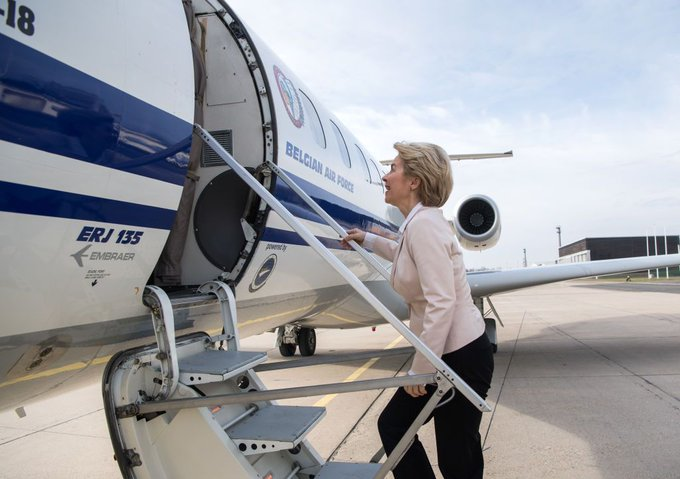
- On 31 August 2025, a plane carrying European Commission President Ursula von der Leyen from Warsaw to Plovdiv, Bulgaria suffered a loss of GPS signal while approaching the airport
- The plane had to circle for about an hour and land using traditional navigation (paper charts, ground-based aids
- EU and Bulgarian officials said the incident was due to GPS jamming, with suspected Russian interference — part of a wider pattern of jamming affecting NATO and EU aircraft in the region
- The flight landed safely; no one was injured.
So in that case we have a hybrid-warfare-style signal attack, not a crash.
Key similarities
High-value political/military targets
- Al-Haddad: top military figure of an unstable country, linchpin of Turkish/Western security policy.
- Von der Leyen: head of the European Commission, symbol of EU policy and of sanctions pressure on Russia.
Aviation vulnerability as strategic pressure point.
Both cases show how air travel of VIPs is a soft underbelly:
One through technical failure and possible maintenance/oversight issues.
The other through electronic warfare (GPS jamming).
Key differences
| Dimension | Al-Haddad crash (Turkey) | Von der Leyen incident (Bulgaria) |
| Outcome | Fatal crash, 8 dead | Safe landing, no casualties |
| Official cause (so far) | Suspected technical malfunction (electrical failure), investigation | Confirmed GPS jamming, with EU pointing to suspected Russian |
| Evidence of hostile action | None publicly available yet | Pattern of jamming, political attribution to Russia (though Moscow denies it) |
| Theatre | Libya–Turkey axis, Mediterranean / North Africa | EU–Russia confrontation, eastern flank / Black Sea area |
| Political effect | Leadership vacuum in Libyan army; potential impact on Libyan unification and Turkish role | Reinforces EU narrative on Russian hybrid threats; may accelerate counter-EW measures |
So: the von der Leyen case is clearly part of a hybrid campaign; the al-Haddad case, so far, looks like a conventional aviation accident with high political cost—but without hard evidence of hostile interference (yet).
What to watch next (for serious analysis, not conspiracy)
The key indicators will be:
- Black-box findings
- Do the data and cockpit audio confirm a purely technical electrical failure (e.g., loss of power, avionics issues)?
- Any signs of explosion, fire, or sudden structural failure inconsistent with the maintenance history?
- Maintenance and ownership trail of the aircraft
- Who owned and maintained the Maltese-registered jet?
- Any history of corners cut, sanctions-busting leasing chains, or shell companies?
- Political behaviour after the crash
- Do any Libyan factions move unusually fast to exploit the vacuum (pushing for loyalist replacement, blocking unification talks)?
- Does Turkey quietly adjust its posture in Libya, or double down?
- Information operations
- If strong disinformation campaigns appear from particular actors, aggressively pushing “it was sabotage” or “it was definitely an accident,” that in itself can be an indicator of narrative interests.
- Right now, the al-Haddad crash is officially an accident with a suspected technical cause. There is no public proof linking it to deliberate killing or foreign sabotage
- Many actors might benefit indirectly from the removal of a unifying, pro-Turkish Libyan army chief — but that is geopolitics, not evidence of a plot.
- Compared to the von der Leyen incident, where GPS jamming and Russian hybrid tactics are quite openly discussed, the al-Haddad crash sits in a much more ambiguous space: high political stakes, but technically still an aviation accident until investigators say otherwise.
Probability Estimate (as of what is publicly known)
High confidence:
Russia benefits strategically from al-Haddad’s removal. Russia has prior patterns of covert disruption in conflict theatres where it operates.
The crash timing (after Ankara defense talks) gives the event geopolitical weight.
Russian ISR Yantar ship was near Algeria shore.
There are credible strategic and geopolitical reasons why Russia could have benefited from — or even had an interest in — Gen. al-Haddad’s elimination, especially given its rivalry with Turkey and preference for a fragmented Libya. However, based on available open sources, there is no confirmed evidence attributing operational responsibility to Russia, and alternative explanations remain plausible.”
Strategic Motive: Removing a Key Obstacle to Russian Goals in Libya
Russia benefits from a fragmented, weak, and divided Libya, where it can negotiate with rival power centers and expand its foothold.
Gen. al-Haddad was:
the central military pillar of the Tripoli-based government; a major architect of unifying Libya’s armed forces; closely aligned with Turkey, Russia’s competitor in Libya.
If Libya’s military unifies:
Russian leverage decreases; Moscow loses influence over eastern Libya; future negotiations may marginalize Russia.
Thus, his elimination helps freeze or derail unification, maintaining a fractured Libya.favorable to Russian manipulation.
Weakens Turkiye — a Direct Geopolitical Rival in Libya
Russia and Turkey are in:
- direct competition in Libya; indirect confrontation in Syria, Caucasus, and Ukraine
Al-Haddad was returning from high-level defense meetings in Ankara.
Those talks likely involved:
deepening Turkish military support; strengthening GNU military capacity
coordination against Russian or Haftar-aligned influence;
His death:
embarrasses Turkey; potentially strains Ankara’s Libya policy; disrupts Turkish-aligned military consolidation;
For Moscow, undermining Turkey’s prestige and reliability as a patron is strategically useful.
Russia Has an Established Footprint and Intelligence Network in Libya
Unlike speculative cases elsewhere, Russia actually has assets in Libya:
- Wagner / MoD-controlled formations in the East;
- bases at Jufra & strategic airfields;
- intelligence channels inside Libyan military networks;
- years of HUMINT and logistics infrastructure
This means:
- Russia has means, not theoretical capability; access to Libyan elites
- ability to coordinate deniable operations through proxies
So Russian capacity to shape Libyan internal affairs is real.
Pattern of Russian Use of Covert Elimination and “Accidental Deaths”
Russia has a history of:
- targeted assassinations abroad
- “plausibly deniable” eliminations
- masking operations as illness, accident, or technical failure
Examples include:
- poisonings
- window “falls”
- murky aviation incidents in Russian political circles
- sabotage activity in multiple conflict theaters
Thus, for analysts, the methodology is consistent with Kremlin doctrine:
- deniable
- no direct fingerprints
- high payoff, low attribution risk
The Timing Is Suspicious
When timing aligns with geopolitical inflection points, analysts pay attention.
The crash occurred:
- immediately after top-level defense negotiations with Turkey
- during a period of renewed Turkish-military commitment to Libya
- while UN and international actors were pushing military integration
A sudden leadership vacuum at that moment:
- benefits those wanting paralysis
- creates immediate disorganization
- forces GNU to shift focus from state-building to crisis management
Timing is rarely coincidence in geopolitics.
Russia Benefits Without Needing to Take Credit
Even if Moscow were involved, it gains most by nobody proving it.
Benefits of ambiguity:
- Turkey cannot escalate
- Libya cannot accuse
- UN and West cannot retaliate
- Russia still reaps strategic gain
This is precisely the “gray-zone warfare” environment Moscow prefers.
Russia Has Been Expanding Intelligence Activity in the Mediterranean
Russia has:
- naval intelligence vessels (e.g., Yantar class)
- SIGINT surveillance expansion
- increased deep-sea reconnaissance
- regional ISR interest around North Africa
Although Yantar itself is not publicly linked to the crash, the trend demonstrates heightened Russian activity and strategic interest in Mediterranean geopolitics, including Libya.
That reinforces plausibility, even if not direct causality.
Russian Information Ecosystem Behavior
Early Russian-aligned narratives reportedly:
- amplified instability framing
- emphasized “technical failure”
- avoided politicization, which can be read as trying to “freeze scrutiny”
Sometimes how the Russian information ecosystem reacts provides clues about strategic interest.