

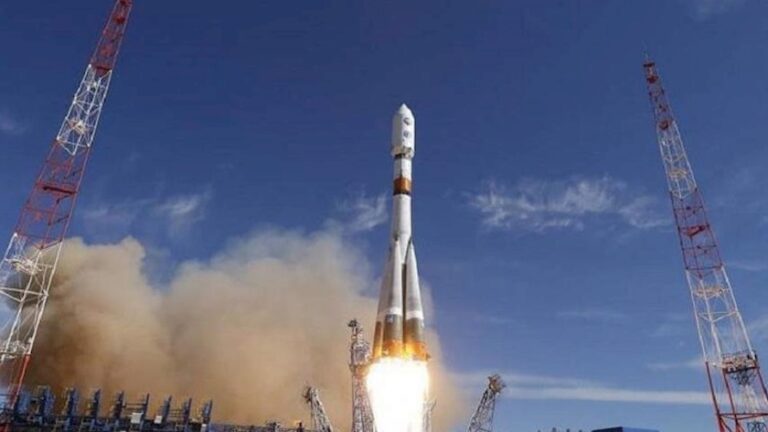
Iran has launched three domestically produced observation satellites into space, using a Russian cosmodrome for the mission.
According to official reports from Iran’s state television, this launch marks another significant milestone in Tehran’s space program, which continues to expand actively despite strict Western sanctions.
From Russia’s Vostochny Cosmodrome, a Soyuz launch vehicle successfully placed into orbit satellites named Zafar-2, Paya, and Kowsar-1.5.
The Iranian side officially states that its aerospace industry operates exclusively for peaceful purposes and strictly adheres to all United Nations Security Council resolutions adopted in connection with Iran’s nuclear program. According to the official IRNA news agency, these satellites are intended for observation purposes and were fully developed by specialists from Iran’s private sector.
The most technologically advanced of the launched satellites is considered to be Paya—a cutting-edge imaging device that uses artificial intelligence technologies to significantly enhance image resolution and quality. It is reported that the satellite’s capabilities will be used for civilian tasks such as environmental monitoring, water resource management, and territorial mapping. The Fars news agency emphasized that the choice of Russia’s Soyuz rocket was due to its reputation as one of the most reliable systems in the world for placing critically important satellites into orbit.
Over the past two years, Iran has conducted ten space launches, one of which also took place in July from the same Russian launch site. However, Western countries express serious concern over these developments. The main reason for alarm is that satellite launch systems rely on technologies that are almost identical and interchangeable with those used in the production of ballistic missiles.
Western governments fear that such rockets could eventually be used to deliver nuclear warheads, making the development of Tehran’s space program a potential threat to international security.
Russia is simultaneously deepening its cooperation with Iran in the field of nuclear technologies, which has caused serious concern in the United States and the United Kingdom. In recent months, the Kremlin has strengthened its engagement with Tehran, helping it advance its nuclear ambitions.
This launch goes far beyond a technological or scientific milestone. It reflects a deeper strategic convergence between Moscow and Tehran, demonstrating how both countries are leveraging cooperation in space, defense, and nuclear-related technologies to counter Western pressure and sanctions regimes. For Russia, enabling Iran’s space ambitions serves several objectives: it strengthens a key geopolitical partner in the Middle East, reinforces Russia’s narrative of technological resilience despite isolation, and creates a mutually beneficial technological exchange in areas where both states circumvent Western export controls.
From Iran’s perspective, the successful deployment of three observation satellites significantly advances its long-term strategic autonomy. Beyond civilian applications publicly emphasized by Tehran, such satellites may enhance Iran’s surveillance, reconnaissance, and targeting capabilities—supporting military planning, maritime situational awareness in the Persian Gulf, monitoring of regional rivals, and battlefield intelligence gathering in conflict zones involving Iran’s proxies. By integrating artificial intelligence technologies such as those reportedly embedded in the Paya satellite, Iran moves closer to developing sophisticated dual-use ISR (intelligence, surveillance, reconnaissance) infrastructure typically associated with advanced military powers.
Western concern is rooted not only in the satellites themselves but in the technological ecosystem surrounding them. Space launch vehicles and ballistic missile platforms share nearly identical propulsion, staging, and guidance technologies. Each successful Iranian satellite launch therefore represents incremental progress in Iran’s ability to produce more reliable long-range missile systems. In parallel, reports of Russia assisting Iran with nuclear-related technologies deepen fears that Tehran is systematically accumulating capabilities necessary for a potential weapons breakout scenario, even while continuing to claim compliance with UN frameworks.
Strategically, this cooperation strengthens an emerging anti-Western technological axis that increasingly includes China and North Korea. Iran’s growing competence in indigenous space manufacturing indicates the maturation of its industrial base, including electronics, materials science, communications engineering, and precision mechanics. These capabilities can feed directly into Iran’s military-industrial complex, enhancing the lethality and sophistication of its drone, missile, and air defense programs, many of which have already demonstrated battlefield effectiveness in Ukraine, the Middle East, and beyond.
Politically, the launch underscores the erosion of Western leverage. Sanctions intended to constrain Iran’s technological development instead appear to have pushed Tehran closer to Moscow, giving both actors shared incentives to defy Western regulatory frameworks. The move also serves a symbolic purpose: demonstrating to internal audiences within Iran that the regime continues to achieve major scientific and strategic milestones despite external isolation, thereby reinforcing domestic legitimacy.
Finally, the launch highlights a broader security dilemma: as Iran modernizes its space, missile, and nuclear-related capabilities with Russian support, regional actors such as Israel, Saudi Arabia, and the Gulf states are likely to intensify their own military modernization and intelligence efforts. This dynamic risks accelerating arms competition in an already volatile region and further complicating any future diplomatic efforts aimed at limiting Iran’s strategic capabilities.
Military Consequences
The deployment of Iranian observation satellites marks a critical leap in Tehran’s military intelligence ecosystem. Even if publicly framed as civilian, such platforms naturally strengthen Iran’s ISR (intelligence, surveillance, reconnaissance) capacity. Access to satellite imagery provides strategic advantages including:
- Enhanced targeting precision for Iran’s long-range strike systems, cruise missiles, and UAVs.
- Real-time monitoring of U.S. and allied military assets in the Persian Gulf, Iraq, Syria, and the Eastern Mediterranean.
- Improved battlefield command and control, benefitting Iran’s network of proxies such as Hezbollah, militias in Iraq and Syria, and potentially the Houthis in Yemen.
- Greater maritime domain awareness, including oil tanker routes, naval deployments, chokepoint traffic (Strait of Hormuz, Bab el-Mandeb), and critical infrastructure surveillance.
Iran’s move toward AI-enabled satellite capability is particularly consequential. AI integration accelerates automated image analysis, enabling rapid threat detection, target verification, and predictive military planning — something previously limited to advanced military powers. This capability shortens Iran’s decision-making cycle, providing it with a qualitative edge in hybrid and asymmetric warfare.
Furthermore, these launches amount to iterative testing under civilian cover of Iran’s long-range missile foundation. Each success improves reliability of multi-stage rocket engines, guidance systems, re-entry control, and payload stabilization — technologies that are directly transferable to intercontinental ballistic missile development. From a military perspective, this means Iran is progressively positioning itself closer to credible strategic deterrence capabilitywithout formally crossing the nuclear threshold.
Legal and Arms Control Implications
Legally, Iran frames its program as peaceful and within its sovereign rights under the UN Charter and international space law. However, the launches inhabit a legal grey zone with several implications:
UN Security Council Resolution 2231 Concerns
Although UNSCR 2231 does not explicitly prohibit satellite launches, it calls upon Iran not to engage in ballistic missile activities capable of delivering nuclear weapons. Since satellite launch vehicles are functionally similar to ICBMs, Western governments argue that these launches undermine the spirit — if not the strict letter — of the resolution.
Dual-Use Technology Issue
International law does not prohibit civilian space activities, but dual-use technology complicates enforcement. Iran exploits this ambiguity deliberately, enabling strategic capability development while maintaining plausible deniability.
Arms Control Regime Erosion
Iran’s progress, enabled by Russian launch platforms and technical cooperation, highlights the weakening of global non-proliferation instruments such as MTCR (Missile Technology Control Regime). Russia’s involvement further undermines existing norms, signaling that great powers are willing to bypass restrictions for geopolitical advantage.
Potential for Legal Escalation
The U.S., UK, and EU may respond with renewed sanctions targeting:
Iranian aerospace agencies; Private sector companies behind satellite development
Russian entities facilitating launches; associated banks and logistics networks.
This risks institutionalizing sanctions warfare as the only remaining regulatory instrument, further diminishing diplomatic leverage.
Geopolitical Consequences
The launch strengthens the emerging Russia–Iran strategic bloc, accelerating transformation of the global balance of power.
For Russia
Moscow gains:
A dependable strategic partner amidst isolation. Access to Iranian wartime technologies such as drones. Another mechanism to challenge Western technological dominance. Additional leverage in the Middle East and the Global South as a “technology provider.”
Russia’s willingness to help Iran expand its aerospace and possibly nuclear competencies demonstrates a calculated strategy to weaponize technology partnerships to weaken Western influence.
For Iran
Tehran gains:
- Greater strategic independence from Western-controlled technological markets.
- Enhanced deterrence posture toward Israel, Saudi Arabia, and NATO forces.
- Increased prestige domestically and across the Islamic world.
Iran also strengthens its bargaining position in any potential future nuclear negotiations. With advanced ISR, missile, and nuclear-adjacent capabilities, Tehran can negotiate from a position of strength — or simply stall engagement entirely.
Regional Security Impact
The launch accelerates a regional security dilemma spiral:
- Israel may intensify intelligence operations, sabotage programs, or preemptive cyber and kinetic strikes.
Gulf States, especially Saudi Arabia and UAE, will expand space surveillance, missile defense acquisitions, and partnerships with Western and Asian security providers. Turkey will deepen its own space and UAV military integration, unwilling to lag behind a regional rival. China quietly benefits, using Iran–Russia cooperation as a test case for sanctions-resistant military-industrial collaboration.
Global Strategic Order
This development reflects a broader structural shift:
Western sanctions are no longer deterrents — they are catalysts for counter-Western technological ecosystems.
Multipolar competition increasingly extends into space militarization.
International institutions are losing the ability to constrain determined revisionist powers.
Iran’s satellite launch from a Russian cosmodrome is not merely a scientific achievement — it is a strategic escalationwith long-term military, legal, and geopolitical consequences. It strengthens Iran’s capacity for intelligence warfare, undermines global non-proliferation norms, and contributes to an emerging axis of authoritarian technological cooperation. Combined with Russia’s support for Iran’s nuclear and military development, this trend risks intensifying regional arms competition, destabilizing the Middle East, and weakening Western strategic leverage globally.
Israel’s Reaction Scenarios
For Israel, the Iranian–Russian space cooperation directly feeds into its core threat perception: a technologically advancing Iran moving step by step toward strategic parity in intelligence, missiles, and potentially nuclear weapons. Jerusalem will likely consider a mix of covert, military, diplomatic, and technological responses. Several plausible scenarios:
- Intensified “Shadow War” Against Iran’s Strategic Programs
The most likely near-term path is an expansion of the ongoing covert campaign Israel already conducts against Iran’s nuclear and missile infrastructure:
- Cyber operations targeting satellite control centres, ground stations, and Iranian aerospace firms. Sabotage and deniable operations against logistics chains, key engineers, and production facilities involved in satellite and launch vehicle development. Kinetic strikes beyond Iran’s borders (Syria, Iraq) against tracking stations, communication relays, or dual-use infrastructure supporting Iranian proxies, under the banner of countering “imminent threats.”
In this scenario, Israel avoids a direct frontal attack on Russian assets but seeks to slow and raise the cost of Iran’s space–missile progression.
B. Preemptive Strike Contingency Against High-Value Targets in Iran
If Israeli intelligence judges that space-based ISR and missile technologies are converging toward a breakout capability(e.g., a combination of accurate long-range missiles and credible nuclear weapons development), Israeli decision-makers could revisit the “Begin doctrine” (preemptive strikes against existential threats):
Target sets could include launch facilities, satellite integration centres, and advanced R&D hubs rather than just nuclear sites. Any strike would be calibrated to avoid Russian casualties, but operationally this would be complex if Russian specialists are co-located with Iranian teams.
This is a higher-risk, less likely scenario in the short term, but the launch from a Russian cosmodrome moves the threat in that direction by hardening and diversifying Iran’s strategic capabilities.
C. Strategic Build-Up and Alliance Deepening
In parallel, Israel will accelerate defensive and diplomatic measures:
Missile and air defense upgrades: continued development of Arrow-4 and related exo-atmospheric interceptors designed to counter future long-range Iranian missiles.
Space and cyber capabilities: investment in its own small satellite constellation and advanced ISR to preserve qualitative superiority.
Regional security architecture: quiet but deepening cooperation with Saudi Arabia, UAE, and Bahrain on shared early-warning, missile defense integration, and intelligence sharing about Iranian launches and satellite use.
In this scenario, Israel’s response is less about a dramatic one-time strike and more about locking in long-term strategic overmatch.
Gulf States’ Countermeasures
For Saudi Arabia, the UAE, and other Gulf monarchies, Iranian progress in space and missile domains—backed by Russia—confirms a trend they already fear: a more sophisticated, harder-to-deter Iran. Their likely reactions span several tracks.
Accelerated Procurement of Missile and Air Defenses
Gulf states will seek to thicken their air and missile shield:
Additional THAAD, Patriot, and European systems (SAMP/T, etc.) to protect critical infrastructure (oil fields, desalination plants, command centres).
More advanced early-warning radars and integration with U.S., UK, and possibly Israeli surveillance networks.
Interest in space-based or near-space surveillance via partnerships with Western or Asian providers (France, South Korea, Japan).
The Iranian AI-enabled satellites will be interpreted as a step toward higher-precision strikes on Gulf targets, justifying further spending.
Discreet Security Cooperation with Israel
The shared perception of Iran as a systemic threat creates a powerful incentive for quiet trilateral cooperation: Gulf states + Israel + U.S.
Intelligence sharing on Iranian launch activities and satellite tasking patterns.
Joint cyber defense and potentially offensive cyber co-operations targeting Iranian C4ISR.
Gradual interoperability in air and missile defense (shared tracking, deconfliction of airspace, common operating pictures).
Formal public alliances may move slowly due to domestic sensitivities, but functionally, the security web will thicken.
Nuclear and Technological Hedging
Iranian advances, supported by Russia, will strengthen voices in the Gulf arguing:
For civil nuclear programs with latent breakout potential (fuel cycle capabilities, heavy investment in nuclear research and expertise).
For closer ties with China, South Korea, or France as alternative high-tech partners, diversifying away from sole reliance on the U.S. while still seeking Western security guarantees.
In the worst-case trajectory, this could push the region toward a multi-state nuclear latency competition, where several actors retain the technical option to weaponize if Iran crosses the line.
U.S. and NATO Policy Options
The Iran–Russia space launch cooperation presents a challenge that sits at the intersection of non-proliferation, great-power rivalry, and regional security. Washington and key NATO capitals have a menu of imperfect options.
Targeted Sanctions and Export Control Warfare
The most immediate, politically feasible tool is tightened sanctions and export controls:
Sanction Iranian private-sector firms involved in satellite design, electronics, AI, and launch services. Target Russian aerospace entities and spaceport operators facilitating Iranian launches. Apply secondary sanctions to non-Western suppliers (in China, Central Asia, or the Caucasus) that provide dual-use components.
Pros: relatively low cost, politically straightforward in the U.S. and Europe.
Cons: Iran and Russia have already adapted significantly to sanctions; this risks pushing them further into a sanctions-resistant technological ecosystem.
Strengthening Regional Deterrence and Missile Defense
The U.S. and NATO can compensate for Iranian advances by hardening regional allies:
- Expand integrated air and missile defense architecture linking Israel, Gulf states, and U.S. regional assets.
- Increase naval presence and ISR coverage in the Mediterranean, Red Sea, and Persian Gulf to counter Iranian long-range strike potential.
- Provide space situational awareness (SSA) data to regional partners to help them track Iranian satellites and analyze their tasking patterns.
This option aims to convince Iran that its growing capabilities do not translate into usable coercive leverage.
Cyber and Information Operations
Given the dual-use nature of space technologies, covert cyber operations are an attractive tool:
- Disrupt Iranian satellite command links, imagery processing chains, or AI analytics platforms.
- Conduct information operations exposing the military dimension of Iran’s “civilian” space program to delegitimize Tehran’s narrative and galvanize international support for countermeasures.
This approach is escalatory but often deniable, fitting the current “grey zone” toolkit used by NATO and its partners.
Diplomatic Reframing and a Broader Negotiating Package
If Western capitals choose to re-engage diplomatically, they may need to move beyond the narrow nuclear focus of past agreements:
A future framework would likely have to cover missile ranges, space launch activities, and military applications of satellite technology, not just enrichment levels and centrifuges.
Any agreement could involve incentives around civilian nuclear and space cooperation in exchange for verifiable constraints, intrusive inspections, and clear limits on missile ranges and payloads.
Politically, this is difficult: Iran feels stronger, the U.S. is polarized, and Europe is distracted by Russia and China. But without such a broader deal, the technical trajectory is clearly unfavorable to Western security interests.
Managing the Russia Dimension
For NATO, the Iran–Russia link is not a separate issue—it is part of a single extended confrontation with Moscow:Expose and publicize Russian support to Iran’s strategic programs in international fora to increase diplomatic cost for Moscow. Consider linking sanctions relief or adjustments related to Ukraine to Russian behavior not only in Europe but also in the Middle East, including its cooperation with Iran. Reinforce NATO’s own space posture, treating Iranian–Russian space cooperation as another argument for investing in resilient satellite constellations, SSA, and space defense.
More on this story: Russia and Iran: The Limits of Strategic Partnership in the Face of Conflict

More on this story: Iran uses Russian war on Ukraine to modernize, develop own UAV program