
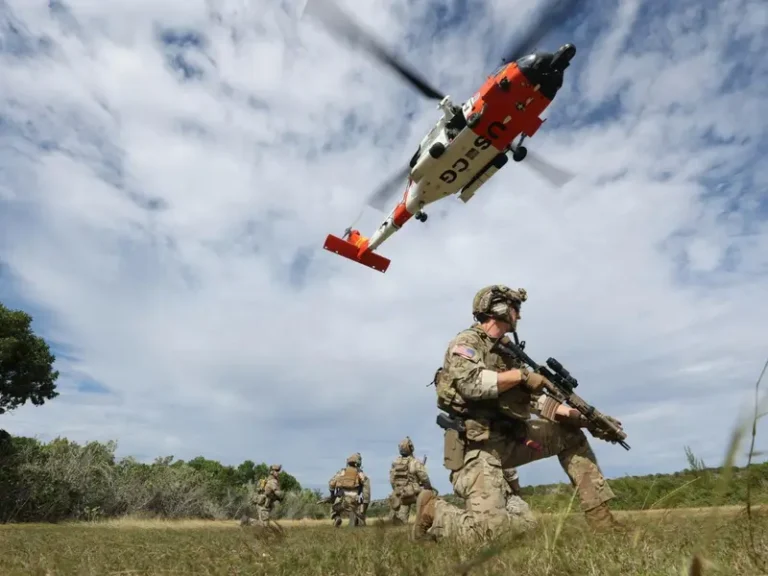
In the early hours of 3 January 2026, the United States launched Operation Southern Spear, a large-scale strike against Venezuela that targeted key military facilities around Caracas and other locations in northern Venezuela. According to U.S. President Donald Trump, the operation culminated in the capture of President Nicolás Maduro and his wife Cilia Flores, who were reportedly flown out of the country to face long-standing narco-terrorism charges in the United States.
The attack marks the most dramatic escalation in U.S.–Venezuela confrontation since the start of Trump’s second term, transforming a pressure campaign framed as a “war on narco-terrorism” into an overt, regime-decapitating strike.
Strategic Background and Reasons for the Operation
From “narco-terrorist” indictment to kinetic campaign
Maduro has been under U.S. indictment on narco-terrorism and related charges since 2020, accused of running a drug trafficking network tied to Colombian insurgents and funneling cocaine to the United States.
Beginning in late summer 2025, Trump’s administration shifted from sanctions and covert pressure to open military action:
- U.S. Southern Command began kinetic strikes on suspected drug-smuggling vessels in the Caribbean and eastern Pacific, killing over 100 alleged traffickers.
- A naval buildup followed: deployment of warships, including the USS Gerald R. Ford, and thousands of troops to the region, combined with a de facto naval quarantine of Venezuelan oil exports.
- In late 2025, Trump authorized CIA covert operations on Venezuelan territory, including at least one drone strike on a dock allegedly used by cartels.
Operation Southern Spear is thus the logical culmination of a campaign whose stated objectives have been:
- Disrupting drug trafficking networks (“kinetic strikes” on “narcoterrorists” heading to the U.S.).
- Removing what Washington labels a narco-dictatorship that collaborates with criminal and terrorist groups.
- Signaling U.S. willingness to conduct unilateral regime-change operations in the Western Hemisphere if framed as counter-narco-terrorism.
Behind that public narrative lie classic strategic motives: control over a major oil producer, rollback of an anti-American, Russia- and Iran-friendly regime, and a demonstration of U.S. power projection capacity in its traditional sphere of influence.
Night of January 3, 2026
- U.S. precision strikes neutralize Venezuelan air defenses in targeted zones without initiating nationwide bombardment.
- Communications interference disrupts regime command networks.
- Delta Force and elite special operations teams conduct rapid ground penetration operation near Caracas.
- Nicolás Maduro and Cilia Flores are reportedly seized and extracted.
Immediate Result
- Venezuelan state media collapses into confusion.
- Vice President Delcy Rodríguez declares “U.S. imperial aggression,” asserts constitutional authority.
- Washington announces success; Trump claims Maduro is in U.S. custody.
Phase VI – Post-Strike Political Shockwave
January 4–7, 2026
- Power struggle begins in Caracas:
- Opposition leaders push for interim transition.
- Some Chavista factions harden stance.
- Military leadership scrambles to determine alignment.
- Regional governments split between approval, caution, condemnation.
- Russia, Cuba, Iran express outrage but avoid direct escalation.
- Risk of violence spikes in urban centers.
Phase VII – Transition or Turmoil? (Current Outlook)
Short-Term Dynamics Now in Motion
- Contest between:
- Constitutional Succession Narrative (Rodríguez)
- Opposition-Driven Transition Narrative (Machado)
- Military Guardian Model
- Risk factors:
- Chavista paramilitary resistance
- criminal-insurgent hybrid actors
- possible foreign asymmetric support to anti-U.S. forces
- U.S. goal: rapid political settlement without prolonged occupation.
Key Strategic Takeaways from the Timeline
- The operation was not impulsive; it followed a deliberate escalation ladder.
- Rubio’s role was central in:
- narrative construction
- reducing perceived escalation risk
- aligning domestic and regional support.
- Trump approved the moment intelligence, regional conditions, and political timing aligned.
- Whether the operation ends in controlled transition or long insurgency depends on the next 2–6 weeks.
Why the Operation Started Now
Several converging factors help explain the timing.
Operational and intelligence window
Open sources suggest a stepwise escalation since August 2025: buildup, maritime strikes, CIA covert actions, and then airstrikes and special forces on Venezuelan soil.
A decapitation raid of this kind requires:
High-confidence intelligence on Maduro’s location and movements;
Established air and maritime dominance around Venezuela;
It is likely that a narrow intelligence window—Maduro being at a predictable site, probably a protected command facility—was a decisive trigger.
The political clock in Washington
Domestic politics also matters:
- The U.S. has carried out dozens of strikes against suspected traffickers since September, but without a decisive “victory image.”
- Public support for a full-scale war in Venezuela appears low; one report notes that around 70% of Americans oppose military action there.
By launching a short, high-impact, special-forces-driven operation rather than a conventional invasion, Trump aims to:
- Deliver a spectacular, televisable success (“we captured Maduro”) without large U.S. casualties;
- Reframe the Venezuela issue as law-enforcement plus counter-terrorism, not “another Iraq”;
- Claim that a central campaign promise—crushing “narco-terrorists” and confronting socialism in the hemisphere—has been fulfilled.
The international environment
Secretary of State Marco Rubio had publicly downplayed the risk of escalation with Russia over Venezuela just weeks earlier, signaling Washington’s assessment that Moscow would limit itself to diplomatic condemnation.
At the same time:
- Argentina’s President Javier Milei and some regional right-wing governments strongly favor Maduro’s removal.
- The Biden-era consensus against unilateral “regime change wars” has eroded under Trump’s second term, especially when actions are framed as anti-cartel operations rather than democratization crusades.
In short, Washington judged that costs were manageable, the window was open, and the political payoff of acting decisively outweighed the risks of waiting.
The Role of Marco Rubio
Marco Rubio is not just Trump’s Secretary of State; he has spent over a decade as one of Washington’s most vocal hawks on Venezuela.
Architect of the “narco-terror” framing
In late 2025, Rubio repeatedly described Venezuela’s status quo as “intolerable,” stressing that the Maduro regime is intertwined with transnational criminal and terrorist organizations using Venezuela as a hub.
Key elements of his role:
- Narrative building: branding Maduro’s government as a narco-terrorist entity rather than a standard dictatorship, which lowers political barriers to kinetic action.
- Linkage to U.S. domestic security: arguing that cartels tied to Venezuela constitute the “single most serious threat” from the Western Hemisphere to U.S. national security.
- Regional diplomacy: courting like-minded leaders (e.g., Milei, conservative governments in the region) to pre-bake a bloc that would welcome regime change.
Rubio also campaigned actively in 2025 for María Corina Machado to be awarded the Nobel Peace Prize and promoted her as the democratic face of post-Maduro Venezuela, simultaneously elevating a friendly opposition figure and marginalizing more moderate or anti-interventionist voices.
Managing escalation narratives and legal cover
Rubio’s messaging ahead of the strike served several functions:
- Reassurance to U.S. elites: asserting that escalation with Russia or Cuba was unlikely, to reduce resistance within the Pentagon and Congress.
- Legal signaling: emphasizing Maduro’s indictment and “narco-terrorism” label to blur lines between foreign policy and law-enforcement, making an extra-territorial capture operation seem analogous to seizing a cartel boss.
- Elite briefings: early reporting suggests Rubio personally briefed U.S. lawmakers (e.g., Sen. Mike Lee) that Maduro would be brought to the U.S. for trial, suggesting he was deeply involved in planning and selling the operation.
In analytic terms, Rubio functions as chief strategist and narrative entrepreneur of Operation Southern Spear, with Trump providing the political will and signature.
Why Trump Signed Off Now
Beyond operational feasibility and Rubio’s lobbying, several factors likely shaped Trump’s decision to authorize the final strike at this moment:
- Legacy and optics: Capturing a long-vilified socialist strongman and alleged narco-terrorist echoes the capture of Saddam Hussein and the killing of Osama bin Laden—high-symbolism operations that define presidencies. Wikipedia already explicitly links the operation to that precedent set.
- Consistency with his second-term brand: Trump has centered his foreign policy on aggressive action against cartels, Iran, and “rogue regimes,” while ridiculing “endless wars.” A short, high-impact raid fits that narrative.
- Alignment with key allies: Trump enjoys strong backing from parts of the Venezuelan diaspora and from figures like María Corina Machado, who has publicly praised him and framed his Venezuela policy as “visionary.”
- Domestic distraction and agenda control: A dramatic foreign operation can temporarily push other domestic controversies off the front pages and rally parts of his base around themes of strength, anti-socialism, and law-and-order.
We can’t know his private motivations, but viewed structurally, the strike is a low-cost, high-symbolism move that serves both Trump’s personal legacy and his broader ideological project.
Possible Fate of Nicolás Maduro
At the time of writing, Maduro’s precise whereabouts and condition remain unclear; only Trump and senior U.S. officials claim he has been captured and flown out of Venezuela, while Caracas demands “proof of life.”
Realistic scenarios include:
Public trial in the United States (most likely politically):
- Maduro is presented before a U.S. federal court on the existing narco-terrorism indictment plus additional charges.
- Trump and Rubio showcase the trial as a rule-of-law victory.
- High risk that Maduro uses the platform to portray himself as a victim of imperial aggression, potentially galvanizing Chavista hardliners and sympathetic governments.
- Negotiated outcome / plea and quiet detention:
- Behind-the-scenes bargaining leads to a plea deal or sealed proceedings, perhaps in exchange for intelligence on networks linking Venezuela, cartels, and foreign partners.
- Politically less explosive, but weaker as a public demonstration.
- Extradition or transfer to a third state or international court (less likely):
- Symbolically attractive to some allies, but Trump has historically been skeptical of international courts and may prefer a U.S. venue.
In all scenarios, Maduro risks becoming a martyr figure for segments of the Latin American left, potentially inspiring violent or non-violent resistance movements even if his personal power is ended.
Who Could Be the Next President of Venezuela?
The immediate question is not just who becomes president, but which legitimacy track prevails: constitutional succession, opposition-driven transition, or military control.
Constitutional line: Delcy Rodríguez
Under Venezuela’s current constitutional logic, Vice President Delcy Rodríguez should assume interim authority. She has already appeared on state media demanding proof of life for Maduro and denouncing U.S. “imperialist aggression.”
However:
- She is deeply associated with the Maduro inner circle and U.S. sanctions.
- Washington and much of the opposition consider her part of the same criminal structure.
Her claim to power is therefore legally coherent but politically toxic in the eyes of Washington and the opposition.
The opposition: María Corina Machado and allies
María Corina Machado is the most prominent opposition figure with both domestic legitimacy and massive international recognition, including the 2025 Nobel Peace Prize and other human-rights awards.
Pros:
- She symbolizes a clean break with Chavismo and has a detailed “Freedom Manifesto” for a post-Maduro democratic transition.
- She has close ties to Washington and explicitly supports Trump’s hard line, which makes coordination easier.
Constraints:
- The regime previously banned her from running and tried to arrest her; any perception that she “rides in on U.S. tanks” could damage her legitimacy among Venezuelans wary of foreign intervention.
- Some opposition factions and regional governments may see her as too ideologically rigid and too close to Washington and the market-liberal right.
A plausible short-term arrangement: a transitional authority or unity government where Machado is the central civilian figure, possibly with a more moderate technocrat (e.g., Edmundo González-Urrutia or another respected politician) in a formal presidential role to soften the optics.
The armed forces and a “guarded transition”
Given that U.S. ground presence is, so far, limited, the Venezuelan armed forces remain the key arbiter. The spectrum of outcomes includes:
- A pro-U.S. military council promising quick elections and aligning with the opposition;
- A Chavista hardline faction attempting to hold power without Maduro, preserving the regime minus its figurehead;
- A split military, with units aligning with different political poles and local power centers.
For Washington, the optimal (but not guaranteed) scenario is a military-backed transitional government that quickly hands off to a civilian opposition-led administration.
Internal Support for Maduro and Risk of Insurgency
Residual Chavista support
Despite economic collapse and mass emigration, Chavismo has maintained:
- A core base among public-sector employees, parts of the urban poor, and sectors tied to state patronage;
- Armed colectivos and paramilitary groups in certain neighborhoods;
- Elements of the intelligence services and specialized military units loyal to the Bolivarian project rather than to Maduro personally.
Even if Maduro is gone, this ecosystem is unlikely to vanish overnight. The question is how they reinterpret their struggle:
- As a fight to restore Maduro; or
- As a more diffuse resistance against a U.S.-imposed order and a liberal-market opposition.
Conditions for insurgency against the U.S. and a new government
Several factors will shape the likelihood of an insurgency:
Perceived occupation vs. limited intervention
- If the U.S. restricts itself to air and special operations, then leaves Venezuelans to manage the transition, insurgency will likely manifest as urban unrest, terrorism, or targeted attacks on perceived collaborators, rather than a classic guerrilla war against U.S. forces.
- A large, prolonged U.S. troop presence would be a strong catalyst for a broader armed resistance.
Short-term assessment:
In the next 6–12 months, the most probable pattern is episodic violence: bombings, armed clashes in pro-Chavista strongholds, targeted assassinations, and cartel-linked violence exploiting the chaos.
A sustained, nationwide insurgency on the Iraqi model becomes more likely if:
- The transitional authorities purge broad segments of the security forces and public sector;
- The U.S. retains visible, large-scale military presence on Venezuelan soil;
- Socio-economic conditions fail to improve quickly and visibly.
Operation Southern Spear is not an isolated event but the peak of a year-long U.S. escalation that fused a “war on narco-terrorism” with classic regime-change objectives. Trump’s decision to strike now reflects a convergence of operational opportunity, domestic political calculus, and the strategic vision of Secretary of State Marco Rubio, who has spent years crafting the narrative that made such an operation politically possible.
Maduro’s likely transfer to the U.S. for trial will close one chapter but open several others: the struggle over succession, the legitimacy of any post-Maduro order, and the risk that a mix of Chavista loyalists, criminal networks, and foreign sponsors will fuel a prolonged phase of instability or insurgent violence.
The key variables to watch in the coming days and weeks are:
Whether Delcy Rodríguez can impose a constitutional succession narrative;
How quickly and coherently the opposition, especially María Corina Machado, can articulate a unified transition plan;
The stance of the military high command;
The scale of U.S. military and political footprint on Venezuelan soil.
Those will determine whether 3 January 2026 is remembered as the beginning of Venezuela’s democratic rebirth—or as the opening shot in a new, long-term conflict in the Americas.
Russia’s Strategic Silence: Calculated Restraint Rather Than Abandonment
One of the most striking dimensions of the operation is Russia’s conspicuous silence and lack of tangible support to its long-standing Venezuelan ally. Far from rushing to Maduro’s defense or threatening retaliation, Moscow confined itself to rhetorical condemnation and symbolic diplomatic gestures. This restraint reflects a cold cost–benefit calculation rather than weakness. First, the Kremlin understands that Venezuela lies firmly within the U.S. strategic sphere, and any attempt to challenge American military action there would risk direct great-power confrontation in a theater where Russia lacks escalation dominance. Second, Russia is currently overstretched militarily and politically elsewhere, prioritizing resources for Ukraine, Middle Eastern balancing, and domestic stability rather than an unpredictable Latin American conflict. Third, Moscow likely assesses that its core interests in Venezuela—energy projects, intelligence footholds, and influence networks—can survive under a post-Maduro order, especially if the transition becomes chaotic and fragmented. Finally, Russia has learned from Syria and Ukraine that saving a regime requires enormous military commitment and long-term stabilization burdens; Venezuela does not justify such investment. Thus, Russia’s silence is not apathy but a deliberate strategic posture: letting Maduro fall while preserving opportunities to exploit the ensuing instability, undermine U.S. nation-building efforts, and later re-enter the Venezuelan equation through covert influence, disinformation, and support for any emerging anti-U.S. resistance.
More on this story: Venezuela’s Asymmetric Shield: How Moscow Plans to Bleed a U.S. Invasion
More on this story: Venezuela: Prospects and Risks of a Military Operation