
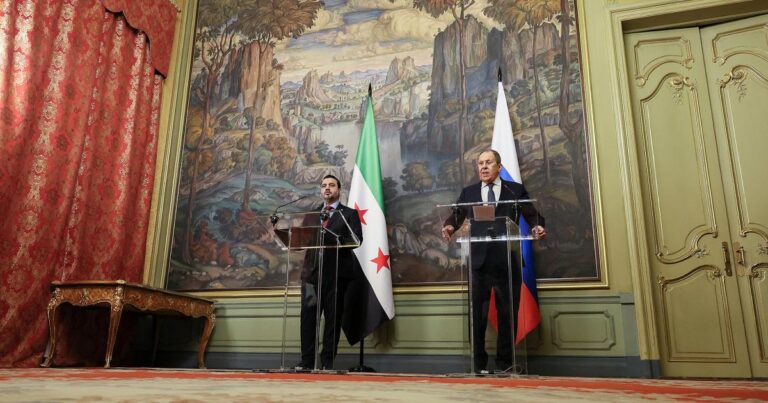
Russia is rebuilding its security partnership with Syria following the collapse of the Assad regime and the rise to power of Ahmed al-Sharaa. Despite an initial cooling of relations, Moscow has been able to use diplomatic, humanitarian, and economic leverage to restore dialogue with Damascus. The centerpiece of this renewed rapprochement is security cooperation—particularly discussions about rebuilding the Syrian army and the possible expansion of Russia’s military presence, which Moscow seeks to legitimize by portraying it as a stabilizing factor.
For the United States, these developments pose a threat because they strengthen Russia’s influence in the Eastern Mediterranean. The restoration of Russia’s operational capabilities in Syria restricts the freedom of action of Israel—America’s principal ally in the region. The presence of Russian air-defense systems, intelligence assets, and electronic warfare capabilities complicates U.S. and NATO operations. Moscow is also using Syria as a bargaining chip in negotiations with Washington across broader geopolitical tracks. The re-emergence of Russia as a security actor raises the risk of an alternative influence architecture taking shape in the Middle East—one in which the United States plays no decisive role. This dynamic could reduce the effectiveness of American diplomatic pressure on Damascus.
Washington also faces intensified competition over who will become Syria’s leading external partner. Russia–Syria military-technical cooperation could further destabilize the regional balance of power and stimulate a new arms race in the Middle East—forcing the United States to divert additional resources both to support allies and to preserve its own influence.
Context After Assad: Vacuum, Fragmentation, and Moscow’s Adaptation
After Bashar al-Assad’s overthrow, Syria’s new leadership in Damascus attempted to distance itself from past alliances while simultaneously searching for security guarantees. Russia, having lost a significant portion of its position in Syria, was forced to adapt. Its military footprint was sharply reduced and its freedom of movement significantly constrained.
At the same time, Iran and Hezbollah were effectively pushed out of Syria, creating a vacuum that was quickly exploited by the United States, Turkey, and other regional actors. The escalation of violence against minority communities in 2025 underscored the weakness of central authority. Israel intensified its military strikes, signaling its readiness to act unilaterally.
Against this backdrop, Damascus began to view Russia as a tool to deter external pressure. Moscow, in turn, offered humanitarian assistance and political support. Intensive contacts unfolded in parallel between Russian and Syrian military and diplomatic institutions. In particular, the Kremlin sought to secure the retention of its military bases in Tartus and Hmeimim. Discussions also included the restoration of Syria’s defense-industrial facilities with Russian assistance.
During this period, the White House expanded its own dialogue with Damascus, positioning itself as a priority partner—while inevitably taking into account Israel’s stance on any Russian activity in southern Syria. Events in Syria are unfolding amid multilayered great-power competition.
Implications for the United States: Strategic Risk and Growing Complexity
For Washington, the primary danger lies in Russia’s effort to restore its status as an indispensable security broker in Syria. Russia’s presence undermines American efforts to construct a pro-Western security architecture. Over the long term, this reduces Washington’s ability to shape decision-making in Damascus.
Russia’s military footprint in Syria also creates additional risks for U.S. operations and those of its allies. Particularly dangerous would be the potential return of air-defense systems and electronic warfare assets, which would complicate efforts to deter America’s adversaries in the region.
For Moscow, Syria serves as a platform to demonstrate global relevance despite sanctions. Success in this arena weakens the impact of Russia’s international isolation. For the United States, this translates into a gradual erosion of sanctions-based and diplomatic pressure.
The U.S.–Russia competition for influence in Damascus is unfolding in parallel with Turkey’s active role. This emerging multipolarity complicates American strategic planning and increases the risk of unpredictable crises.
Syria’s interest in leveraging Russia as a deterrent against Israel carries broader consequences, as it may draw the United States into difficult dilemmas—between supporting a key ally and avoiding escalation. As a result, the burden on American diplomacy and military planning increases.
Russia is using limited resources efficiently, emphasizing symbolic presence. Even small Russian troop contingents in Syria can generate disproportionate political impact. For Washington, this means responding to challenges that are not proportional to Russia’s actual material input.
The United States remains Syria’s most significant external actor. Yet that advantage is not guaranteed without an active and consistent policy. Without it, Russia will once again be able to entrench itself in Syria as a permanent factor in regional security—despite Washington’s interests.
Key Judgments
- Russia is reconstructing influence in Syria not through ideology, but through transactional security services—military coordination, intelligence integration, and selective economic support aimed at embedding Moscow into Damascus’s survival calculus.
- Syria is re-opening the Russian channel out of strategic necessity, not nostalgia. The post-Assad order remains fragmented, exposed to external pressure (Israel, Turkey, U.S.), and institutionally weak—conditions in which Russia can sell itself as a stabilizer and counterweight.
- For Washington, the central risk is not the size of Russian forces, but their “disproportionate strategic effect.”Even a limited Russian presence can constrain U.S./Israeli freedom of action by restoring Russian air-defense, ISR, and electronic warfare (EW) capabilities.
- Moscow will leverage Syria as a geopolitical bargaining chip—using its role as a security mediator to extract concessions in broader tracks (Ukraine, sanctions, regional deconfliction). This reinforces Russia’s narrative of being “indispensable” despite isolation.
- If unchecked, Russia’s re-entry could contribute to a parallel regional influence system in the Eastern Mediterranean and Levant—reducing U.S. diplomatic leverage over Syria and complicating coalition strategy.
Background: Post-Assad Syria and the Emergence of a Strategic Vacuum
After the fall of Bashar al-Assad, Syria’s new leadership under Ahmed al-Sharaa sought to distance itself from the previous regime’s alliances while simultaneously searching for new security guarantees. This balancing strategy—rejection of Assad-era dependency without losing external protection—proved difficult to sustain under conditions of weak institutions and factional pressure.
Moscow, having lost significant operational freedom in Syria after Assad’s collapse, faced an urgent need to adapt. Russia’s military footprint was reduced, movement constraints increased, and its political influence initially declined.
At the same time, Iran and Hezbollah were largely pushed out of Syria, producing a security vacuum. This vacuum was quickly exploited by the United States, Turkey, Israel, and multiple local actors. The fragmentation of security authority created a volatile environment where the central government struggled to control territory, militia behavior, and minority protection.
The escalation of violence against minorities in 2025 underlined the new leadership’s limitations: Syria’s post-Assad regime could claim political change, but could not guarantee order. Israel’s intensified strikes reinforced a key reality of the emerging environment—regional actors were prepared to act unilaterally, regardless of Damascus’s preferences.
This was the strategic opening Moscow needed. Where institutional weakness prevails, a security provider gains leverage.
Why Damascus is Returning to Moscow
Damascus is not restoring ties with Russia because it trusts Moscow—it is doing so because it fears isolation and coercion.
Key motivations on the Syrian side include:
- Deterrence-by-association: using Russia as a signal to Israel, Turkey, and the U.S. that Syria has external backing, even if limited.
- Reconstruction of coercive institutions: Syria requires rapid rebuilding of the army, intelligence services, and border security.
- Regime security: post-Assad governance needs hard tools to survive in a fractured state.
Thus, Russia becomes useful as a provider of:
- training and restructuring support for Syria’s armed forces,
- intelligence-sharing and technical systems,
- symbolic diplomatic cover, including UN and diplomatic shielding narratives.
Russia’s Strategy: From Military Footprint to Political Control
Russia is rebuilding influence using a post-imperial, cost-efficient model: minimal troops, maximal strategic output.
Moscow’s toolkit includes:
A) Diplomatic re-entry
Russia seeks to normalize contact with the new Syrian leadership through sustained dialogue, framing itself as a pragmatic partner rather than an ideological actor tied to Assad.
B) Humanitarian + economic leverage
Humanitarian assistance and reconstruction pledges are not primarily altruistic; they are entry points into Syria’s decision-making chain and elite dependency networks.
C) Security cooperation as the core mechanism
The central pillar is security: negotiations on rebuilding the Syrian army, restoring defense-industrial enterprises, and reviving Russia’s operational platforms.
Russia’s essential objective is to legitimize its presence by portraying it as:
- a stabilizing force,
- a counter-terrorism instrument,
- a deconfliction mediator.
Strategic anchor: bases and infrastructure
The Kremlin’s priority remains the retention of Tartus and Hmeimim and the re-expansion of the supporting architecture—ISR, EW, and air-defense nodes.
Why This Matters for the United States
For Washington, the danger is not simply “Russia in Syria.” It is Russia re-establishing itself as a security gatekeeper.
A) Loss of strategic leverage over Damascus
If Damascus internalizes Russia as an “insurance policy,” Syria becomes less responsive to U.S. diplomatic incentives and pressure. Over time, Russia could regain a veto-like influence over Syria’s foreign alignments.
B) Operational constraints on Israel—and by extension the U.S.
Israel is the United States’ principal regional ally. Russian systems in Syria have historically restricted Israeli freedom of action through:
- air-defense deterrence,
- radar tracking and early-warning,
- EW interference.
A restored Russian ISR/EW posture increases operational costs and strategic uncertainty for both Israel and U.S./NATO forces.
C) Russia as bargaining instrument
Russia will likely use Syria as a negotiating chip—trading regional access and “stability guarantees” for concessions in unrelated theaters. This expands the risks of issue-linkage and undermines Western attempts to isolate Moscow strategically.
D) Erosion of sanctions and isolation policy
Syria provides Russia with a stage: a visible demonstration that Moscow remains globally relevant despite sanctions. Even partial success would weaken the perception of Russian isolation—reducing the deterrent and reputational value of sanctions.
Multipolar Competition: U.S.–Russia–Turkey Triangle
U.S.–Russia competition in Damascus unfolds in parallel with Turkey’s active and often decisive role. This multipolar environment creates three complications for Washington:
- Strategic overload: too many actors with divergent agendas, making coordination harder.
- Crisis unpredictability: more channels of escalation, fewer reliable control points.
- Reduced U.S. command of outcomes: Damascus gains maneuver space, playing major powers against one another.
Strategic Dilemma: Syria Uses Russia to Deter Israel
A critical risk is Damascus using Russia as a deterrent instrument against Israel. Even if Russia does not directly confront Israel, its presence can change the calculus:
- Damascus may assume it can take more risks under Russian “shadow coverage.”
- Israel may feel compelled to act pre-emptively.
- Washington may face dilemmas between defending ally freedom of action and avoiding escalation.
This increases the burden on U.S. diplomacy and military planning—particularly deconfliction management.
A Disproportionate Threat Model
Russia does not need a large force to create a large effect.
The key U.S. takeaway is asymmetric political impact: even small Russian contingents can:
- shape Syrian decisions,
- create operational friction for Western forces,
- restore Russia’s image as a Middle East security actor.
This forces Washington into “high-cost response” patterns: reacting to Russia’s low-cost symbolic deployments with expensive reassurance of allies and increased operational readiness.
Outlook: Scenarios
Scenario 1 — Limited Russian Return (Most probable)
Russia restores bases and selective military functions but remains resource-constrained. Syria leverages Moscow as diplomatic cover while keeping channels open to Washington.
Scenario 2 — Security Deepening and Institutional Capture (High risk)
Russia embeds advisors into security ministries, influences procurement, and gradually becomes indispensable in Syrian defense planning. This scenario most damages U.S. leverage and Israeli operational freedom.
Scenario 3 — Russian Leverage for Grand Bargaining
Moscow uses Syria aggressively as a bargaining instrument with Washington—offering deconfliction or containment of threats in exchange for political concessions.
Russia’s renewed partnership with Syria represents a strategic attempt to restore Moscow’s regional status through security services rather than occupation-scale presence. Syria’s fragility and exposure to external pressure make it vulnerable to this model. For the United States, the core risk is not battlefield dynamics but the re-emergence of Russia as a gatekeeper security actor—limiting Israeli freedom of action, complicating U.S./NATO operations, weakening sanctions isolation, and reducing Washington’s influence over Damascus.The United States remains Syria’s key external actor, but this advantage is not self-sustaining. Without an active, consistent strategy, Russia can once again entrench itself in Syria as a persistent determinant of regional security—despite U.S. interests.
More on this story: The Decline of Assad’s Grip and Russia’s Waning Influence in Syria”