

Viktor Orbán continues his political war with Brussels.
Viktor Orbán’s government has responded irresponsibly to security recommendations for all European Union citizens developed in the European Parliament by politicians from the European People’s Party. Official Budapest has portrayed these materials not as ordinary guidance aimed at better preparing the public for emergencies, but as an attempt to psychologically condition Europeans for war — including a nuclear scenario.
In particular, Hungary’s state secretary for public diplomacy and public relations, Zoltán Kovács, accused EU institutions — the symbolic “Brussels” — of fueling panic. He emphasized that such issues were previously discussed only during disaster-response exercises, but are now being pushed into the public sphere by the European Parliament’s largest centrist political group. Against this backdrop, Orbán’s government is presenting Hungary as a country determined, at any cost, to stay out of war, and is openly setting its foreign policy line against the broader course of the European Union.
This position is being actively amplified by Russian media outlets affiliated with Russia’s military intelligence services. It fits the Kremlin’s strategy of portraying the EU and NATO as sources of danger and militarism in Europe.
Mr. Kovács condemned the tone of the materials proposed by the European Parliament, even though they contained entirely routine guidance: explaining warning signals, identifying the nearest shelters, listing the contents of a basic 72-hour survival kit, stressing the need to stock iodine tablets, outlining first-aid measures, describing evacuation procedures for civilians, and recommending steps to counter disinformation. Similar materials have repeatedly been disseminated by EU institutions in member states as part of civil protection exercises. Yet now Budapest is manipulating these recommendations, presenting them as explicitly aggressive and militaristic in character.
Crucially, the measures proposed by the European Parliament apply not only to the event of a nuclear conflict, but also to accidents at nuclear energy facilities — a relevant concern for Hungary given the proximity of Russian nuclear capacity and the historical legacy of the Chernobyl disaster. In this way, the Hungarian government is effectively seeking to leave the country unprepared in the event of nuclear incidents, despite Russia’s active nuclear signaling during its war in Ukraine.
Orbán’s reaction to the EU’s recommendations is best explained by the ongoing election campaign ahead of parliamentary elections scheduled for April. The prime minister and leader of the ruling Fidesz party has repeatedly sought to convince voters that his government is working conscientiously to keep Hungary out of war, because the Hungarian people “want peace.” By contrast, Budapest accuses “Brussels” of deliberately trying to drag Hungary into war — including a nuclear scenario.
This narrative is difficult to reconcile with the Orbán government’s own behavior in February 2022, when it nearly pulled the country into a confrontation with Ukraine by attempting to send Hungarian military units into Transcarpathia in pursuit of annexing that territory.
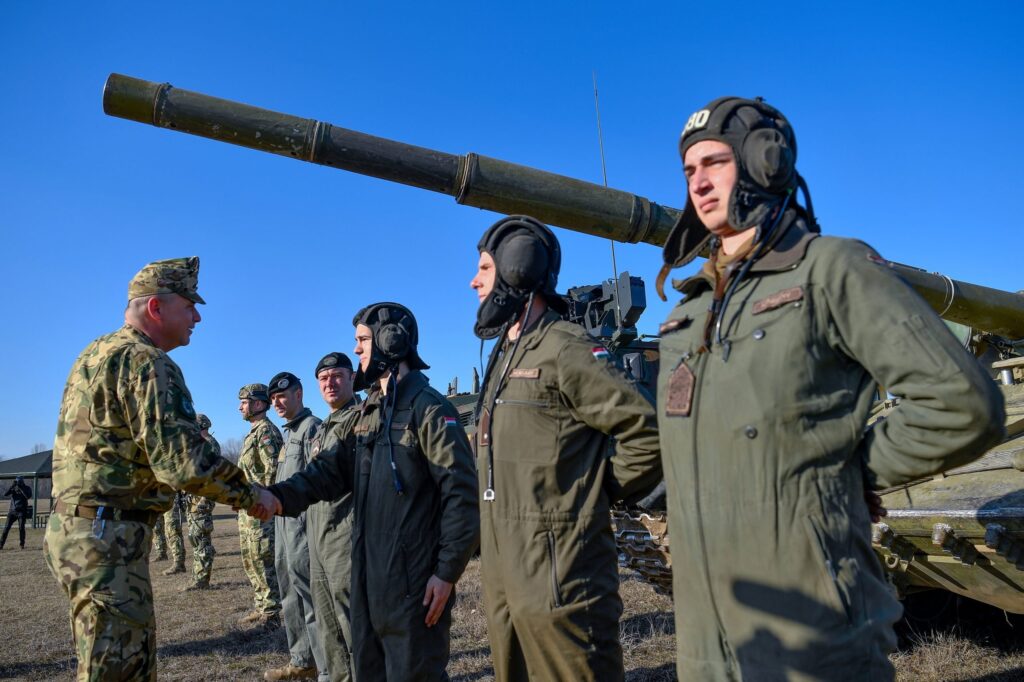
More on this story: Peacekeeper or Invader? Hungarian Forces and the Future of Western Ukraine
Orbán talks about nuclear war and assigns EU responsibility for three interconnected reasons: (1) domestic power, (2) strategic positioning inside the EU, and (3) narrative alignment with Russia’s preferred framing of the Ukraine war.
What looks like “speculation” is actually a political instrument.
He needs a maximum-threat frame for the 2026 election.
Orbán is already shaping the April 2026 Hungarian election as a binary choice:
“Brussels path = war” vs “Hungarian path = peace.”
Reuters reports he launched an anti-Ukraine “national petition,” presenting the election as a struggle between “war and peace,” and claiming Brussels and the opposition could drag Hungary deeper into the war.
When you want to mobilize a society through fear, “conventional war” is not enough. Nuclear escalation is the ultimate fear amplifier:
- it collapses nuance (“we must stop this now”)
- it delegitimizes opponents (“they are reckless with our survival”)
- it immunizes him from policy criticism (“this isn’t about budgets—it’s existential”)
So nuclear rhetoric serves regime maintenance, not strategic forecasting.
He’s blaming the EU to justify veto tactics and extract concessions
Orbán often uses security framing to make his obstruction look principled.
Example: he has argued EU moves like using frozen Russian assets would be tantamount to a “declaration of war”, implying Brussels is escalating toward catastrophe.
That rhetoric is useful because it:
- legitimizes Hungary’s “no” vote as “anti-war responsibility”
- paints EU solidarity measures as reckless escalation
- strengthens his bargaining leverage in EU negotiations
This is not “analysis”—it is negotiating posture.
Orbán’s narrative mirrors Russia’s escalation playbook (without saying “Russia is right”)
Russia’s strategic communication has consistently tried to make Europeans believe:
Supporting Ukraine = escalation = catastrophe.
Orbán re-packages this in EU-internal language: Brussels is pushing Europe toward war.
He explicitly describes a European “pro-war elite” vs an anti-war camp led by Hungary.
That’s extremely valuable for Moscow because it shifts blame from the aggressor (Russia) to the supporter (EU).
4) He’s trying to build a Europe-wide “anti-war bloc”
Orbán presents himself as the leader of a continent-wide uprising against “pro-war elites.”
In his January 2026 Q&A, he argued that social movements against the pro-war elite are growing across Europe—positioning Hungary as the model.
“Nuclear war” rhetoric is an accelerant for that project, because it pressures other politicians:
- either echo his framing (“we must stop escalation”)
- or risk being portrayed as irresponsible
It also supports Hungary’s Russia-energy exception and “sovereignty” branding
Hungary remains structurally dependent on Russian energy and continually resists maximal EU decoupling. Orbán’s broader strategy is to frame energy sanctions and Ukraine aid as European self-destruction.
Reuters earlier reported Orbán warning EU financing of Ukraine would “ruin Europe.”
“Nuclear risk” is the psychological capstone of that same argument:
EU policy = not only costly, but suicidal.
Bottom line
Orbán’s “nuclear war” line isn’t primarily about whether nuclear war is likely.
It’s about:
- winning the 2026 election at home (fear + peace narrative)
- legitimizing anti-EU obstruction as “responsibility”
- shaping Europe’s public mood against supporting Ukraine
Public health risks (highest consequence)
A) Delayed protective actions = higher doses
If the state can’t rapidly execute:
- shelter-in-place orders
- potassium iodide (KI) distribution
- evacuation routing
- contamination zoning
…then civilians receive avoidable exposure, especially:
- children (thyroid risk)
- pregnant women
- emergency responders
Core risk: Hungary loses the “golden hours” where exposure can be reduced by orders of magnitude.
B) Collapse of medical triage capacity
Radiological events produce:
- panic-driven ER surges
- mass screening demands
- need for decontamination stations
- scarcity of protective equipment
If hospitals and EMS aren’t trained/equipped, you get:
- contamination of facilities
- staff incapacitation or refusal
- cascading medical failures (not just radiation patients)
Panic + social destabilization (likely even for small incidents)
Radiological events are “terror multipliers.” People panic even at low doses.
If Hungary is underprepared, expect:
- mass flight from Budapest
- fuel/food runs
- misinformation spikes (Telegram/TikTok)
- violence at hospitals/pharmacies (KI rumors)
This can happen without meaningful radiation exposure—panic becomes the main threat.
National security risks (radiological sabotage)
A hostile actor doesn’t need a nuclear weapon to cause chaos:
- sabotage of energy infrastructure
- attack on radiological sources (medical/industrial)
- “dirty bomb” in an urban area
If preparedness is weak:
- response time expands
- contamination management fails
- forensic attribution becomes harder
That creates a strategic vulnerability: Hungary becomes an attractive testing ground for hybrid warfare.
Economic risks (long tail)
A) Agriculture and exports
Even limited fallout contamination can trigger:
- export bans
- destroyed food stockpiles
- long inspections and certification hurdles
B) Tourism, aviation, logistics
Budapest is a key hub. A radiological incident can cause:
- flight restrictions
- mass cancellations
- business exit and insurance shocks
C) Cleanup and compensation costs
The cost often comes from:
- relocation;
- decontamination;
- compensation schemes;
- legal battles;
rather than medical care alone.
Infrastructure and governance risks
A) Grid + water + transport strain
Emergency response can fail if:
- power grid operators lack radiological contingency plans;
- water treatment isn’t protected against contamination;
- rail/road evacuation is uncoordinated;
B) “Command and control” breakdown
In nuclear/radiological incidents, communication is everything:
- consistent messaging;
- trusted experts;
- real-time data dashboards;
If the state is unprepared, the government risks:
- contradictory announcements
- credibility collapse
- conspiracy dominance
International and EU risks (political damage)
If Hungary is not prepared, then in a regional incident (even outside Hungary):
- EU neighbors may impose border controls
- Hungary’s crisis management may be publicly questioned
- NATO/EU trust in Hungarian resilience decreases
This matters because resilience is now part of deterrence.
The biggest strategic risk: “preparedness gap becomes leverage”
A weak preparedness posture can be exploited:
- externally (hybrid actor uses fear/panic as weapon)
- internally (political actors weaponize crisis incompetence)
- regionally (Hungary becomes the weak link in Central European continuity planning)
So the danger is not only radiation.
It’s state fragility under stress.
RLI Risk Matrix (Hungary): Nuclear / Radiological Incident Types (2026)
Scale (RLI standard)
- Probability: Low / Medium / High
- Impact: Moderate / High / Critical
- Risk level: derived from Probability × Impact (qualitative)
1) Core Risk Matrix (Probability × Impact)
| Incident type | Probability (12–24 months) | Impact (national level) | Overall risk | Why it matters |
| NPP accident (domestic / regional) | Low–Medium | Critical | High | Even low probability events have catastrophic consequences (public health, evacuations, economic paralysis). |
| Fallout from external nuclear incident | Low | High–Critical | Medium | Hungary can be affected by regional events (depending on wind patterns); damage driven by panic + logistics failure. |
| Dirty bomb (radiological dispersal device) | Medium | High | High | Most “cost-effective” terror method: limited deaths but maximum chaos, long shutdown of city zones. |
| Sabotage (radiological sources / energy infrastructure / monitoring systems) | Medium–High | Moderate–High | High | Hybrid actors prefer sabotage: plausible deniability; can trigger cascading failures and political crisis. |
Risk Profiles (RLI scenario cards)
A) NPP Accident (domestic or near-region)
Risk rating: HIGH (Low–Medium probability × Critical impact)
Trigger pathways
- technical failure + human error
- grid instability / blackout cascade
- cyber interference in industrial systems
- stress events (heatwaves; supply chain disruption; staffing strain)
What “unprepared” looks like
- delayed public warning + contradictory orders
- KI (iodine tablets) distribution failure
- evacuation choke points (Budapest–west corridors)
- hospital decontamination capacity shortage
Early warning indicators (EWIs)
- unexplained/abnormal operational events at nuclear sites or grid nodes
- increased cyber intrusion targeting energy sector
- emergency drill cancellations / underfunded readiness programs
- staff retention problems in critical operator roles
Strategic consequence
- credibility shock to state institutions + EU/NATO civil resilience doubts
- long-tail political destabilization
B) Fallout from External Nuclear Incident
Risk rating: MEDIUM (Low probability × High/Critical impact)
Trigger pathways
- incident at a European NPP / radiological release
- nuclear strike/accident far from Hungary but with meteorological impact
What “unprepared” looks like
- panic-driven mass flight
- food/water misinformation (“contaminated supply” rumors)
- border closures, trade disruptions, and agricultural bans
EWIs
- elevated regional tensions; warnings about nuclear safety
- unusual radiation measurements in neighboring monitoring networks
- “false alert storms” and conspiracy narratives spreading early
Strategic consequence
- the main threat becomes societal panic rather than exposure
- major economic hit through agriculture + export restrictions
C) Dirty Bomb (RDD)
Risk rating: HIGH (Medium probability × High impact)
Trigger pathways
- acquisition of medical/industrial radioisotopes
- organized crime facilitation (smuggling logistics)
- hostile proxy operation timed to elections / protests
What “unprepared” looks like
- failure to rapidly cordon / decontaminate zones;
- collapse of EMS triage from panic surge;
- inability to communicate “dose reality” → mass hysteria.
EWIs
- theft or unexplained movement of radiological sources
- chatter about “special cargo,” isotope theft, or black market spikes
- mapping/surveillance activity around transport hubs
- sudden “health scare” propaganda campaigns (preconditioning effect)
Strategic consequence
- long economic shutdown of central districts (Budapest)
- political crisis due to perceived state failure
D) Sabotage (Hybrid Radiological / Infrastructure Operations)
Risk rating: HIGH (Medium–High probability × Moderate–High impact)
Trigger pathways
- sabotage of radiation monitoring networks (blindness)
- sabotage of water treatment, grid substations, or transport nodes
- targeted disruption of emergency communications
- “incident chain”: small sabotage → panic → institutional overload
What “unprepared” looks like
- emergency command-and-control breakdown
- inability to maintain public trust
- fragmented messaging creates information vacuum for hostile narratives
EWIs
- cyber activity against critical infrastructure (energy/water/transport)
- insider recruitment patterns (bribery/coercion)
- rising extremist chatter framing “radiation purification” etc.
- repeated small infrastructure “accidents” (patterned)
Strategic consequence
- Hungary becomes a low-cost test zone for hostile hybrid doctrine
- erosion of EU/NATO resilience posture
Summary Ranking (Most dangerous in practice)
By likelihood of occurrence:
- Sabotage;
- Dirty bomb;
- NPP accident;
- Fallout
By worst-case impact:
- NPP accident;
- Fallout;
- Dirty bomb;
- Sabotage.
Overall highest strategic risk:
Dirty bomb + sabotage (because they are plausible, deniable, and politically destabilizing)


More on this story: The Kremlin’s Battle for Budapest: Russia’s Hybrid War to Keep Orbán in Power
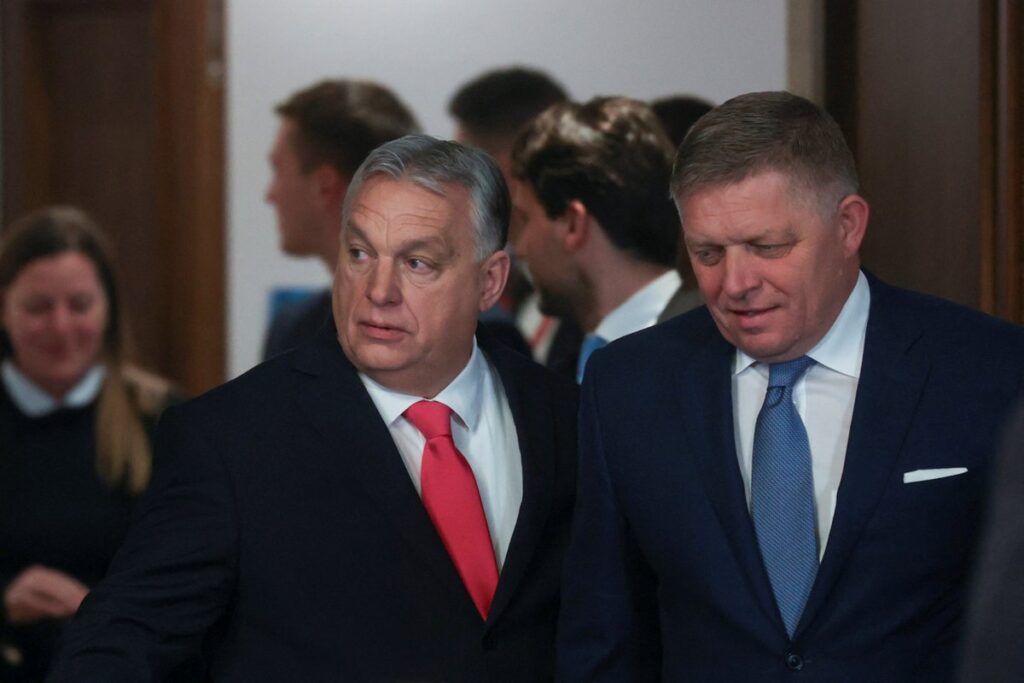
More on this story: Orbán’s ‘EU of 26’: A Slip of the Tongue—or a Signal of Huxit Thinking?”
More on this story: Hungary’s Espionage Against EU Institutions: